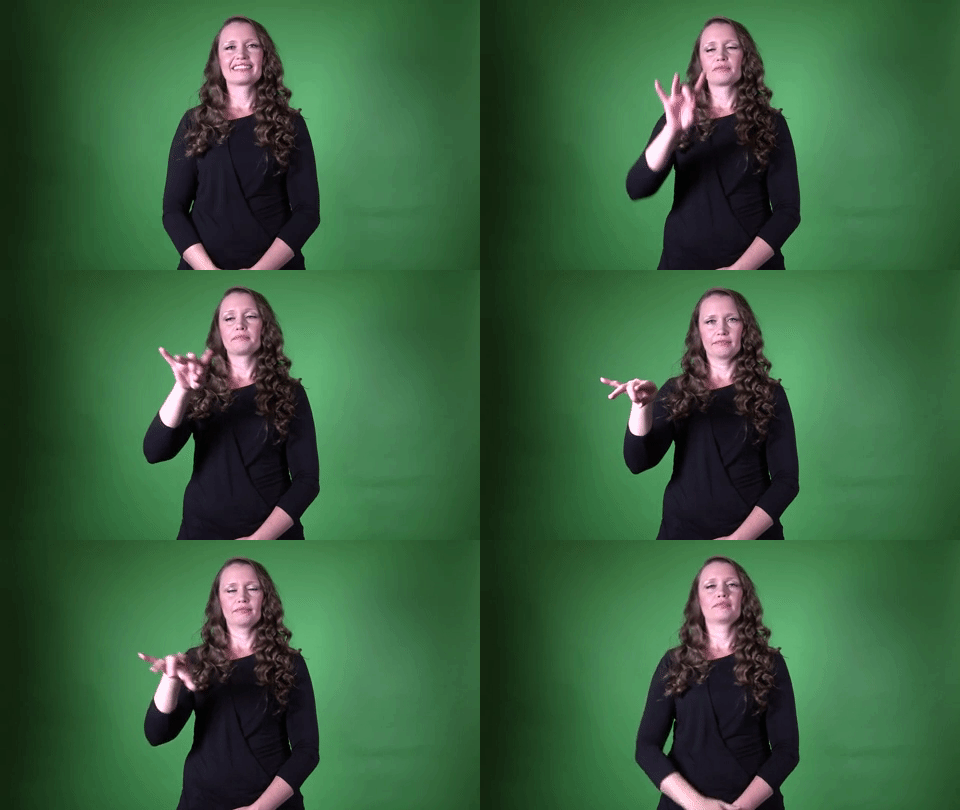
Definition: Refers to the number eighty-eight
Sign for THE NUMBER EIGHTY-EIGHT in ASL
Practice Activities:
Practicing the sign for the number eighty-eight in ASL starts with repetition. Start by forming the number with your dominant hand and flicking your fingers slightly as you sign. Repeat this movement at least ten times in front of a mirror to ensure accuracy.
Use the sign for the number eighty-eight in ASL while counting objects. Gather small items like coins or beads and count aloud while signing. Try saying each number leading up to eighty-eight and then signing it smoothly. This helps reinforce your understanding and muscle memory.
Challenge yourself with number pattern drills. Sign different numbers, such as eighty-six, eighty-seven, eighty-eight, and eighty-nine, to see the subtle differences. Switch randomly between numbers to test recall and fluidity. Practicing with a partner can make this more interactive.
Use the sign for the number eighty-eight in ASL in real-world scenarios. Think about situations where you might use the number, such as discussing a price, reading a year, or sharing a statistic. Act out these scenarios with a partner and respond naturally using the sign.
Create a short story that includes the number eighty-eight. It could be about an athleteβs winning score, an eighty-eight-year-old grandparent, or an event that happened in 1988. Incorporate the sign fluidly to make storytelling engaging and beneficial.
Play a number memorization game with a friend. One person signs a number, and the other repeats it back. Include the sign for the number eighty-eight in ASL randomly to reinforce learning. Speed up gradually to build fluency.
Finally, watch ASL number tutorials or number-related conversations online. Observe how native signers use numbers in context. Try imitating their movements until signing feels natural.
Cultural Context:
The sign for the number eighty-eight in ASL is part of the number system in American Sign Language, which is essential for communication in various contexts. Numbers play a crucial role in daily conversations, from giving addresses to discussing prices and dates. The number eighty-eight follows the common pattern of repeated movements for double-digit numbers in ASL.
When using the sign for the number eighty-eight in ASL, the signer typically moves both eights slightly in a repeated motion. This handshape and movement help differentiate it from numbers with similar formations. Precision and fluidity in signing numbers ensure clarity and reduce misunderstandings in conversation.
The number system in ASL is deeply connected to Deaf culture and communication. The ability to sign numbers fluently, including the sign for the number eighty-eight in ASL, is important for discussing math, ages, and financial transactions. Many Deaf individuals develop strong number fluency early in life, helping them in academic and real-world situations.
ASL numbers, including the sign for the number eighty-eight in ASL, are used in many aspects of daily life. Whether discussing sports scores, phone numbers, or measurements, knowing how to sign numbers correctly enhances communication. The accuracy of numerical signs allows for smooth conversations across various social and professional settings.
In Deaf education, numbers hold significance for learning math and science concepts in ASL. Teachers often incorporate number signs like the sign for the number eighty-eight in ASL into lessons to ensure students grasp numerical concepts effectively. This approach helps bridge the gap between visual language and mathematical understanding.
The sign for the number eighty-eight in ASL is also useful in financial transactions and business interactions. Whether discussing prices, quantities, or statistics, clear number signing is essential. Deaf professionals rely on these number signs to engage in workplace discussions and negotiations.
Deaf culture embraces ASL numbers in storytelling, games, and everyday interactions. The sign for the number eighty-eight in ASL, like other number signs, appears in various activities, from playing bingo to talking about historical events. Numbers add specificity and accuracy to ASL communication, making them a fundamental aspect of Deaf life.
Technology has made learning ASL numbers more accessible through video tutorials and digital dictionaries. Anyone interested in mastering numbers can easily find resources to learn the sign for the number eighty-eight in ASL. With online tools, learners can practice and improve their ASL number skills at their own pace.
ASL numbers continue to evolve, influencing how people engage in
Extended Definition:
The sign for the number eighty-eight in ASL is a two-handed number sign commonly used in American Sign Language. This number is made by forming the number eight on both hands and slightly bouncing them in place. It is important to use the correct handshape and movement to ensure clarity in communication.
In ASL, number signs follow specific rules to maintain linguistic accuracy. The sign for the number eighty-eight in ASL belongs to a group of repeated digit numbers, which means both hands mirror each other while forming the number. Mastering these patterns can help improve fluency when signing numbers.
Numbers play a critical role in everyday conversation, and recognizing signs like the sign for the number eighty-eight in ASL helps with counting, addresses, and other numerical references. This number is used in various contexts, from discussing prices to sports statistics. Being able to sign numbers quickly and clearly enhances communication in daily life.
Handshape and movement are essential when forming the sign for the number eighty-eight in ASL. The fingertips of both hands should touch the thumb in an “8” handshape while giving a subtle movement. Keeping the hands steady and maintaining the correct bounce ensures the sign is easily recognized.
For learners new to ASL, practicing repeated numbers like the sign for the number eighty-eight in ASL can help with muscle memory. Signing numbers accurately requires controlled hand movements and confidence. Watching native signers and using ASL dictionaries can provide additional guidance in mastering numbers.
The ability to correctly sign numbers boosts confidence in communicating with the Deaf community. Using the sign for the number eighty-eight in ASL correctly ensures clarity in signed conversations. Learning ASL numbers allows for smoother interactions in educational, professional, and social settings.
Context is important when using the sign for the number eighty-eight in ASL. This number could refer to a specific year, a sports jersey, or even a financial amount. Understanding how and when to use number signs improves overall ASL proficiency.
ASL learners often practice number signs in sequences to build fluency. Mastering digits like the sign for the number eighty-eight in ASL helps in quickly recognizing and producing numerical information. Consistent practice ensures better retention and smoother communication.
Resources such as ASL videos and online dictionaries provide useful demonstrations of numbers in ASL. Watching the sign for the number eighty-eight in ASL in real-time helps learners refine their signing technique. Interactive tools can also aid in reinforcing muscle memory for number signs.
Developing
Synonyms: eighty-eight, number eighty-eight, number 88, the number 88, the number eighty-eight
Educational resources: Find related learning materials in our course bank!
Want more? Check out some of our popular learning activities on the homepage!
Need to look up a sign? Use our highly rated dictionary: https://aslinteractive.com/best-asl-dictionary/
Follow us on tiktok: https://www.tiktok.com/@aslinteractive. More social media links at the bottom of this page!
Long-tail Keywords: what is the sign for the number eighty-eight in ASL, how do you sign the number eighty-eight in ASL, learn how to sign the number eighty-eight in American Sign Language
Categories: Numbers – Basics, Numbers 81-90, cardinal numbers
tags: Numbers, Numbers 81-90, Math, Language Learning, Educational Content
Parameters
*Handshape*:
The sign for the number eighty-eight in ASL uses the “8” handshape on both hands. Both hands are held in front of the body with palm orientation facing outward. The fingertips and thumbs of both hands briefly touch and separate in a bouncing motion. This movement is repeated once to complete the sign. The sign for the number eighty-eight in ASL is a natural extension of numerical signing, making it visually distinct from other numbers.
*Palm Orientation*:
The palm orientation for the sign for the number eighty-eight in ASL is forward, facing outward toward the observer. Both hands are in the “8” handshape with the thumb and middle finger touching. The fingertips of each hand bounce slightly as they remain in the same position. While forming the sign for the number eighty-eight in ASL, ensure the hands stay steady and the motion is fluid for clear communication.
*Location*:
The sign for the number eighty-eight in ASL is made at the neutral space in front of the body, around chest level. Both hands form the number eight with the thumb pad touching the tips of the middle fingers. The hands move slightly side to side in a bouncing motion. The sign for the number eighty-eight in ASL remains within the signing space, ensuring clarity and ease of recognition. β
*Movement*:
To produce the sign for the number eighty-eight in ASL, form the number eight handshape with both hands, with palms facing outward. Quickly flick both middle fingers and thumbs together twice in a small, bouncing motion. The movement should be fluid and rhythmic to clearly differentiate it from other number signs.
Maintain relaxed fingers while ensuring distinct repetition of the movement. The sign for the number eighty-eight in ASL relies on consistent hand positioning and precise flicking action to convey the intended number.
*Non-Manual Signals*:
Facial expression remains neutral or slightly focused when performing the sign for the number eighty-eight in ASL. The eyebrows may be slightly relaxed, and the mouth typically stays in a natural position without exaggeration. If emphasizing quantity, slight head nodding or raised eyebrows may occur.
The overall posture should remain steady with minimal movement aside from the hand motion. Eye gaze is directed towards the listener, ensuring clear communication. A small head tilt may occasionally accompany the sign for THE NUMBER EIGHTY-EIGHT in ASL, reinforcing engagement.
*Prosody, Dominant/Non-Dominant Hand*:
For the sign for the number eighty-eight in ASL, use the dominant hand in a modified “8” handshape (thumb touching the middle finger). Palm faces forward, and the hand moves slightly side to side, bouncing once. The non-dominant hand is not used. This movement helps distinguish the sign for the number eighty-eight in ASL from other two-digit numbers with repeated digits. Facial expressions remain neutral unless adding emphasis. β
Tips for Beginners:
When learning the sign for the number eighty-eight in ASL, focus on finger clarity and control. This number is signed using both hands, forming the number eight with each hand and slightly bouncing them in place. Keep your fingers relaxed but firm to maintain accuracy and avoid awkward shapes.
A common mistake beginners make when signing the number eighty-eight in ASL is bouncing their hands too much or shifting them unevenly. The movement should be subtle, with a slight repetition to differentiate from numbers like eighty or eight. Keep your hands steady and ensure they stay parallel to each other to maintain proper form.
Hand positioning is key when practicing the sign for the number eighty-eight in ASL. Make sure each hand clearly forms the number eight, with the thumb and middle finger touching while the other fingers stay extended. If your fingers curl too much or spread too far apart, the sign may be unclear to the viewer.
Practicing in front of a mirror can help refine movements and finger positioning. Watching online videos of fluent signers executing the sign for the number eighty-eight in ASL can also help improve accuracy. Repetition will help you achieve a more natural movement over time.
Be mindful of the rhythm in your hand movements. A smooth, controlled bounce is necessary, but avoid excessive force or speed. Signing too quickly can make it difficult for others to read your number, so aim for clarity over speed.
If you struggle with this sign, focus on mastering the number eight individually before attempting to sign eighty-eight. Once you feel comfortable forming the number eight correctly, adding the repetition for eighty-eight will feel more natural. Keep practicing, and muscle memory will develop!
Connections to Other topics:
The sign for the number eighty-eight in ASL connects to the broader system of number signs that involve repeated movement or handshape transitions to indicate different values. The repetition of the movement in this number follows a pattern used in other double-digit numbers like seventy-seven, ninety-nine, and sixty-six. Learning the sign for the number eighty-eight in ASL helps build an understanding of rhythmic movement changes involved in numerical sequences.
This sign also relates to counting, pricing, and mathematics in ASL. Expressing monetary values, such as “eighty-eight dollars,” applies the same handshape and movement with the added sign for “dollar” afterward. Similarly, the sign is useful when discussing statistics, percentages, and scores, reinforcing its connection to data and numerical literacy in ASL.
In conversations, the sign for the number eighty-eight in ASL appears when discussing historical dates, sports scores, or measurements. For example, a person might sign “the year 1988” by combining “nineteen” with “eighty-eight.” This emphasizes the importance of knowing number patterns for discussing years, addresses, and other numerical information efficiently.
The handshapes used in the sign for the number eighty-eight in ASL are also commonly found in other numerical patterns and concepts. The open eight handshape used in the sign appears in words like “address,” “percent,” and some classifiers in ASL storytelling. Recognizing how this handshape is used across different contexts improves fluency and comprehension in ASL discussions.
Mastering the sign for the number eighty-eight in ASL provides a foundation for understanding number-grouping patterns. This knowledge extends to pluralization, sequences, and time concepts in ASL grammar. Recognizing number variations supports overall signing efficiency for discussing dates, amounts, and specific numerical references in everyday communication.
Summary:
The sign for the number eighty-eight in ASL uses both hands. Each hand forms the number eight handshape, with the thumb and middle finger touching while the other fingers extend slightly. The hands move slightly in a shaking or fluttering motion, emphasizing that it is a double-digit number.
Numbers in ASL follow a structured pattern, making it easier to sign and recognize sequences. The sign for the number eighty-eight in ASL fits within this system by using repetition of the number eight to indicate the double-digit value. This repetition is common for certain double-digit numbers like 33, 44, 55, and others.
In ASL, numbers are signed with clarity to avoid confusion. The sign for the number eighty-eight in ASL prevents misunderstanding by incorporating a brief, controlled movement. The slight bouncing motion of the hands ensures that the viewer sees each number distinctly.
Numerical signs in ASL are critical for everyday communication. The sign for the number eighty-eight in ASL is frequently used in discussions about age, addresses, and financial figures. It can also appear in contexts like sports scores and historical dates.
In Deaf culture, numerical signs play a crucial role in storytelling and information exchange. The sign for the number eighty-eight in ASL may be encountered in discussions about years, historical events, or milestones. Precision in signing numbers is essential for conveying accurate information.
ASL numbers rely on handshape, movement, and palm orientation to differentiate values. The sign for the number eighty-eight in ASL maintains palm orientation toward the viewer for clarity. This orientation ensures that the numbers are distinct and easily readable.
Hand dominance in ASL affects the way numbers are signed. A dominant-handed signer will lead the motion while the non-dominant hand mirrors the action. The sign for the number eighty-eight in ASL requires symmetrical movement for a visually balanced sign.
Palm orientation can change meaning in ASL numbers. The sign for the number eighty-eight in ASL typically maintains forward-facing palms. This is consistent with other double-digit number signs that rely on repetition within the same location.
Numbers in ASL are often influenced by signed English or regional variations. While the sign for the number eighty-eight in ASL is commonly understood, slight differences in speed or movement may occur. These variations maintain visual clarity while reflecting personal or regional signing styles.
In education, ASL numbers are taught early to ensure fluency. The sign for the number eighty-eight in ASL is part of a systematic approach to teaching numerical concepts. Mastery of numerical signs helps students develop strong mathematical and communicative skills.
ASL has a visual and spatial grammar that differs from spoken languages. The sign for the number eighty-eight in ASL illustrates this grammar through its handshape repetition and motion. Visual languages like ASL rely on space, movement, and facial expressions to convey precise meaning.
Consistency in number signs is key to comprehension. The sign for the number eighty-eight in ASL follows the same principles as other double-digit numbers. This uniformity allows signers to quickly recognize and interpret numerical values.
ASL numbers are used in storytelling, business, and everyday life. The sign for the number eighty-eight in ASL is no exception and appears in many contexts. Whether discussing historical dates, monetary amounts, or numerical patterns, ASL users rely on clear, structured signs.
Mathematics in ASL is visually structured to support clear numerical communication. The sign for the number eighty-eight in ASL fits into this structure by maintaining a distinct movement. This visual clarity is crucial in settings like education, banking, and data interpretation.
In sports, numbers are essential for keeping track of scores and player information. The sign for the number eighty-eight in ASL may be seen when discussing jersey numbers or game statistics. Numbers ensure that Deaf athletes and fans receive accurate information.
ASL numbers interact with other signs in numerical sequences. The sign for the number eighty-eight in ASL may be used alongside other numbers to form larger values. Understanding how numbers combine is important for fluency in financial and mathematical contexts.
Some number signs in ASL are influenced by historical changes in signing conventions. The sign for the number eighty-eight in ASL follows standardized numerical patterns established in Deaf communities. Consistency has helped maintain clear communication across generations.
Technology has made signing numbers more visible through video calls and digital communication. The sign for the number eighty-eight in ASL benefits from clear video framing and good lighting. Proper positioning allows for accurate interpretation even in virtual spaces.
Number signs often appear in Deaf education when teaching math and financial literacy. The sign for the number eighty-eight in ASL may be used in discussions about percentages, equations, or statistics. Fluency in ASL numbers supports academic and professional success.
Linguistic studies of ASL examine number signs as an essential part of the language. The sign for the number eighty-eight in ASL reflects the broader numerical structure in ASL grammar. Understanding these structures helps linguists analyze the formation and
Want more? Check out some of our popular learning activities!
ASL Interactive Resources
ASLInteractive YouTube Channel
Follow us on tiktok: @aslinteractive.com
Follow us on Instagram: aslinteractive
Facebook page: aslinteractive
Facebook group: aslinteractive
LInkedIn: ASL Interactive LLC
Twitter: @ASL_interactive
*Some information on this page is AI-generated. AI can make mistakes. Please check the information.


Responses