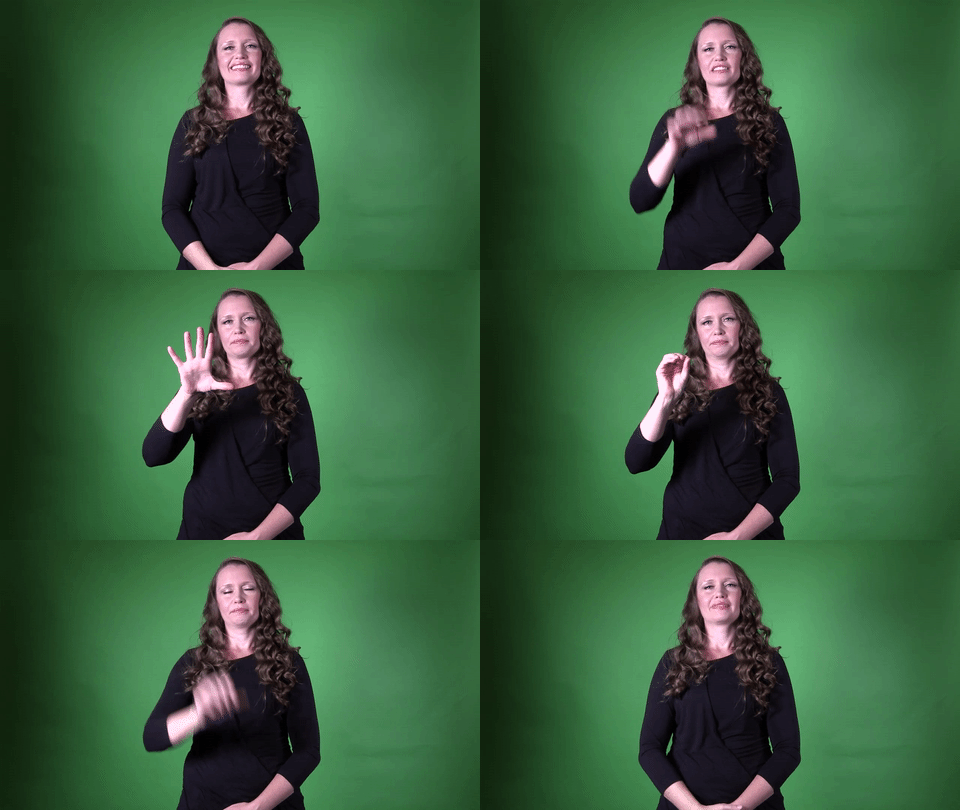
Definition: Refers to the number fifty
Sign for THE NUMBER FIFTY in ASL

Practice Activities:
Practicing the sign for the number fifty in ASL can be done through repetition and real-world applications. Start by forming the number sign slowly, ensuring your handshape is correct. Repeat it multiple times while looking in a mirror to check for accuracy. Try switching between forty, fifty, and sixty to become comfortable transitioning between similar number signs.
Use the sign for the number fifty in ASL in different counting exercises. Count by tens, saying each number aloud as you sign it. Set a timer and see how many times you can correctly sign from ten to one hundred in one minute. Write down random numbers from one to one hundred and practice signing each one to reinforce recognition.
Incorporate the sign for the number fifty in ASL with fingerspelling practice. Spell out prices such as “fifty cents” or “$50” and sign the number clearly. Practice signing amounts like “fifty apples” or “fifty dollars” in conversational phrases. Work with a partner to quiz each other by showing written numbers and responding with the correct sign.
Create a short story or scenario using the sign for the number fifty in ASL. For example, describe a shopping trip where you bought fifty balloons or talk about a race where fifty people participated. Exchange stories with a partner and see if they can sign the right numbers as they listen.
In a group setting, play a numbers game where one person signs a number and someone else must quickly sign the next multiple of ten. Use flashcards with written numbers and challenge yourself to sign them as fast as possible. Practicing in different contexts will help reinforce fluency and confidence in using the sign for the number fifty in ASL.
Cultural Context:
The sign for the number fifty in ASL is an important part of numerical communication in American Sign Language. Knowing how to express numbers accurately is essential for conversations about age, money, time, and quantity in ASL. The number system in ASL follows a logical pattern that helps signers quickly convey numerical information.
Using the sign for the number fifty in ASL allows for clear and efficient communication. Whether discussing a total amount, a specific measurement, or referencing an age, this sign plays a role in daily interactions. Mastering numbers in ASL helps signers engage in conversations with fluency and confidence.
The sign for the number fifty in ASL follows a natural handshape transformation that makes it easy to remember. ASL numbers are often expressed with an open or closed hand, depending on the movement and formation of the sign. Understanding number signs strengthens overall ASL proficiency and comprehension.
Numbers hold cultural significance in ASL and Deaf communities. The ability to sign numbers is essential for education, business, and everyday communication. Learning the sign for the number fifty in ASL supports smoother conversations and deeper connections among signers.
Deaf culture values clarity and precision in signed communication. Knowing the sign for the number fifty in ASL ensures that numerical concepts are accurately conveyed. Effective number signing prevents misunderstandings, especially in contexts like shopping, scheduling, and storytelling.
Many sign variations exist depending on regional dialects and personal signing styles. However, the sign for the number fifty in ASL remains generally consistent across different ASL users. Exposure to various signing styles enhances comprehension and adaptability in different conversations.
Learning ASL numbers, including the sign for the number fifty in ASL, helps signers become more proficient in expressing numerical values. This skill is particularly useful in math-related settings, statistics, and phone numbers. Practicing number signs regularly improves fluency in ASL communication.
ASL is a visual language, and numerical signs play a significant role in daily interactions. The sign for the number fifty in ASL integrates into broader conversations about time, dates, and quantities. Using the correct number sign enhances the clarity and effectiveness of signed messages.
Interacting with fluent ASL users strengthens understanding and application of number signs. Observing how Deaf individuals use the sign for the number fifty in ASL in conversations provides insight into natural signing patterns. Immersion in ASL environments enhances number recognition and signing skills.
Numbers in ASL carry meaning beyond just counting. The
Extended Definition:
The sign for the number fifty in ASL is a simple and fluid movement made with one hand. It is part of the larger ASL number system, which is essential for counting, mathematics, and everyday communication. Knowing how to correctly form and recognize this sign is important for both beginners and advanced signers.
To sign the number fifty in ASL, start by showing the number five with an open hand, palm facing outward. Then, quickly close the fingers together into a zero shape, forming a smooth transition between the two handshapes. This motion represents the number fifty clearly and efficiently.
The sign for the number fifty in ASL follows the same pattern as other round numbers like sixty, seventy, and eighty. Each of these signs involves a combination of the five-handshape and a closing motion into a zero. This pattern makes it easier to recognize and remember numbers in ASL.
Using the number system correctly in ASL helps improve fluency in everyday conversations. Whether discussing age, money, measurements, or math problems, knowing the sign for the number fifty in ASL ensures clear communication. It also allows signers to understand and respond quickly in conversations involving numbers.
Numbers are an essential part of signing in various situations, from casual chatting to professional and academic settings. Mastering the sign for the number fifty in ASL is useful for counting, telling time, and following signed instructions. This makes learning numbers a crucial step in becoming a confident signer.
When signing larger numbers that include fifty, it’s important to transition smoothly between signs. For example, signing 150 or 250 requires combining movement patterns naturally. Practicing these transitions improves accuracy and makes signing more fluid.
Facial expressions and body language can also help convey meaning when signing numbers. While the sign for the number fifty in ASL remains the same, the context of conversation can influence how it is signed. Being aware of these non-manual signals helps reinforce the message.
Learning the ASL number system, including the sign for the number fifty in ASL, also supports math education for deaf students. Many ASL classes focus on numerical concepts to ensure students can follow along in academic settings. Numbers are also frequently used in daily activities, making them a necessary part of sign language fluency.
Watching videos or practicing with native ASL users can help reinforce the correct way to sign the number fifty in ASL. Observing how fluent signers transition between numbers makes it easier to replicate the
Synonyms: fifty, number fifty, number 50, the number 50, the number fifty
Educational resources: Find related learning materials in our course bank!
Want more? Check out some of our popular learning activities on the homepage!
Need to look up a sign? Use our highly rated dictionary: https://aslinteractive.com/best-asl-dictionary/
Follow us on tiktok: https://www.tiktok.com/@aslinteractive. More social media links at the bottom of this page!
Long-tail Keywords: what is the sign for the number fifty in ASL, how do you sign the number fifty in ASL, learn how to sign the number fifty in American Sign Language
Categories: Numbers – Basics, Numbers 41-50, cardinal numbers
tags: Numbers 41-50, Numbers, Math, Educational, Language Learning
Parameters
*Handshape*:
The sign for the number fifty in ASL uses the open and closed “5” handshape. Begin with the number “5” handshape, where all five fingers are extended. Then, quickly transition to a closed “0” handshape by bringing the fingertips together. This action creates a repetitive motion between the “5” and “0” handshapes. The sign for the number fifty in ASL should be performed with a smooth, fluid motion to ensure clarity.
*Palm Orientation*:
The palm orientation for the sign for the number fifty in ASL starts with the dominant hand facing forward, with all five fingers extended. The fingers then repeatedly close together into a loose “O” shape and reopen. Throughout the movement, the palm remains forward, ensuring visibility for the viewer. The sign for the number fifty in ASL maintains a consistent orientation without significant rotation or angling of the hand.
*Location*:
The sign for the number fifty in ASL is produced in the neutral space in front of the signer, generally at chest level. The movement occurs in the dominant hand, with the gesture staying within a small to moderate signing space to maintain clarity. Proper positioning ensures that the sign for the number fifty in ASL is visible to the viewer and easily distinguishable from other number signs.
*Movement*:
To make the sign for the number fifty in ASL, start with the number five handshape, with all fingers extended. Then, quickly move the fingers together into a zero or “O” shape and open them back to five. This motion should be fluid and repeated once or twice in a subtle flicking movement. The sign for the number fifty in ASL should remain at chest level with the palm facing outward.
*Non-Manual Signals*:
When signing the sign for the number fifty in ASL, maintain a neutral or slightly focused facial expression. The eyebrows remain relaxed unless emphasizing or clarifying the number. Mouth movements may stay still, or the lips might subtly press together as the fingers move.
If the sign for the number fifty in ASL is being used to answer a question, a slight head nod can reinforce confirmation. For emphasis, slightly raising the eyebrows or tilting the head can add clarity. Keep eye contact to maintain engagement.
*Prosody, Dominant/Non-Dominant Hand*:
The sign for the number fifty in ASL uses the dominant hand, forming the number “5” with the palm facing outward. The fingers close together and then quickly open and close into the number “0” shape. This motion repeats smoothly, showing a transition between “5” and “0.” The non-dominant hand is not used. The movement should be fluid, keeping the hand relaxed. The sign for the number fifty in ASL is clear and easy to recognize.
Tips for Beginners:
Mastering the sign for the number fifty in ASL requires fluid hand movements and controlled finger transitions. This sign is performed by forming the number five with your dominant hand, then quickly pulling your fingers in to form a zero. The motion should be smooth and not overly exaggerated to maintain clarity.
One common mistake beginners make when signing the number fifty is holding the transition too long or making movements too stiff. Keep your fingers relaxed and allow a natural flow between the five and zero hand shapes. Practicing in front of a mirror or recording yourself can help identify areas where the motion needs refinement.
Finger dexterity plays a big role in making the sign for the number fifty in ASL clear. If you struggle with finger coordination, try warming up your hands by stretching your fingers and making slow, deliberate transitions. Muscle memory will develop with frequent repetition, allowing the sign to become effortless over time.
When signing numbers, especially in quick succession, consistency is important. The sign for the number fifty in ASL should look distinct and not be confused with similar numbers, such as forty or sixty. Pay attention to how your fingers close into a zero shape without lingering in an intermediate position.
Clarity in signing numerical information is vital, especially in conversations involving age, money, or measurements. Ensure the sign for the number fifty in ASL is prominent by keeping your hand steady and in your signing space. If unsure whether the sign is being understood, you can fingerspell the number as a clarification tool.
Finally, watching fluent signers and engaging in ASL practice sessions will boost confidence in using numbers. Seeing how native signers transition between numerical signs will provide a visual model to emulate. The more exposure and repetition you have, the more natural the sign for the number fifty in ASL will feel.
Connections to Other topics:
The sign for the number fifty in ASL connects to broader patterns in ASL number formation. It follows the general rule for signing multiples of ten, where the hand transitions from the number five to a quick closing movement. This motion is part of a pattern seen in multiple ten-based numbers, such as twenty or thirty, which also incorporate a combination of an open and closed movement. Understanding this structure helps learners recognize consistency in numerical signs.
The number system in ASL is integral to various topics, such as time, money, and measurements. The sign for the number fifty in ASL can be combined with other number signs to express larger values, such as “fifty-five” or “one hundred fifty.” It is also used in expressing monetary amounts like “$50,” where the dollar amount can be integrated into the number sign. This connection highlights how numerical concepts in ASL remain logically structured and easy to extend into different contexts.
Ordinal numbers often build on cardinal number signs, and learning the sign for the number fifty in ASL supports comprehension of related sequences. While ordinal signing usually involves a twisting motion for numbers like first and second, this pattern does not extend into higher numbers like fifty. However, when ordering numbered lists, incorporating number signs smoothly into communication is essential, making fluency with these forms particularly useful.
This sign is also relevant in discussions about age, historical dates, and percentages. For example, when signing “fifty years old,” the number connects directly with the age structure in ASL. Similarly, percentages such as “50%” can be illustrated using this number sign along with the percentage movement. Proficiency in these numeric expressions supports clear communication in diverse real-world discussions.
Summary:
The sign for the number fifty in ASL is a dynamic representation of numerical concepts through hand movements. It utilizes a flicking motion where the hand starts in a full five shape and repeatedly transitions to a zero, demonstrating both numerical components in a fluid motion. This sign visually conveys the numeral by combining elements of both five and zero in a seamless transition.
ASL numbers have a unique grammatical structure tied to contextual use, and the sign for the number fifty in ASL follows this pattern. The movement differentiates it from similar number signs like fifteen or twenty, which utilize different finger motions. Since this sign visually merges two digits, it provides a clear and immediate representation of its numerical value.
The cultural significance of number signs in ASL extends beyond just counting. Deaf culture often emphasizes visual and spatial awareness, and numbers are frequently used in financial, academic, and everyday settings. Mastery of number signs like the sign for the number fifty in ASL is essential for communication in both casual and formal interactions.
Linguistically, the ASL numerical system incorporates elements of morphology and syntax, impacting how numbers are used within a sentence. When signing the number fifty, the flicking motion acts as a morphological feature distinguishing it from static number signs. This dynamic change in handshape embodies a fundamental principle of ASL’s visual expressiveness.
Numbers in ASL function both independently and as modifiers within sentences. The sign for the number fifty in ASL can indicate quantity, age, money, and other numerical data depending on contextual placement. Awareness of numerical classifier usage helps ensure appropriate grammatical application in different scenarios.
The movement in this sign is indicative of ASL’s iconicity, where visual features directly represent meaning. The alternating transition between five and zero enhances clarity, removing ambiguity in numerical communication. This makes the sign not only efficient but also a clear reflection of ASL’s structural efficiency.
Deaf education frequently incorporates numbers early in language acquisition due to their practical necessity. Learning the sign for the number fifty in ASL becomes crucial for basic arithmetic, shopping, and time-related concepts. Teaching strategies often emphasize repetition and visual comparisons with similar numbers to aid memory retention.
Since ASL is not universal, numerical signs can differ between sign languages. The sign for the number fifty in ASL may be distinct from its British Sign Language or French Sign Language counterpart. This distinction highlights the linguistic diversity among signed languages, even though they share visual-spatial elements.
ASL number signs also tie into larger topics of numerical cognition and processing. Research in signed languages shows that visual numerical representation can aid in cognitive efficiency and memory recall. The sign for the number fifty in ASL contributes to this body of research by demonstrating how visual numerical representation supports comprehension.
Beyond formal language studies, numerical signing has significant implications in accessibility and inclusion. The ability to clearly sign numbers like fifty allows Deaf individuals to engage in everyday transactions without barriers. This reinforces the necessity of widespread ASL education and awareness for fostering a more accessible society.
Within Deaf culture, numbers frequently appear in storytelling, poetry, and name signs. The sign for the number fifty in ASL can be used metaphorically when discussing age, milestones, or significant figures. The fluid nature of ASL allows for creative and expressive variation even within numerical signs.
In real-world applications, numerical signs are essential for interacting in domains like banking, business, and medicine. Accurately using the sign for the number fifty in ASL ensures clarity in financial discussions, age identification, and other numerical exchanges. Proper sign execution reduces the likelihood of misunderstandings in critical situations.
By looking at the phonology of ASL, handshape and movement are key components of sign formation. The sign for the number fifty in ASL requires precise hand configuration, with the transition from five to zero highlighting phonological contrast. Understanding these phonological elements allows for more accurate and expressive signing.
Dexterity and motor control play a role in signing, especially in rapid numerical exchanges. The sign for the number fifty in ASL requires controlled finger movements, particularly the ability to smoothly transition between two distinct handshapes. Practicing this transition helps improve both speed and accuracy in sign production.
Technology and digital communication have also impacted how numbers are used in ASL. Video calls, texting, and online platforms provide opportunities for fluid sign exchanges, making accuracy in signing numbers essential. The sign for the number fifty in ASL remains critical for ensuring effective virtual interactions within the Deaf community.
ASL learners sometimes struggle with differentiating similar number signs, particularly those with repetitive motions or shared handshapes. Consistently practicing the sign for the number fifty in ASL in contrast with other numerical signs can reinforce muscle memory and prevent confusion. Visualizing the number while signing can also help with recall.
Games and interactive learning tools often incorporate numbers to enhance ASL instruction. Educators frequently use counting activities that involve the sign for the number fifty in ASL to engage
Want more? Check out some of our popular learning activities!
ASL Interactive Resources
ASLInteractive YouTube Channel
Follow us on tiktok: @aslinteractive.com
Follow us on Instagram: aslinteractive
Facebook page: aslinteractive
Facebook group: aslinteractive
LInkedIn: ASL Interactive LLC
Twitter: @ASL_interactive
*Some information on this page is AI-generated. AI can make mistakes. Please check the information.


Responses