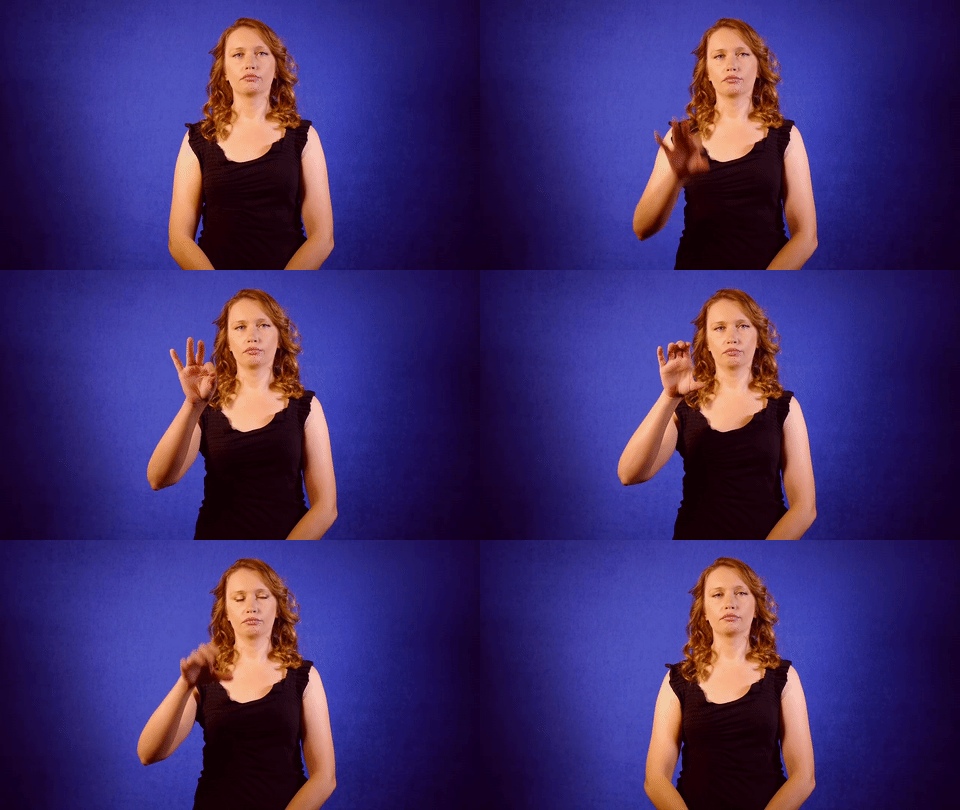
Definition: Refers to the number nine hundred
Sign for THE NUMBER NINE HUNDRED in ASL
Practice Activities:
To practice the sign for the number nine hundred in ASL, begin by signing it in isolation. Face a mirror and repeat the sign several times, ensuring proper handshape and movement. Try saying “nine hundred” aloud as you sign it to strengthen the connection between the visual and numerical concepts.
Use flashcards with numbers written on them. Shuffle the deck and pick a card, then sign the number without looking at a reference. Include the sign for the number nine hundred in ASL and mix it in with other numbers to challenge recognition.
Practice signing numbers in a sequence that includes the sign for the number nine hundred in ASL. For example, sign 100, 200, 900, 1,000 to reinforce number fluency. Increase speed gradually to improve accuracy.
Create real-life scenarios where you might use the sign for the number nine hundred in ASL. Think of situations such as describing a price, addressing a large quantity, or giving an address. For example, sign “This costs nine hundred dollars” or “There were nine hundred people at the event.”
With a partner, play a guessing game. One person signs a number, and the other must write it down or say it aloud. Include the sign for the number nine hundred in ASL in the rotation to ensure repeated exposure to it.
For storytelling, imagine you are telling a history-based fact, such as “Nine hundred years ago, an important event happened.” Incorporate the sign naturally into your storytelling practice.
Watch videos of native signers using numbers in conversation. Pay special attention to how the sign for the number nine hundred in ASL appears in context. Then, try to reproduce what you observed by signing along with the video.
Cultural Context:
American Sign Language (ASL) is a rich and expressive visual language used by the Deaf community across North America. Numbers play an essential role in communication, from telling time to discussing prices or quantities. The sign for the number nine hundred in ASL follows the logical structure of ASL number formation.
When signing the number nine hundred in ASL, understanding the formation of both nine and hundred is crucial. ASL follows a consistent pattern when signing large numbers, making it easier to communicate mathematical values quickly. This system allows for a natural and fluid way to express numbers without needing spoken language.
The concept of numbers in ASL is deeply embedded in everyday interactions. Whether discussing money, measurements, or addresses, knowing how to sign the number nine hundred in ASL is valuable. Numbers in ASL also appear in educational settings, business conversations, and casual discussions.
ASL relies on a combination of handshapes, movements, and facial expressions to convey meaning. Signing the number nine hundred in ASL is not just about hand movements but also clarity and accuracy. A clear and properly signed number ensures effective communication within the Deaf and Hard of Hearing community.
In Deaf culture, numbers are frequently used in sports, storytelling, and historical discussions. The sign for the number nine hundred in ASL could be seen when discussing historical events, large sums of money, or significant milestones. Precision in signing numbers helps avoid confusion and ensures mutual understanding.
Learning to sign numbers correctly enhances fluency in ASL. The number nine hundred in ASL follows standard number conventions, making it easier for learners to grasp counting principles. Practicing numbers regularly improves confidence when communicating with native ASL users.
ASL thrives as a visual language passed down through generations in Deaf culture. Knowing how to sign nine hundred in ASL is just one part of a broader linguistic system. Exposure to ASL in social settings strengthens signing skills and promotes effective communication.
Teachers and interpreters often emphasize the importance of mastering numbers in ASL. The sign for nine hundred in ASL is commonly used in education, finance, and personal discussions. Mastering large numbers helps bridge communication gaps in many real-life situations.
Numbers in ASL are an integral part of daily life, from shopping to discussing measurements. Whether signing temperatures, years, or amounts of money, knowing how to sign the number nine hundred in ASL is useful. Paying attention to correct handshape and movement ensures clarity in conversations.
Facial expressions
Extended Definition:
The sign for the number nine hundred in ASL is formed by combining the sign for nine with a movement or handshape that represents hundred. American Sign Language uses a specific numerical system where larger numbers are indicated by modifying the basic numbers with a secondary motion or placement. Understanding how to express the number nine hundred in ASL correctly ensures clear and accurate communication.
When signing the number nine hundred in ASL, start by forming the nine handshape, which is made by touching the tip of the thumb and index finger to create a circular shape while the other fingers remain extended. Then, transition into the handshape or movement that represents hundred, such as a slight pulling motion or a modified “C” shape. This method helps differentiate hundreds from single digits or tens in ASL.
Numbers in ASL follow a logical structure that allows users to build larger numbers efficiently. The sign for the number nine hundred in ASL follows this structure by incorporating elements of both the number nine and the concept of hundred. This pattern is essential for signing large numbers accurately in conversations related to finance, dates, math, and general counting.
Learning to sign numbers correctly in ASL is vital for effective communication with the Deaf community. When expressing the number nine hundred in ASL, it’s important to maintain clear handshapes and a consistent signing motion. Proper finger positioning and fluid movements ensure the number is easily understood by others familiar with American Sign Language.
The sign for the number nine hundred in ASL is commonly used when discussing amounts of money, populations, measurements, and sequences. Whether talking about $900, 900 miles, or 900 people, this sign provides a quick and efficient way to communicate large numerical values. Being able to sign numbers fluently in ASL enhances comprehension and interaction in various scenarios.
American Sign Language numbers are structured in a way that makes them easy to understand for both native signers and learners. The number nine hundred in ASL follows the same numerical rules that apply to other hundred-based numbers, providing consistency in communication. Knowing how to properly express these numbers ensures effective exchanges in personal, academic, and professional settings.
For those learning American Sign Language, practicing numbers is an essential step toward fluency. Repeating the sign for the number nine hundred in ASL helps build confidence and muscle memory, making numerical communication more natural. Since ASL relies on visual and spatial elements, practicing in front of a mirror or with a partner can improve accuracy.
Mastering
Synonyms: nine hundred, 900, 9 hundred
Educational resources: Find related learning materials in our course bank!
Want more? Check out some of our popular learning activities on the homepage!
Need to look up a sign? Use our highly rated dictionary: https://aslinteractive.com/best-asl-dictionary/
Follow us on tiktok: https://www.tiktok.com/@aslinteractive. More social media links at the bottom of this page!
Long-tail Keywords: what is the sign for the number nine hundred in ASL, how do you sign the number nine hundred in ASL, learn how to sign the number nine hundred in American Sign Language
Categories: Numbers – Basics, hundreds, cardinal numbers
tags: Numbers, Counting, Mathematics, Educational, Language Learning
Parameters
*Handshape*:
The sign for the number nine hundred in ASL uses a combination of two handshapes. First, form the number nine by touching the tip of the thumb to the tip of the index finger, creating a circular shape while keeping the remaining fingers extended. Then, transition into the letter “C” handshape to represent hundred, curving your fingers while maintaining an open palm. The movement should be smooth to clearly convey the sign for the number nine hundred in ASL.
*Palm Orientation*:
For the sign for the number nine hundred in ASL, the palm orientation begins with the dominant hand facing outward for the number nine. The index finger and thumb form a closed circle, while the other fingers remain extended. Then, for hundred, the dominant hand starts in a bent “C” shape, with the palm facing outward before transitioning into a smaller bent motion. Throughout the sign for the number nine hundred in ASL, the palm orientation shifts smoothly between the two number components.
*Location*:
The sign for the number nine hundred in ASL is formed in the neutral signing space in front of the body. The dominant hand starts by forming the number nine, with the thumb and index finger touching in an “O” shape while the other fingers remain extended. Then, the hand transitions into a “C” or bent handshape to indicate the hundred portion, maintaining movement in the same general space.
*Movement*:
To sign for the number nine hundred in ASL, begin by forming the number nine with your dominant hand—extend the thumb and index finger while keeping the other fingers curled. Touch the tip of the index finger to the tip of the thumb, creating an “O” shape. Then, smoothly transition into the sign for hundred by moving your hand slightly forward while curling the index finger down, resembling the letter “C.”
*Non-Manual Signals*:
Facial expression remains neutral or slightly firm while signing for clarity. Eyebrows may raise slightly to emphasize the numerical value in the sign for the number nine hundred in ASL. Mouth may stay neutral or form the number shape silently to reinforce the meaning.
Head may subtly nod for confirmation or clarity, ensuring the sign for the number nine hundred in ASL is understood. Eye contact is maintained with the listener to reinforce attention and understanding.
*Prosody, Dominant/Non-Dominant Hand*:
For the sign for the number nine hundred in ASL, the dominant hand forms the number 9 by touching the thumb and index finger together while the remaining fingers stay extended. Then, transition into the number 100 by shaping the hand into a modified “C” or transitioning from the “1” shape to a “C” movement. The non-dominant hand is not used. This fluid motion ensures clarity in representing the numerical concept accurately.
Tips for Beginners:
When learning the sign for the number nine hundred in ASL, start by mastering the individual number nine. Form the number nine by touching the tip of your thumb to the tip of your index finger while keeping the other three fingers extended. This handshape should be clear and distinct to avoid confusion with other numbers like six or zero.
To convey the number nine hundred, move from the number nine into a C-handshape with a small directional movement outward. This represents multiplication by one hundred in ASL number conventions. Keeping the motion fluid and controlled will help ensure your sign is visually accurate and understood.
One common mistake beginners make is not fully forming their number nine handshape, leading to misunderstanding. Make sure your fingers are not too loosely held or collapsing inward. Another issue is rushing the transition into the C-hand for hundred, which can make it look unclear. Practice keeping each movement deliberate and practiced for clarity.
For better retention, practice signing different numerical values alongside the sign for the number nine hundred in ASL, such as nine, ninety, and nine thousand. This will reinforce patterns commonly seen in ASL numbering and make larger numbers feel more intuitive. Using a mirror can help you check handshape precision and placement.
Finger dexterity is essential for clear ASL number signing. Exercises like opening and closing each finger separately, or fanning the fingers in and out, can help improve control over number signs. The clearer and more confident your hand movements are, the easier it will be for others to recognize the sign for the number nine hundred in ASL in conversation. Keep practicing until the motion becomes smooth and second-nature.
Connections to Other topics:
The sign for the number nine hundred in ASL is connected to the broader system of numerical signs in ASL, following a logical pattern that builds upon smaller numbers. In ASL, numbers in the hundreds are often formed by modifying the base number with an incorporation of the “C” handshape, symbolizing the concept of hundreds. This same structure applies when signing other hundreds, such as six hundred or seven hundred, reinforcing a consistent way of expressing large numbers.
Numbers are integral in ASL and are frequently combined with other signs to specify time, money, or quantity. The sign for the number nine hundred in ASL can be used in contexts like discussing prices, such as nine hundred dollars, or stating years, like the year nine hundred in historical references. Knowing how to sign numbers fluidly and accurately is crucial for clear communication, especially when discussing math, measurements, and statistics.
The principles behind forming the sign for the number nine hundred in ASL also help ASL learners understand how to modify signs for larger numerical values. For instance, the same method used for signing nine hundred is applied when forming the sign for nine thousand or ninety thousand, where the number nine is maintained, but the placement or movement is adjusted to indicate the larger value. This reinforces a broader numerical framework that allows deaf and hard-of-hearing individuals to convey mathematical and financial concepts efficiently.
Numbers in ASL are often used in classifiers and descriptions that require quantity specification. For example, signing nine hundred alongside a classifier can describe a group of nine hundred identical objects. Additionally, numerical incorporation is often used in sports statistics, population counts, and temperature readings. These applications show how numerical signs like the sign for the number nine hundred in ASL are fundamental to effective signing, allowing for precision and clarity when communicating numerical data.
Summary:
The sign for the number nine hundred in ASL combines the numeral sign for “9” with a movement that conveys the concept of “hundred.” The number “9” is formed by bringing the thumb and index finger together in a circular shape while the remaining fingers extend upward. To express “hundred,” the dominant hand arcs slightly downward or bends at the wrist following the numeral formation.
In ASL, numbers like the sign for the number nine hundred in ASL are signed fluidly to maintain clarity and efficiency. The movement should be smooth, ensuring that the combination of “9” and “hundred” is natural and not separate gestures. Maintaining proper hand orientation and palm facing outward when forming “9” helps avoid confusion with similar numerals.
Understanding numeral incorporation is crucial when signing large numbers like the sign for the number nine hundred in ASL. ASL follows specific rules for conveying numerical values without ambiguity. When expressing monetary values, addresses, or statistics, the signer may need to emphasize the numeral structure for precision.
Culture plays a role in how numbers, including the sign for the number nine hundred in ASL, are used within the Deaf community. Numbers are often seen in educational settings, financial transactions, and everyday communication. Mastering numerical signs allows for more effective discussions about prices, measurements, and data.
Linguistic analysis of the sign for the number nine hundred in ASL reveals a blend of numeral and classifier-like movement. The adaptability of ASL numerals showcases both its efficiency and depth. Unlike spoken languages, ASL uses space and movement to signify numerical values with minimal ambiguity.
Grammar in ASL dictates how numbers like the sign for the number nine hundred in ASL are structured within sentences. Depending on context, the number can stand alone, modify a noun, or be integrated into a larger numerical concept. Sentence structure changes based on use in quantity statements, money amounts, or discussion of historical years.
Comparing number signs across sign languages reveals differences in numeral formation. While ASL uses a specific pattern to express numbers like the sign for the number nine hundred in ASL, other sign languages may incorporate different strategies. These structural variations highlight the diversity in signed languages worldwide.
Numeracy is an essential skill in Deaf communication, and mastering the sign for the number nine hundred in ASL enhances fluency. Proper numerical expression is necessary in business, education, and technology-related discussions. Using ASL numbers correctly ensures clarity when conveying precise information.
For financial contexts, the sign for the number nine hundred in ASL is commonly used in banking, salary discussions, and transactions. Signing currency amounts requires additional signs for “dollars” or “cents” depending on the conversation. Precision in number signing is vital to avoid miscommunication in professional settings.
Historical usage of numerical signs, including the sign for the number nine hundred in ASL, has evolved over time. Older versions of numerical signs may have incorporated different movements or handshapes. Standardization over time has helped streamline number production within ASL.
Educational resources often emphasize proper number signing in ASL classes. The sign for the number nine hundred in ASL is taught alongside patterns for recognizing and producing large numerical values. Developing number fluency in ASL improves overall language confidence.
Sentence examples incorporating the sign for the number nine hundred in ASL help solidify understanding. “There were nine hundred people at the event,” or “The cost of the item is nine hundred dollars” both require clear execution of the sign. Placing the number correctly in ASL syntax ensures proper comprehension.
Technology and digital communication have influenced how numbers, including the sign for the number nine hundred in ASL, are used in text-based ASL conversations. Numeric substitution in texting and video relay services enables faster communication. Digital adaptations of number signs reflect the flexibility of ASL in modern contexts.
When signing large numbers, maintaining fluidity is important. The sign for the number nine hundred in ASL should be executed smoothly without hesitation. Practicing in front of a mirror or recording oneself can help refine movements.
Parents and educators teaching ASL to children ensure that numerical concepts like the sign for the number nine hundred in ASL are introduced at appropriate stages. Interactive games, visual aids, and repetition improve retention. Mastering signs for numbers builds confidence in young signers.
DeafBlind signers may modify the sign for the number nine hundred in ASL using tactile signing. Tactile signing adjustments ensure proper understanding of the numeral formation through hands-on techniques. These adaptations make number communication accessible to all members of the Deaf community.
Storytelling in ASL may also include the sign for the number nine hundred in ASL when describing quantities or historical elements. Storytellers emphasize numbers using facial expressions and body language. The use of spatial structuring helps define numerical meaning in signed narratives.
Understanding numerical classifiers in ASL provides further insights into how numbers function. The
Want more? Check out some of our popular learning activities!
ASL Interactive Resources
ASLInteractive YouTube Channel
Follow us on tiktok: @aslinteractive.com
Follow us on Instagram: aslinteractive
Facebook page: aslinteractive
Facebook group: aslinteractive
LInkedIn: ASL Interactive LLC
Twitter: @ASL_interactive
*Some information on this page is AI-generated. AI can make mistakes. Please check the information.


Responses