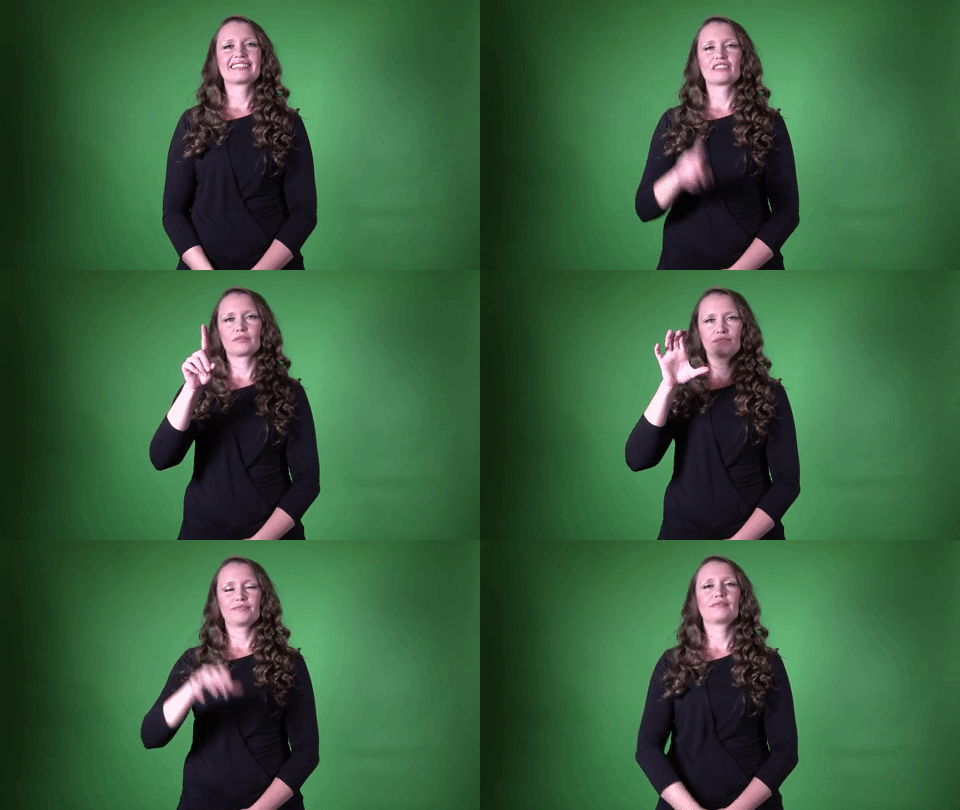
Definition: Refers to the number one hundred
Sign for THE NUMBER ONE HUNDRED in ASL
Practice Activities:
Practicing the sign for the number one hundred in ASL begins with repetition. Stand in front of a mirror and sign it slowly, ensuring correct handshape and movement. Try signing it with both hands to improve clarity and muscle memory. Once comfortable, practice signing it at different speeds while maintaining accuracy.
Use the sign for the number one hundred in ASL in counting exercises. Count aloud from one to one hundred using ASL numbers, pausing to emphasize the number one hundred. Try skipping by tens or fives, signing each milestone, and finishing at one hundred.
Incorporate the sign for the number one hundred in ASL into real-world scenarios. For example, pretend to count money, household objects, or people in a crowd. Practice signing, “I have one hundred dollars,” or “There are one hundred books in this library.” Use different contexts to reinforce comprehension.
Work with a partner to quiz each other on numbers leading up to one hundred. One person can sign random numbers, and the other must respond with the correct follow-up, ensuring that one hundred is included in the sequence. This will enhance recognition speed.
Write and sign a short story that incorporates the number one hundred. For example, “I found one hundred seashells on the beach,” or “My grandmother is one hundred years old.” Share your story with a partner or record yourself for self-review.
Play a guessing game using the sign for the number one hundred in ASL. One person signs a series of numbers while the other guesses which number they are thinking of. Make sure to correctly emphasize the sign when one hundred is the right answer. Engage in creative number discussions to enhance fluency.
Cultural Context:
In American Sign Language, the sign for the number one hundred in ASL is essential for discussions involving numbers, measurements, and counting. This sign is used when talking about money, ages, scores, and various statistics. Understanding how to correctly sign numbers helps improve communication in both casual and professional settings.
The sign for the number one hundred in ASL is commonly seen in educational environments, especially in math and finance discussions. Teachers and students frequently use this sign when solving problems, discussing test scores, or counting large amounts. Mastering this number enhances fluency when signing about quantities and numerical concepts.
Culturally, the sign for the number one hundred in ASL is useful when celebrating milestones and achievements. People use it when congratulating someone on reaching a goal, such as scoring 100% on a test or completing a 100-day challenge. It also appears in historical discussions, like referencing an event from 100 years ago or honoring centenarians.
This sign is helpful in business and financial conversations, as it allows for clear communication regarding amounts of money or discounts. When discussing prices, budgets, or fundraising goals, signing the number one hundred correctly ensures accuracy. In negotiations or transactions, clarity in numbers helps avoid misunderstandings.
When signing large numbers, knowing how to sign the number one hundred in ASL is a foundational skill. It becomes especially important when discussing quantities in sports, like a baseball player reaching 100 home runs or a runner completing a 100-mile race. From competition results to training goals, this number is frequently signed in athletic communities.
The sign for the number one hundred in ASL also appears in everyday life, like counting items at a grocery store or setting personal targets. Whether keeping track of exercise repetitions, savings goals, or social media followers, this number is often mentioned. Learning this sign improves everyday interactions that involve counting.
Understanding the sign for the number one hundred in ASL helps build confidence in signing larger numbers. In conversations about distance, time, or large-scale events, this number is often included. Mastering it prepares signers for more advanced numerical communication in personal and professional situations.
From historical discussions to personal achievements, the sign for the number one hundred in ASL is widely used across different contexts. Its importance in communication, mathematics, celebrations, and everyday activities makes it a valuable addition to any ASL vocabulary. Learning and using this sign correctly contributes to clear and effective conversations in ASL.
Extended Definition:
The sign for the number one hundred in ASL is an essential part of learning American Sign Language numbers. It follows a simple handshape and movement that allows for clear communication. This sign is frequently used in discussions involving money, quantities, and measurements.
To sign the number one hundred in ASL, start by forming the number one with your dominant hand. Then, transition into a bent-C or modified-C handshape to represent the hundred. This smooth motion makes the sign distinctive and easy to recognize.
The sign for the number one hundred in ASL is commonly used in both everyday conversations and academic settings. It appears when talking about prices, counts of objects, or even historical years. Understanding this sign helps improve fluency in ASL number systems.
Different ASL users might see slight variations in how this number is signed. Some may use a bent-C handshape, while others may prefer a different transition. Despite these variations, the meaning remains the same, making the sign easy to understand in context.
Numbers play an important role in American Sign Language, and the number one hundred is no exception. Learning how to correctly form and use this number increases the ability to express amounts clearly. Mastering number signs also helps in understanding higher values and patterns in ASL numbering.
Counting in ASL follows a systematic approach, and the sign for the number one hundred fits naturally into this numbering system. Recognizing how it connects to other numbers makes learning larger values easier. Becoming familiar with this sign prepares learners for more complex number signs.
When using the number one hundred in ASL, context is key to clarity. It can be used in discussions about age, distance, or even statistics. Practicing this number in different settings improves confidence and signing accuracy.
The sign for the number one hundred in ASL is often taught early in ASL education. Since it is a milestone number, it helps learners build a strong foundation for understanding larger numerical values. Consistently practicing this sign contributes to better overall ASL comprehension.
American Sign Language relies on visual and spatial elements to convey meaning. The way numbers are signed, including one hundred, helps enhance communication in both formal and casual settings. Learning this number alongside others strengthens fluency in ASL.
Using the hundred marker in ASL allows for quick representations of larger values. Combining this number with others helps in communicating precise details. Expanding knowledge of ASL numbers, including one hundred, simplifies everyday interactions.
Synonyms: century, one hundred, 100, hundred percent, 1 hundred
Educational resources: Find related learning materials in our course bank!
Want more? Check out some of our popular learning activities on the homepage!
Need to look up a sign? Use our highly rated dictionary: https://aslinteractive.com/best-asl-dictionary/
Follow us on tiktok: https://www.tiktok.com/@aslinteractive. More social media links at the bottom of this page!
Long-tail Keywords: what is the sign for the number one hundred in ASL, how do you sign the number one hundred in ASL, learn to sign the number one hundred in American Sign Language
Categories: Numbers – Basics, Numbers 91-100, cardinal numbers
tags: Numbers, Numbers 91-100, Math, Language Learning, Educational Content
Parameters
*Handshape*:
The sign for the number one hundred in ASL starts with the dominant hand forming the “1” handshape—an extended index finger—while the other fingers remain curled against the palm. The hand moves slightly downward while transitioning into a bent “C” handshape, resembling a backward arc motion. This smooth shift between handshapes visually represents the numerical value. The sign for the number one hundred in ASL is clear and efficient for communication. ✋
*Palm Orientation*:
The palm orientation for the sign for the number one hundred in ASL begins with the dominant hand in the upright position, palm facing forward. The index finger is extended to form the number one, then transitions into a bent-C shape as the hand slightly moves back. The palm remains forward or slightly tilted downward during this movement, ensuring clarity in forming the number. This fluid motion effectively conveys the sign for the number one hundred in ASL.
*Location*:
The sign for the number one hundred in ASL is produced in the signing space in front of the body, typically around chest level. The dominant hand starts in the handshape for the number one, with the index finger extended while the other fingers remain curled. The hand then curves into a “C” or bent-hand shape as it moves slightly backward. This location allows for clear visibility and natural execution of the numeric concept.
*Movement*:
To produce the sign for the number one hundred in ASL, start by forming the number 1 with your dominant hand—extend the index finger while keeping the other fingers curled. Then, transition into the letter C by curving your fingers and thumb. The movement is fluid, with the index finger straight at first, followed by a smooth shift into the C shape, representing the number one hundred. Keep the motion natural and controlled.
*Non-Manual Signals*:
When signing the sign for the number one hundred in ASL, keep a neutral or slightly focused facial expression. If emphasizing an exact number, slightly raise your eyebrows and tilt your head forward. Maintain direct eye contact to affirm clarity, especially in educational or formal settings. If expressing an approximation, a small head shake with relaxed eyebrows may be used. Consistent, natural facial expressions help reinforce meaning and ensure accuracy.
*Prosody, Dominant/Non-Dominant Hand*:
For the sign for the number one hundred in ASL, the dominant hand starts in the “1” handshape with the index finger extended upward. The hand moves slightly forward, then transitions into a “C” handshape, representing the number’s shape. The non-dominant hand is not used in this sign. Facial expressions remain neutral unless emphasizing quantity. This sign is clear and commonly used when discussing monetary values, counting, or numerical references.
Tips for Beginners:
When learning the sign for THE NUMBER ONE HUNDRED in ASL, start by making sure your handshape and movement are precise. Begin with the number “1” handshape, pointing the index finger upward with the other fingers folded down. Then smoothly transition into the “C” handshape to represent “100.” This shift should be fluid, avoiding jerky or exaggerated motions.
One of the most common pitfalls when signing THE NUMBER ONE HUNDRED in ASL is incomplete handshape transitions. If the “C” shape is unclear or rushed, it can confuse the meaning. To prevent this, practice moving from the “1” handshape to the “C” shape in a controlled yet natural manner. Use a mirror or record yourself to check accuracy.
Facial expressions and hand positioning matter when signing THE NUMBER ONE HUNDRED in ASL. Keep your hand at a comfortable place in front of your chest or shoulder level. Avoid signing too quickly, as clarity is more important than speed, especially when numbers can easily be misinterpreted.
Repetition is key to mastering this sign. Practice daily and incorporate the sign into small conversations or counting exercises. Saying the number in your head as you sign can reinforce memory, but remember that ASL is a visual language, so focus on the visual aspects.
Engage with fluent signers or ASL instructors to get feedback on your sign for THE NUMBER ONE HUNDRED in ASL. Live practice helps improve fluency and reduces hesitation. Watching videos of native ASL users signing numbers also builds recognition skills. Stay patient and keep refining the movement for accuracy and confidence.
Connections to Other topics:
The sign for the number one hundred in ASL connects to other number signs and helps learners grasp numerical structures in ASL. Signing numbers fluently is essential for topics like math, pricing, and counting in everyday conversation. Numbers in ASL follow specific patterns, and understanding how hundred-series numbers are signed helps build fluency for larger numbers like two hundred, five hundred, or even one thousand.
The sign for the number one hundred in ASL is related to other century markers like two hundred or nine hundred, which follow a similar pattern. Learning number-related signs also strengthens comprehension of concepts like years, dollars, or percentages. For example, signing “one hundred dollars” combines the sign for the number one hundred with the sign for dollars, which involves a grabbing motion at the forehead.
Fingerspelling plays a role in numbers when precision is needed, such as naming exact figures or serial numbers. The structure of the sign for the number one hundred in ASL also ties into concepts like rounding, multiplication, and fractions. In educational settings, ASL users often sign equations and math problems, making number fluency vital for academic discussions.
Ordinal numbers like “hundredth” or phrases like “every hundred” require modification of number signs in ASL. The ability to quickly sign the number one hundred supports financial and statistical discussions, including percentages, ratios, and even expressing “one in a hundred.” The concept also connects with historical years, teaching learners how to sign dates like 1900 or 2000 properly.
Mastering the sign for the number one hundred in ASL also aids in discussing timeframes, such as “one hundred days” or “one hundred years ago.” Connecting this to concepts like long durations or historical references strengthens a signer’s ability to engage in deeper conversations. This number serves as a foundation for broader ASL number literacy, supporting fluency in complex numerical expressions.
Summary:
The sign for the number one hundred in ASL is an essential numerical representation in American Sign Language. It combines elements of numerical handshapes and movement to create a clear and recognizable sign. This number is frequently used in daily conversations, financial discussions, and educational settings.
To perform the sign for the number one hundred in ASL, begin with the handshape for the number one. Extend the index finger upward while keeping the rest of the fingers curled into the palm. This is the standard numerical handshape for the number one in ASL.
Next, transition into the handshape for the letter C to indicate the concept of one hundred. The index finger curls down as the hand moves slightly forward or downward into the C shape. This transition represents the rounding of the numerical form, providing a visual representation of shifting from a single unit to a hundred.
Hand orientation plays a crucial role in the sign for the number one hundred in ASL. The movement of the dominant hand must be smooth and deliberate to ensure clarity. The shift from the one handshape to the C handshape is integral to differentiating it from other numerical signs.
This sign is part of ASL’s broader numerical system, which blends simplicity and efficiency. The movement is designed for quick recognition, enabling fluid counting and quantitative discussion. The use of a C handshape mirrors how larger numbers are structured in ASL, maintaining consistency in visual language.
The number one hundred has cultural and social significance in both spoken and signed language. It is an important milestone for achievements, such as scoring 100% on a test or celebrating a centennial event. Understanding how to sign this number allows ASL users to communicate effectively in various contexts.
In everyday conversations, the sign for the number one hundred in ASL often appears in financial transactions. It is frequently used when discussing monetary values, such as “$100 bills” or “100 dollars for a service.” Mastery of this numerical sign ensures clarity in financial discussions.
Using the correct numerical signs enhances fluency in ASL. The sign for the number one hundred in ASL follows logical numerical patterns seen in the ASL numbering system. Recognizing this structure aids learners in understanding how higher numbers are formed.
Numbers in ASL follow unique grammatical and linguistic rules. The sign for the number one hundred in ASL aligns with these principles through its structured movement. Numerical accuracy is essential for effective communication, especially when conveying precise amounts.
The use of distinct handshapes in ASL differentiates numbers from other concepts. The sign for the number one hundred in ASL relies on the clarity of the transition from one to C. Without this movement, the intended number could be misinterpreted.
When signing in a formal setting, such as a classroom or business meeting, the precision of the sign for the number one hundred in ASL is crucial. Clear articulation ensures the correct interpretation of numerical data. This is particularly important when relaying large amounts of information.
The role of facial expressions in numerical signs varies based on context. While the sign for the number one hundred in ASL does not require exaggerated facial expressions, contextual emphasis may be used to stress importance. This can be useful when highlighting accomplishments or financial discussions.
Numbers in ASL are often paired with classifiers in more complex phrases. The sign for the number one hundred in ASL may be combined with other numerical structures to convey larger amounts, such as “one hundred thousand” or “one hundred million.” Understanding these combinations enriches ASL fluency.
The motion involved in signing one hundred mirrors numerical progressions seen in other languages. Just as spoken languages have structured ways to indicate larger numbers, ASL utilizes visual cues to highlight incremental numerical growth. This underscores the efficiency of ASL’s numerical system.
Many signed languages around the world have similar representations for the number one hundred. However, variations exist based on regional and cultural influences. While ASL uses a shift from one to C, other signing communities may express one hundred differently.
Teaching the sign for the number one hundred in ASL is an important step in ASL education. Beginning learners must practice the transition between handshapes to develop accuracy. Frequent repetition helps build muscle memory for smooth execution of numbers.
In Deaf culture, numerical fluency is as important as in spoken cultures. The ability to quickly and clearly sign numerical values reinforces effective communication. The sign for the number one hundred in ASL represents not only a number but also a fundamental aspect of everyday interaction.
Numerical literacy in ASL extends beyond learning individual signs. Understanding how the sign for the number one hundred in ASL fits within a broader system allows signers to accurately use numbers in a range of topics. Mastery of these principles contributes to natural and efficient communication.
Advanced signers use numerical signs fluidly in conversation. When signing the number one hundred, experienced signers ensure seamless transitions and proper hand placement. This skill enhances overall
Want more? Check out some of our popular learning activities!
ASL Interactive Resources
ASLInteractive YouTube Channel
Follow us on tiktok: @aslinteractive.com
Follow us on Instagram: aslinteractive
Facebook page: aslinteractive
Facebook group: aslinteractive
LInkedIn: ASL Interactive LLC
Twitter: @ASL_interactive
*Some information on this page is AI-generated. AI can make mistakes. Please check the information.


Responses