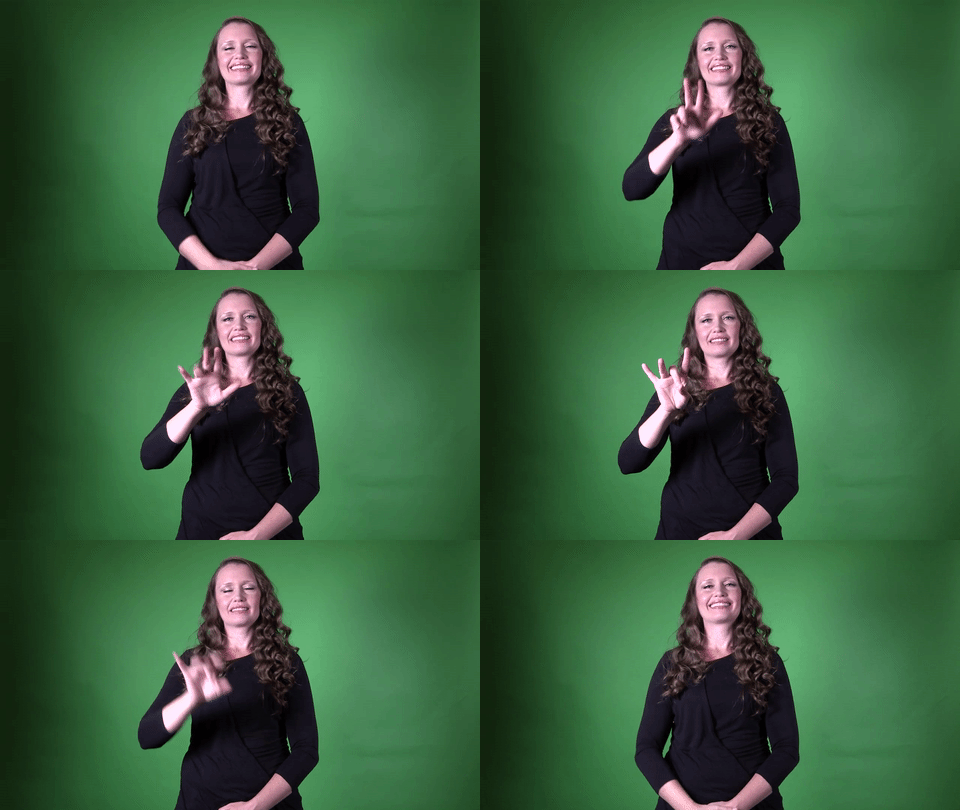
Definition: Refers to the number thirty-eight
Sign for THE NUMBER THIRTY-EIGHT in ASL

Practice Activities:
To effectively practice the sign for the number thirty-eight in ASL, start by forming the sign repeatedly while maintaining proper handshape and motion. Practice signing it in isolation, ensuring that your transitions between the digits are smooth. Use a mirror or record yourself to check for accuracy in hand positioning.
Challenge yourself to sign a sequence of numbers that includes the sign for the number thirty-eight in ASL. For example, sign the numbers 35 through 40 several times in a row, paying close attention to how your hand moves between each one. Try signing random numbers that include thirty-eight to build fluency.
Use the sign for the number thirty-eight in ASL in sentences to enhance context-based learning. For example, sign “I saw thirty-eight birds in the park,” or “My aunt is thirty-eight years old.” Create five different sentences that include thirty-eight and practice signing them smoothly.
Engage in partner activities to reinforce learning. Have a friend or study partner ask questions with numbers, such as “How many books do you have?” and respond with the correct number. Similarly, play a number guessing game where one person signs a number, and the other has to recognize and respond with the correct digits.
Incorporate storytelling by creating a short narrative that includes the sign for the number thirty-eight in ASL multiple times. For example, tell a story about purchasing thirty-eight items at a store, seeing thirty-eight stars in the sky, or running thirty-eight laps at school. Practicing the number in context will improve recall and signing speed.
Finally, test yourself by watching ASL number videos and identifying when the sign for the number thirty-eight in ASL appears. This will help you recognize and differentiate it from other similar-looking numbers.
Cultural Context:
The sign for the number thirty-eight in ASL follows a pattern commonly used for multiple-digit numbers. It blends distinct handshapes smoothly to convey the number efficiently. This sign is part of the numbering system that allows ASL users to express both simple and complex numerical concepts.
Numbers play an essential role in ASL, from counting objects to giving addresses or sharing ages. The sign for the number thirty-eight in ASL is a quick transition between numerical handshapes, maintaining clarity and fluidity. Understanding number signs helps improve communication accuracy in both casual and formal conversations.
ASL number signs rely on handshape, movement, and palm orientation. When signing the number thirty-eight, precise hand positioning ensures the correct meaning. Practicing the motion smoothly is key to maintaining fluency in signed conversations.
Deaf culture emphasizes the importance of clear numerical signs, especially in educational and professional settings. The sign for the number thirty-eight in ASL is useful in everyday discussions, such as talking about prices, years, or quantities. Mastering ASL numbers enhances understanding and strengthens connection within the signing community.
Numbers in ASL follow a structured format, but some variations may exist depending on region or context. Learning the sign for the number thirty-eight in ASL helps expand fluency and comprehension of ASL numeric patterns. Accurate number signing is crucial in storytelling, instructions, and casual conversation.
Whether discussing math problems or sports scores, the sign for the number thirty-eight in ASL contributes to clear communication. ASL users often rely on number signs to share important details efficiently. Developing confidence with numbers in ASL allows for better interaction with both Deaf and hearing signers.
Using the sign for the number thirty-eight in ASL correctly ensures effective exchanges in social and professional settings. ASL numbers are essential in conversations about dates, measurements, and statistics. Fluency with numerical signs strengthens overall signing skills and communication flow.
Seeing the number signs in real-world situations helps reinforce learning. The sign for the number thirty-eight in ASL may appear in classroom settings, business transactions, or storytelling. Hands-on practice and exposure to native signers enhance the learning experience.
Mastering numerical signs like the sign for the number thirty-eight in ASL supports better comprehension of ASL linguistics. Understanding numerical expressions allows for smoother interactions in daily life. Whether signing time, age, or quantities, accurate number signs are fundamental for clear ASL communication.
Extended Definition:
The sign for the number thirty-eight in ASL is a combination of individual number signs. It blends the digits three and eight in a fluid motion. This ensures clarity and accuracy when conveying the number in American Sign Language.
To sign the number thirty-eight in ASL, begin by forming the number three with your dominant hand. Extend the thumb, index, and middle fingers while keeping the ring and pinky fingers curled. Then transition smoothly into the number eight by folding the middle finger and touching it to the thumb.
Finger movements should be clear and precise to avoid confusion with similar numbers. The hand shape and position should remain consistent throughout the sign. Practicing in front of a mirror or with a fluent signer can help refine accuracy.
The sign for the number thirty-eight in ASL is widely used in various contexts. It can indicate an age, a count, a price, or even a sports jersey number. It is essential to sign it correctly, as accuracy is key in effective communication.
ASL number signs, including the number thirty-eight, follow a logical pattern. Numbers in the thirties maintain consistency in hand transitions. Learning these patterns can help with fluency and ease of signing.
Facial expressions and context can enhance the comprehension of the sign. When listing numbers or providing information, a neutral or slightly focused expression is typically appropriate. If emphasizing the number, slight nodding or pausing may help convey importance.
The number thirty-eight in ASL is part of the broader numerical system within sign language. Recognizing the patterns in number signs makes it easier to sign larger numbers. This understanding allows for smoother and quicker communication in conversation.
Mastering the sign for the number thirty-eight in ASL benefits anyone learning the language. Numbers are essential for everyday interactions, from giving addresses to discussing quantities. Becoming comfortable with number signs enhances ASL proficiency.
Watching fluent signers and practicing regularly can strengthen skills with ASL numbers. Resources such as videos, instruction from native signers, and real-life use help improve signing confidence. Understanding number transitions leads to better overall fluency in ASL.
Synonyms: thirty-eight, number thirty-eight, number 38, the number 38, the number thirty-eight
Educational resources: Find related learning materials in our course bank!
Want more? Check out some of our popular learning activities on the homepage!
Need to look up a sign? Use our highly rated dictionary: https://aslinteractive.com/best-asl-dictionary/
Follow us on tiktok: https://www.tiktok.com/@aslinteractive. More social media links at the bottom of this page!
Long-tail Keywords: what is the sign for the number thirty-eight in ASL, how do you sign the number thirty-eight in American Sign Language, learn how to sign the number thirty-eight in ASL
Categories: Numbers – Basics, Numbers 31-40, cardinal numbers
tags: Numbers 31-40, Numbers, Math, Educational, Language Learning
Parameters
*Handshape*:
The sign for the number thirty-eight in ASL uses a shifting handshape. The dominant hand starts in a “3” handshape, with the index, middle fingers, and thumb extended. Then, the hand transitions smoothly into an “8” handshape by folding the middle finger to touch the thumb. This movement creates an effortless shift, keeping the palm facing out. The sign for the number thirty-eight in ASL requires a clear transition to ensure accuracy and clarity. ️
*Palm Orientation*:
For the sign for the number thirty-eight in ASL, the palm starts facing outward, with the index, middle, and thumb forming a “3” shape. As the transition happens, the hand moves slightly, and the middle and ring fingers tap together while the thumb remains extended, forming an “8” shape. The palm remains forward throughout the motion, ensuring clarity in the sign for the number thirty-eight in ASL. ✋
*Location*:
The sign for the number thirty-eight in ASL is produced in the neutral space in front of the body. The dominant hand forms a “3” handshape, with the index, middle, and thumb extended. Then, the thumb and pinky retract while the index and middle fingers remain extended, transitioning into an “8” handshape. This movement happens smoothly and naturally in one fluid motion. The location remains in front of the torso without touching the body.
*Movement*:
To make the sign for the number thirty-eight in ASL, start by forming the number three with your dominant hand—extend the index, middle, and thumb while keeping the ring and pinky tucked. Transition smoothly by dropping the thumb while extending the ring finger to form the number eight. The movement should be fluid, without hesitation, emphasizing the switch between three and eight in one continuous motion.
*Non-Manual Signals*:
Facial expressions remain neutral or slightly focused when performing the sign for the number thirty-eight in ASL. Eyebrows should stay relaxed unless contextual emphasis is needed, such as when clarifying or confirming the number. Mouth movements may remain neutral with slight lip rounding if naturally present during articulation. Maintain steady eye contact with the recipient to ensure clear communication of the sign for the number thirty-eight in ASL, reinforcing visual engagement.
*Prosody, Dominant/Non-Dominant Hand*:
The sign for the number thirty-eight in ASL is produced with the dominant hand. Start by forming the number three with the index, middle, and thumb extended, while the ring and pinky fingers remain folded. Transition smoothly to the number eight by touching the thumb to the middle finger while the index finger remains extended. This movement ensures clarity and fluidity in signing the number. The non-dominant hand is not used.
Tips for Beginners:
When learning the sign for the number thirty-eight in ASL, start by positioning your dominant hand in a “3” shape, with the index, middle, and thumb extended. Transition smoothly into an “8” shape by pulling in the index and middle fingers while keeping the thumb and pinky extended. This movement should be fluid without extreme pauses between the number shifts.
A common mistake is moving the hand too fast, making the transition unclear. Keep the fingers steady and controlled so each number is easily distinguishable. The motion should appear natural, almost like counting the digits in your head without rushing.
Pay attention to palm orientation—your palm should face outward during the sign. If your palm angles too much toward the side or your body, the number may be misinterpreted. Practicing in front of a mirror can help ensure your signs remain clear and correctly positioned.
Finger flexibility is important when signing the number thirty-eight in ASL, as the transition from “3” to “8” requires precise control. If you find your fingers feel stiff, try some hand-stretching exercises beforehand. Keeping hands relaxed helps improve movement clarity.
Watching native signers can offer valuable insight into mastering the movement naturally. Observe how smoothly each number transitions and mimic their relaxed yet deliberate motion. With consistent practice, signing this number will become second nature.
Connections to Other topics:
The sign for the number thirty-eight in ASL is part of the broader numerical system in American Sign Language, which follows a structured pattern for forming numbers. Numbers in ASL are often categorized into cardinal, ordinal, age, time, and quantity-related contexts, and learning number patterns can help users quickly recall and produce other numbers. The transition between the digits within the sign for the number thirty-eight in ASL follows a smooth movement, making it similar to other numbers in the thirties, like thirty-seven and thirty-nine.
Number signs in ASL are frequently used in daily communication, including discussions about age, addresses, money, and measurements. The sign for the number thirty-eight in ASL follows the common ASL practice of incorporating handshape changes to indicate numerical progression. Numbers also play a role in sports signs, statistics, and educational contexts, where expressing numerical concepts accurately is essential.
ASL numerical incorporation is a key feature in discussing time-related concepts, such as scheduling, countdowns, and durations. The sign for the number thirty-eight in ASL may appear alongside time signs, such as minutes, years, or dollar amounts, to specify values. Understanding numerical shifts helps learners create compound number-related phrases, such as “thirty-eight minutes” or “thirty-eight dollars,” which enhance fluency and comprehension when discussing detailed quantities.
Beyond basic counting, number signs play a role in mathematical and financial discussions in ASL. Learning the flow of hand movements in the sign for the number thirty-eight in ASL can help with recognizing similar structures in financial terms like amounts, discounts, and totals. Numbers are an integral part of many daily exchanges, reinforcing the importance of mastering them for full ASL fluency.
Summary:
The sign for the number thirty-eight in ASL is a combination of numerical hand configurations that shift smoothly from one to another. It begins with the hand in the number three shape, where the index, middle, and thumb are extended while the ring and pinky fingers are tucked in. The hand then transitions to the number eight shape, bringing the tips of the thumb and middle finger together while the remaining fingers extend.
This number sign is part of the ASL numbering system, which follows distinct rules based on cardinal and ordinal applications. Some numbers have a clear, fluid movement from one digit to another, while others emphasize singular handshapes. The sign for the number thirty-eight in ASL follows the natural transition of fingers, making it intuitive for fluent signers.
Numbers in ASL often adhere to specific palm orientations depending on the context. For counting, numbers typically face outward. However, when used in larger numerical contexts or phone numbers, palm orientation may shift based on convention and ease of signing. The sign for the number thirty-eight in ASL follows this system, allowing flexibility in presentation.
ASL uses numerical incorporation in several contexts, such as age, time, and ranking. Unlike spoken English, where thirty-eight requires clear enunciation, ASL conveys it visually in one motion. This makes the sign for the number thirty-eight in ASL efficient and expressive without needing additional clarification.
When signing numbers consistently, it is important to maintain a steady rhythm. New learners sometimes struggle with transitioning between numbers too quickly or too slowly. The sign for the number thirty-eight in ASL requires smooth handshape accuracy to communicate effectively.
In cultural contexts, numbers have varied significance, depending on the community. Some numbers may hold special meaning in Deaf culture, particularly those involving milestones or historical events. While the sign for the number thirty-eight in ASL does not have a widely recognized cultural connotation, it contributes to the broader system of numerical literacy in ASL.
Numbers play a major role in everyday interactions. Whether sharing phone numbers, ages, or addresses, numerical signs are frequently used in conversations. The sign for the number thirty-eight in ASL is one example of how numerical handshapes integrate into practical communication.
ASL numbering conventions differ slightly from English-based numerical expressions. In signed languages, emphasis comes from movement, palm orientation, and facial expressions. The sign for the number thirty-eight in ASL demonstrates how cohesive and structured number signs are within this visual language.
Some signs require precision due to similarity with others. Numbers like thirty-six, thirty-seven, and thirty-nine have slight variations, relying on accurate handshape changes. Clearly forming the sign for the number thirty-eight in ASL ensures it is not confused with a similar-looking number.
Numbers are a key component in education, especially for Deaf children learning mathematical concepts. ASL-based math education benefits from the clarity of numerical signs. The sign for the number thirty-eight in ASL contributes to this numerical representation, reinforcing visual learning strategies.
In signed storytelling, numbers add depth to narratives. Whether discussing historical timelines or personal anecdotes, numerical signs provide necessary detail. The sign for the number thirty-eight in ASL might be used when recounting ages, years, or quantitative elements within a story.
Some signs are influenced by regional or generational variations. While number signs are largely standardized, small stylistic preferences may emerge within different signing communities. The sign for the number thirty-eight in ASL maintains consistency but may be presented with slight variations in signing style.
Numbers in ASL follow a sequential logic that simplifies comprehension. Unlike spoken numbers, which rely on auditory reception, ASL numerical signs visually convey quantitative value instantly. The sign for the number thirty-eight in ASL fits into this logical pattern, ensuring clarity across different signing situations.
Codeswitching between ASL and spoken or written English sometimes affects numerical usage. Some Deaf individuals might write or fingerspell numbers depending on context. Still, using the sign for the number thirty-eight in ASL allows for a streamlined, visually clear numerical reference.
DeafBlind individuals may rely on tactile signing, including numerical expressions. In tactile ASL, numbers are modified to ensure clarity for the receiver. The sign for the number thirty-eight in ASL might be adjusted for tactile communication but still follows the same handshape principles.
Numerical classifiers in ASL play a major role in expressing size, quantity, or sequence. ASL numbering exists alongside classifiers that give extra detail about objects and amounts. While the sign for the number thirty-eight in ASL is numeric-only, classifiers can pair with numbers to enhance description.
Technology has expanded access to linguistic research on ASL, including digital resources that analyze number signs. Video dictionaries and online tutorials offer in-depth analysis of numerical gestures. The sign for the number thirty-eight in ASL can be easily found in digital ASL resources for learning and teaching.
Historical records show that ASL number
Want more? Check out some of our popular learning activities!
ASL Interactive Resources
ASLInteractive YouTube Channel
Follow us on tiktok: @aslinteractive.com
Follow us on Instagram: aslinteractive
Facebook page: aslinteractive
Facebook group: aslinteractive
LInkedIn: ASL Interactive LLC
Twitter: @ASL_interactive
*Some information on this page is AI-generated. AI can make mistakes. Please check the information.


Responses