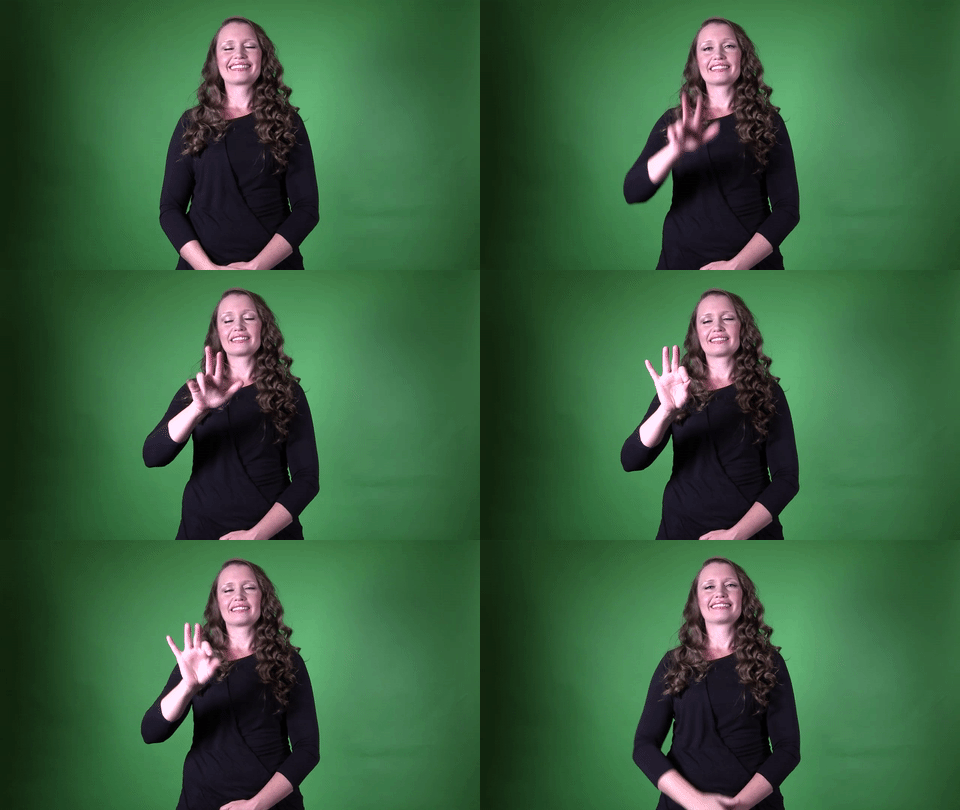
Definition: Refers to the number thirty-nine
Sign for THE NUMBER THIRTY-NINE in ASL

Practice Activities:
To practice the sign for the number thirty-nine in ASL, start by signing it repeatedly while looking in a mirror. Focus on the transition between the digits and ensure your handshape remains clear and accurate. Say the number aloud as you sign to reinforce the connection between the visual and spoken forms.
Try incorporating the sign for the number thirty-nine in ASL into a counting sequence. Count from thirty to forty while emphasizing the transition between numbers. Slow down when switching from thirty-eight to thirty-nine and again from thirty-nine to forty to build fluency.
For a fun practice exercise, play a number guessing game with a partner. One person signs a number between thirty and forty while the other guesses. Include thirty-nine often to gain more exposure to the sign. You can also mix in random numbers to increase recognition speed.
Use example sentences that include the sign for the number thirty-nine in ASL. Sign phrases like, “I have thirty-nine books,” or “She is thirty-nine years old.” Practice these sentences in front of a mirror to check clarity and accuracy. Try creating your own sentences that feature this number.
Create a short story that includes the number thirty-nine. It could be about someone celebrating their thirty-ninth birthday or about finding thirty-nine items in a scavenger hunt. Sign the story to a partner or record yourself signing to analyze and improve your clarity and fluency.
Engage in a fast-sign challenge where you sign numbers from one to forty as quickly and accurately as possible. Make sure thirty-nine is signed correctly each time. Repeat this challenge a few times and try to improve your speed without sacrificing accuracy.
Cultural Context:
In American Sign Language, numbers play an essential role in daily communication. The sign for the number thirty-nine in ASL follows a consistent pattern used for signing numbers in the thirties. Understanding the correct handshape and movement ensures clarity and accuracy when signing numbers.
The sign for the number thirty-nine in ASL is part of the sequential numerical system that makes counting smooth and efficient. This sign is commonly used in various contexts, from giving an age to discussing quantities or listing items. Learning the correct production of number signs enhances fluency and comprehension.
Numbers in ASL are often incorporated into everyday conversations, making them necessary for both beginners and advanced signers. The sign for the number thirty-nine in ASL is useful in describing prices, addresses, or even sports statistics. Mastering number signs allows for effective communication in a wide range of situations.
ASL has a unique way of forming numbers that differs from spoken language. The sign for the number thirty-nine in ASL combines two digit signs into one fluid motion, maintaining clarity and consistency. Correct finger placement and movement ensure that the number is easily understood by other signers.
Numbers in ASL are often influenced by regional variations and stylistic differences. While the sign for the number thirty-nine in ASL follows a standard form, some signers may develop slight variations in finger movements. Consistently practicing number signs helps maintain accuracy and fluency in conversations.
Using numbers in ASL efficiently contributes to better storytelling, teaching, and everyday interactions. The sign for the number thirty-nine in ASL may come up when talking about historical dates or personal milestones. Knowing how to sign numbers properly strengthens overall ASL communication skills.
Numbers in ASL are an essential part of mathematical concepts, education, and workplace communication. The sign for the number thirty-nine in ASL is used in classrooms, financial transactions, and data presentations. Properly forming number signs ensures seamless integration into both formal and informal conversations.
Sign language provides a visual way to express numbers, making them accessible to all signers. The sign for the number thirty-nine in ASL is an example of how numerical information can be conveyed without spoken words. Learning number signs reinforces the structure and rhythm of ASL.
Knowing ASL numbers is crucial for holding fluent conversations about time, dates, and amounts. The sign for the number thirty-nine in ASL is a fundamental part of this numerical system, used in both casual and professional settings. Enhancing number-sign
Extended Definition:
The sign for the number thirty-nine in ASL is an essential component of American Sign Language for expressing numbers clearly and efficiently. This sign is primarily used in everyday conversations, mathematics, financial transactions, and identifying sequences like addresses or dates. Learning the number signs in ASL is crucial for effective communication, especially for Deaf and hard-of-hearing individuals.
To form the sign for the number thirty-nine in ASL, begin by signing the number three with your dominant hand. Extend the index, middle, and thumb while keeping the ring and pinky fingers folded down. Then smoothly transition into the number nine by folding the index and middle down and extending the thumb and pinky, forming the distinctive shape of nine.
This transition from three to nine should be fluid and natural without excessive movement. Practicing these movements will help improve accuracy and ensure clear communication. Consistency in handshape and motion is important to avoid confusion with similar numbers.
The sign for the number thirty-nine in ASL is commonly used when discussing prices, ages, scores, or other numerical values. It may appear in casual conversations, instructional settings, and professional environments where numerical detail is essential. Understanding ASL number signs enhances fluency and helps maintain smooth interactions in sign language.
ASL numbers follow a logical pattern, making them easier to learn with practice. The sign for the number thirty-nine in ASL follows the general numbering system, where numbers from thirty to ninety transition smoothly between digits. Mastering these patterns will make it easier to sign larger numbers quickly and accurately.
When signing the number thirty-nine, hand orientation and facial expressions can provide additional context. For example, raising eyebrows may indicate a question, while a firm nod can emphasize certainty. Facial expressions are an integral part of ASL grammar and help convey meaning beyond hand movements.
The sign for the number thirty-nine in ASL is useful in business transactions, education, and everyday conversations. Teachers often incorporate number signs into lessons to teach math concepts in sign language. In financial discussions, using precise number signs ensures clear and accurate communication.
Numbers in ASL must be signed in a way that maintains clarity and avoids misinterpretation. Practicing in front of a mirror or with a fluent signer can help refine accuracy. Frequent repetition of the sign for the number thirty-nine in ASL will reinforce memory and improve signing speed.
The ability to sign numbers confidently enhances overall communication skills in ASL. Beginners should focus on perfecting the basic numbers before
Synonyms: thirty-nine, number thirty-nine, number 39, the number 39, the number thirty-nine
Educational resources: Find related learning materials in our course bank!
Want more? Check out some of our popular learning activities on the homepage!
Need to look up a sign? Use our highly rated dictionary: https://aslinteractive.com/best-asl-dictionary/
Follow us on tiktok: https://www.tiktok.com/@aslinteractive. More social media links at the bottom of this page!
Long-tail Keywords: What is the sign for the number thirty-nine in ASL, How do you sign the number thirty-nine in American Sign Language, Learn how to sign the number thirty-nine in ASL
Categories: Numbers – Basics, Numbers 31-40, cardinal numbers
tags: Numbers 31-40, Numbers, Math, Educational, Language Learning
Parameters
*Handshape*:
The sign for the number thirty-nine in ASL uses a transitioning handshape. It starts with the number three handshape, where the index and middle fingers are extended, and the thumb is also extended. Then, it transitions to the number nine handshape by folding the middle and index fingers down while keeping the thumb extended and touching the tip of the index finger. This smooth motion creates a clear numerical representation. ➡️
*Palm Orientation*:
The palm orientation for the sign for the number thirty-nine in ASL starts with the palm facing outward. The movement transitions between a “3” handshape and a “9” handshape, ensuring the fingertips remain visible to the viewer. The palm remains steady and oriented forward throughout the motion, allowing for clear visibility of the transitioning numerals. Maintaining this orientation helps ensure clarity while signing the number.
*Location*:
The sign for the number thirty-nine in ASL is produced in the neutral space in front of the signer’s body at about chest level. The movement is fluid as the hand transitions from the sign for three to nine with the palm facing forward. Maintaining a steady posture and clear handshape changes ensures that the sign for the number thirty-nine in ASL is easily recognizable. ✋
*Movement*:
To sign for the number thirty-nine in ASL, start with the number three handshape, where the thumb, index, and middle fingers are extended while the ring and pinky fingers are curled down. Then, smoothly transition into the number nine handshape by folding the middle finger down to touch the thumb while extending the index, ring, and pinky fingers. The movement should be fluid, with a subtle wrist motion ensuring a seamless transition between the two numbers.
*Non-Manual Signals*:
When signing the sign for the number thirty-nine in ASL, maintain a neutral facial expression unless emphasizing or clarifying. Slightly raising your eyebrows can indicate a question, while a small nod can confirm the number. If you’re counting aloud or listing numbers, keep steady eye contact and focus on the movement of your dominant hand. Your mouth may remain relaxed, or you can slightly articulate “thirty-nine” without voicing to add clarity.
*Prosody, Dominant/Non-Dominant Hand*:
The sign for the number thirty-nine in ASL uses the dominant hand. Start with the number three handshape (index, middle, and thumb extended, while the ring and pinky fingers are folded). Transition smoothly into the number nine handshape by closing the thumb and index finger into a circular shape while the other fingers remain extended. This movement should be fluid to clearly convey the number without breaking the motion.
Tips for Beginners:
Mastering the sign for the number thirty-nine in ASL requires careful attention to hand positioning and movement. This number combines two numerals in one fluid motion, so ensuring a seamless transition is key. Keep your dominant hand steady and use distinct yet natural shifts between thirty and nine.
One common challenge with signing the number thirty-nine in ASL is maintaining clear finger articulation. New learners may struggle with keeping the hand open for thirty before transitioning into the nine handshape smoothly. To improve accuracy, practice in front of a mirror or record yourself to correct any unclear transitions.
Finger placement is crucial for clarity when signing the number thirty-nine in ASL. The three should be formed with the index, middle, and thumb extended, while the ring and pinky are tucked. Then, transition smoothly into nine by forming a circle with your thumb and index finger while the remaining fingers extend. Avoid rushed movements which can blur the numbers.
Consistency in finger dexterity plays a big role in mastering this sign. If your fingers feel stiff or uncoordinated, warm them up with simple stretches and repetitions of other number signs. Over time, muscle memory will make signing the number thirty-nine in ASL more fluid and natural.
To ensure proper readability, always sign numbers with a steady pace and clear visibility. If you’re signing in conversation, adjust the speed based on your audience’s familiarity with ASL. A patient and deliberate approach makes it easier for others to recognize and understand your signs clearly.
Watching videos of native signers and mimicking their movements can help solidify your understanding. Be mindful of any regional variations that may influence how numbers are signed in different ASL communities. Practicing with fluent signers will refine your accuracy and confidence.
Connections to Other topics:
The sign for the number thirty-nine in ASL connects with the broader system of number signs, which follow consistent handshape patterns. ASL numbers from one to ninety-nine adhere to logical modifications that help signers recognize numerals quickly. The sign for the number thirty-nine in ASL follows the pattern of combining the signs for three and nine in a fluid motion, making it easy to decipher within sequences or mathematical contexts.
Numbers in ASL play a crucial role in dates, times, money amounts, and age descriptions. Since the sign for the number thirty-nine in ASL falls within the range of thirty to ninety-nine, it follows a dual-digit movement pattern. This structure mirrors other numbers in the same range, reinforcing the importance of consistent numeral formation for effective communication in education, finance, and daily conversations.
Ordinal numbers and ranking signs also connect to the way numbers are signed. If describing an event that happened in thirty-ninth place, signers generally modify the sign for the number thirty-nine in ASL by incorporating a slight twisting motion or directional movement. This variation helps distinguish cardinal numbers from ordinal uses, just as it does with other two-digit numbers in sequence.
The sign for the number thirty-nine in ASL is often used in age references, such as saying someone is thirty-nine years old. In this usage, signers often follow it with the sign for “year” or incorporate it into the age-related signing pattern. Numbers also feature in addresses, sports scores, and statistics, where clarity and consistency are essential for accurate communication.
Summary:
The sign for the number thirty-nine in ASL is a combination of two numerical signs. It begins with the hand forming a “3” shape, using the index, middle finger, and thumb extended while the ring and pinky fingers stay closed. Then, the hand transitions to the “9” shape, by bringing the index and thumb together while the middle, ring, and pinky fingers remain extended.
This transition happens fluidly in one motion without breaking hand positioning. The change from “3” to “9” is quick but controlled, ensuring clarity in communication. Most signers keep the palm facing outward to maintain proper visibility for the viewer.
ASL numbers from 30 to 39 all follow a similar pattern of forming the first digit separately before transitioning to the second. This structure makes it easier to recognize double-digit numbers consistently. For thirty-nine, the contrast in handshapes between “3” and “9” makes the transition smooth but visually distinct.
Numeric signs in ASL follow specific rules regarding palm orientation and movement. In casual or fast-paced signing, slight variations may occur, but the fundamental pattern remains the same. Accuracy in forming these numbers is crucial to ensure clear comprehension.
The sign for the number thirty-nine in ASL is essential for everyday communication involving age, time, money, and counting. It is frequently used in telling personal information, such as saying someone is thirty-nine years old. It is also common in discussions about pricing, addresses, and quantities.
Numbers play a vital role in ASL grammar, with many numerical concepts being incorporated naturally into sentences. Sometimes, numbers like thirty-nine are accompanied by classifiers or facial expressions to add context. This reinforces that ASL is a visual-spatial language that relies on more than just hand movements.
The sign for the number thirty-nine in ASL shows how ASL employs numerical sequencing. Unlike spoken languages, which rely on vocalized numbers, ASL represents numbers visually through handshapes. This visual representation follows logical patterns that make learning numerical sequences easier once the system is understood.
Numbers in ASL exhibit linguistic structure similar to other signs. Just as ASL uses distinct handshapes for different words, it also has distinctive shapes for numbers. The transition from one handshape to another in numerical signs reflects ASL’s efficiency in expressing complex information concisely.
The sign for the number thirty-nine in ASL is also a great example of the economy of motion in sign language. Instead of signing “thirty” and then “nine” separately, it is combined into a streamlined motion. This reduces signing effort while maintaining clear communication.
When expressing numbers in ASL, context is crucial for clarity. For example, when discussing money, the sign for the number thirty-nine in ASL may be paired with the dollar sign. Similarly, when talking about age, the sign may be modified slightly by incorporating it into the age-related motion.
Learning numbers in ASL, including the sign for the number thirty-nine in ASL, is fundamental for fluency. Numbers frequently appear in daily conversations, instructions, and personal details. A strong grasp of numerical signs allows for effective and precise communication.
The use of numerical signs in ASL represents an interesting link between sign language and cognitive processing. Studies suggest that signing numbers activates brain areas related to both language and numerical cognition. This demonstrates the deep connection between sign language and cognitive functions beyond just communication.
Numbers in ASL, including the sign for the number thirty-nine in ASL, incorporate handshape memory. Beginners may struggle with remembering the transition for two-digit numbers, but practice strengthens muscle memory. Over time, signers develop automaticity in smoothly transitioning between numerical handshapes.
The study of numerical linguistics in ASL sheds light on how the brain processes visual numbers versus spoken numbers. Signers often demonstrate different neural pathways in number processing compared to spoken-language users. This reinforces the unique nature of numerical cognition in sign language users.
When fingerspelling numbers or using numerical signs, hand dominance plays a critical role. Right-handed signers use their dominant hand for forming numbers like thirty-nine. Left-handed signers mirror these movements to maintain clarity and consistency.
The sign for the number thirty-nine in ASL reflects the broader principle of numerical representation in sign languages worldwide. While numerical systems may vary across sign languages, the structural necessity of distinct handshapes remains universal. This highlights the importance of distinguishing each numeral in a comprehensible manner.
ASL learners often find numerical transitions challenging at first. The shift from a “3” handshape to a “9” may feel awkward initially, but repetition builds fluency. Learning these transitions through repetition and exposure leads to greater ease in signing numerical sequences.
Facial expressions are generally neutral when signing numbers unless additional context is required. For instance, in storytelling, exaggerated facial expressions may be used to emphasize the number thirty-nine in a dramatic situation
Want more? Check out some of our popular learning activities!
ASL Interactive Resources
ASLInteractive YouTube Channel
Follow us on tiktok: @aslinteractive.com
Follow us on Instagram: aslinteractive
Facebook page: aslinteractive
Facebook group: aslinteractive
LInkedIn: ASL Interactive LLC
Twitter: @ASL_interactive
*Some information on this page is AI-generated. AI can make mistakes. Please check the information.


Responses