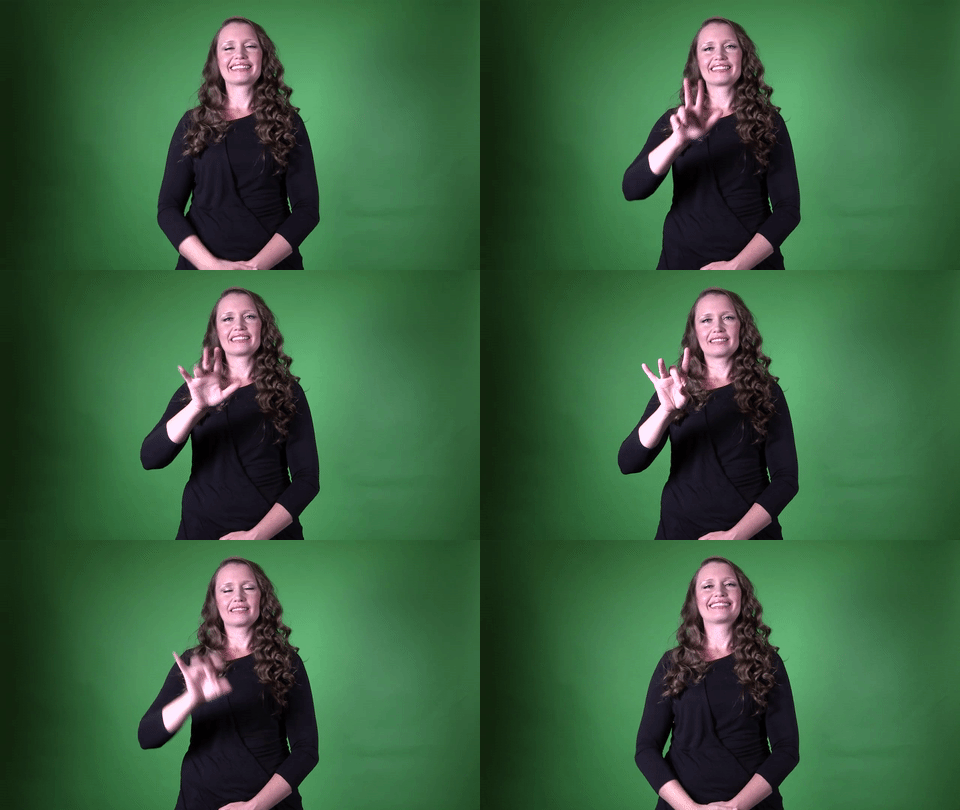
Definition: The number thirty-eight
Sign for THIRTY-EIGHT in ASL

Practice Activities:
Practicing the sign for thirty-eight in ASL begins with repetition. Start by signing thirty-eight slowly while looking in a mirror to ensure correct handshape transitions. Increase speed gradually until signing it feels natural and fluid.
Use number sequences to reinforce the sign. Count from thirty to forty, making sure to sign thirty-eight clearly. You can also challenge yourself by signing different numbers at random and including thirty-eight at various points to check recognition.
Practice using the sign for thirty-eight in ASL in real-world contexts. Try signing, “I have thirty-eight books,” or “The temperature is thirty-eight degrees today.” If possible, record yourself signing these sentences and check for accuracy.
Engage in storytelling that includes numbers to naturally incorporate the sign for thirty-eight in ASL. Create a short story about buying a gift for thirty-eight dollars or mention a person celebrating their thirty-eighth birthday. If working with a partner, take turns quizzing each other on number-related facts.
Play number-related games with a partner or study group. One person can fingerspell a number, and another signs the correct ASL number form. Include thirty-eight among other numbers to build familiarity. Another activity is playing a bingo-style game where participants sign and recognize different numbers, reinforcing their ability to accurately sign thirty-eight.
Challenge yourself by recognizing the sign for thirty-eight in ASL in natural conversations. Watch ASL videos and focus on when thirty-eight appears. Imitate the sign as soon as you recognize it to reinforce memory. Through consistent practice using visual, solo, and interactive techniques, you will develop strong retention of the sign for thirty-eight in ASL.
Cultural Context:
The sign for THIRTY-EIGHT in ASL is an essential part of number representation in American Sign Language. Numbers play a crucial role in daily communication, whether for counting, age, addresses, or measurements. Learning the sign for THIRTY-EIGHT in ASL helps improve fluency and understanding in conversations involving numbers.
In ASL, numbers follow specific patterns, making them easier to remember and sign quickly. The sign for THIRTY-EIGHT in ASL follows the logical structure of ASL numbering, ensuring smooth communication. Understanding how to form numbers correctly is important for clarity and avoiding misinterpretations.
Deaf culture places great importance on clear and precise number signs. The sign for THIRTY-EIGHT in ASL, like other numbers, helps maintain accuracy when sharing information. Whether discussing dates, prices, or statistics, knowing number signs is vital for effective ASL communication.
Numbers in ASL are often signed smoothly in sequence, especially when discussing large amounts or specific figures. The sign for THIRTY-EIGHT in ASL must be performed clearly to prevent confusion with similar numbers. Practicing the sign frequently ensures confidence when using it in real-life situations.
American Sign Language relies on handshapes and movement to convey meanings effectively. The sign for THIRTY-EIGHT in ASL incorporates distinct finger movements that differentiate it from other numbers. Mastering number signs enhances a signer’s ability to communicate efficiently and naturally.
Different variations of numbers exist depending on regional influences and signing styles. The sign for THIRTY-EIGHT in ASL remains consistent within most Deaf communities, ensuring widespread comprehension. Familiarity with standard ASL numbers makes interactions smoother in personal and professional settings.
Using ASL numbers correctly ensures that numerical information is conveyed accurately. The sign for THIRTY-EIGHT in ASL is commonly used when talking about age, money, or quantities. Learning this sign along with other number signs strengthens overall ASL proficiency.
Numbers also play a role in storytelling, games, and academic settings within the Deaf community. The sign for THIRTY-EIGHT in ASL is useful in many contexts, from casual conversations to formal discussions. Knowing how to sign numbers accurately enhances both expressive and receptive ASL skills.
Students learning ASL benefit from practicing numbers regularly as part of their vocabulary building. Mastering the sign for THIRTY-EIGHT in ASL makes number-related discussions easier and more fluid. Consistent use of ASL
Extended Definition:
The sign for thirty-eight in ASL is a combination of numerical handshapes that smoothly transition from one to the other. This number sign follows the pattern of other numbers in American Sign Language, making it easy to recognize. Since ASL is a visual language, proper hand positioning and movement are essential for clarity.
To produce the sign for thirty-eight in ASL, begin with the number three handshape, where the index and middle fingers extend while the thumb remains up. Quickly transition to the number eight handshape by bringing the thumb and middle finger together while folding in the other fingers. This movement should be fluid to maintain the natural flow of ASL number signs.
Numbers play a significant role in American Sign Language, whether for counting, giving addresses, or stating ages. The sign for thirty-eight in ASL is useful in everyday conversations, especially when discussing quantities, prices, or dates. Learning number signs improves overall ASL fluency and enhances communication with deaf and hard-of-hearing individuals.
ASL numbers up to 30 have unique signs, but beyond 30, the format follows a transitional pattern. The sign for thirty-eight in ASL follows this structure, where each digit is signed in sequence. Practicing these transitions helps with speed and accuracy.
Facial expressions and context help clarify number signs in ASL. When signing thirty-eight for a price, it may be accompanied by the dollar sign gesture. If it’s used for an age, it can appear within a phrase indicating someone’s years.
The sign for thirty-eight in ASL, like other number signs, should be performed at a comfortable speed. It’s important not to rush, as accuracy is vital for clear communication. Regular practice will improve both confidence and fluency in signing numbers.
ASL number signs are useful across different settings, from everyday conversations to academic and professional environments. The sign for thirty-eight in ASL may appear in phone numbers, addresses, and time-related discussions. Mastering number signs ensures smooth interactions with fluent signers.
Learning ASL numbers requires repetition and exposure through visual demonstrations. Watching videos or practicing with a fluent signer enhances the ability to perform the sign for thirty-eight in ASL accurately. Memorizing number sequences also strengthens overall ASL comprehension.
ASL is a dynamic language that relies on movement, space, and grammar distinct from English. Mastering the sign for thirty-eight in ASL supports broader language acquisition and improves numerical comprehension. Practicing frequently will reinforce muscle memory and signing confidence.
Number signs
Synonyms: thirty-eight, number thirty-eight, number 38, the number 38, the number thirty-eight
Educational resources: Find related learning materials in our course bank!
Want more? Check out some of our popular learning activities on the homepage!
Need to look up a sign? Use our highly rated dictionary: https://aslinteractive.com/best-asl-dictionary/
Follow us on tiktok: https://www.tiktok.com/@aslinteractive. More social media links at the bottom of this page!
Long-tail Keywords: what is the sign for thirty-eight in ASL, how do you sign thirty-eight in American Sign Language, learn how to sign thirty-eight in ASL
Categories: Numbers – Basics, Numbers 31-40, cardinal numbers
tags: Numbers 31-40, Numbers, Math, Educational, Language Learning
Parameters
*Handshape*:
The sign for THIRTY-EIGHT in ASL uses a dynamic handshape transition. Start with the number three handshape—thumb, index, and middle fingers extended, while ring and pinky fingers remain closed. Then, transition smoothly into the number eight handshape by folding the middle finger down to touch the thumb. This quick shift visually represents the number 38. The sign for THIRTY-EIGHT in ASL is performed with the palm facing outward, maintaining a fluid motion.
*Palm Orientation*:
For the sign for thirty-eight in ASL, begin with the palm facing outward in a comfortable position. The number three is formed with the index, middle, and thumb extended, while the other fingers remain folded. Then, transition to the number eight by bringing the thumb and middle finger together while the index finger and other fingers remain down. Throughout the sign for thirty-eight in ASL, maintain a steady palm orientation to ensure clarity.
*Location*:
The sign for thirty-eight in ASL is produced in the neutral space in front of the body, around chest level. The hand starts with the number three, with the index, middle, and thumb extended. Then it smoothly transitions to the number eight by bringing the thumb and middle finger together. This number sign remains in one location without large movement, keeping the palm facing outward throughout the transition.
*Movement*:
To produce the sign for thirty-eight in ASL, begin with the number three handshape, where the index, middle, and thumb are extended while the ring and pinky fingers are folded down. Transition smoothly into the number eight handshape by bringing the thumb and middle finger together while the index finger folds down. This movement happens in one fluid motion without pausing, maintaining a natural transition between numbers.
*Non-Manual Signals*:
When using the sign for thirty-eight in ASL, maintain a neutral facial expression unless emphasizing quantity or contrast. A slight furrow of the brow can indicate clarification or confirmation. If the sign for thirty-eight in ASL is used in a counting sequence, a rhythmic head nod can enhance the meaning. Maintain eye contact with the conversation partner while signing to ensure clarity. Keep mouth movements minimal unless emphasizing the number in context.
*Prosody, Dominant/Non-Dominant Hand*:
The sign for THIRTY-EIGHT in ASL is produced using the dominant hand. Start with the number “3” handshape—thumb, index, and middle fingers extended, while the ring and pinky fingers remain folded. Then smoothly transition to the number “8” by bending the middle finger to touch the thumb while the index finger folds down. The movement should be fluid and natural, maintaining a steady position in front of the signer.
Tips for Beginners:
When learning the sign for THIRTY-EIGHT in ASL, focus on smooth transitions between numbers. The sign for THIRTY-EIGHT in ASL is formed by signing “3” and then changing to “8.” Make sure to use your dominant hand and maintain a steady pace while transitioning to keep the sign clear and accurate.
A common mistake beginners make is moving too quickly or hesitating between the numbers. Practice by signing “3” confidently and then transitioning to “8” in a fluid motion. Keep your fingers properly positioned to avoid accidental misrepresentation of the numbers.
Hand orientation is important when signing numbers, so ensure your palm faces forward while forming the sign. If the palm faces the wrong direction, it can confuse viewers, especially those new to recognizing ASL numbers. Checking your hand position in a mirror can help reinforce proper orientation.
Another key tip is to keep your fingers relaxed but firm. If your fingers are too stiff, the transition may look awkward. If they are too loose, the shape of the numbers may become unclear. Finding the right balance will help ensure the sign for THIRTY-EIGHT in ASL is easily readable.
Consistency in finger movements is crucial for clarity. When signing multiple numbers in a row, such as in phone numbers or addresses, make sure each number is distinct without merging into the next. Practicing in front of a friend or recording yourself can help identify areas for improvement.
Lastly, remember that facial expressions and body language are part of communication in ASL. Though the sign for THIRTY-EIGHT in ASL does not require a specific facial expression, maintaining engagement and confidence while signing will contribute to overall fluency. Keep practicing regularly, and your sign language skills will strengthen over time!
Connections to Other topics:
The sign for thirty-eight in ASL is part of the numbering system, which is essential for expressing exact quantities, prices, and other numerical values. This sign fits into a pattern used for numbers in the thirties, which typically involve transitioning between specific handshapes. Learning this sign helps in recognizing the general approach ASL uses for shorthand number signs, reinforcing counting fluency.
Understanding the sign for thirty-eight in ASL makes it easier to express prices, ages, measurements, and addresses. Numbers in ASL follow consistent patterns, and mastering one range of numbers, like the thirties, lays the foundation for learning higher or related number combinations. This skill is particularly helpful in fast-paced conversations where efficiency in signing numbers matters.
The structure of the sign for thirty-eight in ASL is similar to other two-digit numbers, making it valuable for learning sequences. For example, thirty-seven and thirty-nine use the same number-initial structure, with only a slight modification for the second digit. Recognizing these patterns helps with broader mathematical concepts and numerical organization in ASL, allowing for smoother communication.
Numbers like thirty-eight can also be incorporated into time expressions, such as stating years or giving approximate counts. In ASL, time-related numbers often appear before the subject or context, reinforcing ASL’s topic-comment structure. This connection between numbers and time expressions strengthens overall ASL grammar comprehension.
Another connection involves classifiers, where numbers can be integrated into signs to show quantities of objects or people. By incorporating the sign for thirty-eight in ASL into classifiers, signers can describe groups of things visually in a way that aligns with ASL’s spatial nature. This helps in storytelling, describing statistics, and emphasizing numerical details in signed conversations.
Summary:
The sign for thirty-eight in ASL is a combination of two numerical handshapes presented in one fluid motion. It starts with the hand forming the number three by extending the index, middle, and thumb while the other two fingers remain closed. Then, the hand smoothly transitions into the number eight by curving the middle finger down to touch the thumb while the other fingers fold in.
This motion is executed with a distinct yet natural movement that ensures clarity when communicating numbers. The transition must be fluid, as choppy or disconnected movements may lead to misinterpretation. Maintaining the correct orientation—palm facing forward—is also important for optimal visual clarity.
Numbers in American Sign Language follow a structured system that ensures efficiency and accuracy. The sign for thirty-eight in ASL adheres to this pattern by incorporating the single-digit numeral transitions used for numbers in the thirties. This structure makes learning numerical signs predictable once the foundational patterns are mastered.
Cardinal numbers like thirty-eight serve an essential role in everyday conversation. Whether discussing age, money, time, or sets of objects, numerical signs occur frequently and must be executed distinctly. The sign for thirty-eight in ASL fits into the larger numerical system, reinforcing the importance of consistency in number presentation.
Variations in number signs exist depending on context and regional signing styles. While thirty-eight follows the standard transition between handshapes, minor differences may appear based on fluency, signing speed, or individual tendency. However, the core structure remains consistent to prevent confusion.
The efficiency of numerical signs in ASL reflects a linguistic economy that minimizes extraneous movements while maximizing clarity. The sign for thirty-eight in ASL is a prime example of this streamlined approach, smoothly integrating two digits within a single motion. This efficiency is particularly valuable in fast-paced conversations or when conveying detailed numerical data.
Counting and numerical accuracy are essential in various areas of life, from financial transactions to giving directions. The clarity of numerical signs such as the sign for thirty-eight in ASL ensures accuracy in these crucial exchanges. Misrepresentation of numbers can lead to errors, so precision is vital.
The cognitive process of signing numbers engages different areas of the brain compared to spoken numerals. The visual-spatial aspects of ASL contribute to a strong sense of numerical representation through hand configurations. The sign for thirty-eight in ASL aids in reinforcing these mental connections through repeated use.
When teaching numerical signs to new learners, muscle memory plays a crucial role. Practicing number transitions like the sign for thirty-eight in ASL helps solidify handshape recall and fluency. Regular repetition builds confidence and improves speed in numerical communication.
The numerical system in ASL aligns with patterns found in other signed languages. Many sign languages incorporate similar shifts between digits when forming compound numbers. The sign for thirty-eight in ASL exemplifies this pattern and fits into the broader linguistic framework of signed numerical systems.
Culturally, numbers hold significant meaning in various contexts. The number thirty-eight may appear in references to historical events, statistics, or cultural milestones. Understanding numerical signs like the sign for thirty-eight in ASL allows signers to engage with these topics fluently.
Interpreters frequently encounter numerical data when translating spoken language into ASL. The ability to rapidly and accurately sign numbers like thirty-eight is essential for conveying precise information. Mastering numerical fluency is a crucial skill for professional ASL interpreters.
Numbers appear in many fixed expressions, such as addresses, calendar dates, and measurements. The sign for thirty-eight in ASL is part of this broader system, making it indispensable in daily communication. Signing numbers correctly ensures clarity in these structured contexts.
In mathematical discussions, numerical precision is non-negotiable. The use of number signs like thirty-eight allows for accurate representation of figures in classroom settings or technical explanations. Mathematics and ASL are deeply connected through their reliance on structured visual representations.
The recognition of specific number signs in ASL involves a combination of finger dexterity and perceptual skills. The sign for thirty-eight in ASL requires the ability to distinguish similar numerical signs quickly. This distinction is critical in settings such as interpreting test scores or statistics.
When numbers appear within storytelling, rhythm and pacing play a role in their presentation. The sign for thirty-eight in ASL may be delivered with emphasis or varied speed depending on the narrative context. This adaptability showcases the expressiveness of ASL even within numerical discourse.
Technology has made learning ASL numbers more accessible through online tutorials and digital resources. Interactive videos demonstrate fluid number transitions, reinforcing handshape memory. The sign for thirty-eight in ASL can be practiced using these educational tools for enhanced skill development.
Standardization of number signs ensures consistency across different ASL users. While regional variations exist, widely accepted forms like the sign for thirty-eight in ASL maintain uniformity within the wider signing community. This consistency aids in mutual understanding across various signing environments.
Linguistic studies
Want more? Check out some of our popular learning activities!
ASL Interactive Resources
ASLInteractive YouTube Channel
Follow us on tiktok: @aslinteractive.com
Follow us on Instagram: aslinteractive
Facebook page: aslinteractive
Facebook group: aslinteractive
LInkedIn: ASL Interactive LLC
Twitter: @ASL_interactive
*Some information on this page is AI-generated. AI can make mistakes. Please check the information.


Responses