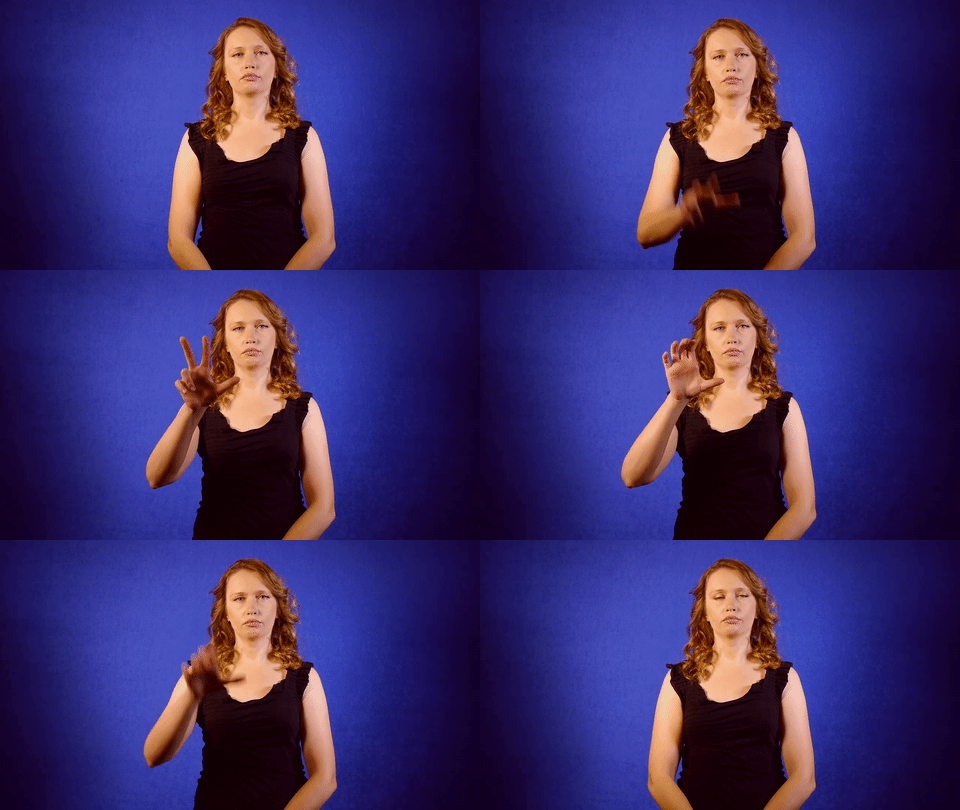
Sign for THREE HUNDRED in ASL | Master the #1 Way to Sign THREE HUNDRED in ASL | Easy & Accurate Tutorial

Definition: The number three hundred

Sign for THREE HUNDRED in ASL

YouTube player

Practice Activities:

Practice Activities:

To practice the sign for THREE HUNDRED in ASL, start by breaking it into smaller components. Begin with the number “Three” by shaping your dominant hand into the ASL handshape for the number 3 (thumb, index, and middle fingers extended, all other fingers closed). Then, transition to the concept of “hundred” by smoothly moving the same hand forming a “C” shape near your chest to symbolize the numeral. Practice transitioning between these elements until it feels fluid.

Use repetition exercises to refine your movements. Stand in front of a mirror and sign the sign for THREE HUNDRED in ASL ten times, focusing on handshape accuracy and smooth transitions. Once you feel confident, sign it in varied speeds, emphasizing clarity when signing slowly and fluidity when signing quickly.

Try incorporating the sign for THREE HUNDRED in ASL into simple sentences for context. For example, practice identifying three hundred of something: “I have three hundred coins,” “There are three hundred apples in the crate,” or “Three hundred people went to the park.” Record yourself signing these sentences and review to spot areas for improvement.

Engage in storytelling prompts that involve the sign for THREE HUNDRED in ASL. Narrate a scenario where exact amounts of three hundred are central, like “Imagine you’re a teacher handing out three hundred pencils to students” or “Pretend you’re organizing a charity event for three hundred attendees.” These activities encourage natural contextual usage.

For a partner activity, work with a friend to practice recognition and repetition. One person signs the sign for THREE HUNDRED in ASL” in a sentence, and the other responds accurately. Alternate roles and increase the challenge by introducing related numbers like “Two hundred” or “Five hundred” to reinforce the numeric concept.

Finally, test your conversational skills by discussing hypothetical situations involving the sign for THREE HUNDRED in ASL. For example, ask your partner, “What would you do with three hundred dollars?” and sign your responses entirely in ASL.

Cultural Context:

The sign for THREE HUNDRED in ASL is expressed using a combination of numerical handshapes and ASL number incorporation rules. Understanding how to sign “three hundred in ASL” requires familiarity with ASL grammatical structures and cultural context around numbers. ASL numbers emphasize clarity and fluidity, which ensures the concept is understood despite linguistic differences from English.

When signing the sign for THREE HUNDRED in ASL, the signer begins by forming the “three” handshape, where the thumb, index, and middle fingers are extended while the ring finger and pinky are closed. Then, the palm orientation and signing space are used to incorporate the value of “hundred.” Typically, this involves transitioning from the “three” handshape into a smooth arc or a modified bending motion to represent “hundred.” This gesture is culturally significant in ASL, as it maintains the visual and spatial language characteristics essential for effective communication.

For Deaf individuals and the ASL community, numbers are more than just mathematical representations. Signing the sign for THREE HUNDRED in ASL involves not just the gesture but also adopting the grammar and spatial nuances that give ASL its rich identity. It showcases how ASL users blend numerical concepts with visual storytelling elements. When practicing the sign for THREE HUNDRED in ASL, signers should remember to keep their movements clear and deliberate to avoid confusion with other numbers. For example, clarity in handshape orientation distinguishes “three hundred” from similar numerical expressions like “thirty” or “thirteen.”

Another cultural note about the sign for THREE HUNDRED in ASL, is its practical application in daily communication. Whether it’s discussing money, years, or quantities, numbers like “three hundred” play a pivotal role in conveying precise information in ASL. Native ASL users expect this precision, as the Deaf community heavily relies on detailed non-verbal communication methods. Signing “three hundred in ASL” correctly reflects respect for the language and the culture it represents.

When learning or teaching the sign for THREE HUNDRED in ASL, repetition and practice are key. Watching videos or engaging with native signers can help solidify the subtle movements required for accuracy. By mastering “three hundred in ASL,” learners not only enhance their signing skills but also deepen their understanding of ASL’s cultural and linguistic depth. Empowering accurate signs like “three hundred in ASL” strengthens connections within and beyond the ASL community.

Extended Definition:

The sign for THREE HUNDRED in ASL

The sign for THREE HUNDRED in ASL refers to the American Sign Language interpretation of the number 300. ASL uses a combination of number handshapes and unique movements to represent numbers, including larger figures such as hundreds, thousands, and beyond. Learning how to sign the sign for THREE HUNDRED in ASL is essential for expressing numbers clearly in conversations, whether in academic, financial, or casual contexts.

To sign the sign for THREE HUNDRED in ASL begin by forming the number “3” handshape with your dominant hand. Extend your thumb, index finger, and middle finger upwards while keeping your ring and pinky fingers bent into the palm. The “3” handshape represents the leading digit of the number.

Next, transition into the “C” handshape to represent the hundreds place. In ASL, this part of the sign visually indicates the concept of “hundred.” Form the “C” handshape by curling your fingers into a semi-circle while keeping your thumb and fingers apart. The motion for the sign for THREE HUNDRED in ASL combines seamlessly, moving smoothly from the “3” handshape to the “C” handshape in one fluid gesture.

When signing the sign for THREE HUNDRED in ASL, ensure the motion is clear and deliberate. Slight pauses or unclear transitions between the “3” and “C” can make the number difficult to interpret. Practicing this motion will help refine your accuracy and fluency when signing numbers above 100. Signing speed and clarity are crucial components when effectively conveying numbers like “three hundred” in conversations.

Context is important when using the sign for THREE HUNDRED in ASL. Numbers can appear in various scenarios, such as discussing money, scores, quantities, or measurements. For example, you might use “three hundred” to talk about $300, three hundred people in an audience, or a measurement like 300 miles. Using proper facial expressions and signing pace will help add clarity and meaning, ensuring the number “three hundred” is understood appropriately in context.

For beginners, it’s helpful to practice signing “three hundred” along with other three-digit numbers to build confidence and familiarity with the handshape transitions. Additionally, watching videos or practicing with native ASL users can improve your comprehension and expression of numbers in ASL. Remember, consistency is key when learning numbers, including the sign for THREE HUNDRED in ASL.

By mastering the handshapes and movements for the sign for THREE HUNDRED in ASL you’ll enhance your ability to communicate.

Synonyms: three hundred, 300, 3 hundred

Educational resources: Find related learning materials in our course bank!

Want more? Check out some of our popular learning activities on the homepage!

Need to look up a sign? Use our highly rated dictionary: https://aslinteractive.com/best-asl-dictionary/

Follow us on tiktok: https://www.tiktok.com/@aslinteractive. More social media links at the bottom of this page!

Long-tail Keywords: what is the sign for three hundred in ASL, how do you sign three hundred in ASL, learn the ASL sign for three hundred

Categories: Numbers – Basics, hundreds, cardinal numbers

tags: Numbers, Counting, Mathematics, Educational, Language Learning

Parameters

*Handshape*:

The sign for the sign for THREE HUNDRED in ASL begins with the dominant hand forming the number 3 handshape, where the thumb, index, and middle fingers are extended while the ring and pinky fingers are closed. Then, the hand transitions to a C-shape to represent the number hundred. The movement is fluid, typically arcing slightly downward as it changes shape, clearly signifying “Three hundred in ASL” through this distinct sequence.

*Palm Orientation*:

The palm orientation for the sign for THREE HUNDRED in ASL begins with the palm facing outward when forming the number three. Transitioning to the representation of the number hundred, the palm shifts to face inward or slightly down toward the signer in a gentle arc movement. This orientation emphasizes fluidity while maintaining clarity for the sign three hundred in ASL, ensuring effective communication.

*Location*:

The location for the sign for THREE HUNDRED in ASL begins with the dominant hand showing the number “3” in the space slightly in front of the chest or upper torso. The hand then transitions into a circular motion or quickly closes into the sign for “C” to represent “hundred.” The gesture occurs within a neutral signing area. The overall movement remains compact and comfortably within the chest-height range for clarity and precision when signing three hundred in ASL.

*Movement*:

To sign the sign for THREE HUNDRED in ASL, begin by holding up your dominant hand, palm facing outward, and display the number “3” with the thumb, index, and middle fingers extended while the remaining fingers are tucked. Transition smoothly to the sign for “hundred” by forming the letter “C” handshape and moving it forward slightly, curving it inward while maintaining smoothness. This combination conveys the sign for THREE HUNDRED in ASL clearly and concisely.

*Non-Manual Signals*:

To sign the sign for THREE HUNDRED in ASL, use relaxed facial expressions, ensuring the brows are neutral, as this is a straightforward numerical concept. Slightly press the lips together or maintain a subtle closed-mouth position to emphasize the numerical nature. Maintain steady eye contact with the listener and a calm head posture to ensure clarity. Avoid rapid head movement or exaggerated emotional expressions while signing the sign for THREE HUNDRED in ASL to keep the focus on numbers.

*Prosody, Dominant/Non-Dominant Hand*:

The dominant hand forms the number 3 handshape (index, middle, and thumb extended, other fingers folded) to represent “three.” The palm is generally outward-facing near shoulder height. For “hundred,” the dominant hand transitions into a bent-C handshape, moving slightly backward and downward. The non-dominant hand stays neutral. This sign for THREE HUNDRED in ASL relies on fluid motion between number representation and the bent-C to indicate the numerical concept.

Tips for Beginners:

To sign the sign for THREE HUNDRED in ASL, you will combine the sign for the number 3 and a movement signaling the hundred component. Begin by holding up your dominant hand with the number 3 (index, middle finger, and thumb extended, while the ring finger and pinky remain closed). This accurately represents the number three. Then, transition into the sign for hundred by forming a handshape resembling the letter “C” or a bent “B” hand, moving it slightly forward and down. Pay attention to the flow of the movement to keep the transition smooth and natural. This combination clearly expresses the sign for THREE HUNDRED in ASL.

**Tips for Beginners:**
When signing the sign for THREE HUNDRED in ASL, ensure that your initial “3” handshape is clear and prominent. Double-check that your fingers are fully extended, with no additional fingers accidentally raised. For the sign’s second part, transitioning to the compact or bent “C” shape, practice bending your hand without losing its clarity. A common beginner mistake is rushing the transition, which can make the sign harder to understand, so slow down your movements as you get comfortable.

Another key aspect is smooth transitions between the two components of the sign. Practice in front of a mirror to visualize the flow and ensure a seamless transition between the handshapes. Maintain consistent hand positioning and avoid unnecessary pauses or jittery movements. This will enhance the clarity and accuracy of the sign.

Facial expressions and body language are foundational to ASL. Although signing “Three hundred” may seem purely numerical, keeping a neutral but attentive facial expression can help convey your confidence and precision.

Lastly, practice signing the sign for THREE HUNDRED in ASL within numeric sequences. For example, count by hundreds (100, 200, 300, etc.) or use real-world examples, such as mentioning “three hundred dollars.” This repetition can enhance muscle memory and familiarity with the sequence, making your overall signing more natural and clear.

Connections to Other topics:

The concept of the sign for THREE HUNDRED in ASL integrates numerical foundation and patterns of counting often used in American Sign Language. The sign combines the gesture for “3” with a movement or modification to represent “hundred,” revealing ASL’s emphasis on natural efficiency and grouped concepts. It relates to other numerical systems in ASL, such as representations of “hundreds,” “thousands,” and “millions,” where handshapes transition smoothly to convey magnitudes. This structure connects the sign for THREE HUNDRED in ASL to broader topics like measurements, money terminology, and numerical sequences.

In conversation, the sign for THREE HUNDRED in ASL often partners with signs denoting categories like “Three hundred dollars,” “Three hundred people,” or “Three hundred miles.” These compound usages highlight how context shapes numerical expressions. For example, the sign might integrate with classifiers, like combining “Three hundred” with a specific handshape to indicate “Three hundred cars” or “Three hundred houses.” This flexibility allows users to describe quantities across different contexts with efficiency and clarity.


The sign for THREE HUNDRED in ASL also shares the numerical base with concepts such as “Three,” helping learners build intuitive connections between small integers and larger aggregates like “Hundreds” or “Thousands.” In educational contexts, it serves as a key stepping stone for introducing numerical progression and mathematical operations in ASL, such as addition (“Three hundred plus fifty”) or subtraction.

The sign’s movement and visual structure also tie to temporal expressions, like saying “Three hundred days” or “Three hundred years ago,” which applies numerical precision to time concepts. Furthermore, it intersects with culturally significant markers like storytelling, where numbers like “Three hundred” might symbolize exaggeration or scale. For instance, in recounting events or quantity-based narratives, the sign for THREE HUNDRED in ASL can add depth to storytelling practices while supporting the linguistic expression of large numerical values in everyday communication.

Summary:

The sign for THREE HUNDRED in ASL is a combination of numerical concepts and a smooth, fluid representation of numbers that reflects the efficiency and elegance of American Sign Language. To sign “Three hundred in ASL,” you begin by signing the number “3” using your dominant hand. The number “3” is made by holding up the thumb, index finger, and middle finger, while keeping the ring finger and pinky tucked down toward the palm. Once “3” is formed, you transition into signing “hundred.” In ASL, “hundred” is typically conveyed by bending the dominant hand slightly at the knuckles to form a C-shape or claw-like movement, indicating a grouping or larger quantity.

This sign operates in two distinct but connected parts that align seamlessly. The initial component, the “3,” is a straightforward representation — visually clear and instantly recognizable by its configuration. The second part of the sign, “hundred,” is more abstract but deeply rooted in ASL’s grammatical structure and cultural norms.

By combining these two elements without interrupting the flow, you create a cohesive and effective representation of the sign for THREE HUNDRED in ASL The transition between “3” and “hundred” is critical; it is typically performed with fluidity to avoid awkward breaks or hesitation. Many native ASL users will emphasize rhythm and smooth transitions in numeric concepts as a hallmark of proficiency.

The representation of the sign for THREE HUNDRED in ASL reflects more than just a numerical value. It embodies ASL’s spatial and iconic nature, where numbers and abstract quantities are mapped visually and sometimes metaphorically. For instance, since “hundred” is depicted by folding the hand into a smaller shape (the claw-like “C” configuration), it metaphorically reduces the abstract concept of “hundreds” into a compact visual image, illustrating the grouping and structure of numerals in a visually intuitive way. This combination of metaphor and visual clarity highlights the sophistication of ASL as a linguistic system.

Understanding how the sign for THREE HUNDRED in ASL interacts with ASL grammar sheds further light on its importance. In conversational ASL, numbers, particularly larger ones, often function within broader sign clusters or phrases. For example, the sign for THREE HUNDRED in ASL might frequently appear in contexts such as measurements, monetary amounts, or quantities. Depending on its context, the sign may be modified slightly to reflect regional accents or dialectical variations, as ASL is not a monolithic language but one composed of vibrant

Want more? Check out some of our popular learning activities!

ASL Interactive Resources

ASLInteractive YouTube Channel

Follow us on tiktok: @aslinteractive.com

Follow us on Instagram: aslinteractive

Facebook page: aslinteractive

Facebook group: aslinteractive

LInkedIn: ASL Interactive LLC

Twitter: @ASL_interactive

*Some information on this page is AI-generated. AI can make mistakes. Please check the information.

sign for number 300 in ASL, sign for 300 in ASL, Sign for Number THREE HUNDRED in ASL, Sign for the number THREE HUNDRED in ASL, Sign for the number 300 in ASL, Sign for THREE HUNDRED in ASL

Responses