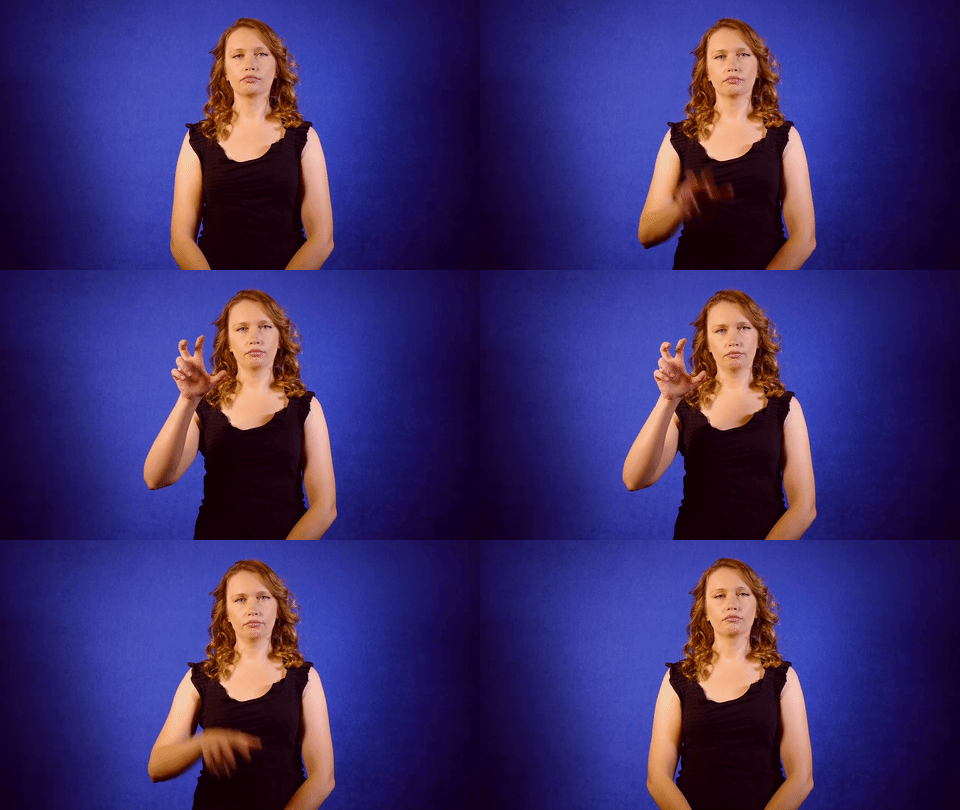
Definition: The number three hundred (v2)
Sign for THREE HUNDRED v2 in ASL

Practice Activities:
Practice recognizing and producing the sign for THREE HUNDRED v2 in ASL by focusing on handshape, movement, and context. First, isolate the sign to ensure proper articulation. Curl your dominant hand into the number three (thumb, index, and middle fingers extended, while the ring and pinky fingers stay closed). Transition smoothly by closing the index and middle fingers into an “O” handshape to represent 100. Practice this movement slowly at first, ensuring clarity between the two parts of the sign for THREE HUNDRED v2 in ASL. Repeat in front of a mirror for self-correction.
To build retention, fingerspell “THREE HUNDRED” in conjunction with signing it. Alternate between signing and fingerspelling so you solidify both methods of communication. Once confident in isolation, integrate the sign for THREE HUNDRED v2 in ASL into example sentences. Sign sentences like, “There are three hundred people at the event,” or, “I saved three hundred dollars this month.” Practice both signing sentences as a whole and breaking them into smaller chunks, ensuring each sign is correct.
As a storytelling prompt, create a short scenario where the sign for THREE HUNDRED v2 in ASL is naturally used. For example, imagine you are explaining to a friend how much something costs or the size of a crowd. Narrate and sign the entire story, incorporating the sign for THREE HUNDRED v2 in ASL in context.
For partner activities, work with someone to create a quiz game. One person fingerspells or gives a number in spoken English, and the other has to sign the sign for THREE HUNDRED v2 in ASL Reverse roles for additional practice. Additionally, engage in a counting exercise aloud with your partner, occasionally inserting the sign for THREE HUNDRED v2 in ASL, and other numbers to build fluency. Expand by signing responses to questions like, “How many books are on the shelf?” Keeping the number visible reinforces accuracy within various contexts.
Cultural Context:
The sign for THREE HUNDRED v2 in ASL is an essential term to know for both beginners and advanced learners in American Sign Language. Understanding how to express numbers like “three hundred” in ASL not only helps you build stronger numeric vocabulary but also plays a vital role in daily communication. Numbers in ASL follow specific grammatical rules, and the sign for THREE HUNDRED v2 in ASL is no exception.
When signing the sign for THREE HUNDRED v2 in ASL, the movement and handshape are critical to conveying the correct numerical concept. In ASL, numbers like “three hundred” follow the rule of combining the sign for “three” with a specific motion to indicate “hundred.” This makes the concept of “three hundred in ASL” intuitive for those fluent in the language, though it requires practice for learners to master fluency. The key is precision in the handshape and placement, as small variations may create confusion or result in signing entirely different numbers.
Culturally, using the sign for THREE HUNDRED v2 in ASL and other large numbers correctly reflects respect and competence in Deaf communication. Signers often use numbers like “three hundred in ASL” within everyday conversations involving age, money, time, quantities, and measurements. Whether you’re discussing $300, the age of a historical landmark, or any other context requiring the sign for THREE HUNDRED v2 in ASL, accurate signing is essential for clarity.
Additionally, mastering the sign for THREE HUNDRED v2 in ASL is crucial when engaging in academic or workplace settings within the Deaf community. For example, situations involving accounting, inventory counting, or statistical reporting often require using numbers like “three hundred in ASL” with precision. This doesn’t just demonstrate effective communication but also builds rapport and trust with native ASL users.
The historical evolution of number signs, including the sign for THREE HUNDRED v2 in ASL, highlights the fluid nature of ASL as a living language. While modern signs for numbers like “three hundred” are more streamlined, they maintain strong continuity with the language’s roots. As you practice, be mindful that signs such as “three hundred in ASL” may slightly vary regionally, so always consider the cultural and situational context.
Learning how to sign the sign for THREE HUNDRED v2 in ASL perfectly represents both linguistic skill and a deeper cultural connection with the Deaf community. It’s more than a number—it’s a gateway to effective communication in countless scenarios.
Extended Definition:
The sign for THREE HUNDRED v2 in ASL refers to the representation of the number 300 using American Sign Language (ASL). ASL is a visual language used by Deaf and hard-of-hearing individuals, as well as those who communicate with them. Numbers, including three hundred, are signed using specific handshapes and movements that convey their meaning visually.
To sign the sign for THREE HUNDRED v2 in ASL, you combine the signs for “3” and “hundred.” Start by forming the number 3 with your dominant hand. This handshape is created by raising your thumb, index finger, and middle finger, while tucking in your ring and pinky fingers. After signing “3,” transition into “claw-3” for “hundred.” To do this, you typically form a “Claw-3” handshape or use a bent hand to indicate the rounding motion often associated with the concept of a hundred in ASL.
When signing the sign for THREE HUNDRED v2 in ASL, it is essential to maintain smooth transitions between the signs to ensure clarity. For example, after forming the “3,” avoid dropping your hand abruptly or disconnecting the motion before transitioning into the “hundred” sign. A fluid movement makes the sign visually coherent to your audience.
Facial expression and body posture can also play a role in signing numbers effectively. While you might not need exaggerated expressions for a simple number like 300, ensuring your movements are deliberate and clear is key to accurate communication. Context matters, too—you might use a number like three hundred in ASL during conversations about prices, sports scores, or distances, or within mathematics lessons.
One thing to note when signing the sign for THREE HUNDRED v2 in ASL is regional variation. Just as spoken languages have accents and dialects, ASL can vary slightly depending on where it is taught or used. Some signers may have unique methods for indicating numbers like 300, but the basic combination of “3” and “hundred” is generally understood across most ASL users.
Understanding numbers in ASL, including three hundred, is a fundamental part of learning the language. Numbers are used in many everyday situations, from telling time to discussing amounts. Practice is important to ensure you are signing numbers clearly and accurately. Watching videos, working with fluent signers, or using a mirror to practice can help build confidence when learning numbers.
If you’re new to ASL and learning numbers like three hundred, break down the steps one at a time. First, master the individual numbers 1-9
Synonyms: three hundred, 300, 3 hundred
Educational resources: Find related learning materials in our course bank!
Want more? Check out some of our popular learning activities on the homepage!
Need to look up a sign? Use our highly rated dictionary: https://aslinteractive.com/best-asl-dictionary/
Follow us on tiktok: https://www.tiktok.com/@aslinteractive. More social media links at the bottom of this page!
Long-tail Keywords: what is the sign for three hundred in ASL, how do you sign three hundred in ASL, ASL sign for three hundred
Categories: Numbers – Basics, hundreds, cardinal numbers
tags: Numbers, Counting, Mathematics, Educational, Language Learning
Parameters
*Handshape*:
The sign for THREE HUNDRED v2 in ASL uses a combination handshape. Begin with the number “3” handshape, where the thumb, index, and middle fingers are extended, and the ring and pinky fingers are closed. Transition smoothly into the “Claw-3” handshape, with all fingers curved to form the shape of the letter C. This fluid motion emphasizes the numerical and conceptual value of the sign for THREE HUNDRED v2 in ASL while maintaining clarity.
*Palm Orientation*:
The palm orientation for the sign for THREE HUNDRED v2 in ASL begins with the palm facing out as the number three is signed, with the thumb, index, and middle fingers extended. Then, the hand transitions smoothly into the sign for “hundred,” where the fingers curl into a modified “Claw-3” shape, with the palm maintaining outward from the signer. The transition emphasizes a fluid movement, and directionality remains consistent for clarity.
*Location*:
The sign for THREE HUNDRED v2 in ASL starts in the neutral space in front of the chest. The dominant hand forms the number “3” with the thumb, index, and middle fingers extended. Transition smoothly as the fingers close into the number “Claw-3” handshape to represent “hundred.” Ensure the motion arcs slightly downward. The sign is performed with a natural, deliberate movement to convey “Three hundred.”
*Movement*:
The sign for THREE HUNDRED v2 in ASL starts with your dominant hand forming the number “3,” with the thumb, index, and middle fingers extended. Then, smoothly transition into a “Claw-3” handshape to represent the “hundred.” The motion flows from the “3” close to your chest or neutral signing space to a “Claw-3” in one fluid movement. Ensure clarity in both positions to emphasize the sign for THREE HUNDRED v2 in ASL accurately and effectively.
*Non-Manual Signals*:
Eyebrows remain neutral, indicating a declarative statement, or may slightly raise at the beginning of the sign for THREE HUNDRED v2 in ASL to mark emphasis or clarity. The lips may form the word “three hundred” subtly, though not exaggerated. Head position is steady, slightly tilted forward for direct engagement. Eyes focus on the conversational partner for clear communication while signing the sign for THREE HUNDRED v2 in ASL. Maintain a firm but relaxed facial expression for natural flow.
*Prosody, Dominant/Non-Dominant Hand*:
The dominant hand forms the number “3” (index, middle, and thumb extended), while the non-dominant hand is not used. Begin with the dominant hand held upright at chest level. Then transition to the number “Claw-3” shape (fingers curved, resembling the letter “C”) to represent “hundred.” The movement is fluid with a slight arc. This motion emphasizes clarity while effectively signing the sign for THREE HUNDRED v2 in ASL. The non-dominant hand remains still and unengaged.
Tips for Beginners:
To sign the sign for THREE HUNDRED v2 in ASL, begin with the dominant hand forming the number 3, with the thumb, index, and middle fingers extended, while the ring and pinky fingers remain closed. Hold the palm outward at chest level. Next, transition smoothly by bending in the thumb, index finger, and middle fingrs at the first joint to create the “Claw-3” shape for the representation of “hundred.” The palm orientation changes slightly inward as you move the hand forward in a slight arc. This transition is fluid and emphasizes the numerical sequence.
**Tips for Beginners:**
When signing the sign for THREE HUNDRED v2 in ASL, focus first on mastering the number 3. Ensure the thumb, index, and middle fingers are fully extended and clearly separated. Avoid letting the fingers touch each other, as this can confuse the sign for other numbers. Additionally, do not tense the ring and pinky fingers; relaxed fingers will allow for a natural and clean handshape.
When transitioning to the “hundred” gesture, work on the movement arc. Beginners often struggle with making this shift smooth enough; practice the transition until the motion feels fluid and not jerky. A common mistake occurs if the “Claw-3” shape is held too rigidly or the palm remains entirely outward instead of slightly inward. Keep finger positioning consistent to avoid misinterpretation.
In context, pair the sign for THREE HUNDRED v2 in ASL with facial expressions that match the flow of the conversation. For example, expressing emphasis during a transaction or discussing quantities can make the sign more impactful. Don’t rush through the formation of the number; clarity is more important than speed.
Practice in front of a mirror to see your own palm orientation during the sign. This can correct subtle inaccuracies. When signing for others, maintain eye contact to ensure clarity and uphold the visual nature of communication in ASL. Repetition and real-life usage will help solidify the proper formation of the sign for THREE HUNDRED v2 in ASL.
Connections to Other topics:
The sign for THREE HUNDRED v2 in ASL is part of ASL’s numerical system, a system that adeptly visualizes quantities and integrates them into natural communication. The formation of this sign directly connects to foundational ASL number conventions, such as the signs for “three” and “hundred.” Understanding its structure also reinforces comprehension of larger numbers, which are often created through combinations of smaller signed components. For instance, signing the sign for THREE HUNDRED v2 in ASLinvolves a specific palm orientation and movement that distinguishes it from related numbers like “three” or “thirty.”
This sign provides a bridge to concepts such as monetary transactions, measurements, or collective quantities. For example, you could integrate “Three hundred (v2) in ASL” into sentences like “I have three hundred dollars” or “The book costs three hundred pages.” These fluid applications demonstrate how numbers in ASL, when paired with context-specific vocabulary, create vivid and precise meanings.
The sign also relates to expressions of time and dates. For example, the sign for THREE HUNDRED v2 in ASL could be used when discussing a span of 300 years in historical contexts or estimating durations, as in “It is three hundred miles away.” Additionally, this numerical sign shares properties with other numbers ending in “hundreds,” enabling learners to apply a similar articulation pattern to sign terms like “Two hundred” or “Four hundred.”
Compound signs can also incorporate the sign for THREE HUNDRED v2 in ASL, especially when describing specific events or objects. For instance, “Three hundred students” combines this number with the sign for “students.” Recognizing the precision and versatility of such signs showcases how numbers elevate ASL communication by bridging daily interactions with conceptual language. As learners focus on this sign, they also strengthen their mental map of numerical sequencing, aiding in more complex mathematical or statistical discussions in ASL.
Summary:
The sign for THREE HUNDRED v2 in ASL is an intriguing and effective combination of numerical representation and broader language mechanics within American Sign Language. The sign typically focuses on articulating the number “three” before transitioning directly into the representation of “hundred.” This version of the sign allows for a seamless and efficient expression of the numeral, adhering to ASL’s unique grammatical structure, which is often compact, spatially oriented, and deeply tied to visual modality. By analyzing the sign for THREE HUNDRED v2 in ASL, we can dive into its grammatical components, cultural relevance, linguistic features, and its place in the broader context of ASL numeracy.
In the sign for THREE HUNDRED v2 in ASL, the sign starts by visually representing the number three. This is typically achieved by extending three fingers — the thumb, index finger, and middle finger — while the ring finger and pinky remain tucked into the palm. This handshape reflects standard protocol for the number three in ASL, which is distinct from how numbers may be represented in other sign languages globally.
What makes this version unique is the way “hundred” is then indicated. Instead of fingerspelling or employing an additive strategy (e.g., signing three followed by a repetitive “hundred”), this version often utilizes a single fluid motion that conveys both concepts as one consolidated unit.
For the representation of “hundred” specifically, the handshape often transitions into a “CLAW-3” or a downward scoop motion, with the handshape moving slightly backward toward the signer. This motion parallels the “hundred” sign often seen in ASL, but when coupled with “three,” this becomes an efficient way to condense numerical concepts into a single unified sign. Linguistically, this approach illustrates ASL’s strength in economizing information without loss of clarity—a fundamental aspect of signed languages’ modality and its one-to-many correspondence compared to spoken languages.
The cultural significance of the sign for THREE HUNDRED v2 in ASL cannot be overstated. Numeracy plays a critical role in everyday communication, whether for financial transactions, time-telling, or counting specific quantities. In Deaf culture, numeracy signs are often designed to optimize clarity and accessibility, a reflection of ASL’s roots as a language designed and maintained within the Deaf community. The specific grammar and flow of the sign for THREE HUNDRED v2 in ASL reflect a broader cultural value of visual efficiency, wherein the expressive clarity of the sign ensures
Want more? Check out some of our popular learning activities!
ASL Interactive Resources
ASLInteractive YouTube Channel
Follow us on tiktok: @aslinteractive.com
Follow us on Instagram: aslinteractive
Facebook page: aslinteractive
Facebook group: aslinteractive
LInkedIn: ASL Interactive LLC
Twitter: @ASL_interactive
*Some information on this page is AI-generated. AI can make mistakes. Please check the information.


Responses