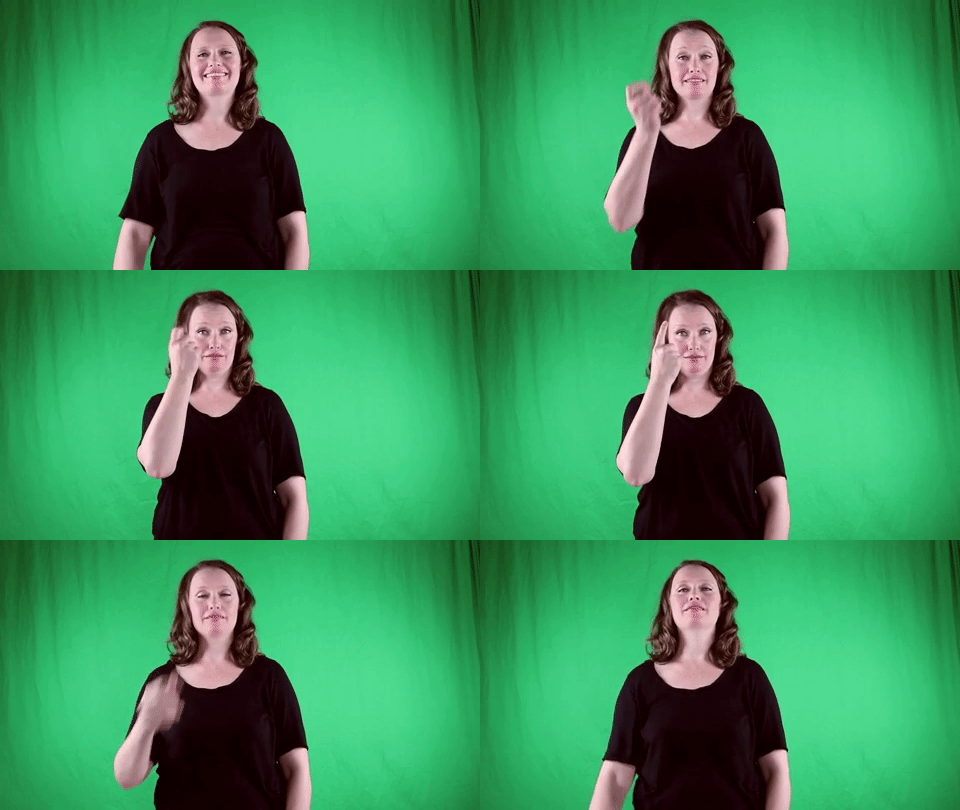
Sign for UNDERSTAND in ASL | ASL Dictionary

Definition: To grasp the meaning, significance, or nature of something. Sign for UNDERSTAND in ASL
YouTube player

Practice Activities

Practicing the sign for UNDERSTAND in ASL takes more than just memorizing hand movements—it’s about building fluency through consistent, thoughtful repetition. One of the most effective ways to begin is mirror work. Stand in front of a mirror and watch yourself sign. Focus on your facial expressions and handshape, especially how the dominant hand forms the flicking motion near the forehead. This helps to ensure your body language matches the meaning behind the sign for UNDERSTAND in ASL. Another useful method is recorded signing. Use your phone or webcam to record yourself signing short phrases or sentences that include the sign for UNDERSTAND in ASL. Review your recordings to catch any inconsistencies or unclear motions. You can also compare your signing to videos from skilled Deaf signers to refine your delivery. Contextual practice is vital. Try incorporating the sign for UNDERSTAND in ASL into real-life scenarios. For instance, sign it when answering comprehension questions or during conversations with peers. If you’re learning in a classroom or group setting, turn simple practice drills into role-playing games that use the sign in natural interactions. Advanced learners can challenge themselves with speed drills. Practice signing full sentences that include the sign for UNDERSTAND in ASL while increasing your signing speed without sacrificing clarity. Also, try swapping between related concepts like THINK, KNOW, and FORGET to build quick recall and fluid expression.

SEO Cultural Context

In the Deaf community, the sign for UNDERSTAND in ASL carries both literal and cultural significance. It’s not only a way to express cognitive comprehension, but also a signal of engagement, presence, and respect in conversation. When a Deaf person uses the sign for UNDERSTAND in ASL, it can indicate that they are following the discussion, which helps maintain the flow of dialogue without interrupting. Understanding ASL involves more than signs; it’s about visual and cultural fluency. Eye contact, body posture, and facial expression are key components. The sign for UNDERSTAND in ASL is often accompanied by a nod, raised eyebrows, or a slight forward lean to show attentiveness. These subtle non-manual markers are essential for effective communication in ASL. There are slight regional variations in how the sign for UNDERSTAND in ASL is produced. While the general motion is consistent—a flicking movement near the temple—some signers may adjust the angle or speed based on dialect or individual style. It’s important to be aware of these variations and remain open to different signed expressions within the Deaf community. In real-life interactions, the sign for UNDERSTAND in ASL is commonly used in educational settings, storytelling, clarification discussions, and casual conversation. It’s a foundational sign that supports deeper language learning and meaningful connection between Deaf and hearing signers alike.

Extended Definition

The sign for UNDERSTAND in ASL is performed by holding your dominant hand in a loose fist near the side of your forehead. Then, extend your index finger upward in a quick flicking motion, as if a lightbulb just turned on. The facial expression usually includes a look of realization or acknowledgment, reinforcing the sign’s meaning. This sign represents the moment of grasping an idea or concept. It can be used alone or within sentences to communicate comprehension. For example, if someone is explaining something and you follow along, you can nod and use the sign for UNDERSTAND in ASL to show that you’re tracking. It’s important not to confuse this sign with similar ones. For instance, THINK involves a stationary tap on the forehead with the index finger, while KNOW uses a flat hand touching the temple. These signs differ in both form and meaning. Misusing them can lead to confusion, so careful practice is essential. Another common error is flicking the finger too high or too far from the forehead. The flick should be small and concise, originating close to the head. Over-exaggerating the motion can make the sign unclear or distracting. Always aim for precision and natural movement when using the sign for UNDERSTAND in ASL.

Tips for Beginners

For those just starting with the sign for UNDERSTAND in ASL, it’s completely normal to feel awkward or unsure at first. The key is to be patient and practice regularly. Start slowly, focusing on the handshape and motion. Watch yourself in the mirror and try to mimic native signers as closely as possible. One common mistake beginners make is treating ASL like a direct translation of English. Remember that ASL has its own grammar and structure. When learning the sign for UNDERSTAND in ASL, try using it in full ASL sentences rather than simply translating from English word-for-word. This helps build authentic fluency. Facial expression is just as important as the hand movement. Without the proper non-manual signals, the sign may lose its intended meaning. Practice signing UNDERSTAND with a look of realization or understanding on your face. This small detail makes a big difference in how your signing is received. Don’t be afraid to ask for feedback. If you’re learning from a Deaf instructor or in a community class, use those opportunities to refine your sign for UNDERSTAND in ASL. Most importantly, stay motivated. Every sign you learn brings you closer to becoming a confident ASL communicator.

Connections to Other Topics

The sign for UNDERSTAND in ASL is closely related to several other signs that express mental processes. One of the most common is THINK. While THINK involves a tap on the forehead, UNDERSTAND involves a flicking motion. Practicing these side by side highlights the nuanced differences between them. Another related sign is KNOW. KNOW is made by tapping the side of your forehead with a flat hand. Although it also deals with cognition, it suggests familiarity or awareness rather than sudden comprehension, which is conveyed by the sign for UNDERSTAND in ASL. The sign for DON’T UNDERSTAND is also important. It uses the same motion as UNDERSTAND but is paired with a head shake or a negative facial expression. This highlights the importance of non-manual markers in ASL grammar and how they can completely change the meaning of a sign. Other useful connections include LEARN and TEACH. These signs are often used in educational settings or conversations about knowledge. By learning to use the sign for UNDERSTAND in ASL within the context of learning and teaching, you can create more dynamic and expressive conversations. Finally, the sign for QUESTION is often used in tandem with UNDERSTAND. In natural dialogue, you might sign a question followed by UNDERSTAND to check if the other person is following. These connections help build cohesive signing and more fluid interactions in ASL.

Lengthy Summary

Mastering the sign for UNDERSTAND in ASL is an essential step toward becoming fluent in American Sign Language. This sign carries more than just a literal meaning—it reflects a cultural and cognitive connection that is central to effective communication in the Deaf community. Whether you’re showing comprehension in a classroom, confirming understanding in a conversation, or expressing sudden insight, the sign for UNDERSTAND in ASL is a powerful and frequently used tool. Practicing through mirror work, recorded videos, and real-life role-plays allows learners to develop both accuracy and confidence. Understanding the cultural context helps signers navigate the subtleties of ASL, including the importance of facial expression and non-manual markers. Being aware of regional variations also fosters better understanding and respect for the diversity within the Deaf community. The sign for UNDERSTAND in ASL is distinct in its motion and easily confused with other cognitive signs like THINK, KNOW, and LEARN. Careful attention to detail avoids these common errors and leads to clearer communication. Beginners should focus on precision, appropriate facial expressions, and using the sign in context. With regular feedback and practice, fluency improves steadily. Exploring related signs deepens your understanding of ASL’s visual and grammatical richness. By connecting UNDERSTAND with signs like QUESTION, LEARN, and TEACH, learners build a more robust and functional vocabulary. These connections also make it easier to engage in more complex conversations and express a wider range of ideas. In summary, the sign for UNDERSTAND in ASL is more than just a gesture—it’s a foundational piece of expressive and receptive language skills. Through consistent practice, cultural awareness, and strategic learning, you can master this essential sign and move closer to fluent communication. Keep practicing, stay curious, and let each new sign bring you closer to the vibrant world of ASL. Synonyms: grasp, comprehend, perceive, discern, fathom Educational resources: Find related learning materials in our course bank! Want more? Check out some of our popular learning activities on the homepage! Need to look up a sign? Use our highly rated dictionary: https://aslinteractive.com/best-asl-dictionary/ Follow us on tiktok: https://www.tiktok.com/@aslinteractive. More social media links at the bottom of this page! Long-tail Keywords: Categories: tags: understand ASL sign, basic ASL vocabulary, learning ASL concepts, ASL communication essentials, emotional expressions in ASL

Want more? Check out some of our popular learning activities!

ASL Interactive Resources

ASLInteractive YouTube Channel

Follow us on tiktok: @aslinteractive.com

Follow us on Instagram: aslinteractive

Facebook page: aslinteractive

Facebook group: aslinteractive

LInkedIn: ASL Interactive LLC

Twitter: @ASL_interactive

*Some information on this page is AI-generated. AI can make mistakes. Please check the information.  

Responses