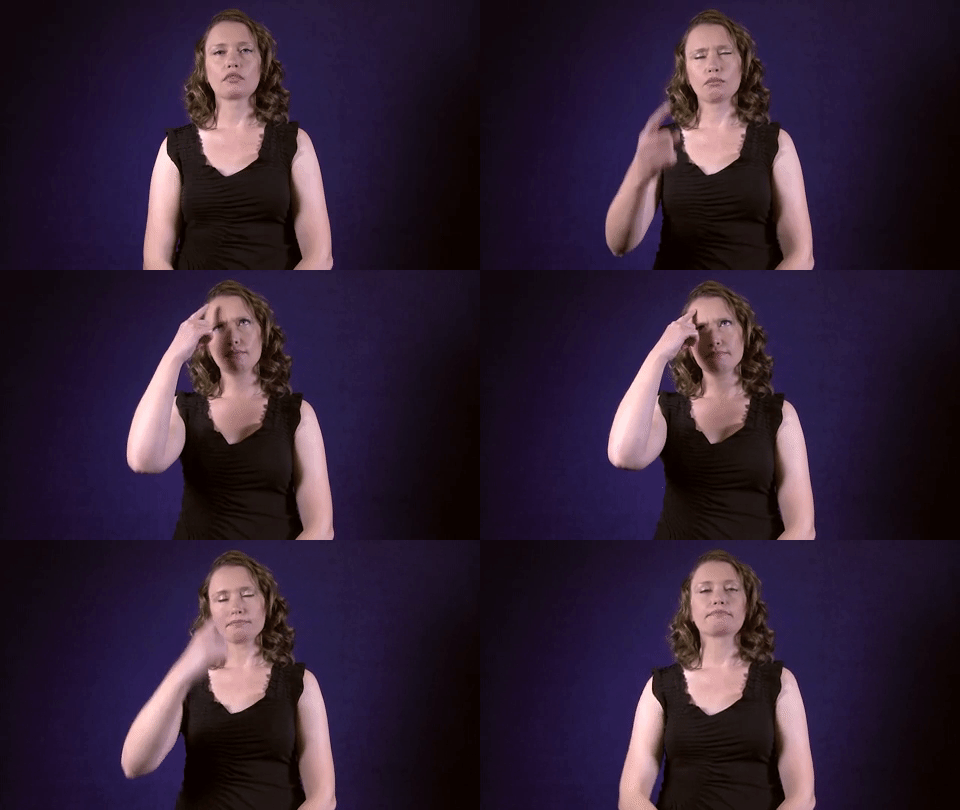
Sign for THINK- in ASL | ASL Dictionary

Definition: To use one’s mind actively to form ideas. Sign for THINK- in ASL
YouTube player

Practice Activities

To build fluency with the sign for THINK- in ASL, learners should begin with mirror exercises. Standing in front of a mirror allows you to check handshape, palm orientation, and facial expressions. Observe whether your dominant hand forms an index finger that gently touches the forehead—this is key to producing the sign accurately. Record yourself signing the word in various sentences. Playback helps identify errors and track progress over time. For example, sign “I THINK school is important” or “THINK about it” and analyze your facial expression, pacing, and clarity. Contextual signing is essential for mastering the sign for THINK- in ASL. Practice using it in full conversations, either in person with Deaf peers or in virtual ASL groups. Try to incorporate different tenses like “I was thinking,” “I think,” or “I will think” to understand how the sign functions in different grammatical contexts. Advanced learners can engage in receptive drills. Watch ASL videos or attend Deaf events, and identify each time the sign for THINK- in ASL is used. Then, pause and repeat the sign, mimicking the signer’s speed and expression. This improves fluency and comprehension. Create flashcards with various thought-related concepts such as IMAGINE, REMEMBER, or FORGET. Use the sign for THINK- in ASL as a base and compare it with these signs in structured drills. This helps reinforce subtle differences and improves sign retention.

SEO Cultural Context

The sign for THINK- in ASL is frequently used and deeply embedded in Deaf cultural communication. In Deaf culture, directness is valued, and the ability to express internal thoughts clearly is essential. THINK- is not just a cognitive verb—it’s a way to show reflection, decision-making, and personal opinions. In ASL, facial expression is grammar. When signing THINK-, adding a furrowed brow or a pensive look adds emotional weight and grammatical context. This is especially important when asking questions or expressing uncertainty. Understanding how to pair facial grammar with the sign for THINK- in ASL is part of being culturally competent in ASL. Some regional variation exists, though the standard sign—a dominant index finger touching the forehead—is widely accepted across the U.S. In certain communities, the handshape may differ slightly or be accompanied by additional signs for clarity. It’s important to respect regional norms and adjust accordingly when signing with native ASL users. In Deaf storytelling and poetry, the sign for THINK- in ASL may take on metaphorical meaning. For example, it might be used in a rhythmic, repeated pattern to indicate deep or obsessive thinking. This illustrates how ASL is not only a language but an expressive art form. The sign also plays a role in educational settings, especially in Deaf schools and classrooms. Teachers often use the sign to prompt students: THINK before signing, THINK before answering. It becomes a behavioral cue as much as a lexical item.

Extended Definition

The sign for THINK- in ASL uses the dominant hand in an extended index finger handshape. The finger gently taps or rests on the center of the forehead, symbolizing the location of the brain and the act of thinking. The movement is minimal, and the palm faces inward toward the signer. This sign belongs to a family of cognitive ASL verbs such as KNOW, REMEMBER, FORGET, and BELIEVE. All of these signs involve contact with the forehead or areas near it, associating the physical space with mental activity. Understanding this spatial metaphor helps learners grasp multiple signs more intuitively. A common error is overemphasis—pressing the finger too hard or making an exaggerated motion. The sign for THINK- in ASL is subtle. Overdoing the movement can appear unnatural or even change the meaning. Another frequent mistake is using the wrong handshape, such as a bent finger or an open hand. In compound sentences or when expressing complex thoughts, the sign can be used multiple times. For example, “I THINK he THINKS too much.” Each usage may include different facial expressions to indicate layers of meaning. This illustrates the sign’s grammatical flexibility and depth. Some learners confuse THINK- with REMEMBER, which uses an “A” handshape moving from the forehead down. Others mix it up with KNOW, which uses a flat hand touching the side of the forehead. Careful attention to handshape and movement will prevent these mix-ups and improve clarity.

Tips for Beginners

Beginners learning the sign for THINK- in ASL should focus on clean handshape and proper forehead placement. It’s easy to rush or misplace the sign, especially when signing quickly or under pressure. Practice slowly and deliberately at first, then increase speed as confidence grows. Don’t forget the importance of facial expressions. Neutral or inquisitive expressions can change the meaning of the sentence. For instance, raising your eyebrows while signing THINK- turns it into a yes/no question like “Do you think so?” Repetition is your friend. Practice the sign for THINK- in ASL in different settings: when watching TV, reading, or doing homework. Silently sign THINK- each time you mentally pause or reflect. This builds muscle memory and natural integration into your signing flow. Watch native ASL users and try to mirror their style and pacing. ASL is a visual language, and mimicry is a powerful learning tool. Notice how skilled signers incorporate THINK- into conversations with ease and nuance. Be patient with yourself. It’s normal to confuse similar signs at first. Use apps, flashcards, and ASL dictionaries to review frequently. Stay curious and ask fluent signers for feedback. Gradual improvement leads to long-term fluency.

Connections to Other Topics

The sign for THINK- in ASL connects closely with the sign for KNOW. Both involve the forehead and represent mental activity, but KNOW uses a flat hand while THINK- uses a pointed index finger. Understanding the distinction between these signs helps clarify statements of knowledge versus contemplation. Another related sign is REMEMBER, which uses an “A” handshape and moves from the forehead to the other hand. It shares the conceptual space of memory and thought, linking it thematically to THINK-. Learners often benefit from studying these signs together. BELIEVE is another cognitive verb that builds on THINK-. In some contexts, you might sign THINK first, then transition into BELIEVE to show a stronger conviction. This illustrates how ASL verbs can be layered for added meaning, especially in complex sentences. The sign for IDEA also shares a similar location and concept. It typically uses an “I” handshape moving out from the forehead, indicating the generation of a new thought. This sign complements THINK- in discussions of creativity or brainstorming. Lastly, the sign for DECIDE often follows THINK- in ASL conversations. First, you THINK about something, then you DECIDE. These signs form a natural semantic sequence and are frequently used together in daily interactions, making them ideal for combined practice.

Lengthy Summary

The sign for THINK- in ASL is a foundational sign that represents internal cognitive processes such as reasoning, wondering, considering, and contemplating. Formed by touching an extended index finger to the center of the forehead, it visually symbolizes the act of thinking. This sign is not only essential for everyday communication but also serves as a building block for more advanced ASL vocabulary related to cognition and decision-making. Understanding the sign for THINK- in ASL involves more than just memorizing a handshape. It requires attention to facial expression, contextual usage, and subtle differences between related signs. It’s a sign deeply embedded in Deaf culture, appearing frequently in conversations, education, and storytelling. Whether used to express a question, share an opinion, or reflect silently, THINK- is versatile and vital. For beginners, mastering this sign means practicing with intention. Use mirrors, record yourself, and engage in real-life signing opportunities to build fluency. Be aware of common errors such as incorrect handshape or exaggerated motion. Learn to pair the sign with appropriate facial expressions to convey your intent clearly. The sign for THINK- in ASL connects with several other signs like KNOW, REMEMBER, BELIEVE, IDEA, and DECIDE. Studying these together enhances your understanding of how ASL categorizes mental actions. These conceptual links help you form more natural and expressive sentences. In summary, the sign for THINK- in ASL is more than a simple gesture—it’s a gateway into understanding how thought and expression intertwine in American Sign Language. Keep practicing, stay curious, and immerse yourself in the language. Every time you sign THINK-, you’re taking a step closer to ASL fluency . Synonyms: consider, ponder, reflect, contemplate, deliberate Educational resources: Find related learning materials in our course bank! Want more? Check out some of our popular learning activities on the homepage! Need to look up a sign? Use our highly rated dictionary: https://aslinteractive.com/best-asl-dictionary/ Follow us on tiktok: https://www.tiktok.com/@aslinteractive. More social media links at the bottom of this page! Long-tail Keywords: Categories: tags: think in sign language, ASL think sign, how to sign think in ASL, cognitive ASL signs, mental process signs in ASL

Want more? Check out some of our popular learning activities!

ASL Interactive Resources

ASLInteractive YouTube Channel

Follow us on tiktok: @aslinteractive.com

Follow us on Instagram: aslinteractive

Facebook page: aslinteractive

Facebook group: aslinteractive

LInkedIn: ASL Interactive LLC

Twitter: @ASL_interactive

*Some information on this page is AI-generated. AI can make mistakes. Please check the information.  

Responses