Practice Activities
Learning the sign for WALK in ASL takes time, consistency, and engaging practice. One of the most effective ways to start is by using a mirror. Stand in front of a mirror and slowly perform the sign for WALK in ASL while watching your hand movements and facial expressions. This allows you to self-correct and build muscle memory. Another helpful activity is recording yourself signing. Create short videos of yourself using the sign for WALK in ASL in a variety of sentences. Watch the recordings to identify any inconsistencies or errors in handshape, palm orientation, or rhythm. Signing in context is essential for fluency. Use the sign for WALK in ASL in daily conversations or practice sentences like “I walk to school” or “Let’s go for a walk.” This contextual use reinforces the meaning and makes the learning process more natural. For more advanced learners, try substitution drills where you replace the verb in a sentence with the sign for WALK in ASL. For example, take a sentence like “They run to the bus” and change it to “They walk to the bus.” This helps with cognitive flexibility and reinforces grammar structures in ASL. You can also practice using the sign with different time indicators like “yesterday,” “every day,” or “tomorrow” to build fluency in full sentence construction. Group practice with peers can make this even more dynamic and educational.
SEO Cultural Context
The sign for WALK in ASL is more than a physical gesture—it reflects cultural and linguistic norms within the Deaf community. It is typically used in narrative storytelling, everyday conversation, and educational settings. Because walking is a common activity, the sign is frequently encountered by ASL users of all ages. In Deaf culture, clear and expressive signing is highly valued. When using the sign for WALK in ASL, it’s important to match your facial expression and body language with the meaning of the sentence. For example, walking slowly or walking angrily would be accompanied by appropriate facial expressions or modified movement in the sign itself. There may be slight regional differences in how the sign is performed, although the standard version is widely recognized across the United States. Some communities may use a more exaggerated motion, while others keep it minimal. These variations are a normal part of language evolution and reflect regional identity. The sign for WALK in ASL is also a great example of how verbs can be visually modified to reflect meaning. You might change the speed or pathway of the sign to indicate walking fast, walking in circles, or walking together. This flexibility is a hallmark of ASL’s visual-spatial grammar and enriches communication within the Deaf community.
Extended Definition
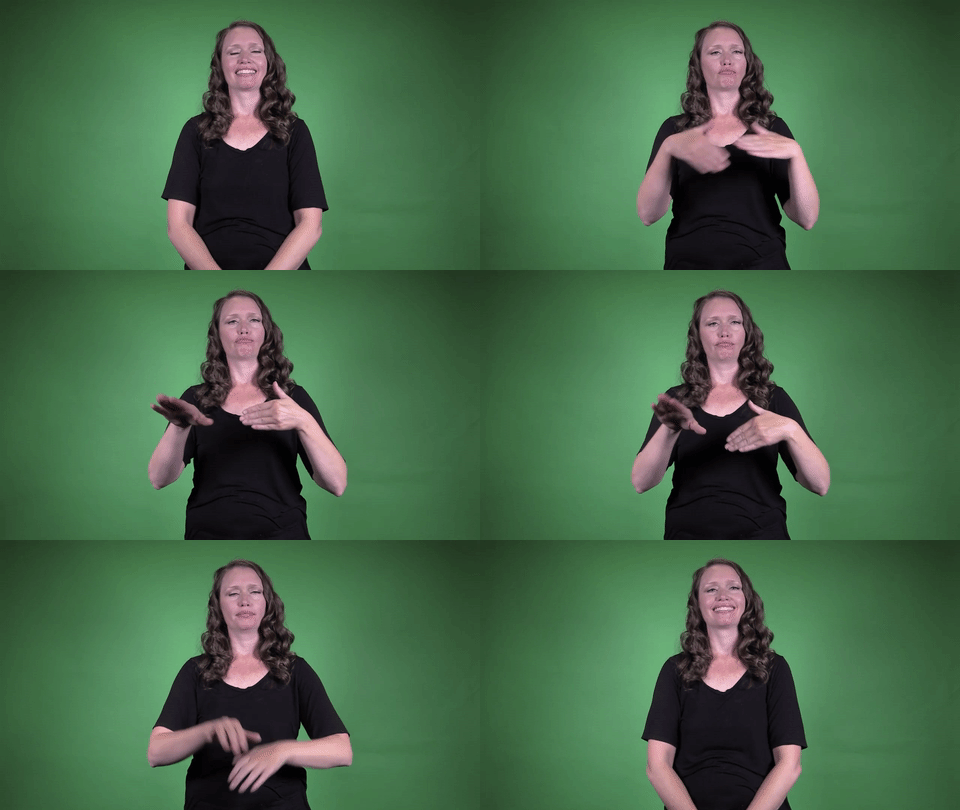
The sign for WALK in ASL typically involves both hands held flat, palms down, moving alternately in a forward motion, mimicking the action of walking feet. The movement should be smooth and rhythmic, often taking place in the neutral signing space in front of the body. This sign is classified as a verb and can be modified to show different aspects of walking. For example, changing the hand movement to a circular path can indicate someone walking around. Slowing down the movement can show someone walking slowly or hesitantly. It’s important to distinguish the sign for WALK in ASL from similar signs like RUN, which involves a different handshape and movement pattern. WALK uses flat hands, while RUN typically uses L-handshapes and a different motion. Confusing these can lead to misunderstandings, so careful observation and practice are essential. One common error is making the movement too large or too stiff. The motion should be natural and fluid, not robotic. Another mistake is dropping the hand position too low, which can make the sign unclear. Keep the hands in front of the torso and use consistent motion to convey the intended meaning.
Tips for Beginners3>
If you’re just starting to learn the sign for WALK in ASL, be patient with yourself. Signing is a motor skill that improves with repetition and attention to detail. Start by watching videos of native signers and mimic their handshapes and movement closely. A helpful beginner tip is to break down the sign into parts: handshape, palm orientation, movement, and location. Focus on mastering each element before putting it all together. Use slow-motion videos or ASL learning apps to analyze each part of the sign for WALK in ASL. Don’t be discouraged by early mistakes. Many beginners confuse this sign with similar verbs or use inconsistent rhythm, but these are all part of the learning curve. Practice daily in short sessions and check your form in a mirror or with a fluent signer. Joining a local Deaf event or ASL meetup can also greatly enhance your learning. Seeing the sign for WALK in ASL used in real conversation helps reinforce its meaning and shows how it fits naturally into the flow of ASL grammar and storytelling.
Connections to Other Topics
The sign for WALK in ASL connects naturally with other signs related to movement and transportation. For example, the signs for RUN, JUMP, and DRIVE often appear in similar contexts and share visual-spatial grammar features. Learning these signs together helps solidify your understanding of how ASL describes actions. Another related concept is directional verbs. While WALK is not typically directional in the same way as GIVE or SHOW, you can still incorporate directionality by modifying the path of the sign to indicate movement from one place to another. This is a key linguistic feature in ASL. Time indicators like YESTERDAY, TODAY, and TOMORROW frequently appear with action verbs. By combining the sign for WALK in ASL with these time markers, you can practice forming complete sentences and improve your grammar skills. Facial expressions are also crucial. For example, adding a tired or happy facial expression while signing WALK can change the meaning entirely. This connection between facial grammar and manual signs is essential to fluency in ASL. You may also explore classifiers, which are handshapes used to represent people or objects in motion. For instance, a V-handshape can represent a person walking, and you can move it across your signing space to tell a story. This adds depth and visual clarity to your communication.
Lengthy Summary
Mastering the sign for WALK in ASL is a valuable step in building your ASL vocabulary and fluency. This sign, which uses flat hands moving alternately to represent walking feet, is simple in form but rich in expressive potential. From basic conversations to complex narratives, WALK is a foundational verb that appears in a wide range of contexts. Practicing the sign for WALK in ASL through mirror work, video recordings, and contextual use helps reinforce correct handshapes and natural motion. More advanced learners can benefit from substitution drills and time-based modifiers to expand their fluency and grammatical awareness. Understanding the cultural context of the sign enhances both usage and respect for the language. Variations in signing styles reflect regional identity, and the ability to modify the sign according to speed, direction, or emotion demonstrates the rich visual-spatial grammar of ASL. Common beginner mistakes—such as stiff motion, incorrect hand placement, or confusion with similar signs—can be overcome through consistent, mindful practice. Watching native signers and engaging with the Deaf community will deepen your understanding and boost your confidence. Related signs like RUN, JUMP, and DRIVE, as well as the use of directional verbs, time indicators, and classifiers, all connect with the sign for WALK in ASL. These connections open the door to richer expression and more advanced conversation skills. By learning and practicing the sign for WALK in ASL, you’re doing more than adding a word to your vocabulary—you’re engaging with a vibrant language and culture. Keep practicing, stay curious, and remember that fluency comes from consistent effort and meaningful interaction. ♀️ Keep signing and enjoy the journey! Synonyms: stroll, saunter, amble, march, stride Educational resources: Find related learning materials in our course bank! Want more? Check out some of our popular learning activities on the homepage! Need to look up a sign? Use our highly rated dictionary: https://aslinteractive.com/best-asl-dictionary/ Follow us on tiktok: https://www.tiktok.com/@aslinteractive. More social media links at the bottom of this page! Long-tail Keywords: Categories: tags: motion verbs, ASL travel vocabulary, physical activities in ASL, everyday actions in ASL, ASL movement signs
Want more? Check out some of our popular learning activities!
ASL Interactive Resources
ASLInteractive YouTube Channel
Follow us on tiktok: @aslinteractive.com
Follow us on Instagram: aslinteractive
Facebook page: aslinteractive
Facebook group: aslinteractive
LInkedIn: ASL Interactive LLC
Twitter: @ASL_interactive
*Some information on this page is AI-generated. AI can make mistakes. Please check the information.
Responses