Practice Activities
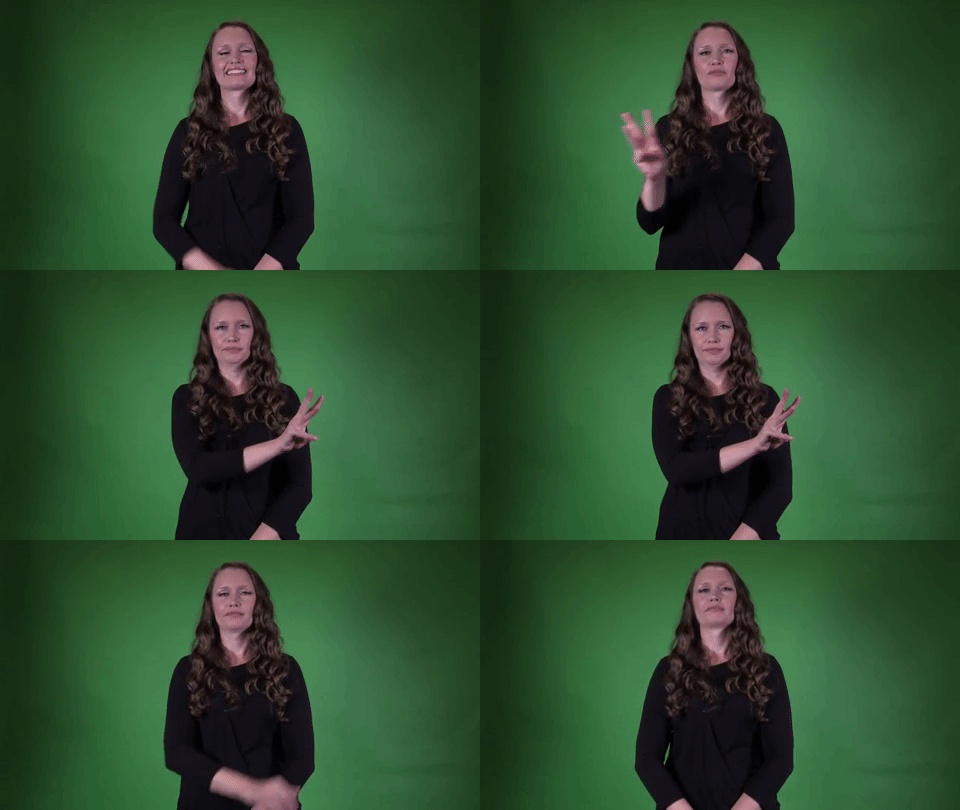
To master the sign for WEST in ASL, consistent and varied practice is essential. Start with mirror work to observe your handshape and movement. The sign for WEST in ASL involves forming the letter “W” with your dominant hand and moving it toward the left side of your body (for right-handed signers). Use a mirror to check that your palm is facing outward and the movement is smooth and horizontal. This helps develop muscle memory and ensures accuracy. Record yourself signing to review your technique. Watching your own signing allows you to catch subtle mistakes and track your improvement. Use your phone or computer to record short videos of yourself signing sentences that include the sign for WEST in ASL, and compare them to videos by fluent signers. Next, move into signing in context. Practice using the sign for WEST in ASL in full sentences like “I am traveling west” or “The sun sets in the west.” This helps reinforce vocabulary within natural language use. Try role-playing conversations with a signing partner to simulate real-life interactions where directions or geographic references are needed. For advanced learners, timed drills and spontaneous storytelling can elevate fluency. Set a timer and go through a series of directional signs including WEST, EAST, NORTH, and SOUTH. Add complexity by integrating these into location descriptions or narratives about road trips and weather patterns. These activities help you react quickly and naturally when using the sign for WEST in ASL in conversation.
SEO Cultural Context
The sign for WEST in ASL is more than just a directional term—it reflects spatial awareness and visual language that is central to Deaf culture. In ASL, directions are not just linguistic concepts but are also visual-spatial references that rely on consistent orientation and placement. Using the correct sign for WEST in ASL helps maintain this visual clarity and is essential for effective communication in the Deaf community. Deaf culture emphasizes visual access and spatial referencing, which means that signs like WEST must be used with precision. The movement of the hand toward the left (for right-handed signers) aligns with how maps are oriented visually in ASL. When signing about geography, travel, or even time-related metaphors (such as the sun setting in the west), the sign for WEST in ASL becomes culturally and linguistically relevant. There may be slight regional variations in how the sign is executed, such as speed of movement or exact positioning, but the fundamental structure remains consistent: the “W” handshape moving leftward. In storytelling or in educational settings, this sign is commonly used to describe locations, directions, and weather patterns, making it a frequent and practical sign in everyday ASL conversation.
Extended Definition
The sign for WEST in ASL uses the “W” handshape, with the palm facing outward and the fingers spread. The hand moves in a straight line toward the signer’s left side (for right-handed individuals), symbolizing the direction west on a map. For left-handed signers, the movement would go toward the right. This directionality mirrors the standard map orientation, reinforcing ASL’s spatial logic. It’s important to distinguish the sign for WEST in ASL from other W-related signs like WATER or WHO, which also use the “W” handshape but have different movements and placements. Confusion may arise if the hand does not move horizontally or if the palm orientation is incorrect. A common mistake is dropping the hand too quickly or turning the palm inward, which can obscure the meaning. The sign for WEST in ASL is part of a group of cardinal direction signs, including EAST, NORTH, and SOUTH. Each uses its respective letter handshape and moves in the direction consistent with a map’s orientation. This consistency supports ASL’s visual grammar and helps signers construct accurate mental maps during conversations.
Tips for Beginners3>
If you’re just starting to learn the sign for WEST in ASL, don’t worry—this is a logical and visually intuitive sign. Begin by practicing the correct handshape: form the letter “W” with your dominant hand. Spread your fingers and make sure your palm faces outward. Then, move your hand smoothly toward your non-dominant side. A common beginner mistake is confusing directionality. Remember, WEST moves outward and to the left (for right-handed signers). Practice slowly at first, focusing on fluid motion and correct orientation. Don’t rush—clarity is more important than speed. Use visual aids like maps to reinforce the concept. Point to the west on a map and sign it simultaneously. This will help you internalize both the meaning and movement. Engage with ASL videos or online tutorials that demonstrate the sign for WEST in ASL in context. Seeing the sign used in real sentences will improve your comprehension and recall.
Connections to Other Topics
The sign for WEST in ASL is closely related to several other directional and geographic signs. One key connection is the sign for EAST. Like WEST, it uses the corresponding letter handshape (“E”) and moves in the opposite direction. Practicing these together can help reinforce visual-spatial orientation in ASL. Another related sign is SUNSET. In ASL, sunset often involves a motion that includes a directional component toward the west, linking the concept of time with geography. Understanding how the sign for WEST in ASL is used in this context strengthens your ability to describe natural events. The sign for CALIFORNIA also has a cultural connection to WEST, as California is located on the West Coast. When signing about states or travel locations, the sign for WEST in ASL might be used to provide additional geographic context. Additionally, the sign for LEFT shares the same general direction as WEST for right-handed signers, though the handshape and meaning differ. Understanding distinctions between LEFT and WEST helps avoid confusion in both casual and formal conversation. Finally, in weather-related discussions, the sign for WEST in ASL might come up when describing wind direction or storm patterns. Phrases like “The wind is coming from the west” are common in both ASL and spoken English, making directional signs an important part of weather vocabulary.
Lengthy Summary
The sign for WEST in ASL is a foundational vocabulary term that plays a vital role in spatial communication. By using the “W” handshape and moving it toward the left (for right-handed signers), you visually represent the direction west as it appears on a map. This sign is not only linguistically precise but also deeply embedded in the visual-spatial logic of ASL, which is central to Deaf culture. Understanding the sign for WEST in ASL requires more than just memorizing a handshape—it involves recognizing its place in a broader system of cardinal directions, geographic references, and cultural contexts. Learners benefit from practicing this sign in a variety of ways, including mirror work, video recording, contextual use, and advanced drills. These methods support fluency and help ensure that you’re using the sign correctly and confidently. Cultural awareness is equally important. The sign for WEST in ASL reflects how the Deaf community values visual clarity and spatial accuracy. Whether discussing travel, weather, or storytelling, using this sign accurately enhances communication and shows respect for the language’s structure. Beginners should take their time to master the handshape and movement, avoiding common mistakes like incorrect palm orientation or direction. Reinforce your learning by connecting this sign to related terms like EAST, SUNSET, and CALIFORNIA. These connections enrich your vocabulary and deepen your understanding of how ASL expresses geography and direction. Incorporating the sign for WEST in ASL into your daily practice will expand your signing abilities and build your confidence. Remember that language learning is a journey. Keep practicing, engage with the Deaf community whenever possible, and use the sign for WEST in ASL in real-life conversations. The more you use it, the more naturally it will become part of your expressive skills. Keep signing and exploring—your ASL fluency is just over the horizon! Synonyms: West, Western, Occident, Sunset direction, Westward Educational resources: Find related learning materials in our course bank! Want more? Check out some of our popular learning activities on the homepage! Need to look up a sign? Use our highly rated dictionary: https://aslinteractive.com/best-asl-dictionary/ Follow us on tiktok: https://www.tiktok.com/@aslinteractive. More social media links at the bottom of this page! Long-tail Keywords: Categories: tags: directions in ASL, ASL travel vocabulary, geographic signs in ASL, ASL for locations, cardinal directions in ASL
Want more? Check out some of our popular learning activities!
ASL Interactive Resources
ASLInteractive YouTube Channel
Follow us on tiktok: @aslinteractive.com
Follow us on Instagram: aslinteractive
Facebook page: aslinteractive
Facebook group: aslinteractive
LInkedIn: ASL Interactive LLC
Twitter: @ASL_interactive
*Some information on this page is AI-generated. AI can make mistakes. Please check the information.
Responses