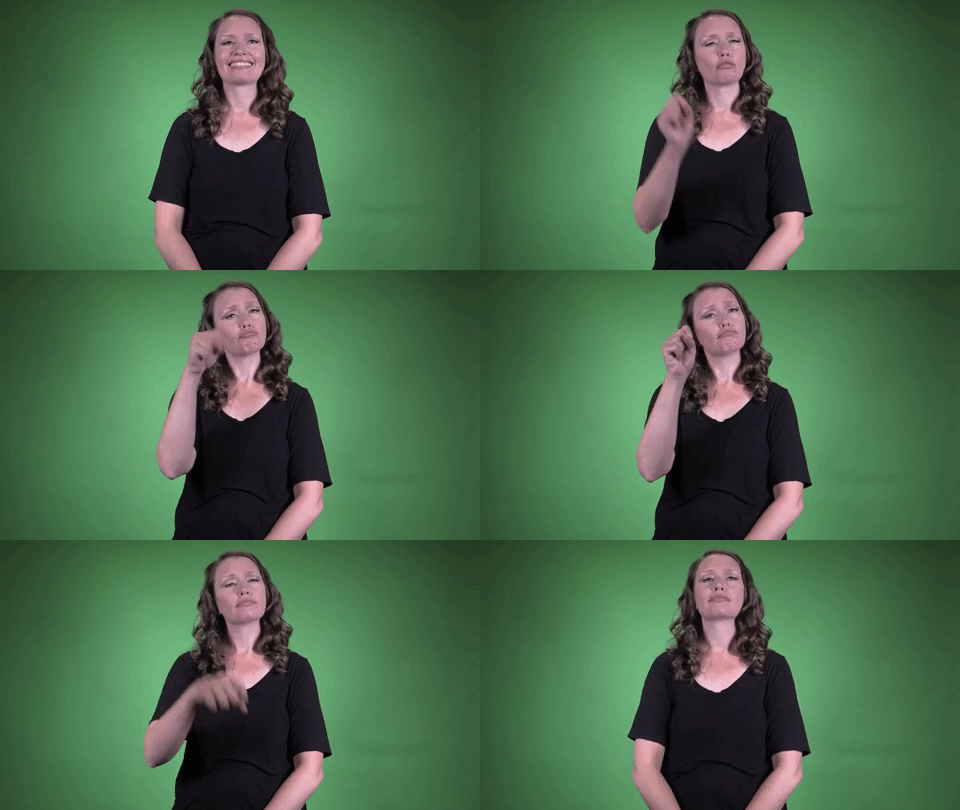
Practice Activities
Practicing the sign for YES in ASL is essential to developing fluency and confidence. One effective method is mirror practice. Stand in front of a mirror and observe your hand movement and facial expression as you sign. This helps ensure accuracy and reinforces muscle memory. Another method is recording yourself signing. Use your phone or camera to film short clips of yourself using the sign for YES in ASL in full sentences. Watch the playback to catch any inconsistencies or unclear movements. Signing in context is also valuable. Try incorporating the sign for YES in ASL during daily conversations. Whether agreeing with a friend or responding to a question during class, using it in real situations helps reinforce its meaning. Advanced learners can challenge themselves with expressive drills. Practice responding quickly to questions using the sign for YES in ASL, focusing on speed, clarity, and appropriate facial expressions. You can also pair the sign with different ASL sentence structures to deepen your understanding of grammar. Partner activities can also boost your skills. Work with a friend or tutor to go through question-and-answer drills. Make it interactive by turning it into a game where you earn points for quick and accurate signing.
SEO Cultural Context
The sign for YES in ASL carries more than just a literal meaning—it reflects key aspects of Deaf culture and communication. In ASL, affirmations are not just verbal equivalents but are embodied through movement and expression. The sign is typically executed with a fist bobbing up and down, similar to a nodding motion, which mimics the natural human gesture for agreement. In Deaf culture, clear and expressive communication is essential. The sign for YES in ASL is often paired with strong facial expressions to convey sincerity or enthusiasm. A simple nod of the head might accompany the sign, reinforcing the message and making the interaction more visually rich. Regional variation in the sign for YES in ASL is minimal, but the intensity and speed of the movement can vary slightly depending on context or personal style. Some signers may use a more exaggerated motion to show strong agreement, while others may keep it subtle in formal settings. This sign is used in a wide range of situations—from casual conversations to formal discussions. Whether you’re confirming a dinner plan or agreeing to a contract, the sign for YES in ASL plays a crucial role in affirming consent and clarity.
Extended Definition
The sign for YES in ASL is a one-handed movement that mimics the act of nodding. To perform it, make a fist with your dominant hand and move it up and down from the wrist. The motion should be smooth and deliberate, as if your fist were a head nodding in agreement. Facial expressions significantly enhance the meaning of the sign. A smile or raised eyebrows can indicate enthusiasm, while a more neutral face can show a simple acknowledgment. These non-manual markers are a vital part of ASL grammar and meaning. It’s important not to confuse the sign for YES in ASL with similar fist-based signs such as SORRY or HELP. Mistaking these can lead to miscommunication. Unlike SORRY, which involves a circular motion on the chest, the sign for YES in ASL is limited to a vertical wrist movement. Learners often make the mistake of moving the whole arm instead of the wrist. This makes the sign appear stiff or unnatural. The motion should be isolated to the wrist to ensure clarity and accuracy. Over-signing or under-signing can also affect understanding, so balanced movement is key.
Tips for Beginners3>
If you’re just starting to learn the sign for YES in ASL, take it slow and focus on form first. Begin by watching native signers and mimicking their movements. Pay attention to how their wrist moves and how their face complements the sign. Common beginner mistakes include using the wrong handshape or moving the entire arm. Always use a closed fist and keep the motion limited to the wrist. Practicing in front of a mirror, as mentioned earlier, will help catch these errors early on. Another tip is to pair the sign for YES in ASL with real-world examples. Think about how often you say “yes” in English, and try replacing those moments with the sign. This helps build muscle memory and makes the sign second nature over time. Don’t be afraid to exaggerate your facial expressions at first. In ASL, a flat facial expression can mute the meaning of your sign. Practicing with full expression will help you become more comfortable and expressive in conversations. Be patient with yourself. Mastering the sign for YES in ASL takes time, especially when integrating it into flowing ASL sentences. Stay consistent, and your skills will grow with each practice session.
Connections to Other Topics
Understanding the sign for YES in ASL opens the door to several related signs and concepts. One closely related sign is NO. The sign for NO in ASL is made by bringing the index and middle finger together with the thumb, resembling a snapping motion. Learning both signs helps with basic question-and-answer exchanges. Another foundational sign is PLEASE. Both YES and PLEASE are commonly used in polite exchanges. Combining these signs in phrases like “Yes, please” builds conversational fluency and teaches proper ASL etiquette. The sign for THANK YOU also complements the sign for YES in ASL. These signs are frequently used together in affirming polite responses. For example, “Yes, thank you” can be used to accept an offer or respond positively to a favor. You can also explore grammatical features like non-manual markers. In ASL, facial expressions play a grammatical role. When signing YES, your facial expression can indicate how strongly you agree, adding nuance to the conversation. Additionally, learning how to ask yes/no questions in ASL is a natural next step. These questions require specific facial expressions, such as raised eyebrows and a slight forward head tilt. Understanding how to respond with the sign for YES in ASL strengthens your ability to communicate effectively in these contexts.
Lengthy Summary
The sign for YES in ASL is more than a simple gesture—it’s a core component of everyday communication within the Deaf community. Executed with a closed fist bobbing at the wrist, this sign visually represents agreement and affirmation. When paired with appropriate facial expressions, it becomes a powerful tool in conveying consent, enthusiasm, or acknowledgment. Practicing the sign for YES in ASL through mirror work, video recording, and contextual usage allows learners to build confidence and accuracy. Advanced drills and partner activities further deepen fluency, ensuring that the sign becomes an automatic part of your expressive toolkit. The cultural context of the sign for YES in ASL underscores the importance of visual clarity and emotional expression in Deaf communication. While regional variations are minimal, personal style and contextual intensity add layers of meaning that enrich the sign’s usage. By understanding the
Extended Definition
of the sign, including common errors and related signs, learners can avoid confusion and strengthen their grasp of ASL vocabulary. The sign for YES in ASL is often misinterpreted or performed incorrectly by beginners, but with mindful practice and attention to detail, mastery is achievable. For those new to ASL, starting with the sign for YES in ASL offers a gateway into the broader linguistic structure of the language. Pairing it with related signs like NO, PLEASE, THANK YOU, and learning about non-manual markers and question formation provides a comprehensive learning experience. Incorporating the sign for YES in ASL into your daily routine is a small but powerful step toward fluency. It not only boosts your vocabulary but also connects you to the cultural richness of Deaf communication. Keep practicing, stay curious, and don’t be afraid to make mistakes—every sign you learn brings you closer to becoming a confident ASL communicator. Synonyms: Yes, Yep, Affirmative, Absolutely, Agreed Educational resources: Find related learning materials in our course bank! Want more? Check out some of our popular learning activities on the homepage! Need to look up a sign? Use our highly rated dictionary: https://aslinteractive.com/best-asl-dictionary/ Follow us on tiktok: https://www.tiktok.com/@aslinteractive. More social media links at the bottom of this page! Long-tail Keywords: Categories: tags: affirmation signs, basic ASL vocabulary, conversational ASL, positive responses in ASL, beginner ASL signs
Want more? Check out some of our popular learning activities!
ASL Interactive Resources
ASLInteractive YouTube Channel
Follow us on tiktok: @aslinteractive.com
Follow us on Instagram: aslinteractive
Facebook page: aslinteractive
Facebook group: aslinteractive
LInkedIn: ASL Interactive LLC
Twitter: @ASL_interactive
*Some information on this page is AI-generated. AI can make mistakes. Please check the information.
Responses