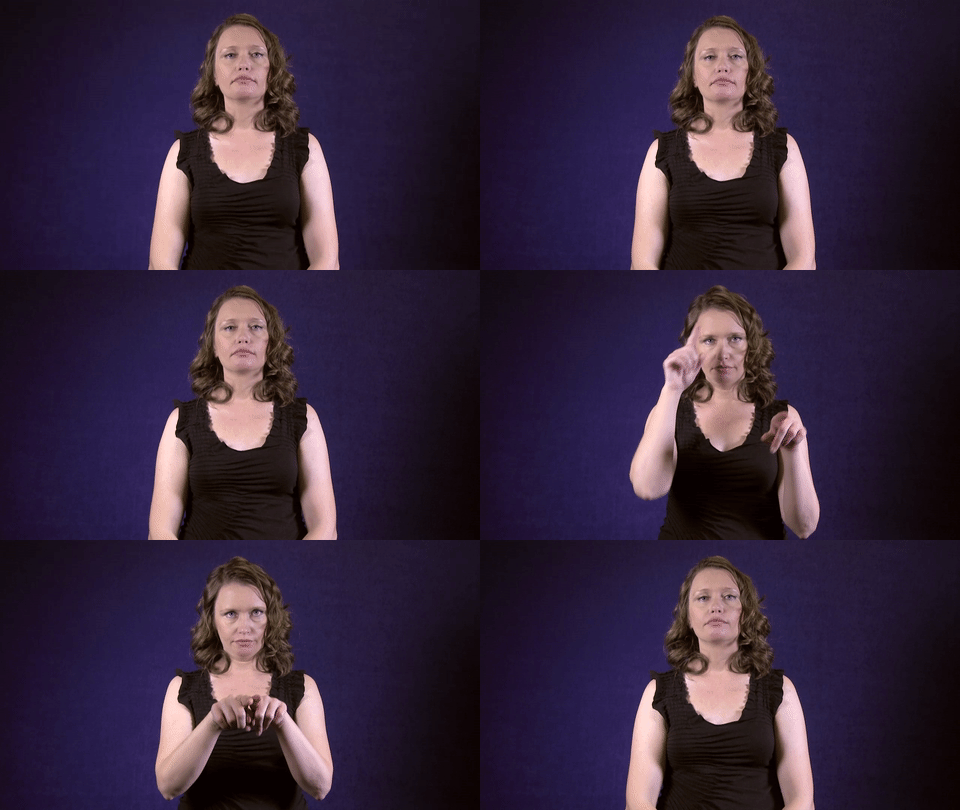
Definition: To have the same opinion.
Sign for AGREE in ASL

Practice Activities:
To practice the sign for agree in ASL, start by signing it in isolation multiple times. Stand in front of a mirror and sign it slowly while saying the English word in your head. Focus on hand positioning, movement, and facial expressions to ensure clarity.
Next, try using the sign for agree in ASL within simple sentences. Sign phrases like “I agree with you” or “We both agree.” Challenge yourself to use different subjects such as “She agrees with him” or “They agree on the plan.” This helps reinforce the sign in different contexts.
Practice incorporating the sign into short dialogues. With a partner, take turns making statements while the other signs if they agree or disagree. For example, one person can sign “I like pizza,” and the other responds using the appropriate sign. This improves conversational fluency and recognition.
Engage in a storytelling exercise by signing a mini-dialogue that involves a discussion or decision-making scenario. For instance, tell a short story about two friends choosing a movie where they eventually agree on what to watch. This promotes natural language development and expressive skills.
Try a quick-response game where someone states opinions or facts, and you must quickly sign whether you agree or not. Examples include “Dogs are great pets” or “Winter is the best season.” This builds reflexive signing and improves recall speed.
Watch ASL videos or attend a Deaf event to observe how native signers use the sign for agree in ASL in conversation. Take notes on sentence structure and repetition patterns. Practicing its usage in real-world settings strengthens understanding and retention.
Cultural Context:
The sign for agree in ASL is an important concept that conveys mutual understanding or shared opinions. It shows that two people are on the same page, whether in everyday conversations or formal discussions. This sign is commonly used in educational, professional, and social settings.
Using the sign for agree in ASL helps create strong communication between Deaf and hearing individuals. It allows for quick and clear confirmation without needing to speak or write. This sign is widely recognized within the Deaf community and is a valuable part of fluent ASL conversations.
Cultural context matters when using the sign for agree in ASL. In Deaf culture, agreement often involves more than just the sign—it includes facial expressions and body language. A simple nod or an engaged expression enhances the meaning and strengthens the interaction.
The sign for agree in ASL is frequently used in school settings when students and teachers confirm understanding. It is also common in workplaces where teams need to align on projects or tasks. In personal interactions, this sign helps express unity and support between friends and family.
In formal ASL discussions, the sign for agree in ASL is often paired with other signs to add depth. For example, signing “I agree with you” or “we both agree” makes the message clearer. Context and sentence structure shape how this sign is interpreted in different situations.
Because ASL is a visual language, using the sign for agree in ASL effectively involves more than just hand movements. Proper facial expressions can emphasize strong agreement or slight hesitation. ASL users rely on these visual cues to fully understand each other.
This sign is also important in Deaf advocacy and activism. When people use the sign for agree in ASL during discussions about rights or policies, it shows solidarity. It allows community members to quickly express their shared stance on important issues.
Learning the sign for agree in ASL can improve communication skills for both Deaf and hearing individuals. It helps bridge communication gaps and fosters better understanding in diverse environments. Whether in casual conversations or formal meetings, knowing this sign is highly beneficial.
Many Deaf individuals appreciate when hearing people take the time to learn ASL signs like the sign for agree in ASL. It shows respect for the language and culture. Using ASL correctly helps promote inclusivity and meaningful interactions in everyday life.
When signing agree in ASL, accuracy is key. Hand placement and movement must be precise to ensure the meaning is clear. Beginners should practice regularly to become more comfortable using this sign in conversations
Extended Definition:
The sign for agree in ASL is a useful and commonly used sign in conversations. It helps express agreement, shared opinions, or mutual understanding in discussions. Knowing how to sign it correctly can enhance interaction in American Sign Language.
To make the sign for agree in ASL, start by pointing your index finger at your forehead. Then, move it down and forward to meet the index finger of your other hand, which is extended horizontally. This resembles two ideas coming together, reinforcing the meaning of agreement.
The sign for agree in ASL visually represents two people sharing the same thought or being on the same page. It is often used in everyday conversations to show mutual understanding. This sign can be used in formal discussions, casual talks, or even storytelling.
Different contexts may slightly affect how the sign for agree in ASL is used. Facial expressions play a key role in emphasizing the strength of an agreement. A nod or smile can reinforce a positive agreement, while a hesitant expression may indicate reluctant agreement.
This sign fits naturally in conversations when discussing opinions, plans, or decisions. For example, if two people are deciding on a meeting time and they both agree, this sign smoothly conveys that consensus. Learning and practicing this sign can help improve fluency in American Sign Language.
The sign for agree in ASL is similar to signs related to thinking and understanding. It is important to use the correct movement and handshape to differentiate it from similar signs. Paying attention to subtle differences ensures clear and accurate communication.
While fingerspelling the word “agree” is possible, using the actual ASL sign is much faster and more fluid. ASL relies on established signs to create a seamless and natural conversation flow. Learning signs instead of fingerspelling every word enhances communication efficiency.
Teaching the sign for agree in ASL to children and beginners is helpful in building their ASL vocabulary. It allows them to express their thoughts clearly and participate in discussions confidently. Practicing with real-life scenarios reinforces understanding and usage.
For those learning ASL, regularly incorporating the sign for agree in ASL into conversations is beneficial. Watching native signers use it in context can help with fluency and comprehension. Online resources, ASL dictionaries, and videos provide great opportunities for practice.
Understanding the sign for agree in ASL contributes to better communication in the Deaf and signing community. It fosters smoother interactions and social connections through shared language. Using it correctly demonstrates respect and cultural awareness in ASL communication
Synonyms: consent, accept, concur, approve, assent
Educational resources: Find related learning materials in our course bank!
Want more? Check out some of our popular learning activities on the homepage!
Need to look up a sign? Use our highly rated dictionary: https://aslinteractive.com/best-asl-dictionary/
Follow us on tiktok: https://www.tiktok.com/@aslinteractive. More social media links at the bottom of this page!
Long-tail Keywords: what is the sign for agree in ASL, how do you sign agree in ASL, agree sign language meaning
Categories:
tags: Language Learning, Commands, Verbs, Responses, Communication
Parameters
*Handshape*:
The sign for AGREE in ASL uses two handshapes. The dominant hand starts in the “1” handshape with the index finger pointing to the forehead, while the non-dominant hand is also in a “1” handshape held outward. The dominant hand moves away from the forehead and comes down to meet the non-dominant hand, forming a parallel position. This movement symbolizes shared thought or agreement between two individuals, making the sign for AGREE in ASL visually intuitive.
*Palm Orientation*:
The palm orientation for the sign for AGREE in ASL starts with the dominant hand in a “1” handshape near the forehead, palm facing inward. The non-dominant hand is also in a “1” handshape, positioned in front of the body with the palm facing sideways. As the movement occurs, the dominant hand moves forward to meet the non-dominant hand, shifting its palm to face downward, showing agreement between thoughts and actions.
*Location*:
The sign for AGREE in ASL is produced in the area near the head and extends outward to neutral space. The dominant hand starts at the forehead, with the index finger touching the temple, while the non-dominant hand remains in front of the chest, forming a flat “1” handshape. The dominant hand moves forward and down to align horizontally with the non-dominant hand, showing agreement between thoughts and actions.
*Movement*:
To produce the sign for agree in ASL, start with the dominant hand forming the index finger and touching the forehead. Next, bring it down while simultaneously forming an “index finger” on the non-dominant hand. The dominant hand meets the non-dominant hand near the chest, both extended forward in parallel. This movement signifies a connection between thoughts and beliefs, reinforcing the meaning of the sign for agree in ASL. Keep the motion fluid for natural expression.
*Non-Manual Signals*:
When using the sign for AGREE in ASL, the facial expression is typically neutral or slightly affirmative, depending on context. A small head nod often accompanies the sign to reinforce agreement. If emphasizing strong agreement, widen the eyes slightly and raise the eyebrows. A relaxed mouth position or a slight smile can indicate a positive, agreeable tone. If the agreement is reluctant, the signer may show a more reserved expression, such as a small head tilt or a subdued nod.
*Prosody, Dominant/Non-Dominant Hand*:
The sign for AGREE in ASL uses both hands. The dominant hand starts with the index finger touching the forehead, similar to the sign for “think.” Simultaneously, the non-dominant hand is positioned in front of the chest with the index finger extended. Then, the dominant hand moves down to meet the non-dominant index finger, forming a parallel horizontal position. This movement represents agreement or aligning thoughts. Facial expression can emphasize intensity or affirmation.
Tips for Beginners:
The sign for AGREE in ASL requires proper hand positioning and movement for clarity. Start with your dominant hand in a “1” shape near your forehead, similar to the sign for THINK. Then, move it downward to meet your non-dominant hand, also in a “1” shape, positioned horizontally in front of your chest. The contact between the two fingers represents agreement or being of the same mind.
When learning the sign for AGREE in ASL, pay attention to fluidity. A common mistake is making the movement too stiff or disjointed. Ensure a smooth transition from the head to the meeting point without pausing awkwardly. It helps to practice in front of a mirror to check your motion and hand positioning.
Facial expression plays an important role in ASL communication. When signing AGREE, maintain a neutral or affirmative expression to reinforce the meaning. A flat or confused expression can contradict the sign’s intent. The face and body should naturally reflect agreement or shared thought.
Beginners sometimes position the non-dominant hand too low or too high, which can confuse the sign. Keep the non-dominant hand steady in front of your chest so that the dominant index finger can land correctly. If your hand placement is inconsistent, it may make recognition more difficult.
To improve fluency, practice signing AGREE in conversational settings. Try pairing it with phrases like “I AGREE WITH YOU” or use it in response to statements when discussing opinions. Watching native signers use it in natural conversation can also help refine your understanding. Repeating the motion slowly at first and then increasing speed will help you develop confidence and accuracy.
Connections to Other topics:
The sign for AGREE in ASL is closely related to concepts of alignment, understanding, and unity. This connection extends to signs like SAME, MATCH, or UNDERSTAND, which express shared viewpoints or commonality. The movement of the sign for AGREE in ASL visually represents two perspectives coming together, reinforcing its meaning of consensus or harmony.
In conversation, the sign for AGREE in ASL often interacts with signs like THINK and RIGHT, emphasizing logical agreement or correctness. Signed expressions such as THINK-SAME convey the idea of shared thoughts and can be used when indicating mutual understanding. Additionally, the sign for AGREE in ASL pairs well with NOT and DISAGREE to form contrasting meanings, showing the full range of agreement and disagreement.
This sign can also be linked to legal or formal contexts, as in agreeing to rules, contracts, or decisions. Related signs such as PROMISE, CONTRACT, and DECIDE help expand discussions about agreements in structured situations. When paired with WANT or NEED, it can indicate personal preferences or obligations, making it useful for discussing commitments.
A simplified variation of the sign for AGREE in ASL can be seen in expressions like ME-TOO, which informally signals agreement in daily conversation. This is useful when responding to opinions, experiences, or preferences. By incorporating facial expressions, the level of agreement can be adjusted, from enthusiastic agreement to reluctant acknowledgment.
Other compound uses of agreement include TEAM-AGREE or GROUP-AGREE, which extend the discussion to collective decisions. These formulations are important in team settings or negotiations where consensus matters. Understanding the sign for AGREE in ASL alongside these related signs enhances clear and nuanced communication across different social and professional interactions.
Summary:
The sign for AGREE in ASL visually conveys alignment between thoughts or perspectives. The movement and handshape depict a connection between the head and another location, symbolizing shared understanding or consensus. ASL, being a visually rich language, often translates abstract concepts into clear, pictorial movements, making this sign straightforward yet expressive.
To produce the sign, start with the dominant hand in the index finger shape, touching the side of the forehead. This represents the idea of a thought or belief forming in the mind. Then, move the hand forward and downward, bringing it to meet the non-dominant hand, which also takes an index finger shape and is positioned in front of the body.
The physical connection between both index fingers in this movement symbolizes agreement, unity, or shared ideas. This direct representation makes it an intuitive and accessible sign for both beginners and advanced users of ASL. Facial expression also plays a role, as a neutral or affirmative expression reinforces the meaning.
The sign for AGREE in ASL differs from the sign for DISAGREE, which involves a visual separation rather than a connection. This distinction is crucial in ASL, as many opposite concepts are conveyed through contrasting movement patterns. Understanding such linguistics principles enhances clarity and prevents miscommunication.
Grammatically, the sign for AGREE in ASL functions similarly to its English equivalent but can adapt to different contexts through changes in facial expression and body language. In casual conversation, this sign can be modified slightly to show varying degrees of agreement, such as strong affirmation or reluctant assent. This flexibility allows ASL to be as nuanced and expressive as spoken languages.
This sign has strong cultural significance, as ASL reflects the values of deaf culture, including collectivism and understanding. Agreement and alignment in discussions play a significant role in fostering strong community ties within Deaf culture. The ability to visually affirm understanding strengthens interpersonal relationships.
Since ASL relies on visual and spatial representation, related signs such as THINK or UNDERSTAND share conceptual similarities with AGREE. THINK, for example, starts in a similar location on the forehead, reinforcing the cognitive aspect. UNDERSTAND also visually connects to intellectual engagement, showing links between thought-related concepts within ASL’s structure.
Linguistically, the composition of this sign follows a common ASL structure where physical contact with the head conveys mental processes. Many ASL signs utilize the forehead as a location to indicate thinking, beliefs, or agreement, reflecting a broader linguistic strategy. This approach transforms abstract ideas into visible and memorable gestures.
From an applied linguistics perspective, ASL’s reliance on movement contrasts with spoken languages, which use intonation and word order to modify meaning. The sign for AGREE in ASL conveys not only agreement but also levels of affirmation through speed, firmness, and facial expression. These non-manual signals are crucial for accurate communication.
Facial expressions such as a nod or raised eyebrows can add emphasis or context to the sign. When signing AGREE in response to a statement, nodding naturally enhances the intent. In contrast, a neutral or hesitant facial expression can indicate mild or reluctant agreement.
For learners, practicing this sign with different expressions helps build fluency by connecting body language with meaning. Observing fluent signers demonstrates how subtle changes can modify interpretation. This highlights how ASL’s visual nature allows for significant range in expression.
Broader themes related to the sign for AGREE in ASL include concepts of consensus, communication styles, and social bonding. Agreement is a fundamental element of conversation and decision-making, making this sign frequently used in discussions. In Deaf culture, visual validation of agreement strengthens interaction and shared understanding.
Understanding AGREE in ASL also reinforces the importance of space in signed communication. The movement from the forehead forward illustrates ASL’s spatial grammar, where the body signifies cognitive processes and the movement toward another location represents relational concepts. This mirrors how spoken languages use word order to establish relationships between ideas.
Interpreters must master this sign’s nuances to accurately convey agreement in professional settings. The context in which it appears influences whether it should be signed with strong emphasis or a more reserved motion. Additionally, interpreters utilize facial expressions and pauses to enhance clarity.
Comparing AGREE in ASL to its English equivalent highlights the efficiency of signed languages. While spoken English requires variations in tone or additional words to modify agreement, the sign inherently integrates meaning through motion. This efficiency makes ASL an expressive and dynamic language.
A historical perspective on ASL reveals that many cognitive-related signs have evolved from their original gestures. Some early forms of AGREE in ASL may have had slight variations before becoming standardized in modern ASL usage. Language evolution within the Deaf community reflects communication needs and cultural influences.
ASL also allows for classifiers to modify the concept of agreement in specific contexts. For instance, classifiers can illustrate two groups agreeing or two individuals reaching an understanding visually. This capability expands ASL’s ability
Want more? Check out some of our popular learning activities!
ASL Interactive Resources
ASLInteractive YouTube Channel
Follow us on tiktok: @aslinteractive.com
Follow us on Instagram: aslinteractive
Facebook page: aslinteractive
Facebook group: aslinteractive
LInkedIn: ASL Interactive LLC
Twitter: @ASL_interactive
*Some information on this page is AI-generated. AI can make mistakes. Please check the information.


Responses