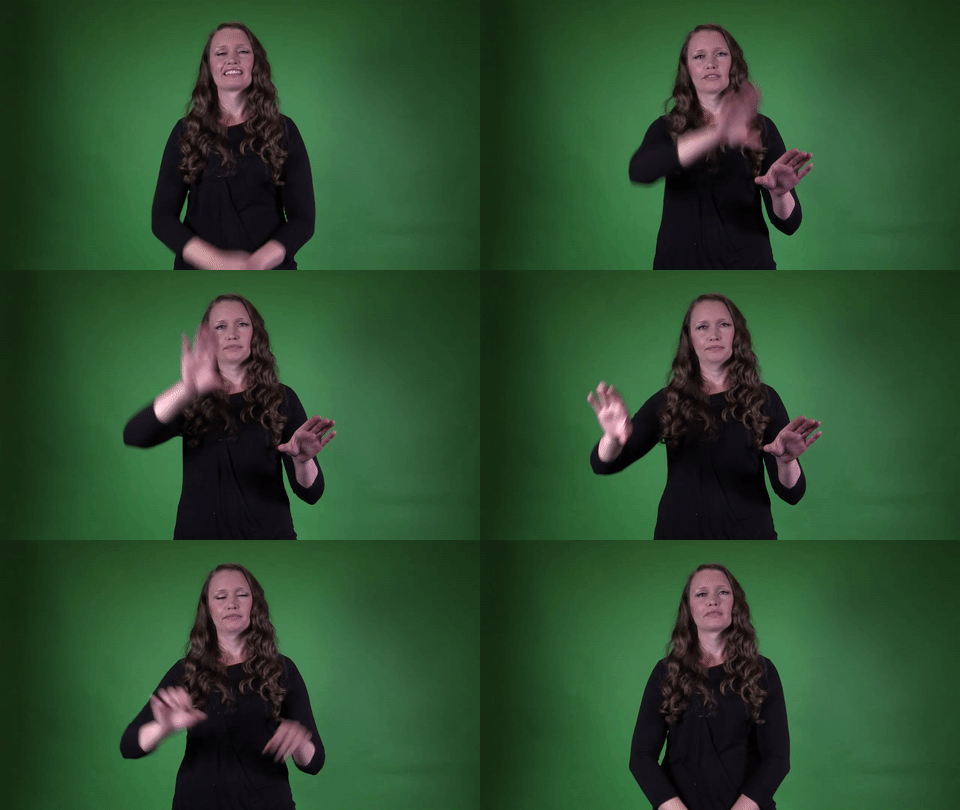
Sign for CAMEL in ASL | 🐪 ASL Dictionary

Definition: A large animal with a humped back.

Sign for CAMEL in ASL

YouTube player

Practice Activities:

To build fluency with the sign for CAMEL in ASL, begin by practicing the sign repeatedly in isolation. Stand in front of a mirror to observe handshape and movement. Watch videos of native signers demonstrating the sign and imitate their pace and fluidity. Practice using both dominant and non-dominant hands, especially when incorporating the sign into longer phrases or sentences.

Next, try simple descriptive sentences such as: “I see a camel at the zoo,” “The camel has two humps,” or “Camels live in the desert.” Sign these slowly at first, then gradually increase your speed as you grow more confident. Keep your facial expressions aligned with the sentence context—for instance, use a look of amazement when talking about meeting a camel for the first time.

Create short stories or visual scenes involving a camel. For example, imagine a day at a desert safari. Describe what the camel is doing: walking, drinking water, or carrying supplies. This exercise helps retain the sign in memory and builds fluidity in context. Try using a whiteboard or drawing simple images to frame your storytelling before practicing.

Work with a partner if possible. One person signs short descriptions while the other guesses the context using the sign for CAMEL in ASL. Make it more challenging by incorporating other animal or location signs to make full scenes. For example, sign: “CAMEL – DESERT – HOT – WALK” and have your partner interpret the meaning.

Integrate fingerspelling practice for related vocabulary like “desert,” “zebra,” or “safari” to add to your storytelling. Mix signed and fingerspelled words to build comfort with transitions. Watching animal documentaries and signing what you see is another excellent way to use the sign for CAMEL in ASL regularly in a natural setting.

Cultural Context:

The sign for CAMEL in ASL carries more than just a visual meaning—it connects with cultural concepts and shared experiences in the Deaf community. When teaching or learning this sign, it’s important to consider how animals are viewed across cultures, especially in educational or storytelling contexts in ASL. The distinctive hump of the camel often serves as a visual clue in the sign, making it easy to remember and effective in both formal and informal settings.

In American Sign Language, visual characteristics of animals are often highlighted, and the sign for CAMEL in ASL reflects the animal’s iconic hump perfectly. Deaf storytellers often use this sign when narrating adventures or explaining differences between desert animals, providing a way to engage young learners with visual language. The physical motion of the sign also helps convey not just identity but the essence of the animal’s behavior and habitat.

People learning ASL – whether in classrooms, online, or through Deaf community interaction – often encounter this word when discussing animals, nature, or world geography. The sign for CAMEL in ASL typically appears alongside other desert-related signs like sand, hot, and dry, giving learners chance to group vocabulary thematically. This helps reinforce concepts while expanding vocabulary within a cultural and environmental framework.

Deaf culture values vivid, expressive communication, and the sign for CAMEL in ASL fits naturally into that expressive storytelling tradition. Whether used in children’s storybooks translated into sign, nature films interpreted into ASL, or classroom lessons, this sign enhances clarity and retention. It’s a favorite among students because of its visual simplicity and how it matches the real-world look of a camel.

In some parts of the United States, especially where camels are found in zoos or themed parks, ASL tours often include the sign for CAMEL to help Deaf visitors engage with the attractions. Using the sign in context helps reinforce its meaning and gives learners a chance to experience ASL in the real world. Cultural accessibility is strengthened when signs like CAMEL are integrated into public experiences like exhibitions, field trips, and family stories.

The sign for CAMEL in ASL has also made its way into educational videos and TikTok clips that showcase ASL animals. The growing popularity of these clips helps spread awareness and interest in correct ASL usage. These short visual formats are not just entertainment—they’re also tools in building ASL fluency and deepening cultural respect.

Language in the Deaf community reflects daily experiences, animals included. Being familiar with signs like CAMEL strengthens communication and

Extended Definition:

The sign for camel in ASL represents the physical characteristics of a camel, particularly its humps. This sign uses a handshape and movement that mimic the familiar look of a camel’s back. Like many animal-related signs, it visually communicates a trait that makes the animal easily identifiable.

To produce the sign for camel in ASL, extend your dominant hand in a flat shape and move it over the air in a slight bumping motion, as if tracing one or two humps. The motion can vary slightly depending on regional or stylistic differences. Some signers may emphasize the hump more prominently, especially when describing a specific type of camel, like a dromedary or Bactrian camel.

This animal sign is commonly used in conversations about the desert, the zoo, or when talking about travel and faraway locations. Children may learn the sign for camel in ASL during early vocabulary development or when introduced to animals in books, videos, or classroom settings . It often appears along with other animal signs like lion, elephant, or giraffe.

Understanding the sign for camel in ASL can also enhance visual storytelling. For example, when narrating a desert journey or describing a trip to a wildlife park, including this sign creates a clearer mental picture for the audience. It adds depth and context to topics that include nature, animals, or exotic places.

Incorporating the sign for camel in ASL into everyday vocabulary helps improve both expressive and receptive signing skills. For those learning American Sign Language, using specific animal signs increases fingerspelling alternatives and strengthens memory retention. Each unique handshape and movement builds muscle memory, making communication more fluid and expressive over time.

Some signs for animals vary slightly based on location or community. While the general sign for camel in ASL is widely recognized, regional differences may influence the specific motion or hand position. It’s always helpful to observe fluent signers or ASL instructors to ensure accuracy and clarity when signing.

The cultural and educational value of knowing the sign for camel in ASL extends beyond just vocabulary. It opens up more inclusive conversations with d/Deaf and hard-of-hearing individuals who share an interest in geography, animals, or nature. Signing allows deeper engagement and brings learners into a space where visual language connects communities.

For educators and parents, teaching the sign for camel in ASL provides an opportunity to blend language learning with geography or science lessons. Students can better retain information about where camels live, how they survive in dry climates

Synonyms: dromedary, Bactrian, desert ship, pack animal, humpback

Educational resources: Find related learning materials in our course bank!

Want more? Check out some of our popular learning activities on the homepage!

Need to look up a sign? Use our highly rated dictionary: https://aslinteractive.com/best-asl-dictionary/

Follow us on tiktok: https://www.tiktok.com/@aslinteractive. More social media links at the bottom of this page!

Long-tail Keywords: what is the ASL sign for camel, how do you sign camel in American Sign Language, ASL sign language for camel

Categories:

tags: Animals, Zoo animals, Desert animals, Transportation, Geography

Parameters

*Handshape*:

The handshape used in the sign for CAMEL in ASL involves a dominant hand in a modified “B” handshape. The fingers are held together while the palm is oriented sideways, mimicking the shape of a camel’s hump .

In the sign for CAMEL in ASL, the edge or back of the hand moves in a curved motion over the air to represent one or two humps, depending on the variation. This curved gesture reflects the animal’s distinctive humped back.

*Palm Orientation*:

The palm orientation for the sign for CAMEL in ASL typically faces to the side, with the dominant hand open and extended forward from the shoulder area. The palm faces slightly downward or to the side, imitating the shape of a camel’s humps as the hand moves in a slight wave-like motion.

When using the sign for CAMEL in ASL, maintain a stable wrist with the fingers extended and close together. This helps clearly represent the intended meaning while keeping the palm properly angled for visual clarity.

*Location*:

The sign for CAMEL in ASL is typically produced in the neutral space directly in front of the upper torso. The dominant hand begins near the middle of the chest and moves slightly forward while forming a curved motion to represent the distinctive hump, or humps, of a camel .

This location allows the viewer to easily visualize the shape of a camel’s back. The neutral signing space in front of the body ensures clear visibility and is essential for the sign for CAMEL in ASL to be understood accurately.

*Movement*:

The sign for CAMEL in ASL is made using your dominant hand in a bent-handshape, like a “bent 5.” Starting at the middle of your chest, move your hand forward in a slight up-and-down wave motion, mimicking the humps of a camel.

This movement usually travels in a gentle arc outward while maintaining the undulating motion. The sign for CAMEL in ASL visually represents the animal’s distinctive shape and gait, reinforcing its iconic desert silhouette.

*Non-Manual Signals*:

When using the sign for CAMEL in ASL, non-manual signals often include a relaxed and neutral facial expression, matching the descriptive nature of the sign itself. If adding emphasis, slightly raised eyebrows or an exaggerated mouth movement may be used to indicate a larger or more dramatic camel .

The sign for CAMEL in ASL is descriptive and often accompanied by a subtle head tilt or small forward nod to reflect the hump or stature of the animal. Context will influence the intensity of non-manual signals used.

*Prosody, Dominant/Non-Dominant Hand*:

The sign for CAMEL in ASL uses the dominant hand shaped in a flat “B” handshape, fingers together and palm facing to the side. The hand moves in a wave-like motion, mimicking the humps of a camel starting near the chest and moving forward slightly. The non-dominant hand remains out of the way or at rest.

This iconic movement imitates the distinctive shape of a camel’s back. The sign for CAMEL in ASL visually conveys the animal’s defining characteristic, making it easily recognizable.

Tips for Beginners:

When learning the sign for CAMEL in ASL, it’s important to pay close attention to handshape and movement. The sign uses a flat hand with fingers extended and together, mimicking the shape of a camel’s hump. The motion goes over the shoulder in a curved arc to replicate the back of a camel, typically one large hump. Be sure your hand maintains that consistent arc to clearly suggest a camel rather than confusing it with signs like HORSE or DEER.

New signers might struggle with the fluidity of the movement. A helpful practice technique is to perform the sign slowly in front of a mirror to check the shape of your arc. Keep the wrist relaxed and allow your arm to guide the motion rather than flicking with just the wrist. Accuracy in the height and curve of the hump is vital to distinguish the sign for CAMEL in ASL properly.

Another tip is to use appropriate facial expressions. While the sign for CAMEL in ASL is largely iconic, adding a subtle raised eyebrow or neutral expression helps reinforce that you’re naming an animal rather than describing an actual hump. Expressions in ASL play a key role in meaning, so don’t overlook them even for animal signs.

Exposure is another critical step. Watching native signers use the sign for CAMEL in ASL within a sentence can help solidify your understanding. Try engaging with animal-themed ASL videos or vocabulary drills that include desert wildlife to reinforce this and related signs.

Lastly, remember that practice builds muscle memory. Repetition, patience, and feedback from more experienced signers will improve your fluency. Over time, the correct motion for the sign for CAMEL in ASL will become natural and confident, enhancing your ability to describe the animal accurately during conversation or storytelling.

Connections to Other topics:

The sign for CAMEL in ASL is visually descriptive, mimicking the characteristic humps on a camel’s back by moving the dominant hand in a wavy motion typical of a camel’s silhouette. This sign falls under a broader category of animal signs that rely on iconic representation, such as signs for HORSE, ELEPHANT, or GIRAFFE. Each of these shares a strategy of using handshape and movement to represent distinctive physical traits.

Learning the sign for CAMEL in ASL connects easily with regional and environmental vocabulary. For example, when discussing geographical contexts like DESERT, the sign for CAMEL may naturally appear alongside signs like HOT, SAND, or CACTUS, creating opportunities to narrate or build scenes related to desert climates or animal habitats. This enhances spatial storytelling, an important aspect of ASL.

In educational settings, particularly when discussing ecosystems or animals with children, the sign for CAMEL in ASL supports thematic lessons that may include farm animals, zoo animals, or even topics like transportation in different cultures—such as how camels are used in Middle Eastern or African desert travel. This can be paired with signs for RIDE, TRAVEL, or WALK to convey how camels are used.

Additionally, the sign for CAMEL may be expanded upon in compound topics such as CAMEL RACE or CAMEL RIDE, depending on the context. While these aren’t standard compounds, ASL users often seamlessly blend descriptive signs and classifiers to express complex ideas. The use of classifiers is especially helpful when describing the camel’s movement or when showing one or more camels in a scene.

The sign for CAMEL in ASL also connects to cultural or religious vocabulary if discussing traditions that include camels. This demands engagement with both linguistic and cultural competence, enriching the ability to discuss global customs using ASL effectively and respectfully.

Summary:

The sign for CAMEL in ASL involves a single sweeping motion that mimics the humps of a camel. The dominant hand is open with fingers together, palm facing down, and moves in a wave-like arc near the chest or shoulder area.

This motion resembles the bumpy silhouette of a camel’s back, capturing the essential visual feature of the animal. The number of humps shown in the hand motion can vary depending on emphasis but is generally a single wave.

Culturally, camels are not native to the United States, so the sign is used mainly in educational, zoological, or travel-related contexts. The sign for CAMEL in ASL is relatively straightforward and mimetic, typical of many animal signs.

Within grammar, the sign can function as a noun and integrates into broader structures involving countries, climates, or transportation. For example, it might appear in a sentence describing travel through the desert or during discussions about animal adaptations.

When comparing to other animal signs, such as HORSE or GIRAFFE, the sign for CAMEL in ASL similarly uses space and hand shape to depict an iconic feature. Each animal’s sign tends to be classifier-based or visually motivated, reflecting characteristics essential to identification.

The iconicity of the sign connects directly to the morphology of ASL, which relies heavily on visual-spatial modalities. This makes the sign for CAMEL in ASL an effective example when teaching iconicity in signed languages.

There is minimal variation in the sign depending on region, as CAMEL maintains consistency across dialects of ASL due to its visual clarity. This universality helps it serve well in both formal and informal ASL environments.

In teaching contexts, the sign is often used in animal classification segments or storytelling that features exotic or wild animals. It’s a valuable addition to a young signer’s vocabulary, enriching zoological storytelling.

Teachers often pair the sign for CAMEL in ASL with visual aids or actual pictures of camels to reinforce the hump imagery. This symmetrical pairing of visual stimulus and sign helps learners connect linguistic content with real-world imagery.

You may also encounter the sign in biblical or historical storytelling, as camels appear frequently in ancient narratives. This connects religious and linguistic instruction, especially in Deaf ministry or religious education contexts.

Linguistically, the sign’s movement path and natural handshape adaptation demonstrate how ASL uses classifiers and iconic representation. It reinforces the concept that ASL is not arbitrary but often driven by visual perception and metaphor.

Classifier usage emerges when describing a camel more intricately — such as its long legs or gait. The base sign serves the animal noun, but classifiers expand the expression by showing how a camel moves or interacts with its environment.

In Deaf history, camels may not play as significant a role as domestic animals, but they do appear in broader narratives about Deaf international travel or wildlife awareness. The sign’s existence supports rich discourse even in areas unrelated to daily American culture.

From a semiotics angle, the hump shape conveys an essential metaphor — it encodes the idea of ‘exotic’ or ‘desert-bound.’ So the sign for CAMEL in ASL is not just descriptive but symbolically connected to warmth, endurance, or remoteness.

When signing with children, teachers often dramatize the motion and even link multiple humps for comic or fantasy effect. This expressive freedom showcases how ASL adapts to audience and storytelling tone.

The sign for CAMEL in ASL can also be contrasted with the sign for DROMEDARY, which is sometimes specified with a single arc to suggest one hump. Though less common, such distinctions introduce lexical precision to Deaf discourse on animals.

In multilingual Deaf classrooms, the sign for CAMEL in ASL might be compared with corresponding signs in other sign languages. This intercultural comparison helps learners appreciate how visual languages adapt differently to universal ideas.

ASL poets and visual storytellers sometimes use the sign for CAMEL in ASL for metaphorical content, symbolizing travel, patience, or strangeness. Its topographic movement allows for layering meaning within visual performance.

There are instances where fingerspelling CAMEL is more appropriate, such as in science settings or academia where clarity and formality are required. However, the signed version remains more common in everyday or narrative use.

The sign’s ergonomics appeal to early learners due to its simplicity and recognizable motion. There’s a kinesthetic satisfaction in making the arc, which supports memorization and recall.

Digital learning platforms featuring animal vocabulary often include the sign for CAMEL in ASL due to its relevance in educational units on the environment or adaptation. Integrated videos bring the sign to life and reinforce pronunciation through motion.

The gesture engages spatial awareness by using the airspace in front of the signer to represent physical form. Like many ASL signs, it collapses three-dimensional ideas into performative communication.

There are no controversial meanings or double meanings associated with the sign, which keeps it clean for general use. This makes it ideal for younger

Want more? Check out some of our popular learning activities!

ASL Interactive Resources

ASLInteractive YouTube Channel

Follow us on tiktok: @aslinteractive.com

Follow us on Instagram: aslinteractive

Facebook page: aslinteractive

Facebook group: aslinteractive

LInkedIn: ASL Interactive LLC

Twitter: @ASL_interactive

*Some information on this page is AI-generated. AI can make mistakes. Please check the information.

Sign for CAMEL in ASL

Responses