Sign for CHILDREN in ASL | 🧒 ASL Dictionary

Definition: More than one child.

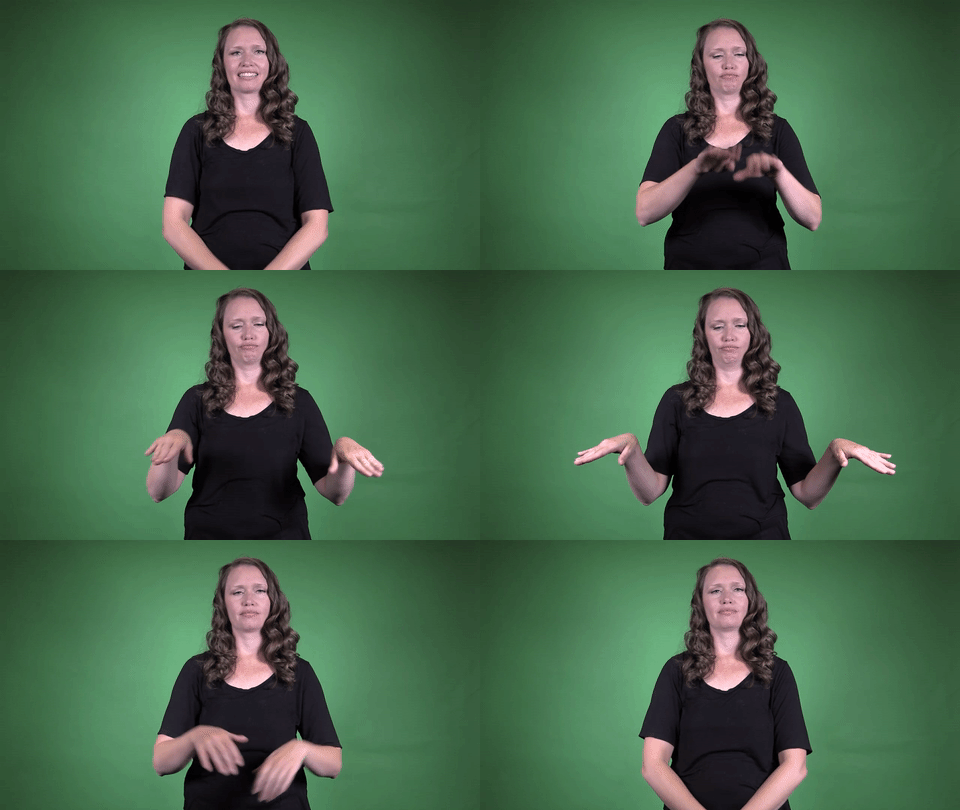
Sign for CHILDREN in ASL

YouTube player

Practice Activities:

To practice the sign for CHILDREN in ASL, start by isolating the sign and repeating it in front of a mirror. Focus on making the correct movement and hand placement, which mimics patting the tops of small children’s heads at a low height in front of your body. Use a consistent rhythm and practice signing it ten times while saying the English word to reinforce the association.

Try incorporating the sign into simple phrases such as “I love children” or “children are playing.” This helps you connect the sign with real-life usage. Sign each phrase slowly first, then again at a natural pace. Mix in additional signs for people, actions, or places to support your understanding of how the sign for CHILDREN in ASL functions in broader sentence structures.

Create a short story that includes the sign often, such as a day at the park, a school day, or family gathering. Use signs for activities like “run,” “laugh,” and “play,” to describe what the children are doing. Rehearse this short story multiple times, gradually reducing your dependence on written notes as your comfort grows.

With a partner, take turns describing photos that feature children. Describe what each child is doing using ASL, incorporating the sign for CHILDREN naturally. For example, you could say, “Children eat ice cream” or “Children read books.” This reinforces facial expressions and spatial referencing in ASL.

Watch videos featuring family settings or educational themes, and identify when the sign for CHILDREN in ASL appears. Mimic the sign along with the video for real-time engagement. Practicing expressive and receptive skills together ensures you’re not only producing the sign correctly, but also recognizing it easily in different contexts.

Cultural Context:

In American Sign Language (ASL), understanding cultural context is key to fully grasping the meaning and appropriate usage of signs. The sign for children in ASL is not only about vocabulary—it reflects values, interactions, and perspectives within the Deaf community. The way children are viewed and respected in Deaf culture influences both how this sign is taught and how it’s used every day.

Deaf culture places a high value on children’s participation and inclusion. Signing around children and involving them in everyday communication builds language acquisition organically. The sign for children in ASL is commonly used in homes, at Deaf schools, community events, and religious gatherings—settings where children are seen as full members of the community, not just learners.

ASL is a visual language deeply connected to facial expressions and body movement. When someone signs children in ASL, they often include facial grammar that matches the context—whether speaking joyfully about playtime or more seriously about education . This non-verbal layer adds emotional depth and clarity beyond the hand sign itself.

In Deaf culture, raising bilingual children—fluent in both ASL and written English—is considered essential. The sign for children in ASL is often one of the first signs used by Deaf parents interacting with their kids. It carries emotional weight and cultural pride, especially for families committed to passing on ASL as a native language.

Storytelling and play are major components in Deaf child-rearing. The sign for children in ASL is commonly used while telling stories, teaching lessons, or initiating group games. It becomes part of visual storytelling, working seamlessly with animated facial expressions, gestures, and spatial referencing.

Group identity is also expressed through the sign for children in ASL. During Deaf events like community picnics or youth camps, signing children in ASL while referencing a group helps build unity and shared identity ‍♂️ ‍♀️. It’s not just about pointing to age—it reflects a collective experience shaped by language and culture.

Signs in ASL are sometimes adapted slightly based on regional variations or generational shifts. The sign for children in ASL may look different in some households or schools, shaped by local habits or evolving language use. Even so, the core meaning remains consistent, supported by shared cultural understanding.

Respect for youth and the role of children in Deaf families influence how often this sign is used. From interpreting services to educational rights, the focus on children’s access to ASL is foundational. When using the sign

Extended Definition:

The sign for children in ASL is a visual and expressive representation used to refer to young people or kids. It typically uses both hands to indicate the general height of small children, mimicking the motion of patting children on the head. This sign can vary slightly depending on region or context, but its meaning remains widely understood within the Deaf community.

When using the sign for children in ASL, facial expressions and natural body movements play an important role. ASL communicates not only through hands but also through the face and posture, adding emotional tone and clarity. For example, smiling while signing can add a loving or playful feel to the expression.

This sign is often used in conversations involving family, education, or community events. Whether talking about your own kids, a classroom full of little ones, or programs designed for youth, the sign for children in ASL appears frequently. It’s a foundational term that comes up in everyday signs and casual conversations alike.

ASL is not just a direct translation of English but a language all its own with unique grammar and structure. The sign for children in ASL fits seamlessly within ASL sentence construction, which may place the subject, object, and verb in a different order than spoken English. Context and non-manual signals work together to create full meaning.

The sign for children in ASL is often one of the early signs taught in ASL beginner classes. This is because it is simple to learn and widely applicable. Parents learning baby sign language also find it useful for communicating with their little ones before they develop verbal language.

In storytelling and classroom settings, the sign for children in ASL helps narrators or teachers to refer to characters or groups of students clearly. Its repeated use in these contexts reinforces its importance and supports language development for young Deaf or Hard of Hearing students. Educators often include it in songs, book readings, and daily instructions.

ASL is a dynamic language, and different communities may apply the sign for children in ASL with slight variations in movement or hand placement. These regional differences do not change the meaning but reflect the natural evolution of language through use and culture. Learning the sign with its common variations is helpful when communicating with a broader audience.

Parents and caregivers use the sign for children in ASL to give basic instructions or describe group activities like playtime, meals, or storytime . It becomes an essential part of leading group interactions and creating inclusive environments. In family life, this sign comes up every day, building both

Synonyms: kids, youngsters, minors, youths, tots

Educational resources: Find related learning materials in our course bank!

Want more? Check out some of our popular learning activities on the homepage!

Need to look up a sign? Use our highly rated dictionary: https://aslinteractive.com/best-asl-dictionary/

Follow us on tiktok: https://www.tiktok.com/@aslinteractive. More social media links at the bottom of this page!

Long-tail Keywords: What is the sign for children in ASL, How do you sign children in ASL, ASL sign for children

Categories:

tags: children, family, people, language learning, schools

Parameters

*Handshape*:

The handshape for the sign for CHILDREN in ASL uses a flat hand with fingers extended and together, representing the action of patting multiple small heads. Both hands typically use this shape, starting at the center and moving outward in a patting motion.

This flat handshape mimics the way one might gesture toward a group of kids. In the sign for CHILDREN in ASL, this handshape helps convey the idea of more than one child clearly and visually.

*Palm Orientation*:

The palm orientation in the sign for CHILDREN in ASL involves both hands with palms facing downward toward the floor. The hands tap the air slightly in alternating motion, as if patting children on the heads.

This orientation creates a natural and expressive visual for the concept being conveyed. While producing the sign for CHILDREN in ASL, ensure that the palms stay horizontal throughout the movement for clear communication .

*Location*:

The sign for CHILDREN in ASL is produced in the neutral space in front of the body, slightly below the chest level. Both hands start open and pat downward alternately, mimicking the gesture of patting several small heads.

This location emphasizes a horizontal motion that aligns with the idea of multiple children standing beside each other. The sign for CHILDREN in ASL remains in front of the torso, requiring no contact with the face or head.

*Movement*:

To produce the sign for CHILDREN in ASL, hold both hands in front of your body with palms facing down, fingers slightly spread. Tap both hands downward alternately, as if gently patting the heads of small children around waist height.

The motion is repetitive and light, typically done twice to indicate the plural. The sign for CHILDREN in ASL visually mimics patting multiple little ones, making it easy to remember .

*Non-Manual Signals*:

When using the sign for CHILDREN in ASL, the non-manual signals typically include a soft and warm facial expression, such as a gentle smile and relaxed eyebrows. This conveys a positive, affectionate attitude that aligns with the meaning of “children.”

Eye contact should be soft or directed toward the area where the imaginary children would be. The overall demeanor should express innocence, care, or playfulness to support the sign for CHILDREN in ASL .

*Prosody, Dominant/Non-Dominant Hand*:

The sign for CHILDREN in ASL uses both hands, typically with palms facing downward. The dominant and non-dominant hands perform a gentle tapping motion, as if patting heads of several children in front of you.

Both hands move alternately or simultaneously from the center outward, showing the presence of more than one child. The sign for CHILDREN in ASL clearly conveys the concept of a group of young individuals through this outward motion.

Tips for Beginners:

When learning the sign for CHILDREN in ASL, it’s important to focus on hand placement and motion. The sign mimics the action of patting a few children’s heads in front of you. Use your dominant hand to tap the air in front of you, about chest height, in a light, bouncing motion. Then, move your hand to the side and repeat the motion, as if patting more than one child. This movement indicates plurality, which is essential in distinguishing this sign from the singular form of “child.”

One tip that helps beginners is to keep your hand relaxed and avoid making your taps stiff or robotic. The gesture should be smooth and natural. Practice in front of a mirror to make sure your hand stays horizontal and your motions are even. Don’t rush the movement—maintain a casual rhythm that reflects a gentle, caring pat.

A common mistake is tapping in a straight or diagonal line, which can confuse the meaning. The correct path is horizontal, spaced as if you’re tapping separate heads aligned in a row. Also, be sure not to pat too quickly or too forcefully—this can look aggressive or overly exaggerated. Soft, deliberate movements make the sign for CHILDREN in ASL easy to understand.

Facial expression adds clarity, especially when referring to children in a warm or loving context. Keep a kind expression to match the sentiment. If you’re referencing a specific number of children, you can use a number sign before or after CHILDREN to show quantity.

Practice this sign by incorporating it into everyday scenarios, such as storytelling or describing a family. Consistent repetition and feedback from fluent signers will quickly improve your accuracy. Mastering the sign for CHILDREN in ASL builds confidence and opens up meaningful communication for talking about family and youth.

sign for CHILDREN in ASL, ASL sign for CHILDREN, how to sign CHILDREN in ASL, CHILDREN sign ASL, American Sign Language sign for CHILDREN

Connections to Other topics:

The sign for CHILDREN in ASL is connected closely to the concept of people and family roles. It visually mimics the act of patting heads at a child’s height, tying it to gestures used for other generational signs like BABY or YOUTH. This sign is foundational for building more complex ideas involving young age groups or familial relationships.

This sign often appears in compound signs such as CHILDREN-GROUP or SCHOOL-CHILDREN, where context determines the specific meaning. In educational or institutional settings, the sign helps express meanings like “students,” “youth programs,” or “child-centered services.” Learners can benefit by understanding how the sign combines with others to form clear and intentional phrases.

The sign for CHILDREN in ASL relates to developmental or age-based topics too, connecting naturally to signs like GROW, SCHOOL, and LEARN. For example, phrases like GROW-UP or SMALL-CHILDREN use this sign to depict change over time or relative size. These combinations enrich the language by allowing users to express various stages of childhood.

Emotionally-centered signs also link well with the sign for CHILDREN in ASL. For instance, HAPPY-CHILDREN or PROTECT-CHILDREN illustrates emotional states and priorities in context. This shows how ASL can express complex ideas by pairing individual signs into meaningful units.

There is also a contrast between the sign for CHILDREN in ASL and the sign for STUDENTS, which involves a different focus, even though both may refer to the same group in a school setting. Understanding the appropriate use depending on context is key. When describing age groups in group activities, medical topics, or community events, this distinction becomes vital for clarity.

In storytelling and visual narratives, the sign is essential for characters or actions involving young individuals. It’s also used frequently in religious, educational, and public service interpreting where reference to children is common. This makes the sign for CHILDREN in ASL a valuable tool for clear, expressive communication.

Summary:

The sign for CHILDREN in ASL beautifully captures the essence of youth and community. It typically involves tapping both open hands alternately in a downward motion as if patting several small heads in a row. This mimetic gesture represents a group of children standing together, emphasizing plurality and simplicity.

This sign differs slightly from the sign for CHILD, which uses a single tap to imply one child. The repeated motion in the sign for CHILDREN is a critical grammatical marker in ASL, indicating more than one person. ASL utilizes spatial and temporal repetition as a natural part of its linguistic structure to express plurality.

The use of the sign for CHILDREN in ASL adds emphasis to a group dynamic, often accompanied by facial markers like a broad smile or animated eyebrows, which convey warmth or attentiveness. Non-manual markers play an essential role in ASL grammar and meaning, adding emotional and semantic layers.

Culturally, the sign for CHILDREN in ASL evokes strong connections within the Deaf community. Children are seen as the future of any culture, and Deaf children especially symbolize the transmission of Deaf identity, values, and language. This sign, then, becomes more than lexical—it represents legacy .

The sign is widely used in educational contexts, especially in Deaf schools and family discourse. Deaf educators often emphasize the importance of early language exposure and sign fluency for children to support optimal cognitive and linguistic development. The sign therefore recurs heavily in curriculum and planning.

In grammar, the sign for CHILDREN in ASL can serve as the subject or object of a sentence and is flexible in positioning. Its location in signing space can express differences in perspective or reference multiple groups. ASL’s spatial grammar allows for efficiency and clarity when referring back to groups of children.

When signing a sentence like “I love children,” the signer places the sign for CHILDREN first or indexes the group in space and uses proper facial grammar to clarify affirmative emotion. ASL syntax supports such visual restructuring as part of its non-linear design. This visual modality enriches contextual meaning.

Linguistically, the sign for CHILDREN in ASL is iconic, meaning its form reflects aspects of its referent. It illustrates the way ASL often relies on visual metaphor to construct meaning. Phonologically, the sign uses both handshape and movement for clarity and efficiency.

Morphologically, the repetition of movement reflects a frequent pattern in ASL where repeated action implies pluralization or habituality. A single pat becomes multiple pats, turning the singular into the collective. This morphological economy is typical of ASL structure.

Pragmatically, the sign for CHILDREN in ASL may adjust depending on register—formal, informal, or intimate contexts may change the signing speed or the signer’s facial expressions. Interactional settings like storytelling, academic instruction, or casual conversation all may shift its delivery.

In storytelling and ASL poetry, the sign often appears as part of sequences that illustrate play, learning, or imagination connected with youth. Deaf poets and performers often include references to childhood as shared cultural memory. This deepens its resonance across generations of signers ✨.

Signers may introduce a group by signing CHILDREN and then pointing to each child silently, thereby indexing individuals while preserving the collective group meaning. ASL allows such nuances by blending spatial language and gesture to expand discourse.

In language acquisition studies, the sign for CHILDREN in ASL is often one of the earlier plural signs children themselves will acquire. Sign acquisition research highlights repetition and iconicity as key contributors to early sign learning, and this sign embodies both.

From an applied linguistics perspective, analyzing signs like CHILDREN reveals how ASL encodes pluralization differently from English, not by affixes but by movement patterns. This insight supports second-language acquisition practices that emphasize visual cognition and gesture.

The sign also has pedagogical implications in bilingual settings, where Deaf and hearing children learn both ASL and English. Teachers can scaffold understanding by comparing plural strategies in both languages, making use of the intuitive visual aspects of ASL.

Children’s literature in ASL also routinely incorporates the sign for CHILDREN as part of introductions or closing lines in narrative formats. Storytellers often sign “Hello, children” or “Goodbye, children” by beginning or ending with that signed term, which orients and engages the young audience.

Use of the sign in community events such as Deaf club meetings, camps, religious gatherings, or theater further connects youth identity with broader Deaf cultural life. CHILDREN are celebrated as full participants in these spaces, and the sign invokes that inclusion.

Related signs include CHILD, BABY, STUDENT, and FRIEND—each of which relate to age, social role, or developmental stage. The transition from CHILD to STUDENT in sign form often reflects life changes and thus carries educational significance within the lexicon.

Grammatically, the sign may also appear as part of compound signs or sequences, such as CHILDREN-GROUP or CHILDREN-PLAY. In

Want more? Check out some of our popular learning activities!

ASL Interactive Resources

ASLInteractive YouTube Channel

Follow us on tiktok: @aslinteractive.com

Follow us on Instagram: aslinteractive

Facebook page: aslinteractive

Facebook group: aslinteractive

LInkedIn: ASL Interactive LLC

Twitter: @ASL_interactive

*Some information on this page is AI-generated. AI can make mistakes. Please check the information.

Sign for CHILDREN in ASL

Responses