Sign for CONTINUE in ASL | 🏁 ASL Dictionary

Definition: To keep going.

Sign for CONTINUE in ASL

YouTube player

Practice Activities:

To build confidence with the sign for CONTINUE in ASL, start by practicing it in isolation. Stand in front of a mirror and repeat the motion slowly five to ten times, making sure your handshape and movement are clear and accurate. Watch how your dominant hand leads the motion forward, followed closely by the non-dominant hand in the same shape.

Once you feel comfortable, incorporate the sign into simple sentences. Sign phrases like “I CONTINUE walk,” “Please CONTINUE,” or “CONTINUE practice every day.” Focus on using your facial expressions to reflect your intent—whether it’s encouragement, motivation, or instruction.

Use storytelling to develop fluency using the sign for CONTINUE in ASL. Try describing a daily routine, emphasizing how actions are repeated or carried on. For example, create a short narrative: “I WAKE-UP, EAT, CONTINUE WORK, LUNCH, CONTINUE WORK, then HOME.” This allows you to build a rhythm while maintaining grammatical structure.

Practice with a partner using a turn-taking game. One signs a sentence ending with CONTINUE, and the other adds on, mimicking a real conversation. For example, the first person signs “You STUDY,” then the second signs “CONTINUE STUDY FOR TEST.” This mimics fluid ASL communication and deepens contextual understanding.

For receptive practice, watch videos or classroom materials showing the sign for CONTINUE in ASL and try to identify it in context. Write down surrounding signs to build familiarity with common phrases. You can also record yourself and compare your sign to reference videos to catch subtle variations.

Finally, play an improvisation game where you are given random prompts and must incorporate CONTINUE logically. Prompts can include situations like being stuck in traffic, reading a long book, or trying to fix a computer. This encourages spontaneous, expressive use of the sign.

Cultural Context:

In Deaf culture, communication is more than just words—it’s a fully visual experience. The sign for continue in ASL is used often during conversations to keep the dialogue flowing. When someone wants to show persistence, keep a story going, or express the idea of moving forward, the sign for continue in ASL becomes essential.

The use of the sign is not limited to just literal meanings. Within Deaf spaces, the sign for continue in ASL can symbolize resilience or determination. Whether it’s continuing a chat, a project, or showing strength through hardship, the sign captures the cultural value of moving ahead without stopping.

Language in ASL is deeply connected to facial expressions and body movement. When signing the sign for continue in ASL, your facial expression adds important context. A hopeful look, a serious tone, or even a relaxed face can change the feel of the message without changing the handshape.

ASL isn’t just hands moving—it’s a visual reflection of life and emotions. The sign for continue in ASL gives room for expression that supports clarity between signers. It’s common in storytelling, one of the richest parts of Deaf culture, where stories unfold through signs and expressions with perfect rhythm.

When children in Deaf families learn ASL, they naturally learn how and when to use this sign. The sign for continue in ASL often appears in educational content, tutoring sessions, and even during play. It offers a way for young signers to indicate they want something to go on, or that they aren’t ready to stop yet .

In group discussions and social conversations, the sign for continue in ASL keeps conversations active. It tells others you’re engaged and want more. Cultural cues like this are part of the reason ASL is so effective and beautifully nuanced ⭐️.

Some community members use the sign to say they support ongoing efforts, like social justice or education. So, the sign for continue in ASL also becomes symbolic—used in rallies or community events as a visual signal for collective progress. It’s more than vocabulary. It’s momentum.

In Deaf poetry and visual storytelling, this sign appears when an idea builds or transitions smoothly. The sign for continue in ASL acts like a bridge connecting thoughts, maintaining flow and grace. It allows storytelling to mimic the rhythm of language just like spoken poetry does .

Everyday expressions in Deaf households rely on quick, high-frequency signs. The sign for continue in ASL is one of these signs used both casually and in more formal

Extended Definition:

The sign for continue in ASL is a smooth and simple motion that symbolizes ongoing movement or progression. It effectively conveys the idea of persistence or the act of carrying on with a task, conversation, or journey. This sign is useful in both casual and formal ASL discussions and frequently appears in storytelling, instructions, and everyday dialogue.

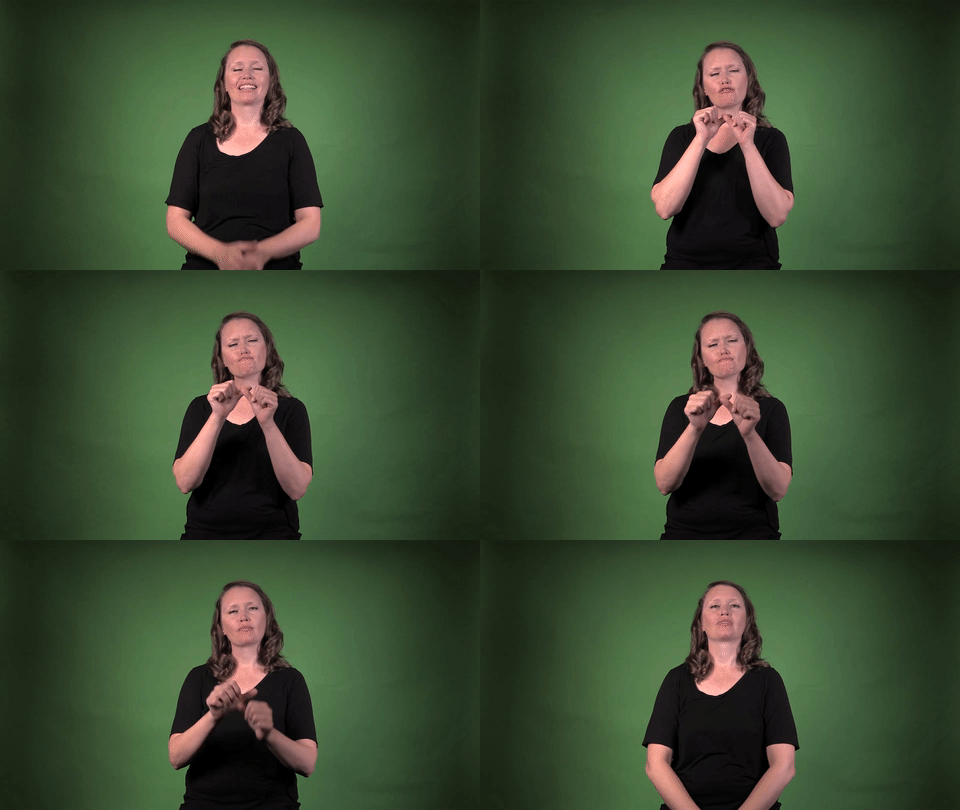
In American Sign Language, the sign for continue is created by placing both thumbs extended while the hands are in fists. Starting with the hands at the center of the chest, they move forward together in a steady, mirrored motion, resembling forward movement. The sign visually represents the passing of time or the ongoing nature of an action.

The sign for continue in ASL stays consistent in structure but can be easily adjusted with facial expressions and body language for added meaning. By emphasizing the movement or changing your facial expression, you can show urgency, hesitation, or determination. Non-manual markers are essential when using this sign because they add emotional depth and clarify the context.

This sign is commonly used alongside verbs such as work, talk, or study. For example, you might say, continue work to express that you need to keep working on a project. In conversation, you could use it after a brief interruption to indicate that you are ready to pick up where you left off.

For children and new ASL learners, learning the sign for continue in ASL is a building block toward mastering time-related concepts and sentence expansion. It helps transition ideas or introduce the next step in a sequence. Teachers often incorporate this sign in classroom routines to transition between lessons or guide students through tasks.

Understanding the sign for continue in ASL deepens comprehension of how ASL uses visual-spatial elements. Unlike spoken language, ASL uses movement and space to communicate time and action. Continue is a perfect example of how motion supports meaning in American Sign Language.

There are variations in how smoothly or firmly the sign is made depending on regional style or personal habits. Despite this, the core concept remains easily recognizable across the ASL community. Watching fluent signers helps new learners adopt natural rhythm and flow when using signs like continue.

ASL interpreters use the sign for continue in ASL when translating live speech or captions that include transitions or ongoing actions. It helps preserve the natural flow of information and maintains the speaker’s intended meaning. Whether the context is casual or academic, this sign fits seamlessly into many sentence types.

As digital communication and online learning grow, more people are searching for the sign for continue in

Synonyms: carry on, proceed, go on, keep going, move ahead

Educational resources: Find related learning materials in our course bank!

Want more? Check out some of our popular learning activities on the homepage!

Need to look up a sign? Use our highly rated dictionary: https://aslinteractive.com/best-asl-dictionary/

Follow us on tiktok: https://www.tiktok.com/@aslinteractive. More social media links at the bottom of this page!

Long-tail Keywords: what is the sign for continue in ASL, how do you sign continue in ASL, ASL sign for continue

Categories:

tags: Commands, Language Learning, Verbs, Classroom Picture, Everyday activities

Parameters

*Handshape*:

The handshape for the sign for CONTINUE in ASL uses two modified “A” handshapes . Both hands are closed into fists with the thumbs extended forward. The thumbs gently brush or slide forward together in unison. This motion represents the idea of progression or moving forward, which aligns with the concept behind the sign for CONTINUE in ASL. The handshape remains steady to emphasize continuous action.

*Palm Orientation*:

For the sign for CONTINUE in ASL, both hands are typically in the “A” handshape with the thumbs extended. The palms face sideways, generally inward toward the body or slightly angled down. The thumbs of each hand are placed side by side and pushed outward simultaneously in a smooth forward motion. This palm orientation helps emphasize the ongoing or prolonged nature expressed in the sign for CONTINUE in ASL.

*Location*:

The sign for CONTINUE in ASL is located in the neutral space directly in front of the torso, a few inches away from the body. Both hands are positioned at mid-torso level, with thumbs extended forward and hands in A handshapes.

To perform the sign for CONTINUE in ASL, the thumbs move forward in a small, simultaneous motion as if pushing something away. This movement remains close to the center of the body, making it visible and easy to follow during communication.

*Movement*:

The sign for CONTINUE in ASL involves both hands in the “A” handshape with thumbs extended. The thumbs are placed next to each other, touching at the knuckle, and held near the chest.

Move both hands forward together in a smooth, steady motion, as if pushing something ahead. This forward movement symbolizes ongoing action, which aligns with the meaning of the sign for CONTINUE in ASL .

*Non-Manual Signals*:

When using the sign for CONTINUE in ASL, the facial expression should remain neutral to slightly focused, indicating a steady progression or ongoing action. Eyebrows are typically relaxed, and the eyes may follow the directional movement of the hands to support the meaning of continuation.

To emphasize the sign for CONTINUE in ASL, a subtle head nod can be added, reinforcing the idea of maintaining an action without stopping. The overall body posture should remain forward and engaged.

*Prosody, Dominant/Non-Dominant Hand*:

The sign for CONTINUE in ASL uses both hands in the “A” handshape with thumbs extended. The dominant hand is placed slightly behind the non-dominant hand at chest level. Both thumbs point forward as the hands move outward together in a small, straight motion. This movement shows the idea of ongoing or forward motion, which reinforces the meaning behind the sign for CONTINUE in ASL .

The hands remain side-by-side, maintaining the same plane and orientation as they glide smoothly forward. Facial expression should stay neutral or slightly focused, depending on the context. Using both hands in the same handshape emphasizes symmetry, which plays a key role in clearly conveying the sign for CONTINUE in ASL.

Tips for Beginners:

When learning the sign for CONTINUE in ASL, it’s helpful to pay close attention to the motion and hand shape. Both hands are used in the “A” handshape (thumbs extended), with the tips of the thumbs touching. The thumbs then move forward together in a smooth, continuous motion, showing progression or persistence. Practicing this motion slowly will help reinforce muscle memory and smooth transitions.

Beginners often struggle with the directionality and uniformity of the forward movement. One common mistake is allowing the thumbs to separate or moving one hand faster than the other, which can confuse meaning. Make sure both hands move at the same speed and remain aligned. Using a mirror or recording yourself can help spot these misalignments early.

Another tip for mastering the sign for CONTINUE in ASL is to maintain consistent facial expressions. Without correct non-manual markers, the sign can lose its emphasis. Keep a neutral or slightly serious expression depending on the context, especially when referring to ongoing actions or emotions. Your face supports the meaning just as much as your hands.

Spacing is also key: make sure your thumbs are not too far apart or touching too tightly. This balance ensures the sign is both natural and easy to understand. Overemphasis in force or speed can make your signing appear aggressive or rushed, so strive for smooth, deliberate motion.

Using the sign for CONTINUE in ASL naturally comes with practice, so try incorporating it into everyday signing. Watch fluent signers and notice their pacing and transitions. Repetition through conversation is one of the best ways to reinforce what you’ve learned. With time and awareness of these details, the sign will become second nature.

sign for CONTINUE in ASL, how to CONTINUE in American Sign Language, CONTINUE sign meaning in ASL, learn CONTINUE in ASL, CONTINUE sign language gesture, signing CONTINUE correctly in ASL

Connections to Other topics:

The sign for CONTINUE in ASL shares structural and semantic similarities with signs like MOVE FORWARD, STILL, and PROCEED. These signs often use directional hand movements that convey continuity, progression, or sustained action. This movement-based approach reflects ASL’s visual-spatial grammar, where directional flow helps express temporal or sequential relationships.

Learners encounter the sign for CONTINUE in ASL when describing ongoing actions or future plans. It commonly appears in narratives to show sustained effort or unbroken activity. For example, in storytelling or everyday conversation, one might say “WORK CONTINUE” to express “keep on working” or “continue working.”

This sign also links closely with temporal concepts like FUTURE, AGAIN, and NEXT. These signs often appear together in longer sentences or phrases, reinforcing the duration or progression of events. For instance, combining CONTINUE with STUDY forms a compound concept equivalent to “continue studying” or “keep studying.”

Understanding the sign for CONTINUE in ASL helps learners recognize how signs like TRY, PERSIST, and ENDURANCE develop more abstract meanings. These ideas use similar hand movements or placements, highlighting determination and perseverance, often seen in motivational or instructive contexts. CONTINUE builds a bridge to such emotional and cognitive verbs in ASL.

It also helps in understanding classifiers and role-shifting, especially when demonstrating characters moving forward in space or remaining engaged in an action. Within classifiers, directionality can substitute for the explicit use of CONTINUE, making scenes more fluid and natural.

The sign for CONTINUE in ASL gives learners insight into how ASL handles verbs of duration and progression without adding extra grammar. This makes it easier to understand how ASL handles aspects like tense and continuity in conversation. Mastery of this sign enhances clarity in describing sustained actions or routines over time .

Summary:

The sign for CONTINUE in ASL is conceptually foundational. It symbolizes forward movement, persistence, and progression, making it linguistically and culturally rich. Use of this sign frequently aligns with narratives centered on duration, endurance, or an ongoing action in time.

To produce the sign for CONTINUE in ASL, both hands are formed into “A” handshapes. The thumbs extend forward and touch each other at the tips. The hands are positioned in front of the chest and then move forward together in unison, as if pushing the timeline ahead.

This movement implies real-time advancement and the maintenance of an ongoing state. It does not show a stop-and-go action; instead, its motion is smooth, steady, and deliberate. The direction and intentionality reinforce its meaning both visually and semantically.

The form itself reflects a metaphorical journey. In Deaf culture, progression and continuity are valued themes, especially in educational and advocacy contexts. Thus, the sign for CONTINUE in ASL metaphorically speaks to endurance, resilience, and moving forward through life.

Used grammatically, the sign frequently appears in storytelling or explanation when narrating ongoing events. You might see it in statements like “she continued talking” or “we continue every day.” Here it bridges phrases, creating flow in ASL sentence structure.

In ASL grammar, verbs like CONTINUE express aspect, especially the durative aspect. This aspect focuses on the continuity of an action and is often supported by consistent facial expressions matching the intended duration or emphasis.

Linguistically, the sign for CONTINUE in ASL borrows elements of metaphor. The spatial-forward motion maps time conceptually, portraying the idea of ongoing action through a physical pathway. This is a classic example of how ASL utilizes space to express time.

Application of this sign in educational settings can reflect goals or procedural steps. For example, teachers might use it to indicate that students should proceed with a task or persist during a challenging lesson. It reinforces encouragement.

The sign sometimes overlaps conceptually with other ASL signs such as KEEP-GOING, PROCEED, or MAINTAIN. These similar ideas can be clarified by adjusting facial grammar, pace of movement, or context cues to retain distinct meanings.

In casual conversation, the sign for CONTINUE in ASL is used to prompt someone to go on with a story or explanation. It can be accompanied by raised eyebrows or a nod, inviting elaboration or signaling interest in more information.

Culturally, this sign empowers expression in moments of persistence. Within the Deaf community, stories of overcoming societal barriers or personal adversity are frequent—CONTINUE becomes uniquely expressive in these encouraging retellings.

The embodied movement in the sign is an echo of bilingual-bimodal communication patterns. This non-linear yet continuous flow reflects intersections between language and gesture, making it profound both symbolically and practically.

From an applied linguistics view, CONTINUE in ASL supports scaffolded language development during ASL acquisition. Like how English speakers learn transitions and connectors, ASL users learn this sign to bridge lexical concepts fluidly.

Use of this sign in ASL poetry or visual vernacular enhances rhythm and continuity. It helps flow transitions between visual stanzas or thematic ideas, maintaining coherence. Artists often use CONTINUE in tandem with movement storytelling.

Syntax-wise, it usually follows the subject in a standard SVO (subject-verb-object) structure in ASL. However, topicalization can shift its placement depending on what is being emphasized—such is the flexibility of ASL’s grammar.

In broader discourse, the sign for CONTINUE in ASL contributes to narrative cohesion. It acts like punctuation or conjunctions do in English, linking thoughts, emphasizing progress, or introducing sustained emotion or action.

The sign inherits layered meaning through cultural memory. It is often part of empowerment narratives, particularly those celebrating educational achievements, activism, or community advancements within Deaf identity.

In interpreting, the sign for CONTINUE in ASL can represent sustained conditions like ongoing weather, procedures in meetings, or developing medical treatments. Interpreters may modify prosody and sign size to fit tone or tempo accurately.

This sign inherently resists pausing; it promotes stamina and fluidity. It works well with other action-based signs to indicate sequences or prolonged emotions. CONTINUE easily integrates with classifiers to express ongoing movement or states.

Interestingly, parallel equivalents exist in several sign languages around the world, emphasizing universality. Although signs differ in formation, many share a directional movement denoting forward continuity, signaling shared human cognition in sign structure.

In education, teachers might pair this sign with visual aids or directional paths to teach sequencing or future actions. For example, “first do this, then CONTINUE here” models logical association using visual clarity.

The sign for CONTINUE in ASL may be used in religious signing, such as expressing “continue in faith” or

Want more? Check out some of our popular learning activities!

ASL Interactive Resources

ASLInteractive YouTube Channel

Follow us on tiktok: @aslinteractive.com

Follow us on Instagram: aslinteractive

Facebook page: aslinteractive

Facebook group: aslinteractive

LInkedIn: ASL Interactive LLC

Twitter: @ASL_interactive

*Some information on this page is AI-generated. AI can make mistakes. Please check the information.

Sign for CONTINUE in ASL

Responses