Sign for DISHWASHER in ASL | ASL Dictionary

Definition: A machine for washing dishes.

Sign for DISHWASHER in ASL

YouTube player

Practice Activities:

Start by practicing the sign for dishwasher in ASL in isolation. Stand in front of a mirror and repeat the sign several times, focusing on handshape, movement, and facial expressions. Make sure each repetition is consistent and accurate to build muscle memory.

Next, use flashcards to build your vocabulary around kitchen and cleaning terms. Include the sign for dishwasher in ASL along with related signs like SINK, SOAP, PLATES, and CLEAN. Practice by signing full phrases such as “put dishes in dishwasher” or “my dishwasher is broken.”

Use video prompts to describe your kitchen using signs. For example, record yourself signing a short description such as “In my kitchen, I have a dishwasher, a stove, and a fridge.” This exercise will allow you to incorporate the sign for dishwasher in ASL naturally into your storytelling.

Practice dialogues with a partner or a study group. One person can ask questions like “Do you have a dishwasher?” or “How do you wash your dishes?” Respond in full ASL sentences, integrating role-shifting and facial expression to enhance communication. Repeat with different scenarios to practice flexibility and context.

Try role-playing activities that simulate real-life routines. Act out cleaning the kitchen, including loading the dishwasher, choosing a cycle, and pressing the button to start. Sign each step clearly for peers or teachers and get feedback on your clarity and fluency.

Finally, create a simple story or skit that features the sign for dishwasher in ASL. It could be a daily routine or a funny situation involving a dishwasher mishap. Share with a class or group to gain confidence signing in front of others and to experience using the vocabulary in a meaningful way.

Cultural Context:

In Deaf culture, everyday household appliance signs like the sign for dishwasher in ASL help promote independence and accessibility. Being able to communicate items like dishwasher in ASL gives Deaf individuals the freedom to discuss household tasks clearly and effectively. This sign is especially useful in environments like Deaf-friendly workplaces, kitchens, and home settings.

The sign for dishwasher in ASL is used in conversations about chores, cleaning routines, and meal prep. Using this sign during casual discussions helps make communication more natural and efficient for Deaf users. Whether you’re telling someone the dishwasher is full or asking for help cleaning, this sign fits into lots of different social and family contexts.

Because the dishwasher is a common household appliance, children in Deaf families often learn the sign early in life. Parents, teachers, and interpreters use the sign for dishwasher in ASL to begin teaching responsibility and cleanliness through signed routines. It’s regularly incorporated into ASL vocabulary lessons for young learners and in Deaf education programs.

In many Deaf community gatherings, food preparation and clean-up is a shared responsibility. The sign for dishwasher in ASL becomes helpful for coordinating who’s loading or unloading after meals. It ensures everyone involved can communicate their role in the cleanup process without confusion, building a sense of teamwork and respect.

ASL isn’t just about direct translations—it reflects how the Deaf community interacts with the world. The sign for dishwasher in ASL may vary slightly due to regional dialects or generational shifts, but the meaning remains easily understood. These slight differences show the richness and diversity within ASL itself.

For interpreters, knowing the sign for dishwasher in ASL can be crucial in classroom or domestic interpretations. Whether interpreting for cooking shows or home management classes, this sign helps make sure messages stay clear. ASL interpreters rely on signs like dishwasher to keep up with real-world conversations that include detailed household vocabulary.

Culturally, the use of the sign for dishwasher in ASL shows how visual language adapts to modern tech and appliances. As kitchens evolve, so does the language. Having specific signs for appliances supports full engagement in everyday living for the Deaf community.

Parents sometimes incorporate the sign for dishwasher in ASL during structured home routines to support visual schedules. This helps children follow steps and timelines for chores, encouraging responsibility through accessible communication. It’s a gesture that blends life skills with language development.

In storytelling or skits often performed in ASL, props like a dishwasher are common. Using the sign for dishwasher in ASL adds realism and connects the

Extended Definition:

The sign for dishwasher in ASL refers to the specific American Sign Language gesture used to represent the common kitchen appliance that cleans dishes automatically. This sign can vary depending on regional differences, but most signers use a combination of signs or classifiers to convey the meaning clearly. Knowing the sign for dishwasher in ASL is helpful when discussing household chores, kitchen appliances, or daily routines.

The most common way to sign dishwasher involves using the sign for dish or plate followed by a motion that suggests the washing or cleaning process. Some ASL users may fingerspell the word initially before showing a visual representation using classifiers. This helps clarify meaning when the conversation context is not obvious.

In ASL, context often determines how a concept like dishwasher is signed. If the conversation already involves kitchen appliances, the sign can be abbreviated or rely on gestures showing the appliance’s function. The sign for dishwasher in ASL helps improve understanding and makes communication about household tasks easier in Deaf and Hard of Hearing communities.

Parents, educators, and interpreters benefit from learning the sign for dishwasher in ASL because it allows them to describe kitchen chores and responsibilities clearly. Sign language instructors often demonstrate the symbolic motion of dishes being cleaned as part of teaching this sign. Children learning ASL will often associate this sign with real-world experiences in the kitchen.

When using the sign for dishwasher in ASL, it’s important to maintain facial expressions and body language appropriate to the context. The sign itself might differ slightly depending on whether you’re referring to a built-in dishwasher or someone manually washing dishes. Including these nuances helps express more detail in ASL conversations.

The sign for dishwasher in ASL is often taught alongside other kitchen-related signs like microwave, refrigerator, and sink. This builds useful vocabulary for discussing daily life. It supports Deaf independence and also helps ASL learners improve fluency with functional signs.

Signers frequently use the environment around them to refer back to appliances like the dishwasher. For example, they might look or point in the direction of the dishwasher after signing it to clarify the subject. This spatial referencing adds to the richness of ASL and reinforces visual learning.

Some people choose to fingerspell the full word dishwasher instead of signing it, especially if they are unsure of the regional variation. However, using the actual sign for dishwasher in ASL is more fluid and natural once the vocabulary is learned. That’s why fingerspelling is often used as a bridge while acquiring more ASL vocabulary.

ASL is a dynamic and evolving language, and signs for

Synonyms: dishwashing machine, dish cleaner, dishwashing appliance, dish sanitizing machine, automatic dishwasher

Educational resources: Find related learning materials in our course bank!

Want more? Check out some of our popular learning activities on the homepage!

Need to look up a sign? Use our highly rated dictionary: https://aslinteractive.com/best-asl-dictionary/

Follow us on tiktok: https://www.tiktok.com/@aslinteractive. More social media links at the bottom of this page!

Long-tail Keywords: What is the sign for Dishwasher in ASL, How do you sign Dishwasher in ASL, ASL sign for Dishwasher

Categories:

tags: chores, household appliances, everyday activities, home, kitchen items

Parameters

*Handshape*:

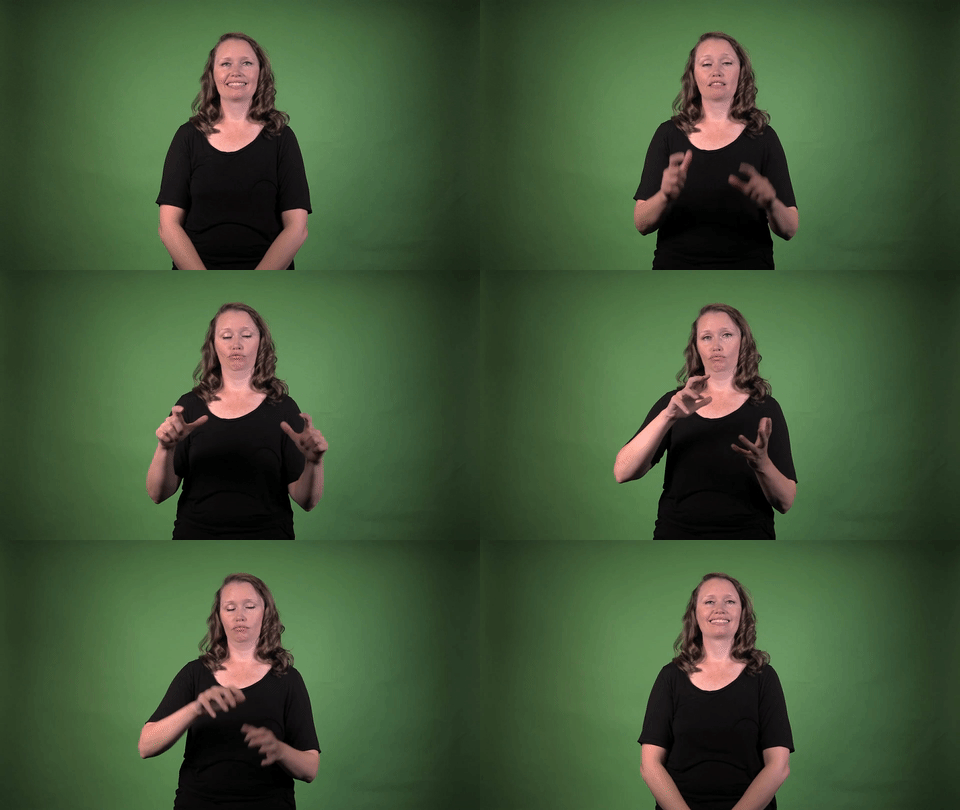
The handshape for the sign for DISHWASHER in ASL typically uses the “flat O” handshape to show the idea of holding a dish. Both hands form flat O shapes and mimic the motion of scrubbing or placing dishes. This visually represents how a dishwasher works.

In some variations, the sign is a compound of the sign for DISH followed by the sign for WASH. The handshapes used remain consistent, emphasizing object and action. The sign for DISHWASHER in ASL clearly conveys its meaning through these familiar hand formations. ️

*Palm Orientation*:

For the sign for dishwasher in ASL, the palm orientation starts with both hands in a flat “B” handshape, palm facing each other as if holding a dish. The movement mimics washing, and the palms stay mostly inward-facing throughout. When fingerspelling the word “DISHWASHER”, each letter is formed with the palm facing forward, as is standard in fingerspelling. This maintains clarity and visibility for the receiver. The sign for dishwasher in ASL often blends signs for “DISH” and “WASH” before fingerspelling “ER” or just fingerspelling the entire word.

*Location*:

The sign for DISHWASHER in ASL generally takes place in front of the torso, slightly above waist level. This is a neutral signing space where many household object signs occur.

Depending on the version used, the sign for DISHWASHER in ASL might combine the signs for DISH and WASH or use a mime-like motion representing a dishwasher door. These movements remain close to the body for clarity and efficiency. ️

*Movement*:

To show the sign for dishwasher in ASL, start by signing DISH: mime holding a dish with the flat dominant hand and rubbing it in a circular motion on the palm of the non-dominant hand, simulating washing. Then, fingerspell W-A-S-H-E-R quickly but clearly, keeping the hand at chest height.

The combination of DESCRIPTIVE + fingerspelling effectively communicates the sign for dishwasher in ASL. Depending on context, some signers may also mime placing dishes into a machine with a downward motion to add clarity. ️

*Non-Manual Signals*:

When using the sign for dishwasher in ASL, the face should remain neutral or slightly engaged to indicate the nature of the appliance. A slight nod and focused eye gaze toward the imaginary dishwasher may accompany the sign to show clarity and engagement.

The non-manual signals for the sign for dishwasher in ASL support the appliance’s routine function. Raised eyebrows may be used when asking a question involving the dishwasher, while a casual expression is suitable when simply naming or explaining it.

*Prosody, Dominant/Non-Dominant Hand*:

The sign for DISHWASHER in ASL typically uses a combination of signs or mimics the action of washing dishes mechanically. The dominant hand often forms a flat hand or modified C-shape and moves in a circular or scrubbing motion over the palm of the non-dominant hand, simulating dishwashing. Some versions may incorporate the fingerspelled D-W to indicate the appliance.

In the sign for DISHWASHER in ASL, both hands work together to show the concept clearly. The dominant hand leads the motion, while the non-dominant hand supports the visualization, helping to distinguish it from manual dishwashing. You might also see the appliance concept added with classifier or initialized handshapes depending on regional variance. ️

Tips for Beginners:

When learning the sign for DISHWASHER in ASL, it’s helpful to break it down into parts. Many signers use a compound sign that includes the sign for DISH followed by the sign for WASHER, or they fingerspell the word DISHWASHER, depending on context. Since the sign can vary by region or personal choice, it’s important to become familiar with both fingerspelling and compound sign methods.

If you opt to fingerspell, practice keeping your hand steady and at chest level, with letters clear and distinct. Make sure not to drop your letters as you go from D to R, which can be a common mistake among beginners. For those using the compound sign, watch how native signers transition from dish to washer smoothly—practicing this flow will make your communication more natural.

One helpful tip is to mirror experienced signers through video clips or live practice. Watching how they use facial expressions and body movement along with the sign for DISHWASHER in ASL can significantly improve your fluency. Timing and facial grammar matter, especially if you’re expanding the context—talking about a broken dishwasher, for example, might require additional signs or facial cues.

Be aware that some people sign DISHWASHER by mimicking a washing motion with flat hands near the dish area. This variation might confuse others not familiar with that version, so when in doubt, fingerspelling is a safe and universally understood option. Try not to rush as you sign or fingerspell, clarity is more important than speed .

Developing confidence with the sign for DISHWASHER in ASL takes time and exposure. Repetition through daily use and incorporating it into household contexts will help solidify memory and comfort. Whether you choose to fingerspell or sign the concept, consistency is key .

Connections to Other topics:

The sign for DISHWASHER in ASL connects closely with the concept of combining base signs to describe technology or appliances. Often, signs for household items are compound signs that merge function and context. In this case, the sign for DISHWASHER may combine the signs for WASH and DISH or use a classifier to describe the shape of a machine depending on the signer’s preference or regional variation.

This sign also relates to the broader category of kitchen and cleaning vocabulary. Other signs in this group include SINK, DRY, SOAP, and CLEAN. Learning the sign for DISHWASHER in ASL can naturally lead into understanding signs like HOUSEWORK, CHORE, or the names of other household appliances like MICROWAVE or WASHING-MACHINE.

Learners will find it helpful to see how the sign for DISHWASHER in ASL can vary in complexity, sometimes showing an abbreviated motion for frequent conversation or using classifiers to demonstrate how dishes are placed into the machine. Advanced signers may incorporate facial expressions or space to show whether the dishwasher is running or broken, which is an important part of ASL grammar.

Compound signs like DISHWASHER also open the door to understanding how signs are created and evolve. For example, the sign for COMPUTER or VACUUM CLEANER also uses descriptive components to show function. The modeling of these items using mime and classifiers helps support spatial reasoning in ASL and makes communication more visual and expressive.

Understanding the sign for DISHWASHER in ASL enhances one’s ability to talk about routines, responsibilities, and home life. It also contributes to narrative skills when describing a day in the life or explaining how tasks are done around the house . This sign is a stepping stone to describing processes, sequences, and technology in ASL fluently.

Summary:

The sign for DISHWASHER in ASL can be expressed in a couple of common ways, depending on the signer’s preference or regional variation. One method involves using a compound sign, combining the sign for DISH and the sign for WASHER. The sign for DISH is often represented by miming a small round object in front of the body, implying the shape of a plate.

For WASHER, the sign usually engages a repetitive rubbing motion that mimics the action of washing or a machine turning. Together, the concept is clearly rendered as a dish-cleaning appliance. Another way is to fingerspell the word DISHWASHER, especially when referring to the modern appliance specifically or in formal contexts.

Fingerspelling tends to be used when clarity is crucial, especially in educational settings or when introducing new vocabulary. The sign for DISHWASHER in ASL reflects both function and technological understanding. When using the compound sign version, it can be especially helpful in casual or conversational contexts where speed and fluency are preferred.

Some signers also reframe the sign depending on whether they’re referring to a person who washes dishes or the machine. When meaning the person, they might sign DISH and then add the AGENT-marker sign, which is made by forming a downward motion with both flat hands at chest level, symbolizing profession. For the appliance, it shifts more toward the machine metaphor.

Context dictates how the sign is used and understood. The sign for DISHWASHER in ASL carries semantic richness because it’s tied to domestic life, work responsibilities, and technology. Signers tend to adapt the sign for DISHWASHER in ASL over time based on shifts in household norms and appliance usage.

Grammatically, the sign can function as a noun, and if referring to the action, signers may switch to signs like WASH-DISHES or WASH-PLATES. These emphasize the process rather than the tool or device. In daily conversation, emphasis on the act or the appliance varies depending on the topic.

This flexibility shows how spatial and classifier information enriches communication. For instance, to depict someone loading a dishwasher, classifiers representing hands placing objects can be employed to display realism. The use of classifiers further adds to the visual storytelling mode that ASL excels at.

The sign for DISHWASHER in ASL is often supported by facial expressions or role-shifting for realism. A signer may simulate the noise or physical presence of the machine through body movement or puffed cheeks, which adds dimensions to the interpretation. These layers of expression show how ASL is uniquely capable of representing dynamic objects and processes.

Within Deaf culture, the concept of a dishwasher touches on broader themes like household roles and accessibility. For Deaf individuals navigating kitchen tasks, hands-on appliances like dishwashers can reduce audial dependency. The visual and tactile feedback from a dishwasher—like lights or vibrations—aligns well with Deaf-centric design.

Additionally, the sign for DISHWASHER in ASL can be a reflection of generational changes. Older signers may prefer fingerspelling the term, while younger individuals might use compound versions or even create a custom lexicalized sign. Evolution in the language reveals how technology shapes vocabulary in ASL.

Language contact also plays a role. ASL often borrows from English through fingerspelling, which is evident in household appliance signs. Still, the core of ASL remains visual-gestural, pulling from spatial logic and intuitive metaphors to form clear concepts.

From a linguistic point of view, the sign for DISHWASHER in ASL embodies morphological richness. When it’s a compound, it fuses two distinct signs into one cohesive concept. This is a frequent ASL strategy, especially in creating terms for modern innovations.

Applied linguistics perspectives show how this sign is taught in classrooms. In ASL instruction, compound signs like that for DISHWASHER offer opportunities to teach grammar, classifiers, and non-manual signals. These signs are often used in role-play or vocabulary-building drills to reinforce learning.

Technology in the Deaf community has strong linguistic implications. ASL evolves swiftly to accommodate new gadgets, making the sign for DISHWASHER in ASL part of a broader narrative of accessibility. As automated home technology accelerates, similar compound signs will continue growing in number.

There’s also a contrast between the use of DISHWASHER and hand-washing dishes. In ASL, differentiating the two involves context and verb agreement. For instance, someone might sign WASH-DISH repeatedly to explain manual cleaning, which differs from describing a machine doing the task.

The regional signs for DISHWASHER may include contractions or modified gestures. This creates diversity in gesture use across ASL-speaking communities. Such variation is an essential aspect of ASL dialectology and reflects local usage patterns.

In translation work, interpreting the sign for DISHWASHER in ASL requires careful attention. The choice between fingerspelling and

Want more? Check out some of our popular learning activities!

ASL Interactive Resources

ASLInteractive YouTube Channel

Follow us on tiktok: @aslinteractive.com

Follow us on Instagram: aslinteractive

Facebook page: aslinteractive

Facebook group: aslinteractive

LInkedIn: ASL Interactive LLC

Twitter: @ASL_interactive

*Some information on this page is AI-generated. AI can make mistakes. Please check the information.


Responses