Definition: A series of thoughts during sleep.
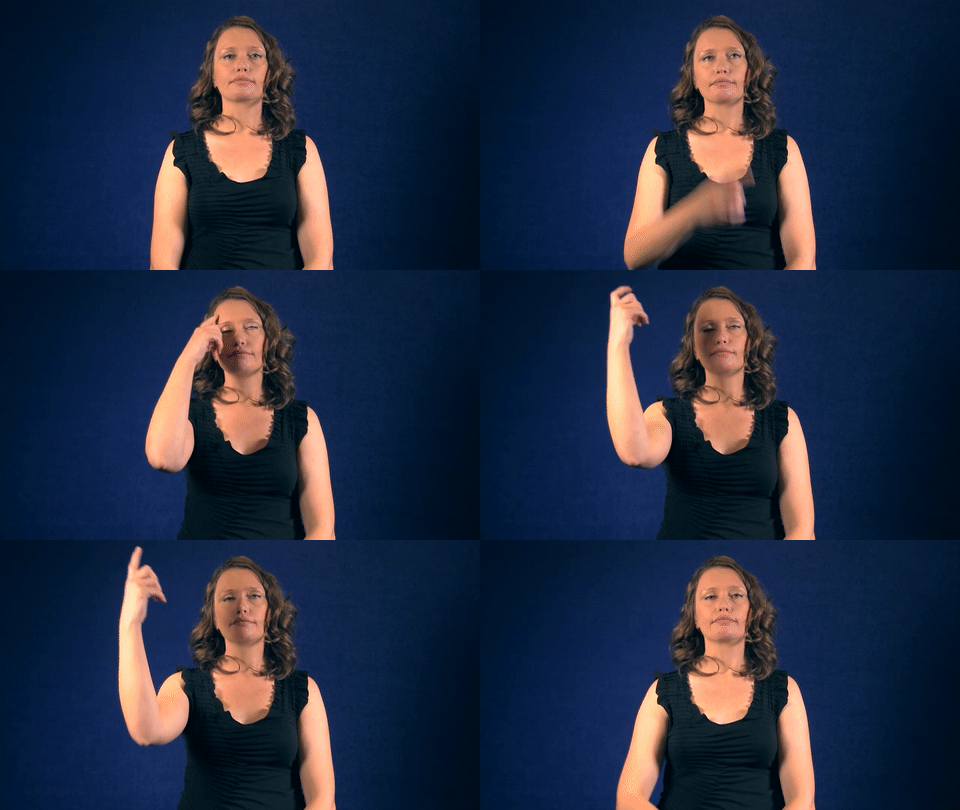
Sign for DREAM in ASL

Practice Activities:
To practice using the sign for DREAM in ASL, start by signing it repeatedly in isolation while watching yourself in a mirror. Focus on handshape, movement from the forehead, and the slight change in finger configuration that mimics the idea of something drifting away. Repeat the sign slowly and then gradually increase your speed while maintaining accuracy.
Form simple sentences using the sign for DREAM in ASL such as “I dream every night,” “What did you dream?” or “She had a strange dream.” Practice both asking and answering these types of questions. Use facial expressions to show if the dream was funny, scary, sad, or happy.
Use visual prompts to build your signing vocabulary around DREAM. Look at a photo of someone sleeping and describe what you think they are dreaming about. Begin with “DREAM” and then add more signs like “flying,” “school,” “family,” or “animals” to build a mini story. This can help build both vocabulary and narrative flow.
For partner practice, take turns describing a fictional dream to each other. One partner signs a dream sequence using ASL while the other guesses or retells it back. Use signs like “BED,” “NIGHT,” “SLEEP,” and “IMAGINE” to give context. Encourage feedback and corrections from your partner to improve sign clarity.
Try journaling a dream in ASL. Record yourself signing a one-minute dream story and watch for areas that could be clarified or expanded. Try retelling the same dream using different signs for similar ideas to explore sign choices.
Incorporate DREAM into a storytelling activity using a prompt like “A child dreams of becoming a superhero.” Develop the story with signs that follow the dream sequence, and share it with classmates or a study group. This helps reinforce the sign for DREAM in ASL while building expressive skills.
Cultural Context:
In American Sign Language, the sign for DREAM is more than just a movement of the hands—it carries cultural depth and emotional meaning within the Deaf community. The sign for DREAM in ASL is often used to express aspirations, nighttime visions, and even metaphorical hopes for the future. For Deaf individuals, being able to talk about their dreams using ASL connects them to their community and allows for rich storytelling and personal expression.
Storytelling holds a vital place in Deaf culture, and the sign for DREAM in ASL plays a key role in sharing personal stories, life experiences, and creative ideas. Whether talking about a dream from last night or a lifelong goal, this sign allows for vivid communication that is full of meaning. For children and young adults in the Deaf community, learning how to sign DREAM in ASL helps them express their thoughts in ways that are accepted and valued within their culture.
In Deaf poetry and visual storytelling, the sign for DREAM in ASL allows performers to explore themes of identity, imagination, and aspiration. These cultural expressions often use the sign in a way that blends facial expression with body language to deepen the meaning. DREAM in ASL becomes more than just a sign—it becomes a visual representation of ambition and hope.
ASL is deeply tied to the everyday experiences of Deaf individuals, and the sign for DREAM in ASL is often used in educational and family settings. Parents use the sign while putting their children to bed, and teachers use it in classroom discussions about goals and futures. The use of this sign helps bridge generational gaps and strengthens cultural bonds within the Deaf community.
In Deaf history, the idea of dreaming was central to civil rights efforts and community leadership. When prominent Deaf figures spoke about their dreams for equality, education, and accessibility, they often used the sign for DREAM in ASL as a powerful symbol. It became a visual counterpart to spoken calls for justice and change. That visual language continues to empower younger generations to dream big and work toward their goals.
The sign for DREAM in ASL is not just about what happens during sleep. It represents a range of emotional and intellectual experiences within Deaf culture. From bedtime stories to motivational speeches, this sign plays a significant part in how Deaf individuals talk about their inner worlds. It helps capture the essence of dreaming in a way that is personal and collective.
The vibrant and expressive nature of ASL gives the sign for DREAM a unique place in the language. It is often used in songs, plays
Extended Definition:
The sign for dream in ASL is a visual representation that connects both emotion and imagination. It captures the essence of dreaming, whether during sleep or in a visionary sense, such as aspiring toward future goals. The concept of “dream” can be interpreted in several ways depending on the context, and the sign adapts to fit both literal and figurative meanings.
In American Sign Language, the sign for dream typically starts by placing the index finger near the forehead. The finger hooks or moves outward, symbolizing a thought or vision leaving the mind. This movement reflects the ethereal and imaginative nature of dreams. As with many ASL signs, facial expressions and body language contribute heavily to the meaning, helping to convey whether the dream is sleepy and peaceful, scary, or inspirational.
ASL is a dynamic and expressive language, and the sign for dream in ASL can change subtly when used in conversations about aspirations or life goals. For example, when describing a long-term dream or ambition, the sign may be emphasized with a larger or more expressive movement. This shift helps provide emotional context, which is vital in ASL communication.
Cultural context influences the way signs are used, and sign for dream in ASL is no exception. Deaf culture values storytelling and shared experiences, so the idea of dreaming often ties into narrative sharing. Whether recounting a vivid sleep dream or talking about dreaming of becoming an artist , the way the sign is delivered plays a powerful part in communication.
Because dreams can be about the past, present, or future, the ASL sign is flexible and can be integrated into various tenses and sentence structures. Sentence flow in ASL doesn’t follow English grammar but instead relies on time markers, facial expressions, and spatial organization. This allows the signer to show clearly if they just had a dream last night, are dreaming right now, or hope to achieve a dream in the future .
Context also includes who the signer is communicating with. In more formal settings like academic settings or storytelling events, the sign for dream in ASL might be slowed down slightly or combined with other descriptive signs. In informal or casual use, it may be used quickly but with clear facial cues that indicate the dream’s tone—whether confusing, exciting, or silly.
Some regional variations exist for the sign for dream in ASL, as is common with many signs. Local dialects or age groups might interpret or perform the sign a bit differently. Nonetheless, the root form of the sign is
Synonyms: vision, aspiration, goal, ambition, fantasy
Educational resources: Find related learning materials in our course bank!
Want more? Check out some of our popular learning activities on the homepage!
Need to look up a sign? Use our highly rated dictionary: https://aslinteractive.com/best-asl-dictionary/
Follow us on tiktok: https://www.tiktok.com/@aslinteractive. More social media links at the bottom of this page!
Long-tail Keywords: What is the sign for dream in ASL, How do you sign dream in ASL, ASL sign for dream
Categories:
tags: dreams, language learning, verbs, emotions, everyday activities
Tips for Beginners:
When learning the sign for DREAM in ASL, it’s important to pay close attention to the movement and facial expression. The sign begins with the dominant index finger placed near the forehead, pointing upwards, and then curls away from the head in a forward arc. This mimics something leaving your mind, symbolizing a dream or thought. Be sure your movement is fluid and deliberate, as a jerky or unclear motion can confuse the meaning.
One tip for beginners practicing the sign for DREAM in ASL is to practice in front of a mirror to ensure your finger curls smoothly from the forehead outward. Your non-dominant hand stays at your side, and there’s no need to use both hands. Keep your face relaxed but thoughtful—facial expressions in ASL are essential to fully conveying meaning.
A common mistake when signing DREAM is using the wrong finger or placing your hand too far from your forehead. The sign loses clarity if your index finger isn’t clearly visible or if your hand doesn’t move in a clean, arched motion. Also, don’t rush; signing too quickly can make it difficult for others to understand you clearly. Slowing down helps build confidence and muscle memory.
Use the sign in different contexts to help reinforce your understanding of the sign for DREAM in ASL. Practice with a friend, describing your dream from the night before or using it in abstract expressions like “I have a dream.” This helps solidify the meaning and gives you conversation-ready language.
Remember, watching videos of native signers doing the sign for DREAM in ASL can give you a better sense of natural rhythm and posture. Stay patient, practice regularly, and over time, your signing will become more fluent and confident .
Connections to Other topics:
The sign for DREAM in ASL connects deeply with other abstract concept signs like IMAGINE, THINK, and HOPE. These signs often share similar facial expressions and placement near the head, emphasizing mental or emotional states. The fluid, drifting motion in the sign for DREAM mirrors the idea of thoughts transitioning from reality to imagination, similar to how signs like IDEA and VISION use upward or outward gestures from the head.
In narrative and storytelling contexts, the sign for DREAM in ASL frequently pairs with signs like NIGHT or SLEEP to clarify meaning. For example, in storytelling, one might describe a dream sequence by layering signs such as SLEEP + DREAM + THINK to express “I had a dream about something.” The fluid, directional motion in the DREAM sign also lends itself well to connecting signs spatially in visual storytelling.
The sign for DREAM in ASL also relates to future aspirations, making it semantically close to signs like GOAL, ASPIRE, or PLAN. These are sometimes combined in compound phrases to emphasize the emotional or long-term nature of a dream, as in DREAM + FUTURE to mean “future goals” or DREAM + WORK to suggest “working toward a dream.” This highlights how ASL conveys both the literal and metaphorical meanings of “dream” through context and facial expression.
Since DREAM often symbolizes personal ambition, it’s regularly used in phrases like DREAM + BIG or DREAM + ACHIEVE when discussing motivation. These constructions make the sign for DREAM in ASL especially useful in educational or motivational settings, reflecting both internal desires and real-world actions. This adaptability helps learners understand how abstract signs integrate with more concrete ones to express layered ideas in ASL.
Summary:
The sign for DREAM in ASL starts from the forehead, linking it to the mental space. The dominant index finger touches just above the eyebrow and then moves away while bending into an X-handshape, as if something intangible is stretching outward. This illustrates the feeling of a thought or idea leaving the mind, a frequent metaphor in ASL for cognition.
This sign is deeply symbolic, capturing the transient, abstract nature of dreaming. The arc and transformation of the finger shape evoke the mystery of dreams—fleeting, elusive, and always changing. The X-handshape reflects the tendrils of a thought escaping control, much like the way dreams dissolve upon waking.
Grammatically, the sign for DREAM in ASL can take on multiple roles depending on context. It commonly functions as a noun, such as in everyday speech describing nocturnal or aspirational dreams. It can also serve as a verb, particularly in constructions with time indicators or personal pronouns.
A signer may say “I dream last night” or “I dream to be successful” with the sign adapting seamlessly. Facial expressions, time indicators, and verb inflections in ASL allow for this flexibility. The fluid nature of the sign parallels the conceptual fluidity of the idea of dreaming.
There are related signs that provide semantic backdrop to the sign for DREAM in ASL. For instance, THINK, IMAGINE, VISION (as in visionary), and GOAL all share conceptual overlap. ASL distinguishes these subtly, showing how deep thought, fantasy, ambition, and sleep-based dreaming are linguistically distinct yet aligned.
The sign for SLEEP connects closely with the sign for DREAM, often appearing in tandem in storytelling or personal narratives. SLEEP involves a hand closing over the face like pulling down a curtain. DREAM then shows what follows—those inner experiences triggered by rest.
Culturally, dreams are significant across Deaf communities. Like in other cultures, dreaming may be taken as spiritual, inspirational, or therapeutic. In Deaf storytelling, dreams often serve metaphorical or poetic functions, representing hope or introspection.
The sign for DREAM in ASL also appears in idiomatic and figurative language. To “dream big” may involve pairing GOAL+IMAGINE, often supported with nonmanual markers conveying effort or hope. Conceptual blending is key with DREAM-related phrases.
Language acquisition researchers find the sign for DREAM especially interesting due to its expressive modality. The movement from the forehead typifies many cognition-related signs, reinforcing how ASL uses spatial symbolism to encode mental processes.
In child language development within ASL, DREAM often appears later than basic verbs due to its abstract nature. It requires a cognitive leap beyond the here and now, making it a sign used often in more advanced expressive stages. Children learn its nuanced grammar through storytelling and pretend play.
Applied linguistics suggests that signs like DREAM can reflect how Deaf individuals cognitively perceive abstract ideas. Since there’s no one-to-one translation from English to ASL, the sign for DREAM reflects a culturally embedded visual metaphor rather than a literal translation.
Interpreters must be sensitive to this conceptual difference. English sentences around dreams may not translate one-to-one, especially when figurative. A phrase like “dream job” might require careful rendering: GOAL+WORK+DESIRE or similar signs combined with appropriate facial grammar.
In literature, theater, and film within Deaf arts, the sign for DREAM plays a dynamic visual role. Performances often exaggerate the curling motion or partner it with modified signs to reflect nightmare, daydream, or vivid dreaming imagery. ASL performance broadens the gestural space around this sign, sometimes iconic and dramatic.
Dreams also play a powerful symbolic role in Deafhood narratives. Often, Deaf individuals refer to dreams as a space where they communicate freely, away from audist systems. Thus, the sign for DREAM in ASL can represent a refuge or utopia, aligning with community aspirations.
Psycholinguistic studies show DREAM engages parts of the brain associated with metaphor and spatial cognition. Because of the physical motion that mirrors imagery, this sign demonstrates how ASL users think differently from speakers of spoken languages. The kinetic lyricism of the sign draws on visual-spatial intelligence.
The sign also appears in educational contexts. Teachers may use it when speaking about student aspirations or when encouraging self-expression. DREAM, as a concept, becomes more than just a nighttime event—it becomes a driver of personal narrative and learning goals.
In some spiritual interpretations, DREAM may intermingle with SIGNS (omens) or VISIONS, reflecting belief systems that honor the unconscious. In ASL, this is conveyed through layered signing techniques, pairing DREAM with facial shifts and expansions of role-shifting to depict visionary clarity.
Deaf poets often manipulate the sign for DREAM to suit rhythm and visual impact. They may shift the starting location, implement slower movement, or alter the X-handshape into another configuration for thematic effect. This reflects ASL’s capacity for morphological improvisation.
Cross-lingu
Want more? Check out some of our popular learning activities!
ASL Interactive Resources
ASLInteractive YouTube Channel
Follow us on tiktok: @aslinteractive.com
Follow us on Instagram: aslinteractive
Facebook page: aslinteractive
Facebook group: aslinteractive
LInkedIn: ASL Interactive LLC
Twitter: @ASL_interactive
*Some information on this page is AI-generated. AI can make mistakes. Please check the information.

Responses