Sign for EARLY in ASL | ASL Dictionary

Definition: Happening before the usual time.

Sign for EARLY in ASL

YouTube player

Practice Activities:

To practice the sign for EARLY in ASL, start by focusing on the basic handshape and movement in front of a mirror. Repeat the sign slowly at first, making sure your middle finger makes contact with the back of your non-dominant hand, then smoothly slides forward. Practice this several times in isolation to build muscle memory and ensure you have the movement down.

Next, incorporate the sign into short phrases. Sign things like “arrive early,” “I woke up early,” or “my class is early.” This helps reinforce how the sign for EARLY in ASL fits in with other vocabulary. You can also practice modifying your facial expressions to match the context of the phrase—for example, looking happy when saying something happened early in a positive way, or stressed if it’s too early.

A great way to build fluency is through storytelling. Create a short story about a time you had to get up early for something important—school, work, or a trip. Use the sign for EARLY in ASL at least three times in your story. This activity improves recall and strengthens storytelling skills.

Working with a partner can enhance your practice. Take turns signing different sentences that include EARLY and quiz each other. One partner can sign a phrase or sentence and the other guesses what was said, checking for accuracy afterward. Mimicking natural pace during conversation will also help with rhythm and timing.

For fun, use role-play. Pretend one of you is always early and one is always late for events. Use the sign to express opinions or feelings about lateness or punctuality. This not only improves sign production, but also reinforces emotional context and everyday usage of the sign for EARLY in ASL.

Cultural Context:

In American Sign Language, the sign for EARLY in ASL carries more meaning than just time. It reflects cultural values within the Deaf community, particularly around punctuality, respect, and communication norms. Being early or on time is often seen as a sign of respect for others’ time, and ASL users emphasize the importance of this in both personal and professional settings.

The sign for EARLY in ASL is commonly used in everyday conversations. Whether you’re showing up to a Deaf event , meeting friends, or attending a class, understanding how to express this sign correctly is essential. It connects to important ideas of responsibility and community engagement in Deaf culture.

When someone uses the sign for EARLY in ASL, they might be talking about arriving before a scheduled time or referencing something happening ahead of expected timing. In the Deaf community, events often begin at the scheduled time without the delays that might be common in hearing environments. This approach underlines why the meaning behind the sign for EARLY in ASL is culturally relevant.

Deaf culture values strong time-awareness partly because clear communication plays such a crucial role in organizing group interactions. If someone arrives early, it ensures there is time to check in, prepare, and socialize. This is especially important in visual languages like ASL, where setting up proper eye contact and visibility takes place before communication begins.

Using the sign for EARLY in ASL also reflects your understanding of respectful interaction within the Deaf community. For example, being early to a Deaf meet-up lets everyone know you’re serious about the gathering and willing to be present and engaged right from the start. This shared understanding builds trust and rapport among community members.

The context of school and work adds an additional cultural layer to the use of the sign for EARLY in ASL. In both Deaf and hearing environments, arriving early shows professionalism. But in Deaf spaces, it also means ensuring communication access and preparedness for any visual or tactile setup that might be needed.

Parents of Deaf children often use the sign for EARLY in ASL when teaching concepts of routine, such as waking up early, showing up for school on time, or preparing early for holidays. The word serves not only as a time marker but as part of a larger value system that encourages thoughtful planning.

Getting familiar with the sign for EARLY in ASL also helps second-language learners understand the rhythm and structure of Deaf social life. It shows how timing and mutual respect form part of the everyday experience in conversations. These qualities are passed

Extended Definition:

The sign for early in ASL is a useful part of everyday conversation when discussing time, appointments, or schedules. Whether you’re talking about getting somewhere before a set time or completing a task ahead of a deadline, this sign brings clarity and efficiency to ASL communication.

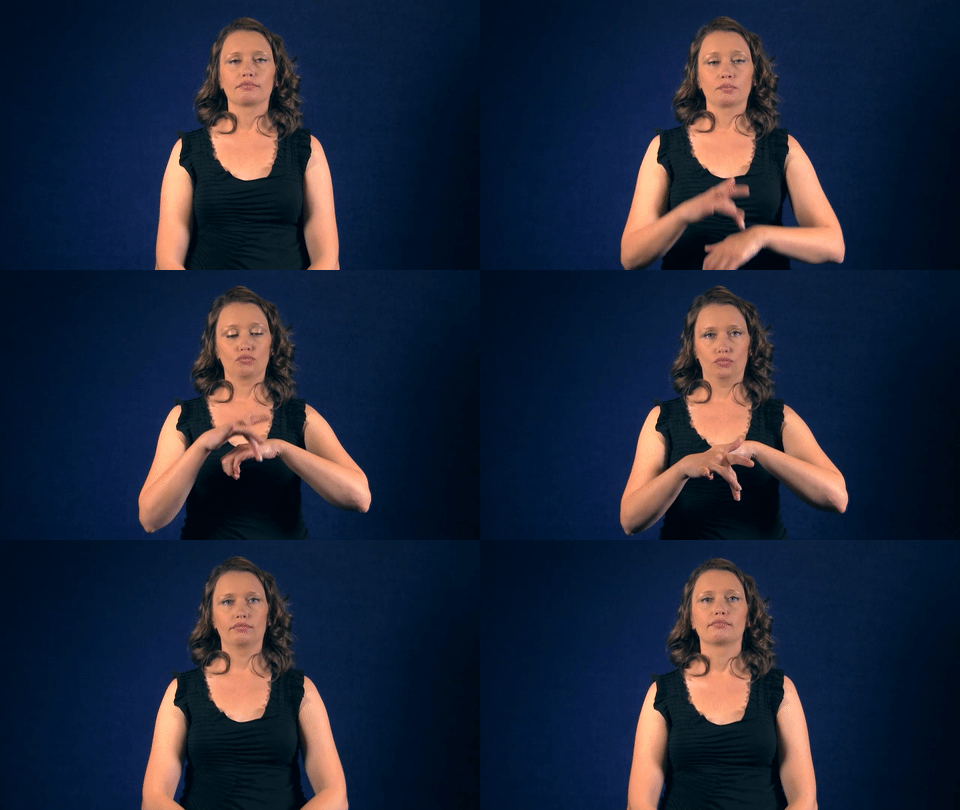
To produce the sign for early in ASL, the dominant hand’s middle finger flicks off the back of the non-dominant hand, which is held flat and horizontal. The middle finger represents something moving forward in time or ahead of schedule. This simple motion conveys the idea of something happening before the expected time.

Understanding the context helps when using the sign for early in ASL. It can describe an event starting ahead of schedule, someone’s arrival before the planned time, or completing something sooner than expected. ASL depends heavily on facial expressions, and showing raised eyebrows or a subtle nod while signing can emphasize your meaning.

The sign for early in ASL differs from signs for words like soon or quick, which may look similar but convey different ideas. Using the correct sign helps avoid confusion and improves communication. As with many ASL signs, one gesture can represent a broad range of meanings depending on the situation.

This sign is often used in school, work, and social situations. Signing “I arrived early,” “The meeting started early,” or “Can we leave early?” are all examples of how this expression works in everyday ASL conversations. It saves time and clearly indicates someone’s intent or timing.

If you’re learning ASL, practicing the sign for early will help you talk about future plans with more flexibility. It’s especially important when managing time-sensitive conversations. Understanding and using this sign can improve fluency and help in both casual and formal settings.

ASL learners should take time to watch videos and see the sign from different angles. Seeing native signers use the sign for early in ASL in complete sentences strengthens comprehension. Practice helps build muscle memory so the sign becomes fluid and natural.

In ASL storytelling or narratives, the concept of early can influence how a story is structured. For instance, arriving early to an event could be a turning point in the story. Using time-related signs effectively helps in building better communication in both personal and professional interactions.

When paired with time signs like morning, afternoon, or specific clock times, the sign for early gives a clearer picture of when something is happening. For example, early in the morning or early in the evening can easily be signed with a combination of signs. This makes meaning

Synonyms: ear protectors, ear coverings, winter earmuffs, cold-weather ear muffs, insulated earwear

Educational resources: Find related learning materials in our course bank!

Want more? Check out some of our popular learning activities on the homepage!

Need to look up a sign? Use our highly rated dictionary: https://aslinteractive.com/best-asl-dictionary/

Follow us on tiktok: https://www.tiktok.com/@aslinteractive. More social media links at the bottom of this page!

Long-tail Keywords: What is the sign for early in ASL, How do you sign early in American Sign Language, Learn the ASL sign for early

Categories:

tags: Time, Early, Days of the week, Morning routines, Scheduling

Parameters

*Handshape*:

The handshape used in the sign for EARLY in ASL involves both hands. The dominant hand is formed into the shape of a flattened “O” or bent “O” handshape, where the fingertips touch the thumb, creating a slight pinch. The non-dominant hand is held in a closed “S” handshape, palm down.

In the sign for EARLY in ASL, the dominant hand’s fingertips brush over the back of the non-dominant hand’s fist near the knuckles. This motion mimics the idea of something moving ahead or arriving before expected, aligning with the meaning of the word.

*Palm Orientation*:

In the sign for EARLY in ASL, the dominant hand typically takes on the shape of a bent middle finger, brushing it lightly across the back of the non-dominant hand, which is held in a flat position. The palm of the non-dominant hand generally faces downward, lying horizontal in front of the signer.

The dominant hand’s palm usually faces downward or slightly inward, depending on the signer’s movement and comfort. Proper palm orientation supports clarity and accuracy when using the sign for EARLY in ASL.

*Location*:

The sign for EARLY in ASL is produced in front of the body at about waist level. The dominant hand, with the middle finger extended slightly, brushes over the back of the non-dominant fist and moves forward, indicating an action happening ahead of time.

This placement keeps the sign visible and easily understood, using the body’s neutral space for clarity. When practicing the sign for EARLY in ASL, keep both hands relaxed and ensure the motion is fluid and natural.

*Movement*:

The movement for the sign for EARLY in ASL involves placing the dominant hand in a loose fist, with the middle finger extended slightly forward. The back of the middle finger then brushes across the top of the non-dominant hand’s fist, which remains stationary.

This motion should be quick and smooth, suggesting a forward sense of time or promptness. The sign for EARLY in ASL is often used to indicate arriving or doing something before the expected time ️.

*Non-Manual Signals*:

When demonstrating the sign for EARLY in ASL, the facial expression should convey anticipation or a slight sense of urgency. Raise your eyebrows slightly and keep your eyes focused on the movement of the dominant hand to emphasize an earlier occurrence.

Your mouth can form a slight pursing or say “early” silently to match the manual sign. Since the sign for EARLY in ASL can reflect time sensitivity, a mildly interested expression helps reinforce the context.

*Prosody, Dominant/Non-Dominant Hand*:

The sign for EARLY in ASL uses a specific handshape and movement that clearly expresses the concept. The non-dominant hand stays palm down in a flat position, creating a base. The dominant hand forms a bent middle finger and brushes it forward over the back of the non-dominant hand, like something arriving ahead of schedule ⏰.

This movement reflects the idea of something happening before the expected time. Facial expression may also help reinforce the meaning when using the sign for EARLY in ASL.

Tips for Beginners:

When learning the sign for EARLY in ASL, be sure to focus on the wrist motion and orientation of your dominant hand. The sign involves brushing the middle finger of your dominant hand forward across the back of the non-dominant hand, which remains stationary with palm down. It’s best to perform this gesture smoothly and avoid jerky movements to maintain clarity and fluidity.

Make sure not to confuse the sign for EARLY in ASL with signs that look similar, such as train or schedule. These can look alike to beginners, especially if your handshapes aren’t distinct or your movements are too fast. Practicing slowly in front of a mirror can help you see what your sign looks like to someone else.

Another helpful tip is to keep your fingers relaxed and curved slightly during the signing motion. A common mistake new signers make is stiff fingers or exaggerated motion, which can make the sign seem unnatural or unclear. It’s okay to start slowly and build up speed as your muscle memory develops.

Watch videos of fluent signers using the sign for EARLY in ASL during everyday conversations. Seeing the sign in context can help you better understand subtle speed and facial expression cues that give it more meaning. Try signing along with the video to practice in real time.

Remember to pair appropriate non-manual signals, such as raised eyebrows or slight forward head tilt, depending on what you’re emphasizing. ASL is a visual language, and body language is just as important as handshape and movement.

Finally, don’t be discouraged if it takes time. The sign for EARLY in ASL may seem simple at first, but precision and fluid motion come with consistent practice. Repetition, real-life usage, and feedback from experienced users are the best ways to improve. Keep practicing daily, even just a few minutes at a time .

Connections to Other topics:

The sign for EARLY in ASL connects closely with time-related concepts such as “late,” “soon,” “schedule,” and “appointment.” Since it expresses an idea of time occurring before an expected point, it’s commonly used in daily conversations about routines, planning, and time management. When learning this sign, it’s helpful to explore how it contrasts visually and conceptually with the sign for “late” to reinforce understanding of temporal opposites in ASL.

This sign can also be used in compound constructions, such as “early morning” or “arrive early.” In these cases, signs like “morning” or “arrive” are added before or after the sign for EARLY to clarify the specific time context. These compound uses help learners deepen their grasp of how time orientation works in ASL structures, particularly through spatial-temporal placement and non-manual markers like raised eyebrows for yes/no questions.

The concept embodied in the sign for EARLY in ASL also supports discussions around habitual actions and frequency. For example, a person might combine it with signs like “school” or “work” to indicate early arrival on a regular basis. This is useful in storytelling, daily conversation, and describing routines, making the sign highly functional across contexts.

In academic or formal settings, the sign for EARLY in ASL ties into broader narratives about punctuality, deadlines, and expectations. It frequently shows up in discussions involving schedules, whether it’s classroom topics, medical appointments, or travel planning. This reinforces the importance of temporal precision within ASL communication, and learners benefit from associating this sign with structured environments.

When comparing ASL to conceptually accurate versions in other signed languages, the sign for EARLY in ASL reveals interesting linguistic choices. ASL often emphasizes movement and relationship concepts over purely lexical equivalents, so the flow and directionality of the sign relate not just to chronology, but to expected outcomes. These nuances are critical for learners looking to develop fluency and sensitivity to ASL’s unique expression of time and expectation. ✨

Summary:

The sign for EARLY in ASL is made with the dominant hand shaped in a bent middle finger brushing over the back of the non-dominant flat hand. This motion resembles the passing or arrival of something ahead of schedule. It metaphorically represents the idea of something happening before the expected or standard time.

The bent middle finger is a key component in conveying temporal ideas in ASL. This specific configuration of bending one finger suggests motion, change, or a specific kind of action. The brushing gesture emphasizes the temporal transition from now to before.

The sign for EARLY in ASL carries semantic associations with time, planning ahead, and anticipation. In Deaf culture, being early or on time is often interpreted as respectful and considerate, reinforcing communal values. Communicating timeliness through native sign supports fluent interaction and shared cultural norms.

It is important to anchor the sign within grammatical functions. In ASL, adverbs of time, including the sign for EARLY in ASL, tend to appear at the beginning or end of a sentence. ASL grammar often flexibly accommodates time signs following time-topic-comment structure.

You might see the sign for EARLY in ASL used in the context of sentence structures such as EARLY I ARRIVE WORK or I FINISH HOMEWORK EARLY. Placing the time modifier helps set the context within the temporal sequence of the narrative. This gives visual logic to the sentence in ASL.

ASL utilizes space to organize time, and signs like EARLY contribute massively to this visual-temporal framework. Directionality and spatial modulation can alter emphasis, and even slightly shifting the sign’s location can make it blend more naturally within a narrative. This spatial anchoring reinforces concepts of past and pre-event focus.

The movement in the sign for EARLY in ASL may also suggest causation in some contexts. For instance, arriving early can lead to surprising consequences or demonstrate preparedness. The language structure allows for tapping into these inferred meanings naturally.

In ASL linguistics, the sign for EARLY in ASL is part of a paradigm of temporal adjectives and adverbs. Other signs in this category include LATE, SOON, BEFORE, and AFTER. Such temporal indicators form a semantic field of time-related signs.

These signs often share morphological similarities rooted in handshape or movement. The bent middle finger used in EARLY is also seen in the signs for LATE and SOON, which emphasizes the linguistic productivity of ASL morphology. This shows a system of presenting time visually and efficiently.

Phonologically, the sign contains specific parameters: handshape, location, palm orientation, movement, and facial expression. These features operate together to form the complete lexical item. The sign’s form is both linguistically meaningful and idiomatic within ASL usage.

Adding non-manual signals or facial expressions to the sign for EARLY in ASL modifies tone or emphasis. Raised eyebrows or widened eyes can convey surprise or urgency. These non-manual grammatical markers are essential to full ASL expression.

Different regional or generational dialects may show slight variations in how EARLY is signed. Some users might hold the sign briefly in one place or alter the brushing motion subtly. These differences reflect the natural evolution of language in community context.

It is worth noting the sign for EARLY in ASL focuses on temporal position, not frequency. This is distinct from signs like OFTEN or USUALLY. Understanding this distinction helps learners avoid confusion about whether something occurred ahead of schedule or happens routinely.

In educational and professional settings, the sign for EARLY in ASL plays a vital role. Students, employees, and interpreters often need to clarify when something happened in relation to a deadline or schedule. The sign offers a succinct way to express scheduling matters clearly.

Culturally, the experience of being early or late carries nuanced meaning in various Deaf communities. Punctuality is often emphasized during events, meetings, or performances. Showing up early reflects awareness and respect, which the sign communicates effectively.

The concept linked to the sign for EARLY in ASL often blends with ideas of responsibility and preparation. Within storytelling or daily narratives, EARLY is frequently used to indicate contrast or cause-effect. This supports ASL’s rich visual storytelling tradition.

People acquiring ASL as a second language find time-related vocabulary like EARLY essential for building narratives. Being able to express temporal concepts is a cornerstone of conversational fluency. It also improves understanding of how ASL conceptualizes time spatially.

For example, in a story about catching a bus, a signer might use EARLY to reveal a twist — arriving too early and waiting too long. Timing-based anecdotes bring in signs like EARLY, LATE, and WAIT. These illustrate how dynamic storytelling emerges from time-layered structures.

In Deaf literature and poetry, signs like EARLY carry layered metaphors. They may convey themes of readiness, missed opportunity, or destiny. Visual parallels between time and emotional states are often traced through such signs.

Sign language

Want more? Check out some of our popular learning activities!

ASL Interactive Resources

ASLInteractive YouTube Channel

Follow us on tiktok: @aslinteractive.com

Follow us on Instagram: aslinteractive

Facebook page: aslinteractive

Facebook group: aslinteractive

LInkedIn: ASL Interactive LLC

Twitter: @ASL_interactive

*Some information on this page is AI-generated. AI can make mistakes. Please check the information.


Responses