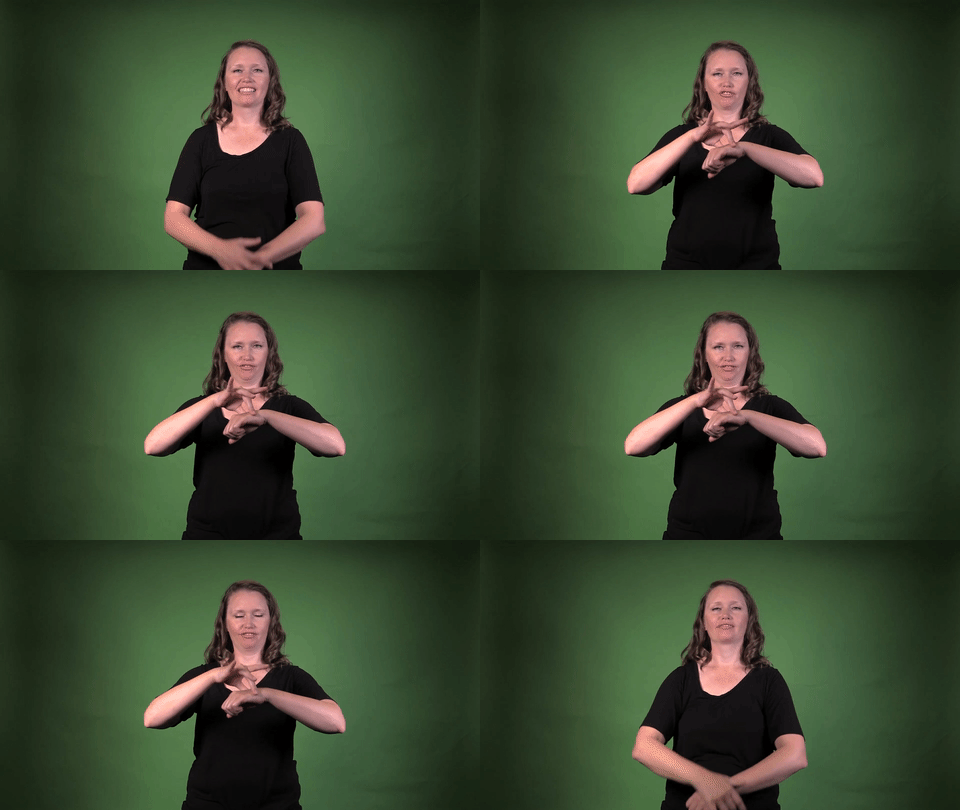
Sign for EARTH in ASL | ASL Dictionary

Definition: The planet we live on.

Sign for EARTH in ASL

YouTube player

Practice Activities:

To build confidence with the sign for EARTH in ASL, begin by practicing it in isolation using a mirror. Watch your dominant hand clasp the back of your non-dominant hand with the thumb and middle finger, gently rocking it twice, mimicking how the Earth is held and rotated. Repeat the motion slowly and focus on consistency in hand placement and motion.

Practice fingerspelling the word EARTH followed by using the sign immediately after. This helps build the connection between the written word and its ASL equivalent, especially useful for receptive skills. You can alternate this with showing images of the Earth or nature and signing EARTH as a response.

Use the sign in short sentences such as “EARTH beautiful” or “EARTH round.” Transition into more creative expressions like “I love EARTH” or “We must protect EARTH.” Try signing these in front of a classmate, friend, or mirror, and focus on facial expressions for emotional impact.

Create a short story or description involving the planet. For example, describe different planets but emphasize how special EARTH is. Include signs like AIR, WATER, PEOPLE to support your narrative and make the sign for EARTH feel more natural in context.

Partner with another learner to quiz each other. One person can describe either weather, natural disasters, or outer space topics that would involve signing EARTH, while the other responds using the appropriate ASL constructions. This back-and-forth reinforces comprehension and spontaneous use.

Add in a daily practice where you sign EARTH during routines like watching the news or reading about the environment. Use the sign whenever seeing maps, globes, or discussing global issues. These real-world links will help deepen memory for the sign for EARTH in ASL. ✋

Cultural Context:

The sign for EARTH in ASL holds cultural significance beyond just referring to the planet. In Deaf culture, this sign can reflect connections with nature, community, and awareness of environmental issues. When using the sign in storytelling or teaching, it often symbolizes more than just a physical place—it carries meaning about preservation and unity.

In many cases, the sign for EARTH in ASL is used in conversations about the environment, science, and geography. It’s an important sign when discussing topics like global warming, natural disasters, or world events. ASL users bring Earth-related discussions to life with expressive signing that often includes facial grammar and body language.

Deaf educators often incorporate the sign for EARTH in ASL in classrooms to promote awareness of sustainability and conservation. Children learn this sign early on, especially during Earth Day celebrations and nature-related activities. The concept of Earth is often linked to respect and guardianship in ASL storytelling.

Community members frequently use the sign for EARTH in ASL during rallies, protests, or awareness campaigns focused on protecting the environment . It becomes a visual and powerful message when shared in group settings through collective signing. The expressive nature of ASL emphasizes the importance of Earth and its well-being.

Visual representations of Earth in signed stories often go far beyond flat definitions. The sign for EARTH in ASL may be paired with signs like protect, save, and life, forming rich storylines that elevate awareness. These layers show how integrated this sign is in cultural and educational narratives within the Deaf community.

The sign for EARTH in ASL is also commonly seen in religious or spiritual discussions. When talking about creation, humanity, or the natural world, this sign plays an important part. The physical form of the sign can vary slightly by region, but its meaning remains strong across ASL users.

In art and performance, the sign for EARTH in ASL is used to express ecological beauty and emotional connection to the planet . Deaf poets and performers use it symbolically, combining it with visual metaphors and movements that connect deeply with the audience. There’s often an emotional layer when this sign appears in creative and expressive contexts.

The use of the sign for EARTH in ASL highlights the way ASL includes more than arbitrary gestures—it’s a language shaped by shared values and collective understanding. In culturally Deaf spaces, the sign can invoke pride and responsibility, promoting a collective identity linked to the Earth. Whether in conversation, protest, classroom, or stage, this sign

Extended Definition:

The sign for earth in ASL is a meaningful and often-used sign in conversations about nature, the environment, science, and geography. It represents our planet both in a physical sense and as a symbol of our global community. This makes it especially important in discussions related to climate change, conservation, and world cultures.

To create the sign for earth in ASL, one hand forms the letter F using the ASL alphabet, and it gently clasps around the back of the opposite hand, which represents the planet. The non-dominant hand is held still, resembling the round shape of the earth, while the dominant hand makes a small rocking motion. This movement can emphasize that the earth is round and is constantly turning or evolving.

The sign for earth in ASL can vary slightly based on regional dialects or the context in which it’s used. In some cases, the sign might lean more toward representing the land or ground, while in others, it clearly symbolizes the entire planet. Location and facial expressions can help clarify the intended meaning, which is a key feature of American Sign Language.

When discussing environmental topics, the sign for earth in ASL may appear alongside other signs like nature, water, or pollution. This helps shape the overall message and highlights the importance of taking care of the planet. Teachers, interpreters, and environmental advocates often use this sign to promote awareness and education during Earth Day events and eco-friendly campaigns.

Kids learning basic vocabulary in ASL will often be introduced to the sign for earth in ASL through visual aids, songs, and stories about the planet. Including this sign early in education helps build not only language skills but also environmental literacy. It encourages curiosity about how we interact with different elements of the natural world.

In storytelling and informational settings, the sign for earth in ASL may be used to set the scene or focus on global events. For example, when talking about international news or natural disasters, this sign helps situate the conversation on a planetary scale. Deaf educators and content creators often use it to bring attention to global issues in an accessible way.

ASL interpreters working in public speaking events, museums, or science exhibits will regularly use the sign for earth in ASL to support the spoken message. Because ASL is a visual language, signs like this one allow for deeper understanding and engagement with complex ideas. They also make it easier to remember information by connecting it with a meaningful visual cue .

In religious contexts, the sign for earth in AS

Synonyms: world, globe, planet, Terra, the blue planet

Educational resources: Find related learning materials in our course bank!

Want more? Check out some of our popular learning activities on the homepage!

Need to look up a sign? Use our highly rated dictionary: https://aslinteractive.com/best-asl-dictionary/

Follow us on tiktok: https://www.tiktok.com/@aslinteractive. More social media links at the bottom of this page!

Long-tail Keywords: what is the sign for Earth in ASL, how do you sign Earth in American Sign Language, ASL sign for Earth

Categories:

tags: Earth, planets, space, science, geography

Parameters

*Handshape*:

The handshape used for the sign for EARTH in ASL involves a dominant hand in an “F” handshape. The thumb and index finger of the dominant hand gently grasp the back of the non-dominant hand, which remains in a relaxed, horizontal position.

This specific handshape mimics holding or feeling the globe, which is key to the visual meaning behind the sign for EARTH in ASL . The “F” handshape effectively conveys the concept of attach or contact, reinforcing the distinction of the sign.

*Palm Orientation*:

For the sign for EARTH in ASL, the palm orientation involves the non-dominant hand held horizontally with the palm facing downward to represent the surface of the Earth. The dominant hand forms an open 5-handshape and clasps the back of the non-dominant hand between the thumb and middle finger, mimicking the way the Earth might be held or suspended.

This sign for EARTH in ASL often has the dominant hand palm facing inward or slightly downward while gently rocking, creating a natural depiction of the planet. The palm orientation plays a key role in clarifying the spatial and conceptual meaning of the sign.

*Location*:

The location of the sign for EARTH in ASL typically occurs at the non-dominant hand, which is held horizontally around chest level. The dominant hand forms the letter F and grips the back of the non-dominant hand, between the index and middle fingers, mimicking the idea of the earth being held or supported.

This sign is produced close to the center of the body, emphasizing its core meaning. To clearly convey the sign for EARTH in ASL, keep both hands within the signing space in front of the torso .

*Movement*:

To produce the sign for EARTH in ASL, start by holding your non-dominant hand in a relaxed “S” shape with the palm facing down to represent the planet. With your dominant hand in an open “5” handshape, place the thumb and middle finger on either side of the back of the non-dominant hand, then gently rock it back and forth like it’s rotating .

This rocking motion symbolizes the world turning. The sign for EARTH in ASL clearly represents the concept of the globe and gives visual context for discussions about geography, the environment, or the planet itself.

*Non-Manual Signals*:

When using the sign for EARTH in ASL, the facial expression is typically neutral but can shift slightly depending on context—curious brows for educational settings or slightly raised brows to reflect wonder or appreciation. Eye gaze is directed toward the dominant hand or the grounding location on the non-dominant hand.

The non-manual signals help convey the broader meaning and connection associated with the sign for EARTH in ASL . A calm, centered posture supports the concept of the planet or the environment, enhancing clarity and intent.

*Prosody, Dominant/Non-Dominant Hand*:

The sign for EARTH in ASL uses the non-dominant hand in a flat “S” or relaxed “5” handshape, palm facing down to represent the ground or the planet. The dominant hand forms an “F” shape and clasps the back of the non-dominant wrist, then gently wobbles or shakes to symbolize balance or rotation, as if the earth is being held or turning.

In the sign for EARTH in ASL, hand movement is fluid and generally centers in front of the torso. The dominant hand does the active work, showing the concept of the planet, while the non-dominant hand provides a stable base. Both hands stay at chest level, with the overall prosody expressing stability and movement.

Tips for Beginners:

When learning the sign for EARTH in ASL, pay close attention to hand placement and the movement of your non-dominant hand. This sign uses the middle finger and thumb of your dominant hand to lightly grasp the back of your non-dominant hand, which is held in a 5-handshape, palm-down to represent the world. A small wiggling motion with the dominant hand emphasizes connection to the planet’s surface and rotation.

Beginners often overlook the subtlety of the motion involved in the sign for EARTH in ASL. Don’t make the movement too dramatic or aggressive—gentle, steady contact conveys the concept more clearly and naturally. Maintain a neutral facial expression unless you’re including emotion or context about the environment. Try to sign at chest level so it’s easy to see and not exaggerated.

Practice in front of a mirror or with a fluent signer to receive feedback on your handshape and motion. Consistency in shape and position will ensure that the sign for EARTH in ASL is accurate and understood. Misplacing fingers or rotating the hand too much can create confusion with other unrelated signs.

To improve fluidity, try using the sign for EARTH in ASL in different sentences or pair it with environmental vocabulary like planet, weather, or protect. Connecting signs helps you build more natural language use and muscle memory. Don’t be discouraged by early fumbles—like learning any language component, repetition and mindful correction are your biggest allies

If you’re learning multiple signs about geography or planets, keep notes or flashcards handy to distinguish them. Many environmental signs use similar handshapes or positions, so clear repetition will reinforce their uniqueness. With practice, the sign for EARTH in ASL will become a confident and accurate part of your signing skills

sign for EARTH in ASL, sign for EARTH ASL, how to sign EARTH in ASL, ASL sign EARTH, EARTH sign in American Sign Language, EARTH ASL sign, American Sign Language sign for EARTH

Connections to Other topics:

The sign for EARTH in ASL is often connected to broader environmental and scientific signs, making it an essential concept in educational settings and discussions about nature. When discussing planets, science, or the environment, the sign for EARTH in ASL helps build foundational vocabulary that ties into more complex phrases like “protect the planet” or “climate change.”

This sign also connects with geographic and spatial concepts, often used alongside signs like WORLD, PLANET, or GLOBE. Learners frequently encounter it in phrases like “around the earth” or “earthquake,” where the base sign contributes to compound meanings. In storytelling or academic contexts, it becomes a pivot point for broader discussions about space and nature.

In everyday usage, the sign for EARTH in ASL appears in conversations around ecology, sustainability, and current events. For example, in signs for EARTH DAY, the sign is often paired with the fingerspelled D-A-Y or the sign for DAY to create a meaningful phrase. The understanding of this sign supports fluency in environmental activism themes or discussions about natural disasters.

This sign also aligns closely with science-based terminology in ASL. When teaching children or students about the solar system, EARTH is included in the sequence of planets and is often contrasted visually and conceptually with signs for SUN, MOON, or MARS. Its iconic depiction, often showing a rotating or globe-like motion, helps solidify the concept in the learner’s mind.

Finally, the sign for EARTH in ASL can be used metaphorically in poetic or artistic signing, especially in Deaf storytelling or performance. It connects with human experience by relating to signs like LIFE, NATURE, and HOME, which are often used interchangeably or in combination, further demonstrating the sign’s linguistic flexibility.

Summary:

The sign for EARTH in ASL beautifully captures both literal and figurative meanings. This sign reflects not only the physical planet but also conceptual ideas such as the world, nature, and humanity’s connection to the environment .

To produce the most common version of the sign for EARTH in ASL, use the non-dominant hand in a relaxed fist to represent the globe. The dominant hand forms an open “F” handshape and clasps gently around the back of the non-dominant wrist, then rocks or tugs slightly to depict rotation or contact with the world.

This movement mimics the way one might demonstrate a physical planet being held or spun, giving a sense of tangibility. It conveys the world as something you can touch, understand, and care for.

The sign is spatially localized, and the slight rocking motion adds a dynamic element, which grounds it in three-dimensional signing space. This movement also adds expressiveness that matches the vastness and gravity of the concept.

There are other variations of the sign for EARTH in ASL. In scientific or academic contexts, it may be fingerspelled to denote the planet in contrast to metaphorical uses. Fingerspelling can provide emphasis or technical specificity.

The sign is conceptually linked to related signs such as WORLD, NATURE, PLANET, and ENVIRONMENT. These signs often appear together in discourse on climate, ecology, and global citizenship.

Grammatically, the sign for EARTH in ASL is a noun. It can function as the subject or object in a sentence depending on the syntactic structure. However, context is everything in ASL, and classifier use or indexing may interchange roles fluidly.

Culturally, the sign for EARTH in ASL participates in larger dialogues about Deaf ecology, inclusion, and social awareness. The Deaf community has engaged in sustainability efforts which often include visual and linguistic representation of Earth and environment.

In poetic ASL or storytelling, the sign for EARTH may be enriched by incorporating facial expression and body shifting. These visual tools deepen the audience’s understanding of the moment and signal perspective.

The sign also appears often in educational settings, especially in describing natural science, astronomy, and environmental studies. Its use helps Deaf learners engage with scientific curriculum visually and tactually.

Linguistically, this sign exhibits how ASL uses metaphor and physical representation to embody abstract ideas. The gripping motion echoes our human desire for contact and control over the Earth.

In ASL morphology, the sign’s movement and shape convey meaning without needing additional modifiers. That economy is a core characteristic of signed languages—packing much into a single motion.

Deeper semantic roles appear when using the sign metaphorically. For example, saying someone is “of the Earth” uses this sign to evoke ideas of humility, organic life, or cultural groundedness.

In a spiritual or indigenous context, this sign may take on sacred significance. Some Native American Deaf signers blend ASL with tribal signs to express deeper concepts of Earth and land.

From an applied linguistics view, the sign for EARTH in ASL is a great example of how embodiment theory plays out in signed communication. The body is the medium; the sign is part of a lived experience.

The sign is highly visual and intuitive to non-signers as well. It often gets used in interpreted events related to Earth Day or international discussions about global warming to help foster accessibility .

Variation also happens across regions. In some parts of the U.S., signers may demonstrate the Earth using a palm-down C-hand circling in space, highlighting local preference or pedagogical environment.

The sign also aligns with international sign applications. In World Federation for the Deaf events, shared concepts like EARTH rely on widely understandable visual motifs.

In narrative ASL, Earth is sometimes personified, and the sign shifts to reflect emotion or intention. For instance, tensing the grip may represent danger or stress, emphasizing ecological urgency.

There are discussions within ASL literature and translation theory regarding how best to sign abstract environmental terms. EARTH is a foundational piece within that larger puzzle.

In Deaf theology, the Earth often symbolizes creation, stewardship, and divine connection. Worship contexts may feature customized expressive versions of this sign to signal reverence.

When teaching the sign to new learners, instructors often use visual analogies—like holding a globe or imagining the Earth rotating. This assists in comprehension and retention.

The sign for EARTH in ASL is deeply tied to sensory and physical cognition, part of how Deaf people process the world around them. It draws from experiential learning.

The classifier system in ASL extends how Earth is portrayed. Classifier “C” and “F” handshapes help model planets, circular paths, or ecosystems, especially in academic discourse.

Media representation of Earth in signed content often uses this sign as the anchor point for discussions on sustainability. Documentaries or vlogs in ASL about climate frequently return to this visual.

Community activism

Want more? Check out some of our popular learning activities!

ASL Interactive Resources

ASLInteractive YouTube Channel

Follow us on tiktok: @aslinteractive.com

Follow us on Instagram: aslinteractive

Facebook page: aslinteractive

Facebook group: aslinteractive

LInkedIn: ASL Interactive LLC

Twitter: @ASL_interactive

*Some information on this page is AI-generated. AI can make mistakes. Please check the information.


Responses