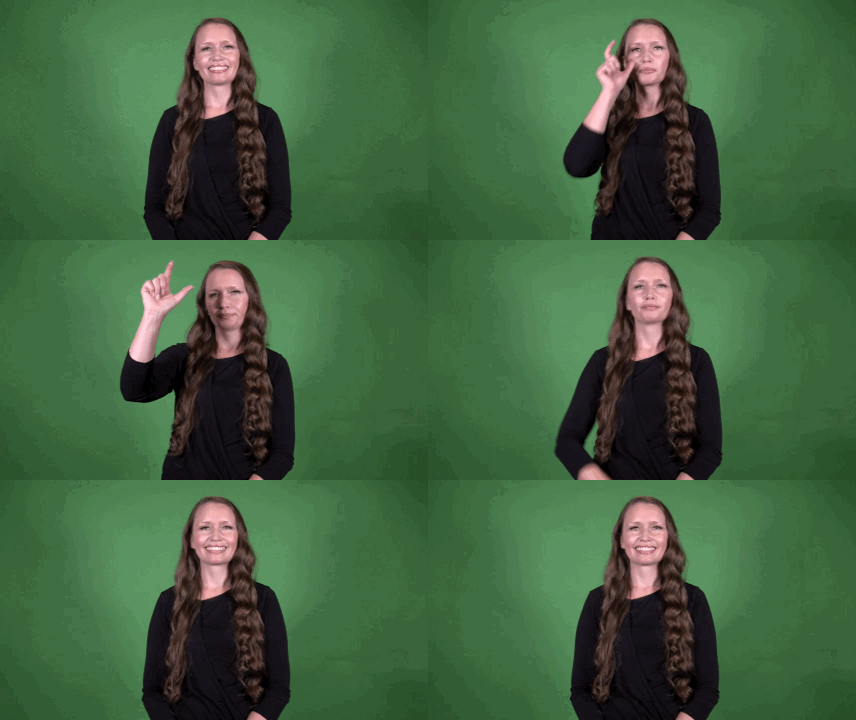
Sign for MOON in ASL | ASL Dictionary

Definition: The natural satellite of the Earth.

Sign for MOON in ASL

YouTube player

Practice Activities:

Cultural Context:

Practice Activities

To build fluency with the sign for MOON in ASL, start by practicing in front of a mirror. This helps you visually confirm your handshape, movement, and facial expressions, which are critical in ASL. Make sure your dominant hand forms an “F” handshape and mimics the motion of a crescent moon moving upward near your face.

Another effective method is recording yourself signing the sign for MOON in ASL. Watching your recordings allows you to self-correct and refine your motion and expression. Pay attention to the placement of your hand near your eye and the arc-like movement, which visually resembles the moon in the sky.

Use the sign for MOON in ASL during storytelling or while describing the sky, night, or weather. Signing in context strengthens memory and comprehension. Describe a nighttime scene using related vocabulary, such as STARS, DARK, or SLEEP, to deepen your understanding.

For more advanced practice, incorporate the sign into ASL dialogues or short narratives. Challenge yourself by varying the sentence structure and combining the sign for MOON in ASL with temporal concepts, like NIGHT or ONCE UPON A TIME. These drills improve fluency and confidence in real-life conversations.

Practice with a partner if possible. Signing with others helps you stay motivated and builds receptive skills. Watching others use the sign for MOON in ASL in natural conversation can also expose you to subtle variations and deepen your cultural understanding.

SEO Cultural Context

The sign for MOON in ASL is not just a vocabulary item—it reflects both visual language and cultural significance. In the Deaf community, visual storytelling often includes natural elements, and the moon is a powerful symbol in many stories. The sign visually conveys the crescent shape of the moon using an “F” handshape, illustrating ASL’s iconic and descriptive nature.

In Deaf culture, storytelling and visual metaphors are deeply respected, and celestial objects like the moon are often used in poetry, narratives, and even name signs. Knowing the sign for MOON in ASL allows learners to participate meaningfully in these contexts.

There can be slight regional variations in how the sign is performed. Some signers may use a more exaggerated arc, while others may keep the motion closer to the eye. However, the core meaning remains the same. It’s important to stay observant and flexible when communicating with Deaf individuals from different regions.

This sign is typically used in discussions about the natural world, storytelling, time, or weather. It can also appear in educational settings, especially when teaching children about space, the environment, or daily routines. Mastering the sign for MOON in ASL helps learners engage in a wide range of conversations with cultural sensitivity.

Extended Definition

The sign for MOON in ASL combines a specific handshape and motion. Begin with your dominant hand forming an “F” handshape (thumb and index finger touching, other fingers extended). Place the “F” hand near the corner of your eye, then move it upward in a slight arc, mimicking the shape of a crescent moon rising in the sky.

This sign is iconic—it visually represents the concept it stands for. It’s closely related to the sign for SUN, which also involves a circular movement near the head but uses different handshapes. Understanding these visual distinctions helps prevent confusion.

Be cautious not to confuse this sign with similar signs like EYE or LOOK, which involve motion near the eye but use different handshapes and directions. A common beginner error is using the wrong handshape or moving the hand in a straight line instead of an arc. These mistakes can change the meaning or make the sign unclear.

The sign for MOON in ASL can also be modified in storytelling contexts. For example, to depict a full moon or an eclipse, signers might use classifiers or additional descriptive signs. These advanced uses showcase ASL’s flexibility and rich visual grammar.

Tips for Beginners

For beginners, learning the sign for MOON in ASL can be a fun and rewarding experience. Start slow and focus on getting the handshape and movement correct. Use a mirror to check your form and make sure your hand moves in an arc, not a straight line.

One of the most common mistakes is placing the “F” hand too far from the face or using the wrong fingers. Always remember that the base of the “F” hand should start near the corner of your eye. Practicing this consistently will help build muscle memory.

Another tip is to practice in short, simple sentences. Try phrases like “MOON BRIGHT” or “MOON COME OUT.” This helps you use the sign in context and improves your conversational flow. Repetition in meaningful phrases enhances retention.

Stay patient and don’t get discouraged if your signing isn’t perfect right away. The sign for MOON in ASL becomes easier with time, especially when practiced regularly. Watching native ASL users sign can also help you pick up nuances and improve your skills.

Connections to Other Topics

The sign for MOON in ASL is closely related to other signs within the category of weather, time, and space. One natural connection is the sign for SUN. This sign also involves movement near the facial area and is used frequently in weather-related discussions. Comparing SUN and MOON helps learners understand visual contrasts in ASL.

Another related sign is NIGHT. This sign often pairs naturally with the sign for MOON in ASL in conversations about daily routines, bedtime, or storytelling. Learners can practice phrases like “MOON OUT, NIGHT COME” to reinforce both signs.

The sign STAR is another valuable connection. STAR and MOON often appear together when discussing the night sky. Combining these signs in storytelling helps learners expand thematic vocabulary and improve narrative skills.

Consider WEATHER as a broader thematic link. MOON may be discussed in relation to clear skies, storms, or lunar phases. Practicing these signs together improves topic cohesion and fluency.

Finally, the sign for MONTH is linked by linguistic form. MONTH uses a similar handshape but involves a different orientation and movement. Learning both signs side by side can help reinforce handshape recognition and prevent confusion.

Lengthy Summary

Mastering the sign for MOON in ASL opens up meaningful opportunities to engage with visual language, storytelling, and cultural expression. The sign uses an “F” handshape that moves in an arc near the eye to represent the crescent moon. This iconic movement makes the sign easy to remember and deeply descriptive.

Practice is essential for fluency. Use mirrors, video recordings, and contextual sentences to reinforce accuracy and confidence. Engaging in conversations and storytelling that include the sign for MOON in ASL helps solidify your understanding and builds fluency over time.

Culturally, the moon is a common subject in Deaf narratives and visual poetry. Understanding how and when to use the sign allows you to participate more fully in cultural exchanges and artistic expressions. The sign also appears in educational and conversational settings, making it a practical and versatile vocabulary item.

Beginners should focus on correct handshape, facial placement, and movement direction. Avoid common errors by practicing slowly and reviewing video examples. Connecting this sign to related vocabulary like SUN, NIGHT, and STAR creates thematic frameworks that support long-term retention.

By learning the sign for MOON in ASL, you’re not just memorizing a hand movement—you’re entering a rich world of visual language and community connection. Keep practicing, stay curious, and continue building your ASL vocabulary. Each new sign brings you closer to true language fluency

Extended Definition:

Synonyms: greater difficulty, increased challenge, higher complexity, added difficulty, intensified struggle

Educational resources: Find related learning materials in our course bank!

Want more? Check out some of our popular learning activities on the homepage!

Need to look up a sign? Use our highly rated dictionary: https://aslinteractive.com/best-asl-dictionary/

Follow us on tiktok: https://www.tiktok.com/@aslinteractive. More social media links at the bottom of this page!

Long-tail Keywords: what is the sign for moon in ASL, how do you sign moon in ASL, ASL sign for moon meaning

Categories:

tags: moon sign ASL, nighttime vocabulary ASL, celestial signs ASL, space-related signs ASL, nature terms in ASL

Tips for Beginners:

Connections to Other topics:

Summary:

Want more? Check out some of our popular learning activities!

ASL Interactive Resources

ASLInteractive YouTube Channel

Follow us on tiktok: @aslinteractive.com

Follow us on Instagram: aslinteractive

Facebook page: aslinteractive

Facebook group: aslinteractive

LInkedIn: ASL Interactive LLC

Twitter: @ASL_interactive

*Some information on this page is AI-generated. AI can make mistakes. Please check the information.


Responses