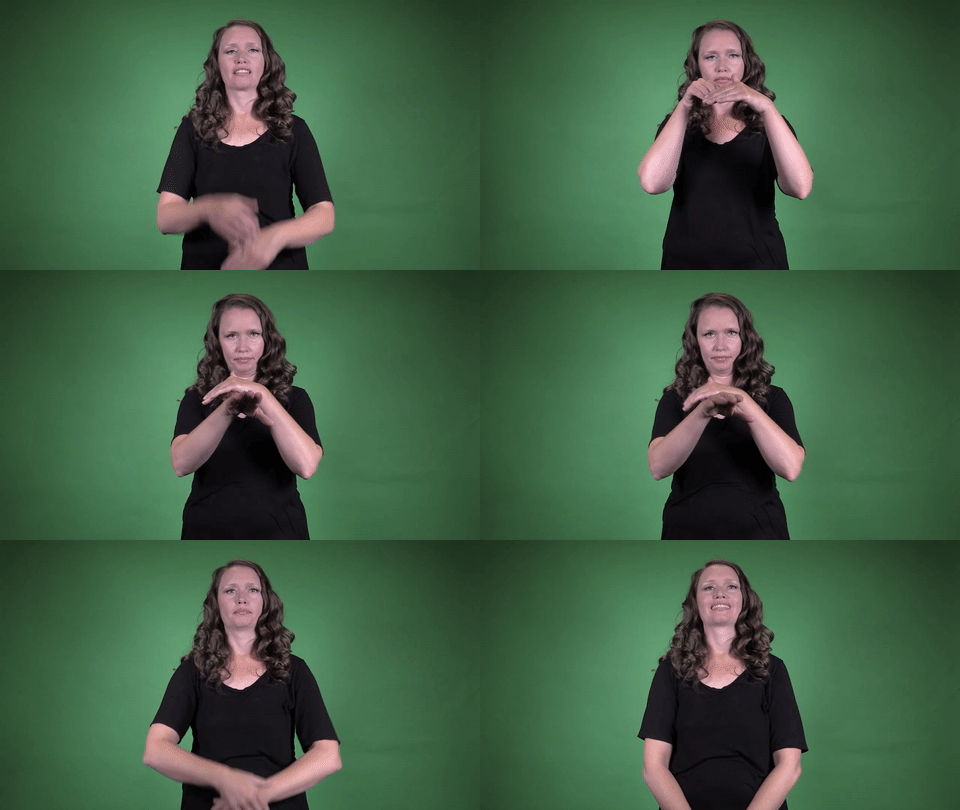
Definition: To come or go into a place.
Sign for ENTER in ASL
Practice Activities:
To practice the sign for ENTER in ASL, begin by signing it repeatedly in isolation while standing in front of a mirror. Watch your handshape and movement to ensure accuracy. Use both hands to show the movement of one hand “entering” under the other hand from the non-dominant side.
Next, create short phrases using the sign for ENTER in ASL alongside other basic signs you know, such as “room,” “class,” or “building.” For example, practice signing “I enter the room” or “She enters the building.” Repeat each phrase several times with different subjects to reinforce fluency.
Work with a partner by taking turns describing different scenarios that use the concept of entering. One person can sign a sentence like “The dog enters the house,” and the other can respond with a related idea, such as “Then the dog goes to sleep.” This builds comfort with the flow of conversation using the target sign.
Try storytelling exercises where you describe arriving at a place. You could create a short story where you enter a classroom, see a friend, and sit down. Incorporate signs for people, places, and actions so the sign for ENTER in ASL becomes a natural part of your vocabulary.
Use visual prompts such as pictures of doors, gates, or entrances to spark ideas for sentences. Look at the image and sign what’s happening, such as “They enter the gym before practice.” This supports connecting signs with real-life context.
Record a short video of yourself using the sign for ENTER in ASL in five different sentences. Watch it to evaluate clarity and form, or share it with a teacher or study partner for feedback. Repetition and contextual use will help you internalize this sign effectively.
Cultural Context:
Understanding the sign for ENTER in ASL offers interesting insights into how American Sign Language reflects social and spatial concepts. Unlike spoken English, ASL often uses hand shape and movement to visually represent direction and location. The sign for ENTER in ASL mimics the action of one object going under or into another, reflecting the physical act of entering a space.
This sign is more than just a word translation—it represents how deaf culture emphasizes spatial awareness and visual context. In everyday interactions, the sign for ENTER in ASL helps convey both literal entry into a room or building and figurative entry into a situation or group. Signing ENTER in a conversation can often be accompanied by facial expressions or body shifts to clarify the intention.
In deaf communities, space and body language play vital roles in communication. The sign for ENTER in ASL is frequently paired with other directional signs to show specific locations like entering a classroom, home, or public place. It shows how ASL users build complex ideas from simple movements grounded in shared experiences.
Cultural context in ASL also includes understanding when and how to use certain signs. While the sign for ENTER in ASL may seem straightforward, it becomes more meaningful when signed in real-life scenarios, such as signaling that someone is about to join a conversation or come inside. For example, in group settings, users may sign ENTER while gesturing to a doorway or pointing toward someone approaching.
The directional aspect of ASL is a good example of why ASL is considered a visual-gestural language rather than a manual version of English. The sign for ENTER in ASL underscores this—it’s a sign that takes on different meanings depending on spatial references and situational context. That flexibility enriches the communication experience and allows for more precise expression.
Deaf culture values clarity, and the use of signs like ENTER helps maintain smooth communication flow. A well-executed sign for ENTER in ASL not only shares information but also respects the flow of group interaction. Visibility and timing are just as important as handshape and motion.
When discussing public events or home routines, entering a space is a shared human experience. The sign for ENTER in ASL builds on that shared concept by offering a visual shorthand that can be universally recognized among ASL users. It’s especially used in educational and social settings where movement in and out of areas is common.
The sign for ENTER in ASL also plays a role in storytelling and classroom activities, where characters move into locations. This helps children and students develop spatial reasoning
Extended Definition:
The sign for enter in ASL is a common and useful vocabulary term taught early in American Sign Language learning. Understanding how to correctly produce and recognize the sign for enter in ASL is essential for fluent communication, especially in conversations related to movement, building access, or introducing a new topic or participant into a signed discussion.
This sign is part of the ASL classifier system and uses a directional motion to show the concept of one thing or person moving into another space. To sign it, typically one hand represents an open space and the other represents something entering it. The movement and handshape are important to perform the sign accurately, as slight variations can impact the meaning.
When using this sign in conversation, context plays a key role. The sign for enter in ASL can be adapted slightly depending on what is entering and where it is going. For example, entering a room might look a little different than entering a vehicle or a conversation. These subtle differences reflect the visual and spatial nature of ASL.
It’s important to understand that ASL is a visual-gestural language, meaning it relies heavily on facial expressions, body movement, and spatial awareness in addition to hand signs. When performing the sign for enter in ASL, your body language and eye gaze may also shift, depending on the spatial reference or the direction of movement relevant to the situation.
Deaf culture emphasizes clarity and precision in signing, so learning how to use basic directional signs like enter is foundational for non-native signers to connect more meaningfully with ASL users . This sign shows up frequently in instructions, tours, stage directions, and classroom settings.
The sign for enter in ASL is not only used literally but also metaphorically in expressive ASL storytelling. For example, it could symbolize entering a new phase of life, stepping into a dream, or moving into another world during a narrative. The flexibility of this sign showcases the deep, layered usage of signs in complex ASL communication.
You might notice the sign being incorporated differently in various regions due to dialectal differences, though the base meaning remains the same. These variations are natural within ASL and reflect the rich linguistic diversity within the signing community. It’s always helpful to ask a Deaf ASL user for feedback when learning to sign properly and respectfully.
The sign for enter in ASL helps enrich your vocabulary and allows for smoother communication about direction, space, and movement. Whether giving someone directions, guiding a guest to enter a room, or discussing how
Synonyms: input, key in, submit, type in, log in
Educational resources: Find related learning materials in our course bank!
Want more? Check out some of our popular learning activities on the homepage!
Need to look up a sign? Use our highly rated dictionary: https://aslinteractive.com/best-asl-dictionary/
Follow us on tiktok: https://www.tiktok.com/@aslinteractive. More social media links at the bottom of this page!
Long-tail Keywords: what is the sign for Enter in ASL, how do you sign Enter in ASL, ASL sign for Enter
Categories:
tags: enter in ASL, how to sign enter in ASL, ASL sign for enter, learn enter in ASL, enter American Sign Language
Parameters
*Handshape*:
The handshape for the sign for ENTER in ASL involves both hands in the B-handshape . The dominant hand moves palm-down and slides underneath the non-dominant hand, which stays stationary and also palm-down.
This sign visually conveys the concept of something going under and into a space, reinforcing the meaning behind the sign for ENTER in ASL. It’s a clean and consistent movement using flat handshapes.
*Palm Orientation*:
The palm orientation for the sign for ENTER in ASL involves both hands, with the dominant hand in a flat “B” shape and the non-dominant hand also forming a flat “B.” The non-dominant palm faces downward while remaining stationary.
The dominant hand, also palm-down, slides underneath the non-dominant hand in a forward motion. This configuration represents the motion of entering a space, a key element in the sign for ENTER in ASL.
*Location*:
The location for the sign for ENTER in ASL is in the area directly in front of the torso, slightly below the chest. The non-dominant hand is held steady and horizontal, palm facing down, while the dominant hand moves underneath it in a forward, sliding motion.
This placement helps visually convey the concept of one thing going under or into something. The torso-level positioning of the sign for ENTER in ASL makes the spatial relationship between the two hands clear and easy to understand.
*Movement*:
To make the sign for ENTER in ASL, start with the non-dominant hand held flat, palm facing down, positioned horizontally in front of the body. The dominant hand also stays flat but starts slightly above and behind the non-dominant hand.
Move the dominant hand under the non-dominant hand in a forward, arcing motion, as if symbolizing someone physically entering into a space . The sign for ENTER in ASL visually represents a person or object going beneath a surface or barrier.
*Non-Manual Signals*:
Facial expressions for the sign for ENTER in ASL should display a neutral to slightly focused demeanor, reflecting the action of someone or something moving into a space. Slight downward head movement can accompany the sign to indicate direction or intent as one object goes under and into another.
Eye gaze generally follows the directional flow of the dominant hand to enhance clarity. The overall non-manual signals should reinforce the concept represented by the sign for ENTER in ASL without adding emotional weight.
*Prosody, Dominant/Non-Dominant Hand*:
The sign for enter in ASL uses both hands. The non-dominant hand stays flat, palm facing down, held horizontally in front of the body. The dominant hand, also flat, moves palm down and slides underneath the stationary non-dominant hand from the non-dominant side toward the dominant side, mimicking the motion of entering a space. Movement is smooth and continuous.
This motion visually represents someone or something going into a place, enhancing the meaning behind the sign for enter in ASL. The prosody is calm and direct, with the dominant hand taking the leading role while the non-dominant stays stable.
Tips for Beginners:
When learning the sign for ENTER in ASL, start by watching fluent signers and mimic their handshape, palm orientation, and movement closely. This sign generally involves one hand moving under the other, in a deliberate, smooth arc. Practice in front of a mirror to catch any awkward angles or unnecessary movements that could alter the meaning.
A common challenge with the sign for ENTER in ASL is forgetting to maintain proper palm orientation. Make sure your dominant hand moves horizontally under your non-dominant hand, with both palms facing down. Keep your wrists relaxed to avoid stiff or robotic motion.
It’s also essential to avoid rushing the sign, especially when you’re still building muscle memory. A rushed or sloppy execution may confuse viewers or change the intended message entirely. Instead, focus on clean, confident motion with appropriate space between your hands.
Facial expressions aren’t critical for the sign for ENTER in ASL, but it’s good practice to maintain a neutral or slightly purposeful expression. This adds to the sign’s clarity and helps viewers focus on your hand movement. Over time, your expression will naturally sync with the message you’re conveying.
Try incorporating the sign into everyday phrases and short sentences to reinforce your learning. For example, “You can enter the room” or “Please enter quietly.” Frequently using the sign for ENTER in ASL in context will help solidify your recall and boost your confidence in real interactions .
If you’re ever unsure whether you’re signing correctly, don’t hesitate to ask a Deaf signer or qualified ASL instructor for feedback. Video yourself occasionally and compare your sign to reliable sources for accuracy. Repetition, attention to detail, and quality input are key to mastering the sign for ENTER in ASL.
Connections to Other topics:
The sign for ENTER in ASL shares conceptual space with other directional and spatial signs such as GO-IN, COME-IN, and ARRIVE. All of these involve a sense of movement into a defined area, typically using dominant and non-dominant hand interactions. Understanding these spatial relationships helps learners decipher how ASL uses motion and orientation to convey meaning beyond just vocabulary.
The sign for ENTER in ASL forms a foundation for compound signs like ENTER-ROOM or ENTER-BUILDING, which add context and specificity to the action. For example, ENTER-ROOM combines the sign for ENTER with the sign for ROOM, visually representing the concept of going into a room. These compounds demonstrate how ASL builds meaning by layering signs rather than using prefixes or suffixes.
Spatial referencing often plays a large role when using the sign for ENTER in ASL. Signers will frequently shift their body slightly or use directionality to indicate WHO is entering WHERE. This adds clarity, especially in storytelling or explanations where sequencing and placement are essential.
The perspective of the signer can alter how the sign for ENTER in ASL is interpreted; for instance, an inward movement might suggest self-entry or invite. Conversely, modifying the direction can imply that someone else is entering. This is a fundamental principle in ASL grammar, as directionality can change the subject or object.
This sign is often seen contextually in idiomatic or situational signs like ENTERTAINMENT or ENTERPRISE, which may veer from the literal motion but still retain philosophical connections. Understanding the core of the sign for ENTER in ASL enhances vocabulary growth and contributes to a more intuitive grasp of ASL’s visually iconic nature.
Summary:
The sign for ENTER in ASL uses movement that is simultaneously spatial and directional. The dominant flat hand slides under the palm of the non-dominant hand, moving forward and slightly downward. This motion simulates the idea of one object physically entering another space, which reflects an intuitive spatial metaphor.
This sign is rooted in classifiers and spatial referencing common in ASL. The dominant hand symbolizes the action while the non-dominant hand becomes the object, or the barrier being crossed. This is a common technique in ASL where handshape and location imply deeper context beyond the literal word.
Grammatically, the sign for ENTER in ASL is typically used as a verb. It often appears in time-sequenced declarative statements, especially in storytelling or descriptive narration. One might use the sign to describe someone coming into a room, stepping into a dream, or entering a situation metaphorically.
Context helps determine nuance. For example, entering a building might be signed similarly to entering a relationship, but the facial expression, speed, and spatial placement will clue viewers into the abstract vs. literal meaning. Facial grammar is crucial in ASL and often affects how this sign is read and understood.
In Deaf culture, the sign for ENTER in ASL goes beyond its surface meaning. Entry into a space, group, or dialogue is highly valued, especially in the context of community. Signing ENTER respectfully at events or gatherings reflects an understanding of shared space and cultural norms.
ENTER is closely related to other motion-based signs in ASL, including GO-IN, ARRIVE, and COME-IN. These often share the same general movement pattern with subtle differences in direction, hand placement, or non-manual signaling. Distinguishing these signs depends on mastering spatial grammar and terms of reference.
Classifiers play a special role in expanding the sign’s visual storytelling. Instead of merely the standard sign, one might use CL:1 to show a person entering a narrow space or CL:3 for a vehicle entering a garage. These classifiers add dimension and specificity that make ASL rich and expressive.
In linguistic terms, the sign for ENTER in ASL operates within the visual-spatial modality of the language. It demonstrates how ASL leverages three-dimensional space to encode meanings, instead of relying solely on linear linguistic structures like word order. Movement, location, and orientation form the skeletal frame of this expression.
ENTER is highly iconic, mimicking a real-life trajectory of one object crossing into another. This type of iconicity is widespread in ASL, where signs often look like what they represent. Gestural cues in the sign for ENTER allow even beginners in the language to intuitively understand its meaning.
Variation exists across regions and generations. Some users might execute the sign more vertically or add a slight bend to the entering hand. These variations do not generally hinder mutual understanding but reflect the natural linguistic evolution present in all living languages.
Historical linguistics shows that signs like ENTER likely evolved from mimetic gestures used in early visual communication. Over time, standardization through education and community use stabilized the form we see in modern-day ASL. This historical context demonstrates how rich and living ASL is.
The sign aligns with visual metaphors and embodied cognition. Studies in applied linguistics confirm that learners of ASL often grasp concepts like ENTER more easily than abstract, non-iconic signs due to their physicality. This visual embodiment supports language acquisition strategies for both Deaf and hearing learners.
The sign for ENTER in ASL shares structural similarities with EXIT, with motion key to distinguishing them. While ENTER moves inward beneath the stationary hand, EXIT reverses direction. These signs mirror cognitive opposites, forming semantic pairs foundational in daily discourse.
In storytelling, the sign for ENTER helps establish space and action progression. It seeds spatial mapping for later reference. Once a character ENTERs a location, that space can be referenced again with indexical or classifier reuse, aligning with ASL’s efficiency in narrative structuring.
The sign’s utility grows in educational settings, especially when discussing physics, computing, or even emotional entry into ideas. For example, in math classes ENTER might be used to describe input or data entry events. With animation, the sign becomes adaptable across disciplines.
In technology discourse, as Deaf people increasingly engage in digital spaces, the sign takes on new uses like entering chat rooms, logging in, or accessing digital platforms. These extensions show how ASL evolves with technological shifts, embracing new domains of meaning.
ENTER also blends into sign poetry and Deaf theater, where physical movement is essential. The choreography of ENTER can be elongated or stylized artistically to evoke anticipation, welcome, or resistance. Performance forms of ASL elevate the mundane function of ENTER into metaphor and motif.
Teachers often use the sign when directing classroom behaviors. Telling students to enter a space, a discussion, or the next activity relies on this sign’s multipurpose nature. In Deaf education, this helps students conceptualize both physical and abstract transitions.
Children learning ASL may first
Want more? Check out some of our popular learning activities!
ASL Interactive Resources
ASLInteractive YouTube Channel
Follow us on tiktok: @aslinteractive.com
Follow us on Instagram: aslinteractive
Facebook page: aslinteractive
Facebook group: aslinteractive
LInkedIn: ASL Interactive LLC
Twitter: @ASL_interactive
*Some information on this page is AI-generated. AI can make mistakes. Please check the information.


Responses