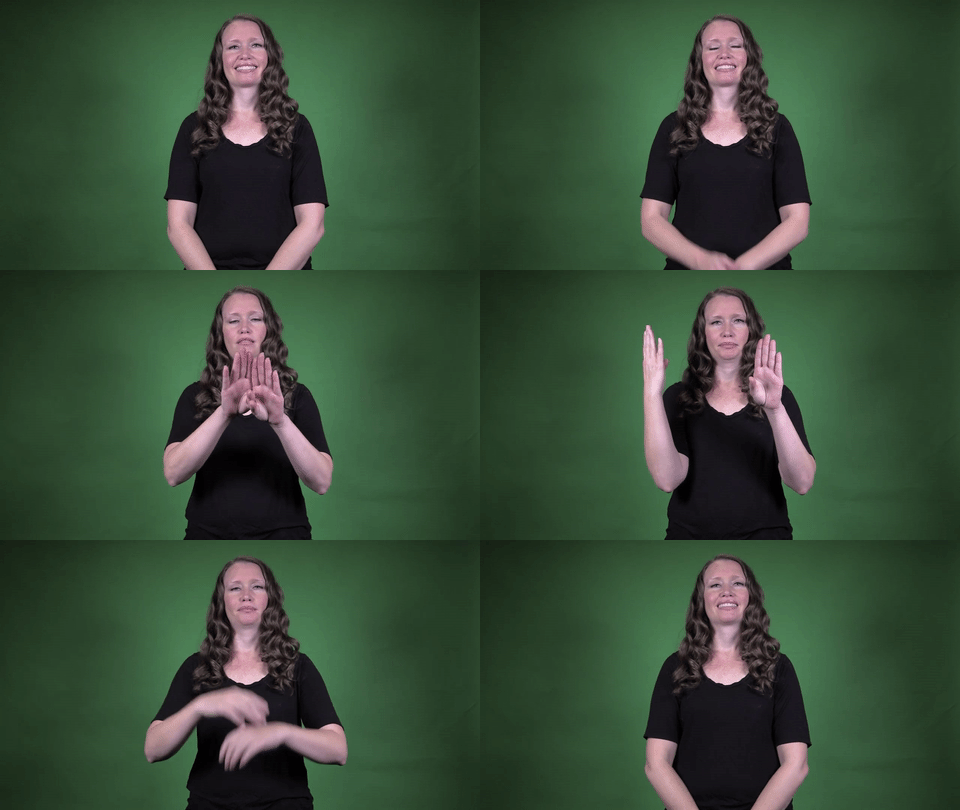
Definition: Not closed or fastened.
Sign for OPEN in ASL
Practice Activities
To master the sign for OPEN in ASL, consistent and focused practice is essential. Start by standing in front of a mirror and repeating the sign while observing your handshape, palm orientation, and movement. Mirror work helps you self-correct and ensures that your sign for OPEN in ASL is clear and accurate.
Record yourself signing in short phrases or sentences that include the sign. Watch the recordings to assess your fluency and clarity. Signing in context is also helpful—use the sign for OPEN in ASL while interacting with everyday objects like doors, books, or containers. Practice saying things like “Open the door” or “Open your book” in ASL.
Once comfortable with the basics, move into more advanced drills. Sign contrastive pairs like OPEN and CLOSE to develop muscle memory. Use flashcards or practice with a partner to identify when the sign for OPEN in ASL is appropriate based on context. These activities reinforce both receptive understanding and expressive skills.
SEO Cultural Context
In Deaf culture, clarity and visual accessibility are fundamental. The sign for OPEN in ASL reflects these values by being highly iconic and easy to understand. It visually represents the action of something being opened, making communication efficient and culturally intuitive.
The sign for OPEN in ASL can differ slightly depending on what is being opened—doors, containers, books, or hands. Regional variation may influence the speed or style of the sign, but the core meaning remains the same. For example, in some parts of the U.S., the movement might be more exaggerated, while in others, it remains compact and efficient.
Deaf individuals often rely on visual cues, so using the sign for OPEN in ASL with appropriate facial expressions and context is vital. This sign is commonly used in daily life—whether you’re inviting someone to open a door, open their heart, or even start a conversation. Understanding when and how to use this sign respectfully demonstrates cultural competence.
Extended Definition
The sign for OPEN in ASL is a classifier-based sign that varies depending on the object being described. To sign OPEN for a door, both hands are held in front of you, palms facing each other, then moved outward as if opening a double door. For a book, the hands are together in front of you and then open upward, mimicking the motion of opening a book.
One common error is using the incorrect handshape or movement for the object. For instance, using the door sign when referring to a book can cause confusion. The sign for OPEN in ASL is context-specific, so it’s important to understand what type of item you’re referring to. Classifier usage and object-specific movements are key to clear communication.
Some related signs include OPEN-DOOR, OPEN-WINDOW, or OPEN-BOOK. Each of these uses specific handshapes and movement patterns to convey the meaning clearly. The general classifier-based sign for OPEN can be adapted to fit the situation, which makes it both versatile and nuanced.
Tips for Beginners
Beginners often struggle with choosing the correct variation of the sign for OPEN in ASL. Start by learning the most common versions—such as OPEN for a door or OPEN for a book—before exploring more nuanced forms. Focus on clean handshapes and controlled movements.
Pay attention to palm orientation. If your palms are facing the wrong direction, the sign may become unclear or look like a different word. Also, don’t rush—the sign for OPEN in ASL should be deliberate and easy to see.
Practice with real objects. Pick up a book and sign OPEN while actually opening it. Use a toy door or a cabinet. Associating physical actions with their ASL counterparts builds muscle memory and reinforces learning.
Be patient with yourself. It takes time to build fluency and confidence. The sign for OPEN in ASL may seem simple, but it’s a rich and flexible concept that you’ll use often as your vocabulary grows.
Connections to Other Topics
The sign for CLOSE is directly related to the sign for OPEN in ASL. They often appear together in dialogues and activities. Learning both helps you understand how opposites are expressed in ASL and how hand movements can mirror one another with opposite meanings.
Another important connection is with classifier handshapes. Since the sign for OPEN in ASL often uses classifiers, understanding how classifiers function in ASL grammar will deepen your knowledge. Classifiers make communication more specific and visually descriptive.
You’ll also benefit from learning signs like ENTER and EXIT. These directional signs often appear in the same contexts as OPEN and CLOSE. They help you build a thematic vocabulary around movement and space.
The sign for UNLOCK is another related sign. It often precedes the sign for OPEN in ASL when referring to secured objects like doors or safes. Knowing how to sequence signs like UNLOCK and OPEN improves your narrative flow and clarity.
Lastly, consider learning the sign for START. In many situations, OPEN and START are conceptually linked. For instance, “Open the meeting” or “Open your mind” uses OPEN in metaphorical ways that overlap with the idea of beginning something.
Lengthy Summary
The sign for OPEN in ASL is a versatile, visually clear sign that plays a critical role in everyday communication. Its usage spans both literal and metaphorical contexts, from opening doors and books to opening conversations and ideas. Because it is classifier-based, the sign adjusts to the object being described, making it a dynamic addition to your ASL vocabulary.
Learners should begin with basic forms of the sign that are most common—like OPEN for doors or books—and gradually explore more complex or context-specific variations. Practicing with real objects, using mirror work, and recording your signing are all excellent ways to build fluency. As you become more advanced, incorporating the sign for OPEN in ASL into spontaneous conversations and expressive narratives will help you achieve greater comfort and naturalness.
Understanding the cultural background of the sign is just as important as mastering its form. In Deaf culture, visual clarity and expressive facial grammar enhance the meaning of signs like OPEN. Respecting these cultural norms ensures that your communication is not only accurate but also respectful and effective. Be mindful of regional variations and always aim for clarity in your movements and expressions.
Common beginner mistakes—such as incorrect palm orientation or misapplied handshapes—can be overcome with practice and feedback. Remember that the sign for OPEN in ASL may look simple but carries a wide range of uses and meanings. It’s part of a broader network of signs that include CLOSE, UNLOCK, START, and others. Learning these related signs helps you build a connected understanding of ASL vocabulary and grammar.
Incorporating the sign for OPEN in ASL into your regular signing practice will reinforce your learning and increase your signing confidence. Whether you’re learning ASL for personal use, interpreting, or building inclusive communication skills, mastering this foundational sign is a crucial step. Keep practicing, stay curious, and explore the richness of ASL through each sign you learn. The sign for OPEN in ASL is your gateway to deeper understanding and more dynamic communication—so open your hands, open your eyes, and dive into the beauty of ASL today.
Synonyms: open, unfastened, unlocked, unobstructed, ajar
Educational resources: Find related learning materials in our course bank!
Want more? Check out some of our popular learning activities on the homepage!
Need to look up a sign? Use our highly rated dictionary: https://aslinteractive.com/best-asl-dictionary/
Follow us on tiktok: https://www.tiktok.com/@aslinteractive. More social media links at the bottom of this page!
Long-tail Keywords: what is the sign for open in ASL, how do you sign open in ASL, ASL sign for open
Categories:
tags: American Sign Language verbs, open signs ASL, ASL travel vocabulary, ASL food terms, ASL clothing signs
Want more? Check out some of our popular learning activities!
ASL Interactive Resources
ASLInteractive YouTube Channel
Follow us on tiktok: @aslinteractive.com
Follow us on Instagram: aslinteractive
Facebook page: aslinteractive
Facebook group: aslinteractive
LInkedIn: ASL Interactive LLC
Twitter: @ASL_interactive
*Some information on this page is AI-generated. AI can make mistakes. Please check the information.


Responses