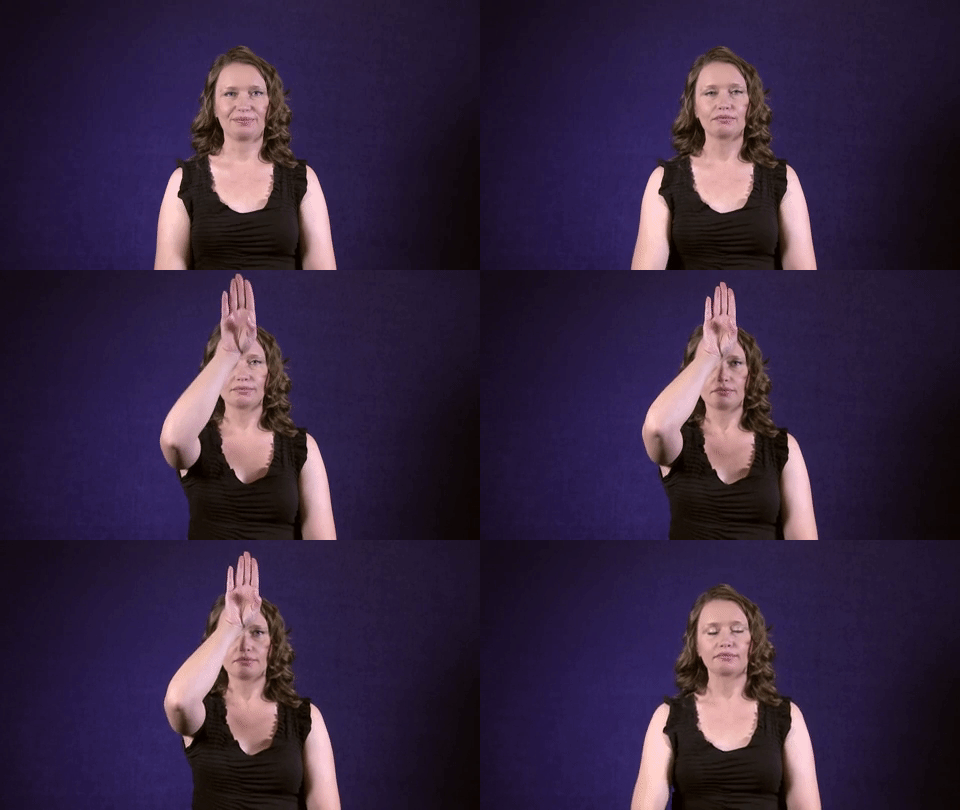
Sign for FIREFIGHTER in ASL | ASL Dictionary

Definition: A person whose job is to extinguish fires.

Sign for FIREFIGHTER in ASL

YouTube player

Practice Activities:

Start your practice by repeating the sign for FIREFIGHTER in ASL in isolation, using a mirror to check your handshape, palm orientation, and location. Complete five repetitions slowly, then five more at a conversational pace. Try signing it while standing and sitting to simulate real-life scenarios.

Next, create simple sentences such as “My brother is a firefighter” or “The firefighter drives a big truck.” Practice these in front of a mirror or record yourself to review your facial expressions and fluidity. Pay attention to how you transition from one sign to the next and maintain spatial grammar.

Work on storytelling by describing a typical day in the life of a firefighter. Include signs like FIRE, TRUCK, HELP, RESCUE, and STATION. Use storytelling to create a connection between vocabulary and real-life context. Signing a brief narrative helps reinforce the meaning and usage of the sign for FIREFIGHTER in ASL.

For a partner activity , describe different types of emergency workers and have your partner guess the profession from your descriptions. Reverse roles and take turns using professions in sentences. This allows for receptive and expressive practice, especially with the sign for FIREFIGHTER in ASL mixed with other community helper signs.

Use an online video of firefighters in action and try to interpret it using ASL. Practice summarizing the video narrative using the sign for firefighter and related vocabulary. This will challenge your comprehension and production skills together.

Close your practice session by fingerspelling names of famous firefighters or local stations, and following them with the sign for firefighter. Reinforce the concept through repetition over several days to build retention and fluency. Don’t forget to use facial expressions to show emotion and emphasis during all parts of practice.

Cultural Context:

In American Sign Language, community-based professions carry cultural significance, and the sign for firefighter in ASL is one such example. The role of a firefighter goes beyond extinguishing fires—it represents protection, bravery, and service within the Deaf and hearing communities alike .

When teaching the sign for firefighter in ASL, it’s important to note how visual language captures the essence of roles in society. The sign mimics the firefighter’s iconic helmet, instantly connecting viewers to the concept without needing spoken language.

The Deaf community often emphasizes clear and visual communication of societal roles, especially those involving safety and emergency services. This makes the sign for firefighter in ASL a commonly used sign in educational settings, especially when discussing community helpers or emergency planning .

Children in Deaf schools and inclusive classrooms often learn the sign for firefighter in ASL as part of thematic units about jobs or public service. Since firefighters are often the first responders during emergencies, knowing this sign can support safety communication for Deaf individuals.

ASL storytelling and role-playing often incorporate public service signs. The sign for firefighter in ASL frequently appears in role-play activities, helping Deaf children visualize and rehearse real-life situations involving emergencies or fire drills .

Cultural respect and accuracy in representing professions are vital in sign language. When using the sign for firefighter in ASL, it’s also an opportunity to discuss the importance of having Deaf or signing firefighters who can respond appropriately in the Deaf community.

Fire safety workshops, hosted in schools and community centers serving Deaf and hard of hearing individuals, use the sign for firefighter in ASL to bridge communication gaps. It empowers participants to interact confidently with first responders through signs they recognize.

Deaf-friendly cities often host events where children can meet local firefighters. During these events, the sign for firefighter in ASL becomes a key connector, allowing youth to engage without barriers and fostering a stronger sense of inclusion and safety in the community .

When creating videos or social media content about public service roles, including the sign for firefighter in ASL makes the content more accessible. It also helps raise awareness about the importance of equal access to emergency communication.

Parents, educators, and interpreters benefit from repeatedly using the sign in a variety of contexts, so understanding the cultural and practical function of the sign for firefighter in ASL enhances vocabulary retention. This repetition supports smoother interaction during fire safety education and emergency response exercises.

By teaching and using the sign for firefighter in ASL, we promote inclusivity while reinforcing trust in first responders across

Extended Definition:

The sign for firefighter in ASL is a commonly used occupational sign that recognizes an important public service role. It’s often used in conversations about jobs, emergency response, community helpers, and safety. Understanding how to produce and recognize this sign helps communicate important messages clearly and respectfully in American Sign Language.

To create the sign for firefighter in ASL, use the sign for fire followed by the sign for person or agent. The fire sign is made by flicking the fingers upward from the tips of one hand, mimicking flames. Then, follow it with the person-marker sign, which is formed by dropping both flat hands down the sides of the body to indicate a person doing a job.

Another common variation of the sign involves tapping a “B” handshape on the forehead as if mimicking a firefighter’s helmet. This version of the sign for firefighter in ASL is used frequently in casual and educational settings. It may appear in children’s books, school activities, and basic occupational vocabulary lessons.

Facial expressions and context play a role in how naturally the sign is understood. When discussing careers, you might see the sign for firefighter in ASL paired with other job-related terms, giving it more context. It’s useful to understand the variations and when to use them.

This sign is helpful not only in educational environments but also in community outreach programs and events that involve emergency services. When teaching children or adults about first responders, using the correct sign for firefighter in ASL builds both language skills and safety awareness. It reinforces the importance of recognizing and appreciating their contributions to society.

ASL uses classifiers and context-specific signs to provide a more vivid and detailed form of communication. You may also see additional signs describing actions like putting out fires, driving a fire truck, or using a hose. These signs can be used alongside the main sign for firefighter in ASL to create a more dynamic and descriptive sentence.

Learning this sign supports inclusive communication, especially in public events, school visits, or fire safety presentations involving Deaf or hard-of-hearing participants. It allows emergency responders and educators to foster a more accessible environment. Knowing how to produce the sign for firefighter in ASL can also enhance storytelling, classroom discussions, and role-play activities.

For those interested in careers or community services, mastering occupational signs is a key part of building ASL fluency. The firefighter sign is one of many job-related signs that help describe the vital roles in society. Signing accurately ensures smoother interactions and prevents miscommunication.

Whether you’re

Synonyms: fireman, firewoman, fire crew member, emergency responder, fire service professional

Educational resources: Find related learning materials in our course bank!

Want more? Check out some of our popular learning activities on the homepage!

Need to look up a sign? Use our highly rated dictionary: https://aslinteractive.com/best-asl-dictionary/

Follow us on tiktok: https://www.tiktok.com/@aslinteractive. More social media links at the bottom of this page!

Long-tail Keywords: what is the sign for firefighter in ASL, how do you sign firefighter in ASL, ASL sign for firefighter

Categories:

tags: firefighter in American Sign Language, ASL sign for firefighter, how to sign firefighter in ASL, firefighter ASL meaning, firefighter sign language tutorial

Parameters

*Handshape*:

The handshape used in the sign for FIREFIGHTER in ASL starts with a flat B-handshape. The fingers are straight and together, and the thumb is tucked in against the palm. This handshape mimics the appearance of a badge or protective gear on the forehead.

In the sign for FIREFIGHTER in ASL, the B-handshape taps the forehead where a firefighter’s hat brim would sit ‍ . This contextual placement and handshape clearly align with the profession.

*Palm Orientation*:

The palm orientation for the sign for FIREFIGHTER in ASL starts with the dominant hand forming a flat B-handshape. The palm faces outward, away from the signer, and the fingertips point upward. This hand is then tapped against the forehead, symbolizing a firefighter’s helmet.

In the sign for FIREFIGHTER in ASL, the consistent outward-facing palm helps visually represent the badge or helmet of a firefighter. This direction enhances clarity and standardization in the sign’s formation. ‍

*Location*:

The location for the sign for firefighter in ASL is primarily at the forehead. The sign uses a modified B-handshape, resembling a firefighter’s helmet, and is placed flat against the forehead.

This placement emphasizes the traditional helmet worn by firefighters and helps distinguish the sign for firefighter in ASL from other occupation-related signs. The use of the forehead as the location adds visual context, making the sign easily recognizable ‍ .

*Movement*:

The sign for firefighter in ASL begins by forming a flat B handshape. Place the palm-out B handshape on the forehead, with the fingers pointing upward, mimicking a firefighter’s helmet badge. There is no major movement with the hand once placed on the forehead; it stays there briefly.

This brief but specific placement is essential to convey the meaning in the sign for firefighter in ASL. Facial expressions remain neutral or slightly serious, appropriate to the context of the profession. ‍

*Non-Manual Signals*:

When using the sign for firefighter in ASL, the facial expression should be neutral to serious, appropriate for the occupational context. Eyebrows remain relaxed, and there is no exaggerated emotion unless you’re discussing a specific situation involving a firefighter.

Maintaining steady eye contact helps emphasize clarity and respect for the role. Non-manual signals should remain minimal to ensure the viewer focuses on the sign for firefighter in ASL itself ‍ .

*Prosody, Dominant/Non-Dominant Hand*:

The sign for FIREFIGHTER in ASL uses a dominant flat B-handshape placed across the forehead, palm facing outward, like a badge on a firefighter’s helmet. The non-dominant hand is not used in the sign itself. This sign clearly identifies the occupation and is visually iconic, helping learners remember it easily.

When discussing the sign for FIREFIGHTER in ASL, it’s important to recognize that only the dominant hand moves, with no symmetrical action from the non-dominant hand. This allows for clarity and maintains focus on the single, iconic gesture representing the profession ‍ .

Tips for Beginners:

When learning the sign for FIREFIGHTER in ASL, it helps to break it down into two main parts. Start with the sign for “fire,” which involves fluttering your fingers upward from an open hand near your chest. Then, add the “person” classifier, which is made by placing both flat hands in a vertical position and sliding them downward along each side of your torso. This makes it clear you’re referring specifically to someone who fights fires.

Practice consistently using your dominant hand for the “fire” motion and ensure your handshape is correct. The sign for FIREFIGHTER in ASL also includes placing the back of a “B” handshape across your forehead to resemble a firefighter’s helmet. Beginners often mistakenly place this hand sign too low on the forehead or use the wrong handshape, so double-check in a mirror.

Keep your movements fluid but not exaggerated. Overacting the flames motion from the “fire” part can confuse meaning or make the sign seem unnatural. Also, remember facial expressions play a key role in ASL—so look alert or serious, as that’s often appropriate when referencing a firefighter.

Be mindful about your positioning. The forehead tap needs to be firm but gentle, right at the center of the forehead, and the palm should face out. If the palm faces in or the hand strays to the side of the head, it can distort the concept you’re trying to express.

Finally, watch native signers or ASL videos demonstrating the correct execution of the sign for FIREFIGHTER in ASL. Practice signing in front of a camera or mirror to check accuracy. Signing with others can also help reinforce the correct motion and build confidence in conversation settings.

Connections to Other topics:

The sign for FIREFIGHTER in ASL connects closely with other occupational signs, as many of them use a common structure that includes the person-agent suffix. This suffix is signed by combining a base sign with the sign meaning “person,” created by a downward movement of both flat hands, palms facing each other. Just like TEACHER and DOCTOR, the sign for FIREFIGHTER includes a classifier that identifies roles or professions.

This sign also relates to signs used for emergencies or community safety. FIRE, which is part of the sign for FIREFIGHTER in ASL, is its own visual concept and appears in other compound signs like FIRE STATION, FIRE DRILL, or FIRE TRUCK. Understanding how FIRE is signed separately helps reinforce the connection between environment and role-based vocabulary.

Another relevant connection is the use of uniforms or badges in occupational signs. The sign for FIREFIGHTER in ASL uses a B-handshape on the forehead to mimic the look of a firefighter helmet badge, similar to how POLICE is signed with a tap indicating a badge on the chest. These visual metaphors are a useful way to remember vocabulary and create mental associations.

The structure of this sign also blends well in conversation when discussing community roles. In dialogues describing emergency response teams, the sign for FIREFIGHTER in ASL may be used alongside signs like PARAMEDIC, POLICE, and AMBULANCE, creating a full picture of civic services. It is important for learners to recognize how these signs interplay and change meaning based on context.

In storytelling or describing job duties, this occupational sign combines easily with verbs like HELP, RESCUE, or EXTINGUISH. The flexibility of this sign encourages learners to explore broader sentence construction. Using the sign for FIREFIGHTER in ASL within a narrative builds skills for rich, expressive ASL communication.

Summary:

The sign for FIREFIGHTER in ASL combines iconic representation with classifier principles, making it easy to remember and visually descriptive. To form the sign, the dominant hand is flat with fingers extended and held in a “B” handshape. It’s placed on the forehead, touching with the fingertips, much like where a firefighter’s helmet shield sits.

This handshape and location are not random. The “B” hand on the forehead represents the front flap of a firefighter’s helmet. The placement conveys meaning through spatial orientation, which is a core principle of ASL grammar.

The sign is considered a compound or combination sign, building off the base sign for FIRE and the suffix -ER. ASL often uses person markers to turn actions into professions by adding an agent suffix. The sign FIRE involves rapidly moving wiggling fingers upward to simulate rising flames, and the -ER agent marker is formed by sliding both flat hands downward at the sides of the body.

When signing FIREFIGHTER, the sign omits the actual FIRE component and focuses on the visual of the firefighter’s helmet to denote the occupation. Therefore, a person unfamiliar with the structure might perceive the sign as unrelated to fire at first unless they understand the metaphor.

Culturally, the sign for FIREFIGHTER in ASL carries deep respect. Firefighters in Deaf communities are often seen as protectors and first responders who risk their lives. Representing this role accurately in ASL is important to honor their contribution.

The simplicity of the sign’s formation doesn’t undermine the complexity of its meaning. In ASL culture, occupations are often signed with visual indicators related to tools, uniforms, or job symbolism. This creates a cohesive visual lexicon that reflects the values and daily experience of the community.

Grammatically, the sign for FIREFIGHTER in ASL functions as a noun. It will generally appear at the beginning or end of a sentence depending on topic-comment structure, which aligns with ASL syntax norms. Non-manual markers are used to add emotional or contextual tones.

When incorporating the sign into sentence structure, classifiers related to vehicles, emergencies, or behaviors are often added to expand the context. For example, using CL:3 for a fire truck or mimicking sirens can help round out a narrative involving a firefighter.

From a linguistic standpoint, this sign offers an example of how ASL uses metonymy in meaning construction. The helmet gesture stands for the entire concept of firefighting, not just the uniform. Spatial modality in sign language frequently utilizes part-to-whole representation.

Applied linguistics research often explores how signs for professions reinforce occupational prestige and social roles. The sign for FIREFIGHTER in ASL is taught early in educational settings not only due to its visual nature but also to reflect its importance in civic life.

ASL learners can benefit from understanding how occupational signs are often rooted in iconic imagery. This supports mnemonic retention. As students explore occupational vocabulary, they learn that ASL’s visual-gestural modality supports direct mapping of physical traits to concepts.

The sign for FIREFIGHTER in ASL also connects to broader discussions in Deaf Studies, particularly representation in emergency preparedness training. Emergency signs need to be instantly recognizable, and FIREFIGHTER is one that has become standardized and widely understood in Deaf communities.

There are regional variations in how the sign may be delivered. Some signers may include an additional FIRE sign before the helmet placement to reinforce meaning. However, the most common version uses just the helmet symbol at the forehead to represent the whole profession.

In storytelling or dramatic expression, the sign may be enhanced with facial markers to convey urgency or bravery. ASL poetry and performance sometimes use firefighter imagery to talk about protection, sacrifice, or community care, adding symbolism to the sign.

Technical accuracy in forming the sign is essential. Incorrect handshapes or palm orientations can lead to misunderstandings, especially since similar signs might include POLICE or MILITARY where hand placement on the forehead is also involved.

Understanding the sign for FIREFIGHTER in ASL also opens up insights into how Deaf communities interact with emergency systems. Clear visual signs, training in emergency scenarios, and access to information are all tied into how this term operates socially.

By learning and using the sign correctly, interpreters and emergency personnel can foster better communication. There’s also an ongoing push to ensure all first responders, including FIREFIGHTERS, have basic training in ASL to better serve Deaf citizens.

In visual language systems like ASL, signs for uniformed occupations tend to share patterns. Military, nurse, firefighter, and police often reflect something iconic in what they wear. This boosts semantic transparency even for beginner signers.

A parallel sign to compare with would be POLICE, which is signed by tapping a “C” hand over the chest or shoulder where a badge would be. Nurses make use of an “N” hand tapping the wrist for taking a pulse. These links showcase how ASL

Want more? Check out some of our popular learning activities!

ASL Interactive Resources

ASLInteractive YouTube Channel

Follow us on tiktok: @aslinteractive.com

Follow us on Instagram: aslinteractive

Facebook page: aslinteractive

Facebook group: aslinteractive

LInkedIn: ASL Interactive LLC

Twitter: @ASL_interactive

*Some information on this page is AI-generated. AI can make mistakes. Please check the information.


Responses