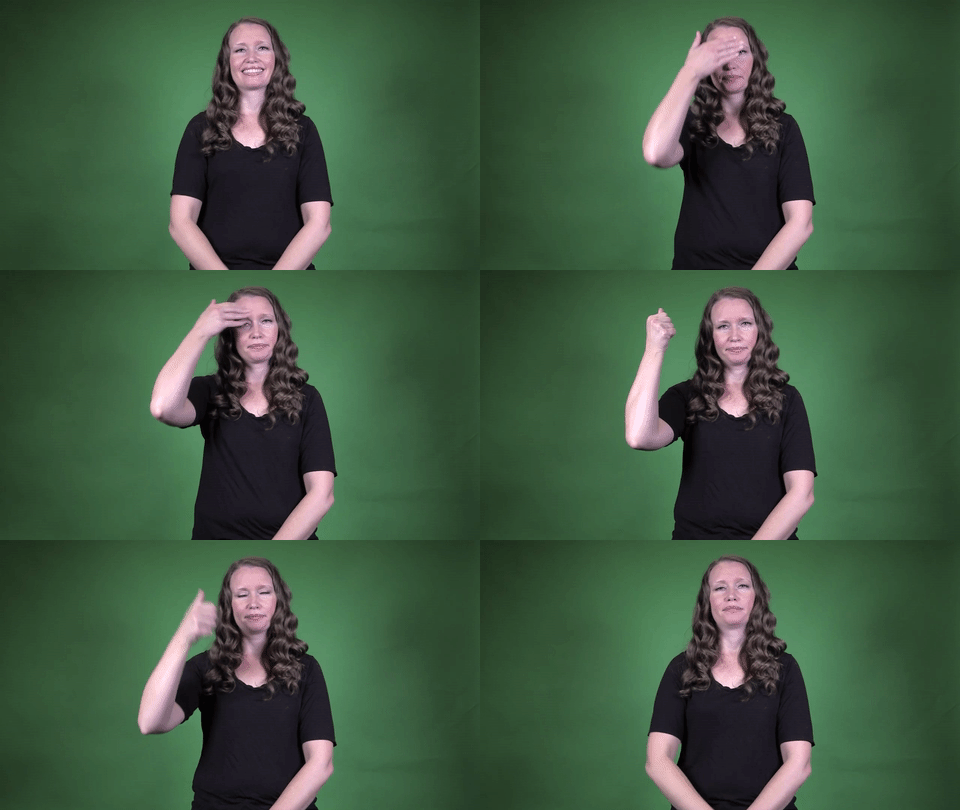
Sign for FORGET in ASL | ASL Dictionary

Definition: To fail to remember.

Sign for FORGET in ASL

YouTube player

Practice Activities:

Begin by practicing the sign for FORGET in ASL in front of a mirror to ensure correct handshape and facial expression. Repetition is key, so practice the sign alone multiple times using both hands if you’re ambidextrous, or just your dominant hand. Focus on the fluidity of motion—starting with a flat hand across the forehead and then wiping away to a bent-O shape, as if brushing away a thought.

Create flashcards with images or words that would prompt you to use the sign for FORGET in ASL. For example, an image of keys or a calendar can cue the sign. Hold up the flashcard, think of a related sentence like “I forgot my keys,” and sign the sentence from start to finish. This will help build your memory and fluency using the sign in meaningful contexts.

Work with a partner to take turns acting out scenarios involving forgetfulness. Maybe one person pretends to forget a birthday, a homework assignment, or an appointment. The other person watches and guesses what’s being forgotten, then repeats back the sentence using the sign for FORGET in ASL correctly. These partner drills make learning both fun and practical.

Use storytelling to expand language skills. Create a short fictional story involving a character who keeps forgetting things. For example, “Yesterday, I forgot my lunch, my homework, and even my phone!” Sign the story fully, trying to incorporate different tenses and supporting vocabulary with the target sign.

Record yourself signing daily routines and intentionally making a mistake, then signing what you forgot. This self-assessment can help reinforce your expressive skills through reflection. Lastly, try using the sign for FORGET in ASL during conversations with fluent signers to get real-time feedback and adjustments.

Cultural Context:

In American Sign Language, the sign for FORGET serves as more than just a direct translation. It reflects cultural nuances in how emotions, memory, and communication are expressed nonverbally within the Deaf community. When using the sign for FORGET in ASL, facial expressions and body language often add emotional depth, showing frustration, surprise, or relief depending on the situation.

The sign for FORGET in ASL involves a motion that denotes wiping something away from the forehead, visually representing a memory disappearing. This sign not only captures the concept of forgetting but also illustrates how ASL uses visual metaphors to express abstract ideas. The gesture is consistent with how sign language pulls from the human experience to make language accessible and meaningful.

In Deaf culture, memory and storytelling are key components of communication. When a signer uses the sign for FORGET in ASL while telling a personal story or anecdote, it can signify a lapse in memory or highlight an overlooked detail. This makes the sign deeply interactive, often prompting others in the conversation to help recall the missing information.

The use of the sign for FORGET in ASL also plays a role in teaching and education within the Deaf community. Students and teachers rely on clear, expressive signs to convey when something needs to be reviewed or relearned. In this context, the sign serves as a helpful indicator during lessons, allowing for smooth transitions between topics and reinforcing the collaborative nature of learning in sign language environments .

Socially, the sign for FORGET in ASL can be used with varying tones depending on context. Among friends, it might be delivered playfully or with a smile to indicate a lighthearted mistake. In more serious conversations, it might be used with a subtle frown or shrug to communicate genuine concern or apology, showing that emotion and empathy are intricately layered into signs.

Within storytelling and performance art in the Deaf community, the sign for FORGET in ASL is often stylized for dramatic emphasis. Performers use body shifts, exaggerated facial expressions, and timing to enhance the narrative’s emotional weight. This showcases the artistic possibilities of ASL as a visual and expressive language .

Understanding the cultural richness of the sign for FORGET in ASL helps learners go beyond memorizing handshapes and movements. It invites them into a visual culture where memory and its loss are portrayed through expressive, intuitive gestures. Immersion in this context helps deepen fluency and appreciation for ASL’s expressive capabilities.

Parents using ASL with young children

Extended Definition:

The sign for FORGET in ASL is a commonly used expression that conveys the idea of something slipping from your memory. It is used in everyday conversations by signers of all ages, making it essential to understand and use correctly. The basic motion of the sign involves wiping across the forehead, followed by a hand shift that suggests erasing or losing something from the mind.

To produce the sign for FORGET in ASL, start with your dominant hand open at your forehead. Then swipe your hand across your brow while gradually closing your fingers into a flat O or similar shape. This movement symbolically shows how a thought is wiped away or forgotten. Facial expression plays a key role in this sign, and a thoughtful or slightly confused look can help add clarity to the message.

This sign can be used in many different contexts. You can say you forgot your homework, forgot a name, or even something more abstract like forgetting an idea. Because forgetting is such a universal experience, the sign for FORGET in ASL is especially versatile and widely understood. Pairing it with time-related signs or subject-specific vocabulary can help clarify what was forgotten.

It’s important to note that modifying your facial expressions when using the sign for FORGET in ASL can change the tone. For instance, adding a head shake and a worried look can indicate regret about forgetting. On the other hand, a shrug and relaxed expression could mean it wasn’t a big deal.

ASL grammar differs from English, so the sign for FORGET in ASL often appears in a different order than an English sentence. Instead of saying I forgot in the typical English way, ASL structure might look more like I WHAT? FORGET or simply FORGET depending on context. Sentence order and emphasis vary based on what message the signer wants to convey.

This sign can also be used in rhetorical questions in ASL, such as Did you forget your keys? The sign for FORGET in ASL would be the central verb in that sentence and might be accompanied by raised eyebrows to indicate the question format. Signers commonly use this form in casual discussions.

Learning the sign for FORGET in ASL is helpful for students, teachers, interpreters, and anyone interacting in the Deaf community. Forgetting is a topic that arises in school, work, and home settings, so knowing how to accurately use and recognize this sign supports clear communication.

The beauty of this sign lies in its simple gesture and universally understood meaning. Once you’ve mastered the

Synonyms: forget, fail to remember, overlook, omit, disregard

Educational resources: Find related learning materials in our course bank!

Want more? Check out some of our popular learning activities on the homepage!

Need to look up a sign? Use our highly rated dictionary: https://aslinteractive.com/best-asl-dictionary/

Follow us on tiktok: https://www.tiktok.com/@aslinteractive. More social media links at the bottom of this page!

Long-tail Keywords: what is the sign for forget in ASL, how do you sign forget in ASL, ASL sign for forget

Categories:

tags: forget in American Sign Language, how to sign forget in ASL, ASL forget sign tutorial, learn the ASL sign for forget, forget sign meaning in ASL

Parameters

*Handshape*:

The handshape used in the sign for FORGET in ASL starts with a flat hand, also called the “B” handshape, placed across the forehead. The fingers are extended and together, with the palm facing inward toward the face.

As you perform the sign for FORGET in ASL, the handshape moves across the forehead and the fingers close slightly into an “A” or fist-like shape. This motion represents wiping away a memory or forgetting something, and the handshape transition is key to conveying the meaning clearly.

*Palm Orientation*:

The palm orientation for the sign for FORGET in ASL starts with the dominant hand open and facing the forehead, usually palm down or slightly in. As the hand moves across the forehead in a wiping motion, the fingers close into an “A” handshape, as if wiping away a memory.

This transition from an open palm to a closed fist is central to the visual concept behind the sign for FORGET in ASL, symbolizing the act of removing or losing a thought .

*Location*:

The sign for FORGET in ASL is typically made near the forehead, just above the eyebrows. This location emphasizes the concept of memory or thought, making it a fitting area for this gesture.

While performing the sign, your dominant hand moves across the forehead, symbolizing the removal or erasure of a thought. The location helps reinforce the meaning conveyed by the sign for FORGET in ASL .

*Movement*:

To perform the sign for FORGET in ASL, begin by placing your dominant hand in a flat “B” shape with the fingertips touching your forehead. In a smooth motion, swipe the hand across the forehead to the side while pulling the fingers into an open “A” or fist, as if wiping something away from your mind .

The movement in the sign for FORGET in ASL symbolizes the idea of removing or erasing memory. Keep the motion fluid and slightly downward to maintain the natural flow of the sign.

*Non-Manual Signals*:

When using the sign for FORGET in ASL, the facial expression should show a sense of realization or mild frustration, as if something important has slipped the mind. Eyebrows are often slightly furrowed, and the eyes may look up or away briefly, indicating an attempt to recall.

The sign for FORGET in ASL often includes a slight puff of air from the mouth and a head shake, reinforcing the idea of memory loss or forgetting something unintentionally.

*Prosody, Dominant/Non-Dominant Hand*:

The sign for FORGET in ASL uses the dominant hand in a loose “flat” shape, touching the forehead with the fingertips. As the hand moves away, the fingers sweep across the forehead and close into an “A” handshape, as if wiping away memory. The non-dominant hand is not used. This motion visually represents the idea of erasing or forgetting something from the mind. The sign for FORGET in ASL emphasizes a quick, smooth gesture with clear facial expression to enhance meaning.

Tips for Beginners:

Mastering the sign for FORGET in ASL can be tricky at first, especially for beginners learning nuanced facial expressions and hand movements. When practicing, focus on fluid motion from the forehead outward, using your dominant hand. This action should appear like you’re wiping away a thought from your forehead, typically done with the fingertips of a flat hand gradually transforming into the letter A handshape as it moves across your head.

One helpful tip for learners is to exaggerate the motion slightly during early practice to solidify the muscle memory. Over time, you can fine-tune the dynamics and make it more natural. Don’t forget that facial expressions can add clarity and intensity to the sign for FORGET in ASL—showing a blank or confused facial expression can enhance the meaning.

A common pitfall is using an inconsistent or unclear handshape change. Remember that the transition from a flat hand to an A should be smooth and consistent. Jerky or shaky movements can confuse viewers, making your sign harder to understand. Slow down and isolate the handshape transformation in drills if necessary.

Be mindful of the sign’s location. Performing the sign too low or too far from the forehead alters the meaning or causes confusion. Always position your starting hand near your forehead before making the wiping gesture. Signing too rapidly or small can also make your sign unclear, especially to those new to watching ASL.

Practicing in front of a mirror is incredibly helpful for signs like this, allowing you to align your hand movement with appropriate facial expressions. Watching videos of native ASL users performing the sign for FORGET in ASL helps build your accuracy and rhythm. Repetition and daily integration into vocabulary drills will solidify comprehension and usage.

Connections to Other topics:

The sign for FORGET in ASL connects closely with cognitive and memory-related concepts. It often appears in contrast with signs like REMEMBER, THINK, or KNOW, allowing users to express complex ideas about mental processes. These cognitive signs are essential for storytelling, academic discussions, or daily conversations involving emotions, responsibility, or time.

This sign frequently combines with other signs to form compound concepts like FORGET-ME-NOT, typically used symbolically rather than literally, or DON’T-FORGET used as a directive or reminder. The sign for FORGET in ASL appears in phrases conveying forgetfulness, such as FORGET-ALL or FORGET-WHAT, which are useful in casual and narrative contexts when describing someone’s lapse in memory.

Learning the sign for FORGET in ASL can help learners explore the broader category of emotion- and mind-based signs. FORGET is tied emotionally to feelings of regret, guilt, or relief, depending on context. These emotional interpretations link to signs like SORRY, MISS, or RELIEF, which are often used together to deepen conversation.

The visual metaphor within the sign for FORGET, which mimics wiping away a thought from the forehead, also helps learners understand how ASL often uses space and gesture to represent abstract concepts. This visual aspect is also mirrored in signs like ERASE or WIPE, connecting physical gestures with abstract actions.

In academic or professional ASL usage, FORGET might be included in discussions about memory loss, Alzheimer’s, or educational struggles. It is a useful term when learning signs related to medicine, psychology, or schooling. Overall, being fluent in the sign for FORGET in ASL empowers users to communicate nuanced experiences related to recollection, personal history, and emotional reflection .

Summary:

The sign for FORGET in ASL is expressive, vivid, and culturally nuanced. It captures a cognitive process—erasing or losing information—from a visual-spatial perspective. This makes the concept more tangible in sign language than it often feels in spoken language.

The typical sign uses the dominant hand, which starts in an open flat “B” or “5” handshape across the forehead. As the hand slides across the forehead, it transforms into an “A” handshape, mimicking the act of wiping away a thought or memory. It’s as though one is cleaning a mental slate.

This motion—across and away from the forehead—symbolizes the deletion of memory and aligns with the metaphor of the mind as a writable surface. The forehead location is important, representing the seat of thoughts and abstract cognition in ASL’s spatial grammar. The shift from open to closed hand intensifies the image of something disappearing or being lost.

In ASL grammar, the sign for FORGET can function as a verb in many sentence structures. It can be directional when reinforced through facial expressions or body posture. You might lean forward for emphasis or backward in a more reflective tone.

Negation is often achieved via non-manual markers, such as shaking the head or furrowing the brow. There’s also a related construction using NOT+REMEMBER to emphasize the idea of forgetting. These signs may be used interchangeably in casual conversation, depending on the context.

The sign can also be modified slightly in speed and intensity to convey differing degrees of forgetfulness. A quick, sharp wipe might suggest sudden memory loss, while a slower slide with an exasperated facial expression can illustrate frustration at forgetting. Non-manual signals, such as raised eyebrows or pursed lips, give the sign emotional coloring.

The sign for FORGET in ASL has several variations depending on regional dialects and generational influences. In some variations, the handshape might begin closed and open as it moves away, though this form is less common. These differences reflect ASL’s natural evolution.

ASL is a living language deeply influenced by culture and community, and signs like FORGET emphasize how cognition is embodied. The wiping gesture illustrates the visual embodiment of a mental process—something that’s often abstracted in spoken languages. This creates a more grounded semantic connection.

In Deaf culture, memory and storytelling are highly esteemed. Signs related to memory carry extra weight in narratives, especially visual storytelling or ASL poetry. The sign for FORGET contrasts powerfully with REMEMBER, highlighting introspection, loss, and reflection.

REMEMBER in ASL involves connecting two fingertips from the forehead to the opposite hand. It captures the storing or securing of a thought. Thus, the sign for FORGET can be seen as the opposite: a letting go or discarding of memory from that same cognitive space.

These binary pairs—REMEMBER and FORGET—reflect cognitive oppositions and offer insight into how Deaf signers conceptualize thought. These signs show how ASL puts visual metaphors at the heart of linguistic processes. It’s not just about symbols—it’s about space and movement.

From a linguistic perspective, the forehead location is categorized as a high-contact area for signs that involve cognition. This mirrors other signs, like THINK or KNOW, that also involve the head as a conceptual core. This spatial mapping reinforces the role of the body in cognition in ASL.

Sign languages engage in what is called “classifier” usage sometimes in storytelling. While not typically used for FORGET in everyday use, creative ASL performers might modify the sign to convey metaphorical forgetting—using their whole body to enact memory slipping away. This enriches the visual grammar.

Applied linguistics sheds light on how the sign for FORGET in ASL plays a role in second language acquisition. New ASL learners find the gesture intuitive but may need coaching on the proper transformation of the handshape and use of facial expressions. Fluency levels determine how well the emotional depth of the sign is conveyed.

Teachers of ASL often incorporate the sign into practice drills about daily experiences—like forgetting homework or birthdays. It’s also part of narratives where forgetting something changes the story’s outcome, allowing the signer to build fluency through meaning-based practice. This makes retention more effective.

In psychosocial contexts, the sign for FORGET may also be used in counseling or support services conducted in ASL. It may be discussed when talking about traumatic memory, repression, or cognitive change. This shows its role beyond conversational language into therapeutic communication.

Memory maintenance is especially important in DeafBlind contexts, where modification of the sign for tactile signing is essential. The hand motion may be modified, but the concept remains clear. This shows how signs are adapted cross-modally to preserve meaning.

There are informal or humorous versions of the sign for FORGET, integrated into jokes or storytelling performances. Performers might exaggerate the wiping motion or make it part of a sequence to indicate complete mental blankness. This creates resonance in

Want more? Check out some of our popular learning activities!

ASL Interactive Resources

ASLInteractive YouTube Channel

Follow us on tiktok: @aslinteractive.com

Follow us on Instagram: aslinteractive

Facebook page: aslinteractive

Facebook group: aslinteractive

LInkedIn: ASL Interactive LLC

Twitter: @ASL_interactive

*Some information on this page is AI-generated. AI can make mistakes. Please check the information.


Responses