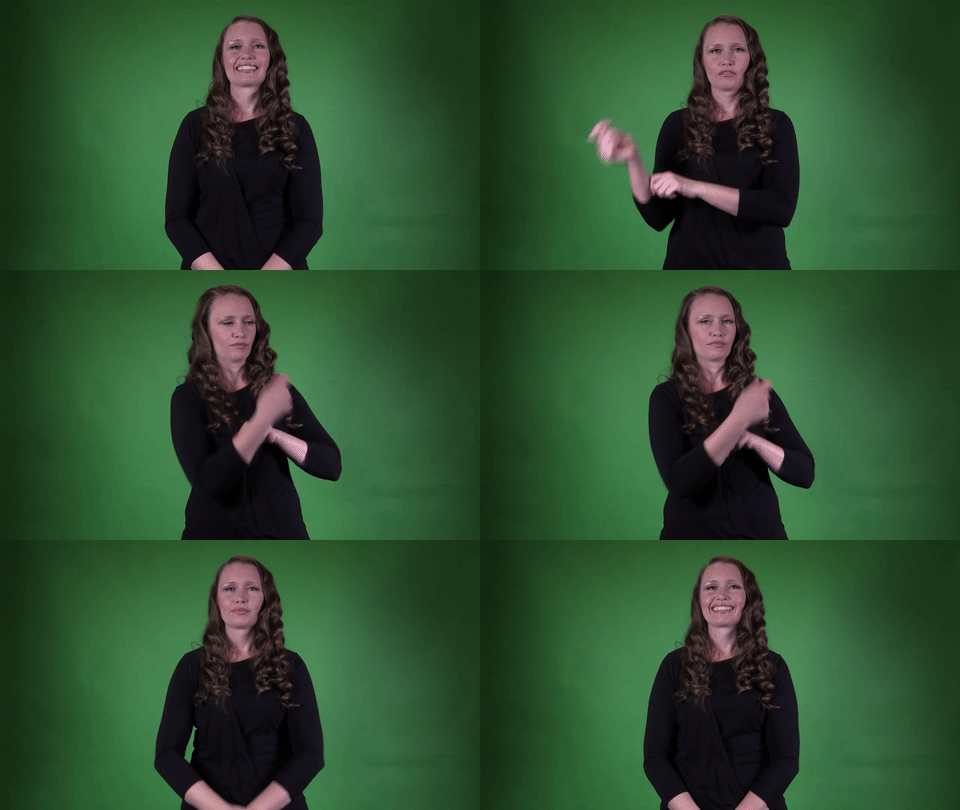
Definition: A sport in which players use clubs to hit a ball into a series of holes on a course.
Sign for GOLF in ASL
Practice Activities:
To practice the sign for GOLF in ASL, begin by isolating the movement. Stand in front of a mirror and repeatedly perform the sign, focusing on the swinging motion that represents hitting a golf ball. Emphasize a relaxed yet precise arm movement, similar to swinging a golf club. Try different speeds and repetitions, then pause and reset after every few swings to reinforce muscle memory.
Once comfortable, incorporate signing the word in full sentences. Examples include: “I like GOLF,” “My dad plays GOLF on weekends,” or “We went to the GOLF course yesterday.” Use these sentences during signing drills or daily conversations. Repeating them out loud while signing helps reinforce receptive and expressive recognition.
Pair up with a partner and practice conversational exchanges where GOLF is contextually relevant. One person can sign a sentence about GOLF and the other responds or asks a related question, such as “Where do you play GOLF?” or “Who won the GOLF game?” Switch roles to increase fluidity and reinforce understanding.
For a fun storytelling prompt, sign a brief narrative about a day at the golf course. Describe arriving, choosing clubs, hitting the ball, and maybe making a hole-in-one. Include expressions and body language for emphasis. Keep the sign for GOLF consistent throughout so your narrative remains clear and engaging.
Watch videos of individuals using the sign for GOLF in ASL in context, then pause and mimic their production. Shadowing native signers enhances fluency. Use flashcards with activities that ask, “Which sport is this?” then sign the correct answer.
Finally, record yourself signing the sign for GOLF in ASL in a sentence or story and watch for accuracy in movement and facial expression. Self-assessment builds awareness and allows for improvement over time.
Cultural Context:
The sign for GOLF in ASL is a great example of how American Sign Language incorporates visual elements from real-life activities. Golf has a distinct motion and culture, and the sign reflects the swinging action that is central to the sport. The visual nature of ASL mirrors this perfectly, allowing signers to communicate clearly and naturally.
Understanding the sign for GOLF in ASL goes beyond just movement. It connects with a wider cultural understanding of sports and leisure in Deaf communities. Just like hearing individuals gather at golf courses and clubs, Deaf individuals also enjoy playing or discussing golf.
The sign for GOLF in ASL may appear slightly different between casual and formal settings, just as spoken language varies by context. In social gatherings like Deaf golf tournaments or clubs, the sign can be used conversationally when sharing stories or making plans. It appears often in dialogues about sports, leisure, or even as part of describing someone’s hobbies in ASL.
In mainstream American culture, golf is often associated with business, recreation, or retirement. In Deaf culture, the sport also represents social interaction, networking, and inclusive recreation. Using the sign for GOLF in ASL allows Deaf individuals to fully participate in conversations related to these shared experiences.
Access to sports vocabulary like the sign for GOLF in ASL is crucial in promoting inclusive education. Deaf students taking physical education or learning sports rules in schools benefit from knowing the proper signs. Teachers and interpreters can make full use of signs like this to ensure students understand and engage.
With a growing number of Deaf athletes and fans, signs for different sports, including the sign for GOLF in ASL, are becoming more visible in media and online discussions. Videos featuring Deaf golfers or events hosted by Deaf organizations often use this sign. It’s also common in educational ASL videos or sports tutorials.
Importantly, the sign for GOLF in ASL helps bridge the communication gap among Deaf and hearing golf enthusiasts. Whether someone is learning golf terminology or explaining game rules, being able to sign golf effectively promotes better inclusion. This is especially true at sporting events, tournaments, or during casual conversations about favorite hobbies.
Golf is a global sport, and for Deaf individuals in the United States using ASL, knowing the correct and accepted sign is part of being culturally and linguistically competent. When new signs emerge, or older signs evolve in structure or usage, it reflects the dynamic nature of ASL. The sign for GOLF in ASL continues to reflect the community’s needs and experiences.
Extended Definition:
The sign for golf in ASL is a visual representation of the physical motion used when swinging a golf club. It effectively communicates the concept of the sport without fingerspelling or needing to explain the game itself.
To make the sign for golf in ASL, hold your dominant hand in the shape of the letter G from the ASL alphabet. Then mimic the motion of swinging a golf club by moving your hand forward in an arc, as if you’re following through a golf swing. This motion gives a clear visual cue to the sport being referenced.
This sign can be used in casual conversation, sports discussions, or when referring to specific golf events. Whether you’re going to play, watching a tournament, or talking about your favorite golfer, the sign for golf in ASL fits smoothly into everyday signing.
When using the sign for golf in ASL, facial expressions and context play an important role. As with many other signs in American Sign Language, how you sign can change depending on whether you’re asking a question, showing excitement, or stating a fact.
ASL thrives on iconic visual cues, and the sign for golf in ASL is a great example of how movements can represent real-world actions. This allows the concept to be easily understood by signers of various skill levels, from beginners to fluent users.
In classroom or educational settings, the sign for golf in ASL is often introduced when discussing sports or leisure activities. Teachers might pair the sign with pictures of people playing golf or even video demonstrations to support learning and retention.
You might also see variations of the sign depending on the signer’s regional dialect or personal style. Some people use a two-handed version to emphasize the swing, while others keep it simple with just a single hand. Both are widely understood within the Deaf community.
Using signs like this helps reinforce the connection between language and action, making ASL a living, dynamic form of communication. The sign for golf in ASL is not only easy to remember but also adds to the rich vocabulary around sports and hobbies.
In social media content and ASL learning videos, the sign for golf in ASL is often taught alongside other sports like baseball, basketball, and soccer. This grouped learning helps students make associations and build a theme-based understanding of different ASL signs.
Whether you’re heading to the driving range or chatting with friends about the Masters Tournament ⛳, knowing the sign for golf in ASL brings that added layer of inclusion and expression. It makes sports discussions accessible within signed conversations, allowing
Synonyms: golf, golf game, golf sport, golfing, playing golf
Educational resources: Find related learning materials in our course bank!
Want more? Check out some of our popular learning activities on the homepage!
Need to look up a sign? Use our highly rated dictionary: https://aslinteractive.com/best-asl-dictionary/
Follow us on tiktok: https://www.tiktok.com/@aslinteractive. More social media links at the bottom of this page!
Long-tail Keywords: what is the sign for golf in ASL, how do you sign golf in ASL, ASL sign for golf
Categories:
tags: Golf sign in ASL, American Sign Language for golf, how to sign golf in ASL, ASL golf tutorial, golf vocabulary in ASL
Parameters
*Handshape*:
The handshape used in the sign for GOLF in ASL typically mimics the action of swinging a golf club. One hand forms an open or relaxed fist, holding an imaginary club, while the other hand may support it or remain at your side depending on the variation. Movement and posture help emphasize the swinging motion.
This representation helps convey the concept of the sign for GOLF in ASL clearly ️♂️. It’s a natural, iconic sign that closely imitates the motion of playing actual golf for better understanding.
*Palm Orientation*:
The palm orientation for the sign for GOLF in ASL typically faces downward or in a neutral sideways direction, depending on the variation. The dominant hand loosely mimics the shape of a golf club, and the motion resembles swinging a club as if hitting a ball.
When performing the sign for GOLF in ASL, keep the hand relaxed, as if holding an invisible club, and rotate from the elbow or shoulder. This helps clearly simulate the intended sport and keeps the sign easily understood. ️♂️
*Location*:
The sign for GOLF in ASL is typically made in the neutral space in front of the body, around chest to shoulder level. It mimics the motion of swinging a golf club, so the location is slightly forward from the torso, allowing room for this gesture.
When performing the sign for GOLF in ASL, the hand moves like a short, controlled swing near the upper body. This space allows clear visibility and doesn’t obstruct the signer’s face or interfere with other nearby signs. ️♂️
*Movement*:
To produce the sign for golf in ASL, form the dominant hand into the shape of holding a golf club, such as an imaginary fist around a handle. Swing the arm in a small arcing outward motion, mimicking a golf swing. ️♂️
The movement reflects the action of hitting a golf ball with a club. This gesture is iconic and visually represents the sport, making the sign for golf in ASL easily recognizable.
*Non-Manual Signals*:
When using the sign for golf in ASL, the facial expression should remain neutral or slightly focused, reflecting the concentration typically associated with playing golf. There’s no need for exaggerated emotion unless emphasizing a personal story or context involving the sport.
To enhance clarity, lean slightly forward with a relaxed posture, showing engagement with the concept. While performing the sign for golf in ASL, eye gaze may follow the imaginary path of the swing to reinforce the meaning visually. ️♂️
*Prosody, Dominant/Non-Dominant Hand*:
The sign for GOLF in ASL typically uses the dominant hand only. Shape your dominant hand into an open or slightly bent “O” handshape and mimic a swinging motion, as if holding a golf club and taking a golf swing. This action represents the motion of playing golf. ⛳
The non-dominant hand is not involved in the sign for GOLF in ASL. Prosodically, the movement is smooth, flowing, and clearly depicts the action associated with golfing.
Tips for Beginners:
When learning the sign for GOLF in ASL, it’s important to focus on mimicking the motion of swinging a golf club. This sign involves a one-handed gesture that represents taking a golf swing, usually with your dominant hand. Keep your elbow slightly bent and make sure the movement is smooth and intentional.
Beginners often make the mistake of making the sign too quickly or too rigidly, which can confuse the meaning. The natural motion of swinging a golf club is fluid and relaxed—try to capture that feeling. Practicing in front of a mirror can help refine your technique and ensure that the motion is clear and understandable from different angles.
To master the sign for GOLF in ASL, consider visualizing yourself actually holding a golf club. This mental association can help improve the authenticity of your movement. You don’t need to exaggerate the swing too much, but it should be large enough to be clearly seen by your conversation partner.
Another helpful strategy is to watch native signers use the sign in context, such as in videos or Deaf community events. This will reinforce not only how the sign for GOLF in ASL is formed but also when and how it’s typically used. Pay attention to facial expressions and body posture, as they often add context to the sign.
Lastly, be patient with yourself. It might take a little time to get the motion just right, especially if you are new to sports-related signs. Record yourself or ask for feedback to see how your sign compares to fluent signers. Incorporating this sign into sentences and casual conversations will also help it become second nature. ⛳
long-tail keywords: sign for GOLF in ASL, how to sign GOLF in ASL, GOLF sign ASL meaning, ASL sign for GOLF
Connections to Other topics:
The sign for GOLF in ASL is often connected to broader descriptive signs in the category of sports and recreational activities. Like other sports-related signs, it uses a classifier movement to mimic the action of swinging a club, offering a visual icon that maps directly to the game. This kinesthetic style links it to similar signs like BASEBALL and TENNIS, where the hand simulates the typical motion associated with the sport.
The visual nature of the sign for GOLF in ASL makes it adaptable in conversations. For example, it can be paired with location signs such as PARK or COUNTRY CLUB to give context. Additionally, when describing events like a charity golf tournament, one may incorporate EVENT or FUNDRAISER signs, showing how GOLF fits into broader sign phrases involving social or community engagement.
Learners who understand the sign for GOLF in ASL can more easily grasp sign strategies that depict action-oriented activities. This sign reinforces classifier use and spatial referencing, as users may visually locate the ball or describe the golf course layout. It’s a solid example of how ASL uses space and motion as grammar, which is a concept also important in other areas like storytelling or directions.
There are also subtle variations when the sign for GOLF in ASL is used to distinguish between a recreational game versus professional play. For example, adding the sign for COMPETITION or PROFESSIONAL before GOLF gives clear context about skill level or setting. This mirrors how ASL modifies base signs to reflect nuance and intent with additional signs as modifiers.
Understanding the sign for GOLF in ASL helps learners engage in conversations about leisure, physical activity, and even health. It can lead into other discussions involving outdoor adventures or hobbies, linking to signs like HIKE, SWIM, or TRAVEL, and expanding expressive capacity in social or narrative contexts ✨.
Summary:
The sign for GOLF in ASL is a visually gestural representation that mimics the motion of swinging a golf club. This non-manual marker sign is often performed with a dominant hand holding an imaginary club, using a small swing starting by the shoulder or near the waist.
In this gesture, handshape varies between a relaxed fist or a modified A-hand as if gripping a club. The motion is smooth, reflecting the real-world swing while keeping the elbow and wrist flexible. This sign focuses more on the concept than specific equipment.
The sign for GOLF in ASL leans heavily on classifier-like imagery. Rather than spelling out the word or using arbitrary motions, it draws from the visual context of golf’s physical mechanics, making the sign highly iconic.
Facial expressions typically remain neutral, but slight engagement such as head tilting or brow movements can add emphasis or context. These expressions are not essential but enrich the realism of the sporting action.
In many usages, this sign stays consistent across different dialects of ASL. Still, some regional variations may see subtle changes in the angle or fluidity of the swing depending on community and generational influences.
The sign for GOLF in ASL falls into the category of sports signs. Like BASEBALL or TENNIS, the sign uses referential movement that suggests the action associated with the sport, which helps in learning and retention.
From a grammatical standpoint, the sign functions as a noun. It can be contextually converted into a verb within ASL syntax when paired with directional markers or temporal indicators, creating phrases like “I play golf on weekends.”
Signers might also fingerspell G-O-L-F instead of using the gestural sign, especially when referencing proper nouns like “Golf Channel” or the names of tournaments. This switch reflects the linguistic flexibility in the ASL lexicon and offers greater precision.
The gesture version of the sign for GOLF in ASL might serve better in casual or conversational settings. When narrative or specificity is crucial, fingerspelling supplements the gestural sign to maintain conceptual clarity.
Golf as a concept in Deaf culture isn’t particularly dominant, but many Deaf athletes and hobbyists play the sport. Thus, the sign maintains its relevance in dialogue related to recreation, sportsmanship, or even professional competition.
Linguistically, the sign aligns with the principle of iconicity—where signs visually resemble the idea they represent. This method of signing is foundational in ASL and bolsters the intuitive nature of the language for learners.
The use of space is minimal in the sign for GOLF in ASL. Still, skilled signers may expand the spatial field to dramatize a scene, create narrative embellishment, or establish reference points in storytelling.
The connection between movement and meaning is crucial in this sign. The curvature and flow of the swing must suggest the idea of golf distinctively enough from other sports involving hitting or swinging.
Eye gaze sometimes supports the direction of the imaginary swing in the sign for GOLF in ASL. Signers may trace the ball’s imaginary path with their eyes, adding realism while reinforcing spatial storytelling.
This sign intersects applied linguistics in its embodiment of embodied meaning. Meaning isn’t only housed in symbols but also in movements of the body, atmosphere-driven interpretations, and muscle memory connections.
Children learning sports-related signs like this often gravitate more easily toward them due to the kinetic and visual-rich features. Educators use the sign for GOLF in ASL to introduce ASL learners to dynamic verbs and the relationship between physical and linguistic expression.
Cultural concepts like competition, leisure, and elite sports overlap with the use of this sign. While golf isn’t universally accessible, its portrayal in ASL remains democratic—a simple image of swinging a club captures it entirely.
In discussions about disability and adaptive sports, golf holds an inclusive position. This inclusivity is often mirrored in the wide and visual accessibility of the sign for GOLF in ASL within community sports dialogue.
When modifying this sign for ASL storytelling, classifiers, eye gaze, and directional verbs can be added. A signer could build a mini-narrative about a golf game using space and movement with the base sign as the central gesture.
The sign allows for depictional variance. Some signers extend or curtail the backswing depending on their visualization tendencies or communicative energy at the moment.
The simplicity of the sign for GOLF in ASL also makes it accessible in international comparison. While other signed languages may differ, the visual logic of miming a swing with both hands or one transcends verbal language.
ASL literature occasionally draws on sports metaphors. Using signs like this one for GOLF in ASL within poetry or narratives injects movement-based metaphor that resonates physically and emotionally with an audience.
Like many sports signs in ASL, golf is also used metaphorically. A person might sign it along with expressions like ‘hole-in-one’ or ‘off-course’ to metaphorically describe excellence or mistakes in non-sport
Want more? Check out some of our popular learning activities!
ASL Interactive Resources
ASLInteractive YouTube Channel
Follow us on tiktok: @aslinteractive.com
Follow us on Instagram: aslinteractive
Facebook page: aslinteractive
Facebook group: aslinteractive
LInkedIn: ASL Interactive LLC
Twitter: @ASL_interactive
*Some information on this page is AI-generated. AI can make mistakes. Please check the information.


Responses