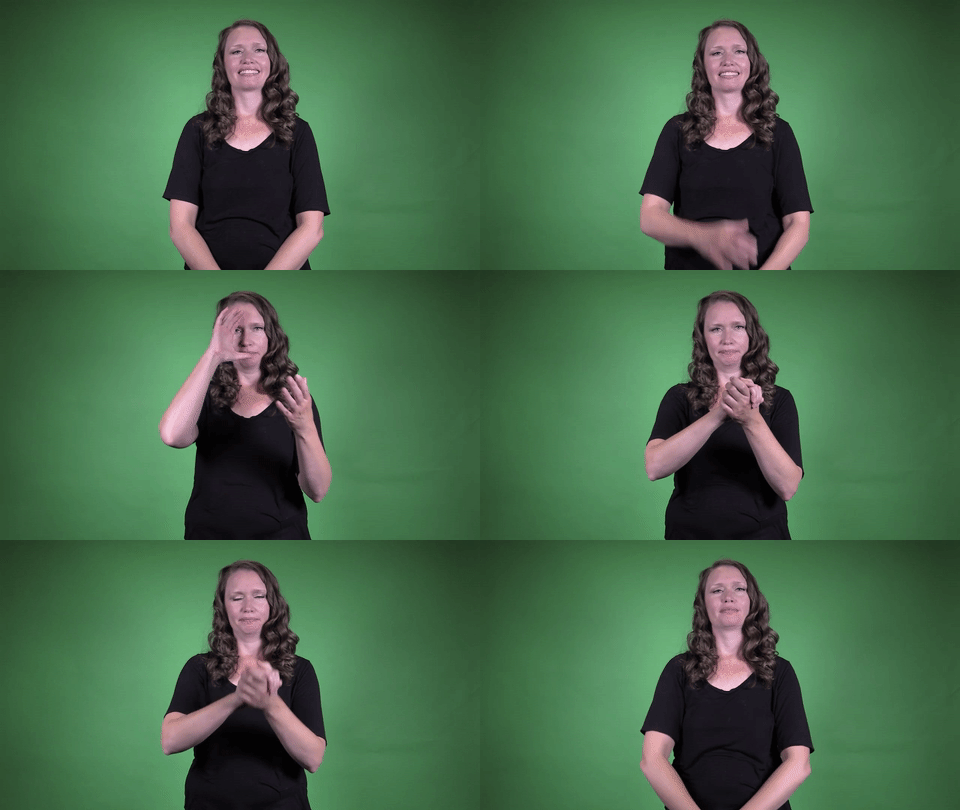
Definition: A married man considered in relation to his spouse.
Sign for HUSBAND in ASL
Practice Activities:
To practice the sign for HUSBAND in ASL, start by signing it in front of a mirror. Focus on the handshape and motion—bringing a flat C-hand from the forehead down to clasp the other hand near the chest. Repeat this several times slowly and then at conversational speed to build muscle memory and fluency .
Next, incorporate the sign for HUSBAND in ASL into simple phrases. Practice signing sentences like “My husband is home,” “She has a husband,” or “Her husband is tall.” This helps you learn to sign naturally within different grammatical structures. Sign these phrases using various facial expressions to show different emotions like happiness, surprise, or frustration, depending on the context.
Use flashcards to combine related family signs with the sign for HUSBAND in ASL. For example, shuffle flashcards with signs like WIFE, MOTHER, FATHER, and CHILD, then draw two and create a sentence using both. This helps improve your vocabulary recall and language structure skills.
Try storytelling prompts such as narrating a fictional wedding or describing a family photo. Create short stories involving a husband going to work, planning a surprise, or spending time with family. Practice signing the story both in front of a mirror and to a partner for feedback.
Engage in partner dialogue activities. One partner can ask questions like “Do you have a husband?” or “What does your husband enjoy doing?” and the other responds using complete signed sentences. Switch roles and adjust the difficulty as comfort increases.
You can also watch ASL videos or mini skits that include family-related conversation. Pause to copy how the sign for HUSBAND in ASL is used and then mimic the sentences independently. This helps you understand how native signers incorporate the word naturally within conversation.
Cultural Context:
The sign for husband in ASL comes with deep cultural associations, reflecting values and traditions within both Deaf and hearing communities. In American Sign Language, signs often reflect more than just meaning—they can convey relationship roles, respect, and family dynamics. Using the correct sign for husband in ASL shows not only linguistic accuracy but also an understanding of the social bonds between people.
In ASL culture, family signs tend to begin around the face or upper chest, symbolizing closeness and identity. The sign for husband in ASL often uses a gesture similar to the sign for man, connecting to the forehead, then moving downward to indicate connection to another person. This movement expresses union, often paired with facial expressions that convey affection or seriousness, depending on the context.
When you use the sign for husband in ASL respectfully and clearly, you demonstrate cultural competence. It can be a sign of affection in casual conversations or a formal reference in storytelling or introductions. In Deaf culture, clarity and intent in signing are important because visual language relies heavily on non-manual markers like facial expression and body posture.
The sign for husband in ASL is not isolated in meaning—it is understood in contrast to other relationship signs, like wife, partner, or fiancé. In discussions about family, relationships, and social roles, using the correct sign invites smoother communication and mutual understanding. Whether you are signing within a Deaf family or talking about someone else’s relationship, accuracy shows respect.
ASL is a living language, shaped by the experiences and identities of its users. The way people sign husband might vary slightly depending on region, age, or personal preference. However, the fundamental aspects of the sign for husband in ASL remain recognizable throughout different parts of the United States.
In daily conversation, the sign for husband in ASL might appear in narratives about family life, marriage, or emotional stories. Storytelling is a valued art form in Deaf culture and using authentic signs strengthens the message being shared. When someone refers to their husband in ASL, they are often sharing part of their identity and connection to loved ones.
Gender and relationship dynamics are also explored through ASL. The sign for husband in ASL reflects traditional family structures, but awareness of evolving family terms allows signers to respect all forms of relationships. While ASL has specific signs for husband and wife, there’s a growing use of signs that include gender-neutral alternatives when needed.
Learning how to use the sign for husband in ASL effectively includes understanding when and how it’s used
Extended Definition:
The sign for husband in ASL is a common and meaningful word used to express a marriage relationship, particularly referring to a male spouse. In American Sign Language, this sign combines the concept of “man” with a gesture that indicates connection or bonding, symbolizing the relationship of a husband within a family unit.
To produce the sign for husband in ASL, start with the dominant hand making the sign for “male” at the forehead, similar to the sign for “man.” Then, bring the hand down to clasp the non-dominant hand in a cupped shape at chest level, a movement that shows a joining or union. This gesture visually connects the identity of a man with the role of a spouse. The motion combines gender and marital relationship to complete the concept.
It’s important to use appropriate facial expressions when signing personal or relational terms in ASL. For the word husband, a soft, neutral facial expression often conveys respect and context, especially in conversations about family or personal life. ASL is visual and context-based, so expressions and movement add extra meaning to the sign.
The sign for husband in ASL is closely related to the sign for wife, but it starts from the forehead to indicate male, whereas wife starts from the chin to signify female. This gender distinction is core in many ASL signs and helps clarify relationships in family discussions. Understanding this pattern can make learning ASL easier and more intuitive.
In various ASL dialects, there may be slight variations in how the sign for husband is performed. Regional or cultural differences might affect hand placement or motion, but the overall meaning remains the same. Always consider the context and audience when using any ASL sign, especially in formal or informal social settings.
When talking about someone else’s husband or referring to your own in conversation, the sign can be incorporated into broader ASL grammar structures. You might pair it with signs for “my,” “your,” “his,” or “her” to be more specific. For example, “my husband” would involve the sign for “my” followed by the sign for husband.
Learning the sign for husband in ASL opens doors to deeper communication, particularly in discussions involving relationships, family structure, or marital status. It’s a key vocabulary word in family and social interactions within the deaf or signing communities. It also helps bridge cultural understanding for hearing people learning ASL.
The sign for husband in ASL is not just a label—it carries emotional and familial significance. By learning it
Synonyms: spouse, partner, mate, significant other, life partner
Educational resources: Find related learning materials in our course bank!
Want more? Check out some of our popular learning activities on the homepage!
Need to look up a sign? Use our highly rated dictionary: https://aslinteractive.com/best-asl-dictionary/
Follow us on tiktok: https://www.tiktok.com/@aslinteractive. More social media links at the bottom of this page!
Long-tail Keywords: what is the sign for husband in ASL, how do you sign husband in ASL, ASL sign for husband
Categories:
tags: family signs, relationship signs, ASL family vocabulary, marital status signs, American Sign Language relationships
Parameters
*Handshape*:
The sign for HUSBAND in ASL uses the flat C handshape. Start with your dominant hand in a C shape at your forehead, similar to the sign for MAN, then bring it down to clasp your non-dominant hand, which waits open at chest level. This motion symbolizes the idea of joining or marriage.
The flat C handshape reflects the connection in the sign for HUSBAND in ASL. The shape stays consistent from the forehead to the chest, helping to visually link the concept of a male partner. This handshape is essential for clearly distinguishing the sign in ASL conversations.
*Palm Orientation*:
The palm orientation for the sign for HUSBAND in ASL starts with the dominant hand open, palm facing towards the side of the forehead, typically with fingers extended and relaxed. The hand then moves down to clasp the other open hand at chest level, ending in a position similar to the sign for MARRY.
In the sign for HUSBAND in ASL, the orientation remains mostly outward or slightly downward as the hand moves from the head to the other hand. This movement represents the conceptual link of a man (head area) joining in marriage. ♂️
*Location*:
The sign for HUSBAND in ASL is performed starting at the forehead area, specifically near the temple. This location relates to the head, symbolizing thought or connection, and transitions downward to the chest to indicate a relational partner. The movement reinforces the role of a husband as part of a family bond.
Using both the head and chest areas helps clearly convey the concept embedded in the sign for HUSBAND in ASL. These locations are integral in many relational signs, adding clarity and depth through their placement.
*Movement*:
The sign for HUSBAND in ASL starts with the dominant hand in a flat C-shape near the forehead, palm facing sideways. The hand then moves downward to meet the other hand, which is in an open B-handshape at the center of the chest, ending with both hands clasped together.
This movement mimics taking a hat off the head and signifies union, often used to convey marriage. The sign for HUSBAND in ASL is fluid and natural, showing the connection between a man and a spouse .
*Non-Manual Signals*:
When using the sign for HUSBAND in ASL, the facial expression should be relaxed and neutral, reflecting a calm and respectful tone. Eyebrows remain in a natural position, and eye contact is gently maintained with the conversation partner ️. Depending on context, a slight warm smile might be appropriate, especially in expressive or affectionate discussions. The non-manual signals help convey the relationship aspect tied to the sign for HUSBAND in ASL.
*Prosody, Dominant/Non-Dominant Hand*:
The sign for HUSBAND in ASL uses the dominant hand in a modified “C” shape. Start by bringing the hand from the forehead (indicating the head or mind) downward to clasp the non-dominant hand, which is open and facing up. This motion represents a union, like a marriage.
The non-dominant hand stays stationary as the dominant hand makes contact. The sign for HUSBAND in ASL mirrors the sign for “wife” but begins at the forehead instead of the chin.
Tips for Beginners:
When learning the sign for HUSBAND in ASL, it’s important to start by mastering the correct handshape and placement. The sign uses the dominant hand in a “C” shape, starting at the forehead (as if referencing a man) and moving down to clasp the non-dominant hand, which is open and relaxed. This motion connects the idea of “man” and “marriage,” representing the concept of husband.
One essential tip is to avoid making the movement too fast or too choppy. New signers often rush the sign, which can cause confusion or reduce clarity. The transition from the forehead to the hand should be smooth and deliberate, not jerky. Practicing in front of a mirror can help you monitor your motion and make sure it’s accurate.
Pay attention to facial expressions and natural fluidity when producing the sign for HUSBAND in ASL. While this specific sign is relatively neutral in facial expression, maintaining a relaxed, open demeanor can help your signing overall look more fluent and approachable. Don’t forget to keep your movements within the standard signing space — not too low, high, or far from your body.
Another thing to watch out for is confusing this sign with the sign for WIFE. Both share similar movements but start from different points — forehead for HUSBAND and chin for WIFE. Be sure you’re consistent with these location differences to avoid miscommunication.
Lastly, immerse yourself by watching native signers and practicing the sign for HUSBAND in ASL in various contexts. Try using it in simple sentences or conversations to build familiarity. Repetition combined with real context will help engrain both accuracy and confidence in your signing style.
sign for HUSBAND in ASL, husband sign ASL, how to sign husband in American Sign Language, ASL husband gesture, ASL sign husband meaning
Connections to Other topics:
The sign for HUSBAND in ASL connects closely with the sign for MAN, as it incorporates the idea of gender. It begins from the forehead, reflecting the traditional location of the sign for MAN, and then transitions into a clasping motion similar to the sign for MARRY. This layering of meanings showcases how ASL often blends concepts to create compound signs that reflect social roles or relationships.
Because the sign for HUSBAND in ASL shares elements with both MAN and MARRY, it helps learners understand how ASL uses conceptual blending. A similar pattern is used in the sign for WIFE, which begins at the chin (as in WOMAN) and also ends with the clasping/hooking motion from MARRY. Recognizing these relationships can deepen understanding of how gendered relationships are depicted in ASL.
The sign for HUSBAND is also useful in discussing family structures and roles. It appears in compound signs like EX-HUSBAND or FUTURE-HUSBAND, where additional temporal or situational markers are added to alter meaning. For EX-HUSBAND, the sign typically starts with the sign for FORMER or a modifying facial expression before transitioning into HUSBAND, helping to place it in time or emotional context.
This sign ties into broader discussions of relational vocabulary in ASL, such as FAMILY, MARRIAGE, and DIVORCE. It can also appear in narrative contexts, especially in storytelling or conversation about personal history, emphasizing its cultural and linguistic relevance. Since the sign builds off recognizable root signs, it supports vocabulary expansion and contextual retention for learners.
When practicing the sign for HUSBAND in ASL, learners naturally begin to understand how ASL represents not just people, but also the social bonds between them. This knowledge is transferable when learning other relationship-based signs like SON-IN-LAW or BROTHER-IN-LAW, which also use a combination of base signs and classifiers.
Summary:
The sign for HUSBAND in ASL draws from deep cultural associations of partnering, identity, and traditional gendered roles. It is formed by taking a flat hand with the fingers together, touching the forehead with a C handshape then bringing it down to clasp the other hand, which is open and in front of the chest. This motion reflects a similar gesture that is used in the sign for MAN, signifying the husband’s masculine identity.
This sign aligns with the sign for WIFE, which involves a similar motion starting near the chin rather than the forehead, symbolizing a traditionally feminine placement. The contrast between the sign for HUSBAND in ASL and the sign for WIFE offers insight into historical understandings of gender roles where men were often associated with the upper part of the body and women with the lower part, such as the mouth or chin.
Grammatically, the sign for HUSBAND in ASL functions as a common noun and is frequently used in everyday conversation involving family structure, marital status, or identity. It can also be modified to show possessive forms through the context of the sentence or paired with the sign for MY or YOUR for clarity.
The directionality of this sign can be used to indicate the referent. For example, if referring to someone else’s husband in a conversation, the signer might shift their body slightly or direct the motion toward the implied third person location in the conversation space. Spatial referencing is an essential linguistic feature in ASL grammar, making it an effective modality for distinguishing between different people with similar roles.
Historically, the sign for HUSBAND in ASL reflects older sociolinguistic viewpoints on marriage and relationships. Although the traditional heteronormative definition persists in this sign’s usage, it can and is used across a spectrum of relationships to reference any person occupying the marital role of ‘husband,’ regardless of gender.
In terms of pragmatics, the sign for HUSBAND in ASL can carry different nuances depending on the signer’s facial expression. A cheerful face may suggest a happily married couple, while a somber or dismissive expression could convey frustration or detachment in a marriage. Non-manual markers are crucial in ASL, conveying the emotion and intent that parallel intonation in English speech.
The morphology of the sign for HUSBAND in ASL draws from compound signs and highly conceptual elements. The component starting at the forehead often represents a masculine origin or identity, while the movement towards a clasped hand suggests union or binding. Together, they combine into a sign that is both iconic and abstract.
In social contexts, the sign for HUSBAND in ASL reflects not just a role but an identity within family units. It can be used in dialogues about parenting, household dynamics, or even in legal discussions regarding marital rights. Its inclusion in narratives signifies stability, partnership, or occasionally, conflict.
This sign is often taught concurrently with the sign for WIFE in beginner ASL classes as part of the family and relationships unit. Pairing these signs helps learners understand relational signs and how they can shift slightly depending on gender, person, or context.
From a linguistic anthropology perspective, the sign for HUSBAND in ASL provides a visual representation of gender norms and family structures as historically interpreted by Deaf communities. Although ASL continues to evolve, traditional signs like this persist, though emerging variations and modifications are beginning to surface in younger and LGBTQIA+ signers’ usage.
Sociolinguistics also plays a role in how the sign is used in different regions or groups across the country. Some signers may slightly modify the handshape or movement, while others might incorporate more neutral or inclusive forms to better reflect their concepts of gender identity and marital roles.
The sign for HUSBAND in ASL is generally well-established and widely understood, but like all signs, it remains subject to regional variation and personal expressiveness. Its meaning, while anchored in tradition, flexes with cultural shifts including same-sex marriage recognition and gender expression awareness.
When explored through applied linguistics, teaching the sign for HUSBAND in ASL offers opportunities for discussing intersectionality, identity, and family diversity. Educators may integrate real-world contexts and visual narratives to broaden understanding of how relational signs function beyond dictionary definitions.
In translation work, the sign for HUSBAND in ASL must be carefully applied to reflect not just the semantic equivalence but also the cultural context. Translators need to evaluate if the sign accurately conveys the original meaning of husband, especially when interpreting texts from different cultural domains or languages.
Language accessibility and clarity are also tied to this sign. For Deaf individuals discussing legal documents, medical records, or family counseling, clarity between HUSBAND and other related terms must be maintained. Interpreters play a critical role in ensuring relational signs are signed with appropriate specificity.
Related signs such as SPOUSE, PARTNER, or SIGNIFICANT OTHER have begun to appear more frequently in ASL discourse, especially in inclusive environments
Want more? Check out some of our popular learning activities!
ASL Interactive Resources
ASLInteractive YouTube Channel
Follow us on tiktok: @aslinteractive.com
Follow us on Instagram: aslinteractive
Facebook page: aslinteractive
Facebook group: aslinteractive
LInkedIn: ASL Interactive LLC
Twitter: @ASL_interactive
*Some information on this page is AI-generated. AI can make mistakes. Please check the information.


Responses