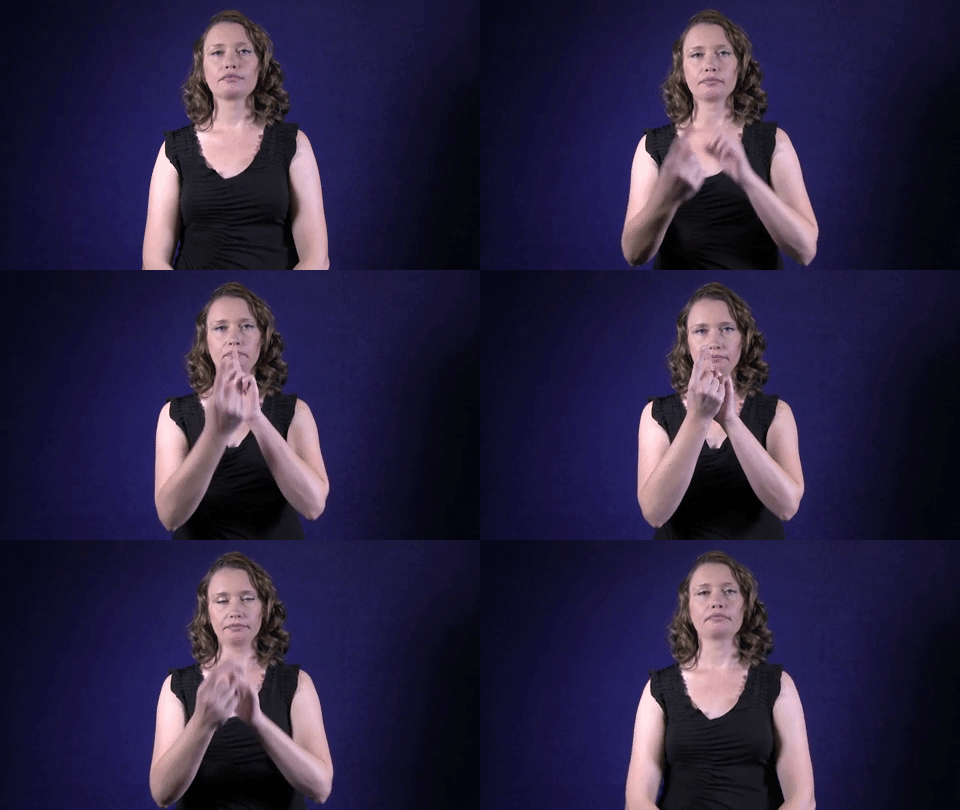
Sign for MEET in ASL | ASL Dictionary

Definition: To come into the presence or company of someone.

Sign for MEET in ASL

YouTube player

Practice Activities:

Cultural Context:

Practice Activities

To master the sign for MEET in ASL, start with mirror practice. Stand in front of a mirror and sign slowly so you can observe your handshape, movement, and facial expressions. This helps reinforce correct form and builds muscle memory.

Record yourself signing in different contexts, such as introducing two people or discussing a meeting. Reviewing your recordings allows you to self-correct and track progress over time. Try watching videos of native ASL users and mimicking their use of the sign to develop natural fluency.

Use the sign for MEET in ASL during everyday conversations, even if you’re just signing with yourself. Practice phrases like “Nice to meet you” or “Let’s meet tomorrow.” This helps connect vocabulary to real communication.

Advanced learners can engage in drills that change the directionality of the sign to reflect who is meeting whom. Practice switching perspectives—for example, “I meet you” versus “You meet me.” This reinforces one of the key grammatical features of ASL.

Language games with peers or classmates can also build fluency. For example, play a game where you describe scenarios in which people meet, using the sign for MEET in ASL repeatedly and in new ways.

SEO Cultural Context

The sign for MEET in ASL carries both linguistic and cultural meaning. In Deaf culture, meeting someone is not just a casual act—it often signifies meaningful connection, trust, and shared communication. Because ASL is a visual language grounded in community, the act of meeting someone face-to-face has special relevance.

In Deaf culture, physical presence is highly valued. The sign for MEET in ASL reflects this value by showing two individuals coming together. This sign is often used when introducing people or setting up future social interactions, which are key moments in building community bonds.

There may be slight regional or stylistic variations in how the sign for MEET in ASL is produced. In some areas, the sign is more compact or exaggerated, depending on the signer’s expressive habits or local signing customs. However, the core structure remains consistent and widely understood.

In real-life situations, the sign is commonly used in greetings, scheduling appointments, or storytelling. For example, a signer may say, “I met my teacher yesterday” or “Let’s meet at the café.” These everyday uses demonstrate the sign’s practical importance in communication.

Extended Definition

The sign for MEET in ASL involves both index fingers pointing upward, with the dominant hand approaching the non-dominant hand. The fingers come together in front of the body, symbolizing two individuals coming together. This directional sign can change based on who is meeting whom.

The base meaning of the sign is “to meet,” but it can also be used in phrases like “meet up,” “meeting,” or “met.” It expresses both casual and formal encounters depending on the context and accompanying signs or facial expressions.

A common mistake is using the wrong handshape or incorrect movement. Some beginners may use flat hands or bring them together incorrectly. It’s important to maintain the upright index fingers and have them meet cleanly to convey the correct meaning.

Another error is forgetting to use directionality. Because the sign for MEET in ASL can be directed from one person to another, it’s essential to understand how to adjust the movement depending on who is being referred to. This visual grammar helps clarify who is meeting whom.

Related signs include INTRODUCE, FRIEND, TOGETHER, and SEE. These signs often appear alongside the sign for MEET in ASL in conversations about relationships and social interactions.

Tips for Beginners

For those new to signing, learning the sign for MEET in ASL can be both exciting and challenging. Start by watching videos of native signers and imitate their movements slowly. Pay close attention to handshape, palm orientation, and direction.

Avoid the mistake of rushing through the sign. Take your time to ensure both index fingers are properly shaped and aligned when they meet. Practicing slowly helps prevent sloppy habits from forming.

Use the sign in everyday phrases like “Nice to meet you” to build familiarity. Repetition in real sentences helps the sign stick in your memory and increases your comfort using it spontaneously.

Beginners should also remember that facial expressions are vital in ASL. When you sign MEET, your facial expression should match the context—friendly for greetings, neutral for factual statements, or excited for happy reunions.

Don’t be discouraged if the sign doesn’t feel natural at first. With consistent practice and feedback, your fluency will grow. Use tools like video playback, peer feedback, and instructor guidance to refine your use of the sign for MEET in ASL.

Connections to Other Topics

The sign for MEET in ASL connects closely with the sign for INTRODUCE. These two signs often appear together when people are meeting for the first time. For example, you might sign “Let me introduce you” followed by the sign for MEET to show the introduction is taking place.

Another related sign is FRIEND. After people meet, they might become friends, so these two signs often appear in narratives or social conversations. Practicing these signs together helps reinforce vocabulary related to relationships.

The sign for TOGETHER is also conceptually linked to MEET. When people meet, they are often physically together in the same space. Signing TOGETHER can expand on the idea of connection initiated by a meeting.

SEE is another sign that frequently appears with MEET. In ASL storytelling, you might sign “I saw her at the store, then we met.” This shows how visual perception and social interaction combine in narratives.

Finally, the concept of DIRECTIONAL VERBS is crucial when learning the sign for MEET in ASL. Directionality allows you to modify the verb to show who is doing what to whom. Mastering this grammar rule is key to using the sign effectively in conversation.

Lengthy Summary

The sign for MEET in ASL is a powerful and commonly used verb that reflects the visual and relational nature of American Sign Language. Its structure—two index fingers meeting in space—symbolizes the coming together of people and is deeply connected to Deaf cultural values of face-to-face interaction and community.

Learning the sign involves more than just handshape; it requires understanding movement, directionality, and facial expression. The ability to adjust the sign based on who is meeting whom is a great example of ASL’s visual-spatial grammar. This makes the sign for MEET in ASL both a vocabulary item and a grammar lesson.

Cultural context enhances our understanding of the sign. In the Deaf community, meeting someone is more than a casual event—it’s the beginning of a relationship built on communication and shared experience. Whether it’s used in a classroom, a social gathering, or a story, the sign carries emotional weight and practical function.

Practicing the sign through mirror work, video recording, and conversational use helps build fluency. Advanced learners can benefit from drills that emphasize directionality and context. Beginners are encouraged to take their time, avoid common mistakes, and use the sign in real-life scenarios.

Connections to other signs such as INTRODUCE, FRIEND, TOGETHER, and SEE provide a broader vocabulary base and help learners understand how ASL conveys relationships and actions. Studying these connections deepens comprehension and prepares learners to use ASL in a fluid and natural way.

In short, the sign for MEET in ASL is more than just a word—it’s a visual representation of human connection. By learning this sign, you unlock the ability to express introductions, appointments, and meaningful encounters. Keep practicing, stay curious, and use every opportunity to sign with others. Your journey into ASL will only grow stronger from here .

Extended Definition:

Synonyms: encounter, come across, run into, bump into, get together

Educational resources: Find related learning materials in our course bank!

Want more? Check out some of our popular learning activities on the homepage!

Need to look up a sign? Use our highly rated dictionary: https://aslinteractive.com/best-asl-dictionary/

Follow us on tiktok: https://www.tiktok.com/@aslinteractive. More social media links at the bottom of this page!

Long-tail Keywords: what is the sign for meet in ASL, how do you sign meet in ASL, meet in ASL meaning

Categories:

tags: meeting signs, interaction signs, ASL social signs, relationship vocabulary in ASL, common ASL greetings

Tips for Beginners:

Connections to Other topics:

Summary:

Want more? Check out some of our popular learning activities!

ASL Interactive Resources

ASLInteractive YouTube Channel

Follow us on tiktok: @aslinteractive.com

Follow us on Instagram: aslinteractive

Facebook page: aslinteractive

Facebook group: aslinteractive

LInkedIn: ASL Interactive LLC

Twitter: @ASL_interactive

*Some information on this page is AI-generated. AI can make mistakes. Please check the information.


Responses