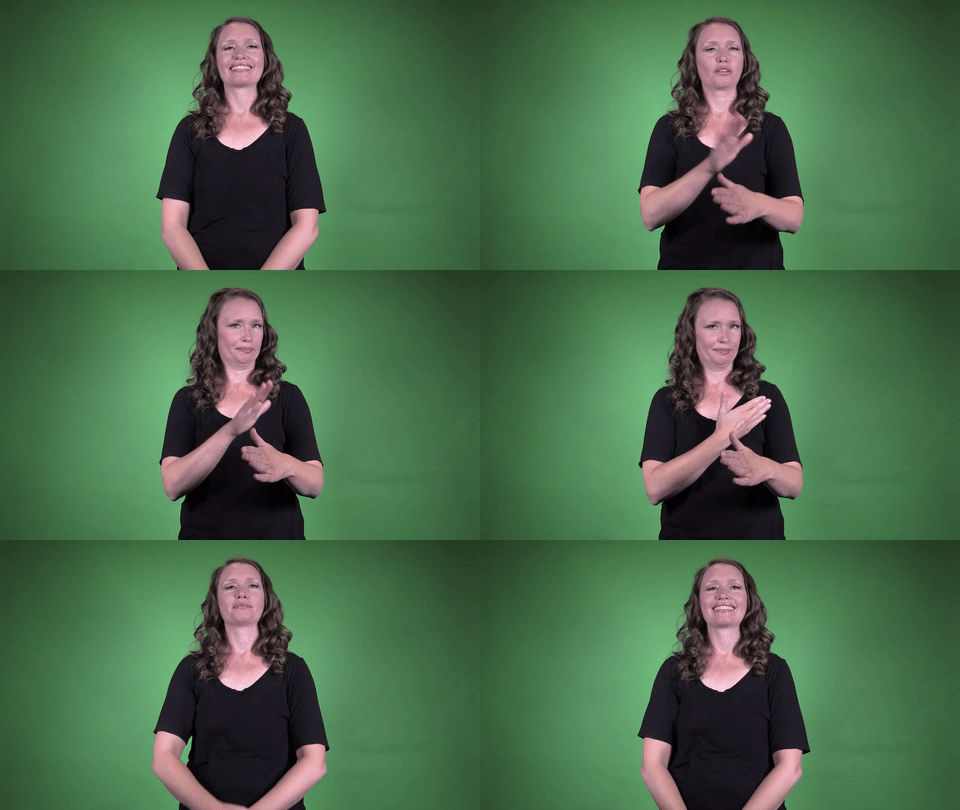
Sign for MUSIC in ASL | ASL Dictionary

Definition: Vocal or instrumental sounds combined to produce harmony.

Sign for MUSIC in ASL

YouTube player

Practice Activities

Practicing the sign for MUSIC in ASL involves more than just memorizing hand movements. To build fluency, start with mirror work. Stand in front of a mirror and sign MUSIC repeatedly while watching your handshape, movement, and facial expression to ensure accuracy and confidence.

Record yourself using the sign for MUSIC in ASL during short monologues or basic sentences. This allows you to review your sign production and notice any inconsistencies. Watching your recording next to a fluent signer or ASL teacher’s demonstration can help you self-correct and improve.

Incorporate the sign into real-life situations. Sign MUSIC when talking about your favorite songs, performances, or genres with friends who know ASL. If you’re learning solo, narrate your thoughts using the sign for MUSIC in ASL while listening to a song or attending a concert.

For more advanced learners, practice drills by combining the sign for MUSIC in ASL with related signs such as DANCE, SING, and INSTRUMENT. Try speed drills, alternating between slow and fast signing to build muscle memory. Use flashcards or ASL apps that prompt you to sign MUSIC in varied sentence contexts. This helps improve your receptive and expressive skills.

Group practice is another effective technique. Join an ASL meetup or virtual signing group and use the sign for MUSIC in ASL in group dialogues. Sharing your favorite musical artist or genre using sign will solidify your understanding and create meaningful engagement.

SEO Cultural Context

In Deaf culture, music is experienced in unique and meaningful ways. While the hearing world often associates music strictly with sound, the Deaf community engages with rhythm, vibration, visual performance, and emotional expression. The sign for MUSIC in ASL reflects this broader, more inclusive understanding.

The sign for MUSIC in ASL is typically performed by swaying one hand back and forth above the opposite forearm, mimicking the movement of a conductor’s baton or a melodic wave. It visually captures the flow and rhythm of music, aligning with how music is felt and interpreted in the Deaf community.

There are some regional differences in the way people sign MUSIC. While the most commonly accepted version involves the sweeping hand motion across the forearm, variations may exist in different parts of the United States or among different signing communities. Always be open to learning from native signers and understanding the context in which variations appear.

The sign for MUSIC in ASL also appears in settings such as Deaf theater, signed music performances, and educational environments. It is used when discussing musical preferences, describing events, or expressing emotion. Understanding how to use the sign appropriately within the cultural norms of the Deaf community is key to respectful and effective communication.

Extended Definition

The sign for MUSIC in ASL uses a dominant hand that moves in a gentle arc above the non-dominant forearm. The non-dominant arm is held horizontally in front of the body, palm facing up. This motion resembles a conductor leading an orchestra or the flow of melodic rhythm.

This sign is iconic, meaning its form visually represents the concept. It’s important to maintain fluidity and grace in your movement when signing MUSIC. Avoid robotic or overly stiff execution, as that can alter the meaning or come across as unnatural.

Common errors include incorrect hand placement or overly aggressive movement. New signers sometimes confuse the sign for MUSIC with similar signs like SONG or DANCE. While related, these signs have distinct handshapes and movements that serve different functions in ASL grammar and vocabulary.

In more advanced usage, the sign for MUSIC in ASL can be incorporated into compound signs or classifiers when describing musical performances, instruments, or genres. For example, combining MUSIC with instrument-specific signs like GUITAR or PIANO adds specificity to your message. Understanding how MUSIC interacts with other signs enhances your fluency and expressive range.

Tips for Beginners

For beginners learning the sign for MUSIC in ASL, start slowly and focus on movement clarity. It can be tempting to rush, but taking your time ensures proper hand positioning and fluidity. Watch videos of skilled signers and mimic their pace and expression.

Practice in front of a mirror or record yourself daily. Seeing your signing from another perspective helps you identify and fix errors. It also builds confidence as you notice improvement over time.

One common mistake is using a flat or rigid handshape that disrupts the natural motion of the sign. Keep your dominant hand relaxed and let your wrist guide the movement. Another frequent issue is holding the non-dominant arm too close to the body or at an awkward angle. Make sure your forearm is horizontal and stable to support the sweeping motion.

Remember that facial expressions are part of ASL grammar. When signing MUSIC, a calm or joyful expression can enhance the meaning. Over time, these expressions will become more intuitive as you continue practicing the sign for MUSIC in ASL.

Connections to Other Topics

The sign for MUSIC in ASL connects naturally with the sign for DANCE. These two signs are often used together when discussing concerts, parties, and other entertainment events. Practicing them in tandem helps you express more complex ideas.

Another related sign is SING. While MUSIC refers to the general concept of melody or sound, SING is more specific to vocal performance. Knowing the difference allows you to describe various aspects of musical experience more precisely.

The sign for INSTRUMENT is also connected. This classifier-based sign can be modified depending on the type of instrument being described, such as GUITAR, DRUM, or PIANO. These signs complement MUSIC and help expand your vocabulary in musical contexts.

You might also encounter the sign for CONCERT, which describes a musical performance or event. Using it alongside the sign for MUSIC in ASL allows you to talk about attending or participating in live shows.

Lastly, EMOTION is a thematic link. Music often evokes strong feelings, and ASL allows you to pair MUSIC with signs like HAPPY, SAD, or EXCITED to convey how a piece of music affects you personally. This connection enhances your expressive depth in conversation.

Lengthy Summary

Understanding the sign for MUSIC in ASL opens the door to a world where visual rhythm and movement express what sound typically does in spoken language. Through deliberate practice—using mirrors, recordings, and conversational drills—you can develop a fluid and accurate signing style. The sign’s graceful motion reflects both the artistic and cultural role that music plays within the Deaf community.

Culturally, music in the Deaf world is experienced through tactile sensation, visual performance, and emotional resonance. The sign for MUSIC in ASL reflects these values with an iconic movement that transcends sound. Whether you’re discussing a concert, describing your favorite genre, or watching a signed performance, this sign grounds your communication in shared cultural meaning.

The extended definition of the sign emphasizes the importance of handshape, movement, and context. Beginners are encouraged to focus on clarity and consistency, avoiding common pitfalls like stiff motion or incorrect arm placement. Through related signs like DANCE, SING, and INSTRUMENT, learners can expand their signing vocabulary and express more complex ideas related to music.

The journey to mastering the sign for MUSIC in ASL is both enriching and enjoyable. It connects learners to a vibrant part of Deaf culture while expanding expressive capacity in the language. As you continue to practice, be mindful of the visual and emotional nuances this sign carries. Use it in daily conversation, storytelling, and creative expression.

Let your hands become instruments of expression. Keep practicing the sign for MUSIC in ASL, and you’ll find that your communication becomes more natural, nuanced, and culturally connected.

Synonyms: song, melody, tune, harmony, composition

Educational resources: Find related learning materials in our course bank!

Want more? Check out some of our popular learning activities on the homepage!

Need to look up a sign? Use our highly rated dictionary: https://aslinteractive.com/best-asl-dictionary/

Follow us on tiktok: https://www.tiktok.com/@aslinteractive. More social media links at the bottom of this page!

Long-tail Keywords: what is the sign for music in ASL, how do you sign music in ASL, what does the ASL sign for music look like

Categories:

tags: music signs, ASL performing arts, ASL music vocabulary, American Sign Language entertainment, ASL creative expression

Want more? Check out some of our popular learning activities!

ASL Interactive Resources

ASLInteractive YouTube Channel

Follow us on tiktok: @aslinteractive.com

Follow us on Instagram: aslinteractive

Facebook page: aslinteractive

Facebook group: aslinteractive

LInkedIn: ASL Interactive LLC

Twitter: @ASL_interactive

*Some information on this page is AI-generated. AI can make mistakes. Please check the information.


Responses