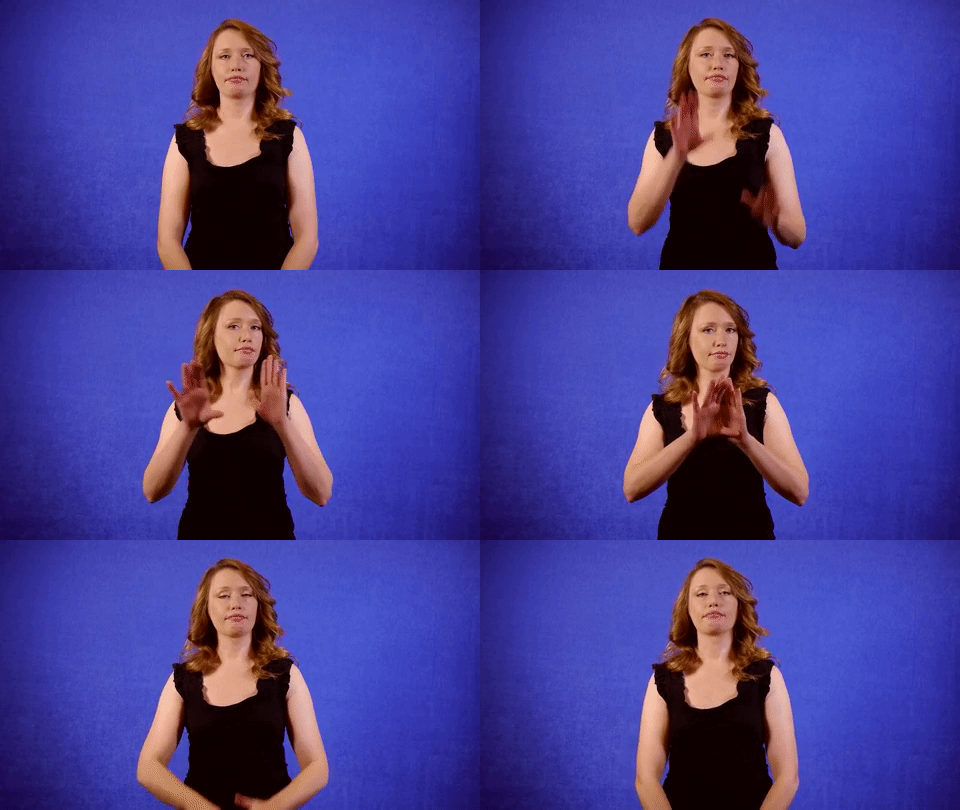
Sign for PICTURE in ASL | ️ ASL Dictionary

Definition: A visual representation of something, such as a photograph or drawing.

Sign for PICTURE in ASL

YouTube player

Practice Activities

One of the best ways to master the sign for PICTURE in ASL is through consistent and varied practice. Start by standing in front of a mirror and practicing the handshape, motion, and facial expressions. This helps you self-correct and develop muscle memory, which is especially important for achieving the fluidity required in everyday signing.

Recording yourself while signing can also help you spot areas for improvement. Watch your recordings to check for handshape clarity and movement accuracy. This is especially useful when comparing your sign for PICTURE in ASL with that of fluent signers or instructional videos.

Use the sign in real-life contexts. For example, while browsing through a photo album, sign about each picture you see. Integrating the sign for PICTURE in ASL into actual conversations helps reinforce your understanding and recall.

For more advanced learners, try speed drills or sentence chaining. Build sentences around the sign for PICTURE in ASL, alternating between past, present, and future tenses. This adds grammatical complexity and prepares you for fluent conversations.

Join ASL study groups or attend Deaf events to use the sign in authentic, interactive settings. Peer feedback and immersion will sharpen your skills and deepen your connection to the language.

SEO Cultural Context

The sign for PICTURE in ASL holds cultural significance within the Deaf community. The concept of visual storytelling is central in Deaf culture, and photos often serve as a way to share memories, identity, and heritage. Using the correct sign shows respect for the language and culture.

Deaf culture values clarity and precision in visual communication. The sign for PICTURE in ASL, which involves a motion from the cheek to the palm, reflects the idea of capturing an image. This visual metaphor aligns with the cultural emphasis on visual learning and expression.

Regional variations may exist. While the standard sign involves a C handshape moving from the side of the face to a flat palm, some signers may use slightly different movements or handshapes depending on their region or age group. Always be open to variation and ask Deaf signers about local preferences.

In everyday life, the sign for PICTURE in ASL is commonly used in conversations about family, events, social media, and art. Whether describing a photograph, asking someone to take a picture, or sharing a memory, this sign is both practical and culturally rich.

Extended Definition

The sign for PICTURE in ASL typically uses a C handshape that starts at the cheek (representing the face or image source) and moves to a flat non-dominant hand (representing the surface or frame). This motion visually conveys the idea of transferring an image from the face onto a surface, much like how a photo captures a likeness.

It’s important not to confuse the sign for PICTURE in ASL with similar signs like CAMERA or PHOTO. While they are related, each has its own distinct handshape and motion. For example, CAMERA often mimics the clicking motion of a camera shutter, whereas PICTURE focuses on the image itself.

Common errors include incorrect handshape, reversed motion, or lack of facial expression. Beginners sometimes use a C handshape too loosely or incorrectly position the non-dominant hand. To avoid this, pay close attention to the spatial orientation and firmness of your handshapes.

The sign can also be modified in compound signs such as FAMILY PICTURE or SCHOOL PICTURE. These combinations retain the core sign for PICTURE in ASL but add context that changes the overall meaning. Understanding these variations increases your vocabulary and fluency.

Tips for Beginners

If you’re new to ASL, learning the sign for PICTURE in ASL is a great way to start expanding your visual vocabulary. Focus on mastering the correct handshape first. Use a C handshape and keep it consistent throughout the motion. Practicing slowly and deliberately will build a strong foundation.

One common beginner mistake is mirroring the sign incorrectly. Since ASL is a spatial language, it’s important to use your dominant hand for the motion from cheek to palm. Practicing in front of a mirror can help correct this issue early.

Another tip is to exaggerate the motion slightly when first learning. This not only helps with memorization but also ensures that your sign is clear to others. Over time, you’ll be able to sign more fluidly and naturally.

Don’t worry about making mistakes. The key is to keep practicing and to seek feedback from fluent signers or Deaf mentors. They can offer corrections and encouragement that will accelerate your learning process.

Lastly, remember that facial expressions are a vital part of ASL. When using the sign for PICTURE in ASL, your expression should match the context—be it joy, surprise, or nostalgia. This adds emotional depth and cultural authenticity to your signing.

Connections to Other Topics

The sign for PICTURE in ASL connects closely with the sign for CAMERA. While CAMERA mimics the mechanical action of taking a photo, PICTURE emphasizes the image itself. Learning both helps you describe photography in more detail.

Another related sign is ART. Both ART and PICTURE involve visual representation, and they are often used together when discussing museums, galleries, or creative projects. Understanding both signs allows for richer storytelling.

The sign for FAMILY is frequently used with PICTURE, especially in phrases like FAMILY PICTURE or FAMILY PHOTO. These combinations are common in conversations about home, ancestry, and special events.

MEMORY is another concept tied to the sign for PICTURE in ASL. Photos often trigger memories, and pairing these signs helps express deep emotional meanings. For example, “THIS PICTURE REMIND ME OF MY CHILDHOOD” becomes a powerful sentence in ASL.

Finally, the sign for DRAW is connected conceptually because both involve creating or capturing images. While DRAW focuses on manual creation, PICTURE focuses on the captured or printed result. Comparing these helps clarify your understanding of visual concepts in ASL.

Lengthy Summary

Mastering the sign for PICTURE in ASL enriches your ability to communicate visually and culturally. From casual conversations about vacations to deeper discussions about family history, this sign plays a valuable role in everyday signing. It bridges concrete visuals with emotional memories, reflecting the core values of Deaf culture.

Through structured practice activities like mirror work, recordings, and contextual usage, you can refine your skills and build confidence. Cultural understanding is equally important. Recognizing the visual and emotional significance of pictures within the Deaf community enhances your appreciation of the language.

The extended definition shows that the sign is more than a simple gesture—it’s a metaphorical representation of image transfer, rooted in visual logic. Avoiding common mistakes and understanding related signs like CAMERA, ART, and MEMORY helps create a more nuanced understanding.

Beginners are encouraged to approach the sign for PICTURE in ASL with patience, curiosity, and consistency. Mistakes are part of the learning journey, and every attempt brings you closer to fluency. Engaging with the Deaf community, whether online or in person, provides real-world feedback and cultural immersion.

Connecting this sign to other vocabulary builds a network of related concepts that support long-term retention. As you explore topics like family, art, and memories, the sign for PICTURE in ASL becomes a versatile tool in your ASL toolkit.

Now is the perfect time to practice. Use every opportunity to sign about your daily life, your photos, your stories. The more you integrate the sign for PICTURE in ASL into conversations, the more naturally it will come. Keep learning, keep signing, and let your hands tell beautiful stories .

Synonyms: image, photo, photograph, snapshot, visual

Educational resources: Find related learning materials in our course bank!

Want more? Check out some of our popular learning activities on the homepage!

Need to look up a sign? Use our highly rated dictionary: https://aslinteractive.com/best-asl-dictionary/

Follow us on tiktok: https://www.tiktok.com/@aslinteractive. More social media links at the bottom of this page!

Long-tail Keywords: what is the sign for picture in ASL, how do you sign picture in ASL, ASL sign for picture

Categories:

tags: ASL vocabulary, ASL for pictures, picture-related signs, visual description in ASL, ASL dictionary topics

Want more? Check out some of our popular learning activities!

ASL Interactive Resources

ASLInteractive YouTube Channel

Follow us on tiktok: @aslinteractive.com

Follow us on Instagram: aslinteractive

Facebook page: aslinteractive

Facebook group: aslinteractive

LInkedIn: ASL Interactive LLC

Twitter: @ASL_interactive

*Some information on this page is AI-generated. AI can make mistakes. Please check the information.


Responses