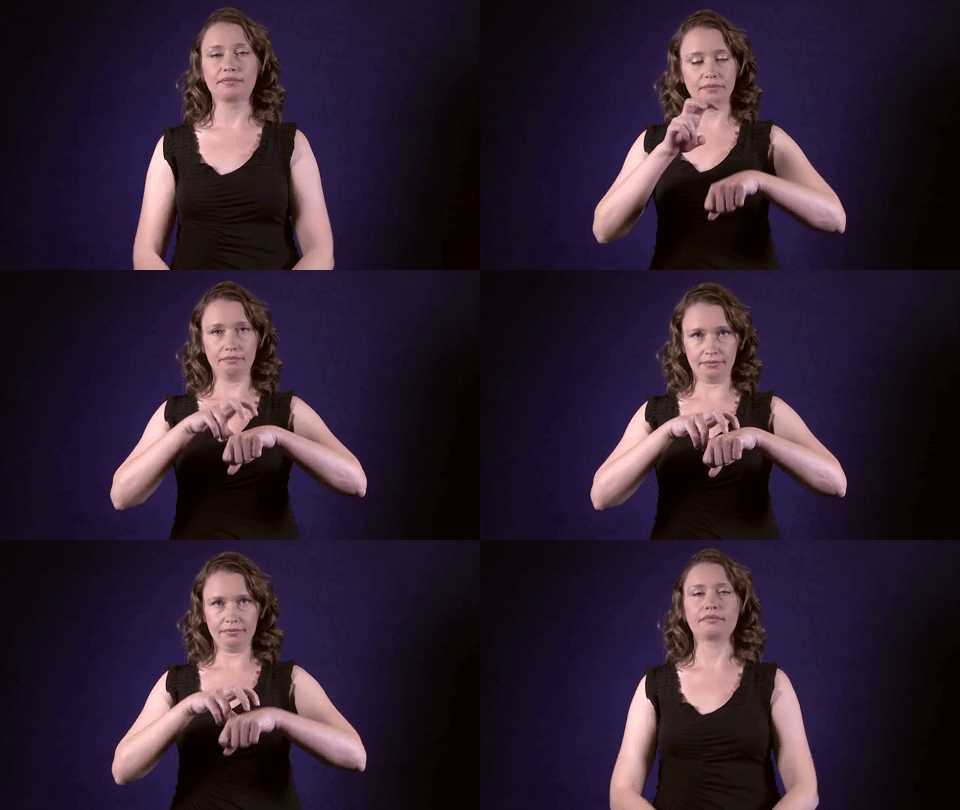
Sign for POTATO in ASL | ASL Dictionary

Definition: A starchy plant tuber that is one of the most important food crops.

Sign for POTATO in ASL

YouTube player

Practice Activities

To build fluency with the sign for POTATO in ASL, start with mirror work. Stand in front of a mirror and practice forming and executing the sign slowly and clearly. Watch your handshape and movement to ensure accuracy. This helps reinforce muscle memory and visual feedback.

Record yourself signing the word in short sentences or as part of a food-related monologue. Watching your playback allows you to spot mistakes and self-correct. Use common phrases like “I like potato soup” or “He ate a baked potato” to place the sign for POTATO in ASL into context.

Incorporate the sign into mock conversations or roleplay with a partner. Practice asking and answering questions about meals or grocery shopping. This adds realism and helps you remember the sign in real-life situations.

Advanced learners should try speed drills. Sign the word repeatedly in rhythm, increasing speed gradually while maintaining clarity. Combine it with other signs in rapid succession, such as VEGETABLE, CARROT, or EAT, to improve fluidity and comprehension of similar signs.

SEO Cultural Context

The sign for POTATO in ASL is more than just vocabulary—it represents a common food item in American culture and is often used in everyday conversations within the Deaf community. The sign mimics the idea of poking or preparing a potato, adding a visual and conceptual layer to its meaning.

Culturally, food signs like this one are frequently used during mealtime discussions, cooking demonstrations, or in educational settings with Deaf students. Knowing the sign for POTATO in ASL allows learners to participate fully in these interactions, respecting Deaf norms around visual storytelling and descriptive signing.

There are minor regional variations in how the sign is executed. In most areas, it involves tapping a bent V-handshape onto the back of a closed fist, imitating the idea of poking or cutting a potato. Some signers may adjust the angle or intensity of the tap, reflecting local or familial signing styles. These variations are embraced within the community as long as clarity and mutual understanding are maintained.

Extended Definition

The sign for POTATO in ASL uses a dominant bent V-hand to tap the back of the non-dominant S-hand, which rests palm-down. The motion resembles spearing or poking a potato, which visually connects to the concept of food preparation. It is a compound of shape and movement that reflects the object’s use or handling.

This sign is distinct but can sometimes be confused with similar signs like FORK or MEAT, which also involve V-handshapes. Beginners should pay close attention to where the V-hand contacts the S-hand and the number of taps—typically one or two light taps. It’s essential to maintain the correct handshape and orientation to avoid miscommunication.

The sign for POTATO in ASL also shares visual similarity with signs like BUG or INJECTION, so context is critical. Always consider the topic of conversation and sentence placement to avoid confusion. When used in a food-related context, it is immediately recognizable to fluent signers.

Tips for Beginners

Beginners learning the sign for POTATO in ASL should take a relaxed approach and focus on consistency. Don’t rush the movement or over-exaggerate the tap. Keep your dominant hand in a bent V-position and make sure the tapping motion is gentle but visible.

One common mistake is confusing the handshapes—some learners mistakenly use a flat hand or an incorrect orientation. Practice slowly and use visual resources, such as ASL dictionaries or video tutorials, to model the sign correctly.

Another tip is to say the English word softly while signing during practice. This technique, called “voicing,” isn’t used in fluent ASL conversations but can help beginners link signs to meanings during early learning stages.

Most importantly, don’t be afraid to make mistakes. The sign for POTATO in ASL is simple once mastered, and with repetition and feedback, it becomes second nature. Join online Deaf communities, attend ASL meetups, or take part in virtual signing circles to gain real-time practice and encouragement.

Connections to Other Topics

The sign for POTATO in ASL connects naturally to the sign for VEGETABLE, which uses a V-handshape rotated on the cheek. This connection helps learners group food vocabulary by category, making it easier to remember.

Another related sign is YAM or SWEET POTATO, which may use a compound form or be fingerspelled depending on the signer. Understanding these variations deepens vocabulary knowledge and increases fluency in culinary conversations.

The sign for EAT is often paired with the sign for POTATO in ASL when describing meals or preferences. Practicing them together reinforces context-based learning and sentence structure.

MEAL and FOOD are also essential signs to learn alongside POTATO. These signs provide a broader framework for discussing diet, cooking, and nutrition in ASL.

Finally, learning the sign for COOK allows learners to place the sign for POTATO in ASL into more complex sentences. For example, “I cook potato soup” becomes a multi-sign phrase that strengthens grammar and sequencing skills.

Lengthy Summary

The sign for POTATO in ASL is a key vocabulary word within the food and meal category. It is visually iconic, using a bent V-hand to tap the back of an S-hand, mimicking the act of poking or preparing a potato. This physical representation makes the sign intuitive and easy to remember when practiced correctly.

Learners should use a variety of practice techniques, such as mirror work, video recordings, and conversational drills, to internalize the sign. By placing the sign in real-life contexts—like discussing dinner plans or listing vegetables—you reinforce both vocabulary and grammatical structures in ASL.

Understanding the cultural context is equally important. The sign for POTATO in ASL is used frequently in Deaf households, schools, and social events. It reflects the Deaf community’s value on visual clarity, storytelling, and shared experience. Regional variations exist but do not significantly hinder communication, as the core meaning remains consistent.

Beginners are encouraged to take their time learning the sign and avoid common errors like incorrect handshapes or exaggerated movements. Use video resources, get feedback from fluent signers, and engage with the Deaf community for authentic learning.

This sign connects to a broader system of food-related vocabulary. Learning related signs like VEGETABLE, FOOD, EAT, and COOK helps learners build a thematic understanding of ASL, making conversations more natural and expressive.

The sign for POTATO in ASL is a foundational part of everyday vocabulary that opens doors to richer conversations about food, culture, and daily life. Keep practicing, stay curious, and enjoy the process of signing with clarity and confidence. The more you integrate this sign into your communication, the more fluent and connected you’ll become .

Synonyms: spud, tater, tuber, root vegetable, earth apple

Educational resources: Find related learning materials in our course bank!

Want more? Check out some of our popular learning activities on the homepage!

Need to look up a sign? Use our highly rated dictionary: https://aslinteractive.com/best-asl-dictionary/

Follow us on tiktok: https://www.tiktok.com/@aslinteractive. More social media links at the bottom of this page!

Long-tail Keywords: what is the sign for potato in ASL, how do you sign potato in ASL, ASL sign for potato

Categories:

tags: food signs, vegetables in ASL, ASL dictionary food, learn ASL vocabulary, American Sign Language for foods

Want more? Check out some of our popular learning activities!

ASL Interactive Resources

ASLInteractive YouTube Channel

Follow us on tiktok: @aslinteractive.com

Follow us on Instagram: aslinteractive

Facebook page: aslinteractive

Facebook group: aslinteractive

LInkedIn: ASL Interactive LLC

Twitter: @ASL_interactive

*Some information on this page is AI-generated. AI can make mistakes. Please check the information.


Responses