Practice Activities
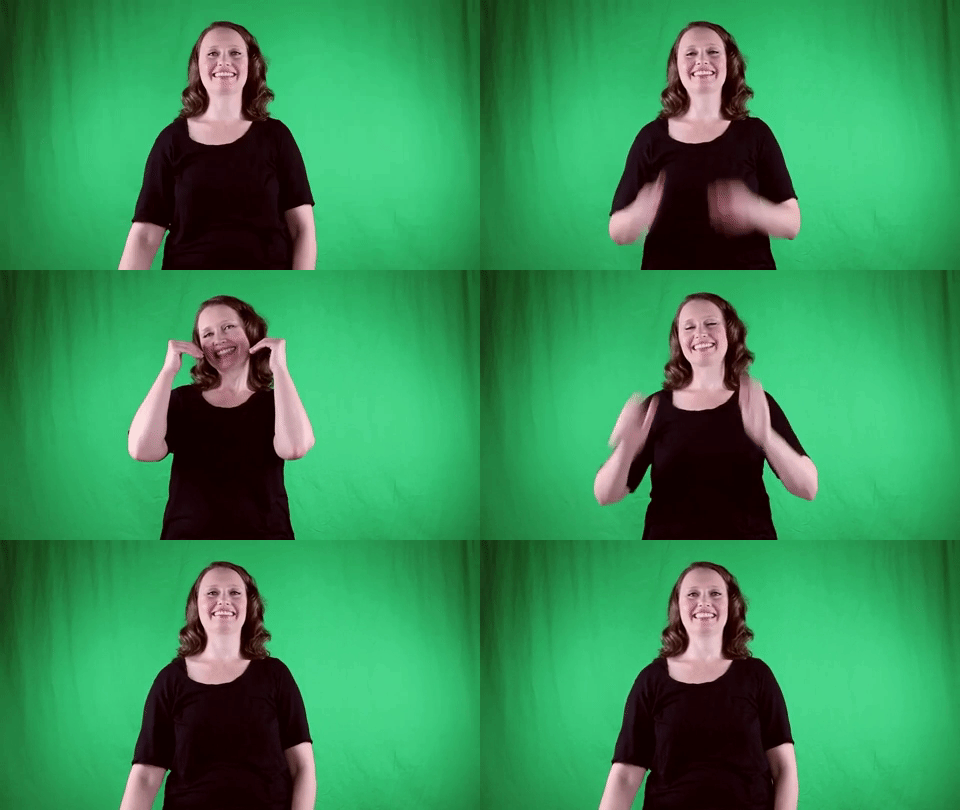
Learning the sign for SMILE in ASL is more than just memorizing a hand movement—it’s about embodying the expression and emotion behind the concept. Start by practicing in front of a mirror. This helps you become aware of your facial expressions, which are vital to conveying the full meaning of the sign for SMILE in ASL. Observe your own face to ensure your smile is natural and not forced. Record yourself signing simple sentences that include the sign for SMILE in ASL. Watching the playback allows you to assess clarity, movement, and emotional accuracy. Try integrating the sign into short dialogues, like “I like to smile,” or “You make me smile,” to build fluency in context. Advanced learners can practice speed and expression drills. Alternate between various emotions—happy, excited, calm—while signing the word SMILE to practice emotional nuance. Pair the sign for SMILE in ASL with related facial expressions to train your brain to communicate authentically and naturally.
SEO Cultural Context
In Deaf culture, facial expressions are a core part of communication, not just emotional add-ons. The sign for SMILE in ASL is a perfect example of how non-manual signals—like a genuine smile—carry meaning. When signing SMILE, your facial expression must match the concept for it to be understood correctly. The Deaf community places a strong emphasis on direct communication and visual clarity. This means that a flat or absent smile while signing SMILE may come off as insincere or confusing. Understanding this cultural context is crucial to using the sign respectfully and appropriately. There might be slight regional or generational variations in how the sign for SMILE in ASL is performed, but the core idea remains consistent: a curved motion near the mouth, often accompanied by an actual smile. Being aware of these subtleties shows cultural competence and a deeper respect for ASL.
Extended Definition
The sign for SMILE in ASL generally involves both index fingers tracing a small upward curve at either side of the mouth or pointing to the corners of the mouth and pulling slightly outward. The most important part of the sign, however, is the facial expression that accompanies it. Without a real smile on your face, the sign loses its meaning. It’s important not to confuse the sign for SMILE in ASL with other similar signs like HAPPY or LAUGH. While these signs may share the theme of positive emotion, each has a distinct handshape and motion. SMILE is more subtle and controlled, whereas LAUGH often uses a repeated movement near the stomach or chest to mimic chuckling. A common mistake is over-exaggerating the hand movement or neglecting the facial expression altogether. Beginners sometimes mistakenly use the sign for HAPPY when intending to sign SMILE. These are not interchangeable, so paying close attention to detail is essential.
Tips for Beginners3>
If you’re just starting to learn the sign for SMILE in ASL, focus first on the emotion behind the word. Smile naturally as you sign—think about something that makes you happy and let that feeling guide your expression. This will make your sign more authentic and easier to understand. Don’t worry if you don’t get it perfect at first. Many new signers forget to include facial expressions, but that’s a skill that develops with time. Practice slowly and review videos of fluent signers to observe how they use the sign for SMILE in ASL in real conversations. Also, be careful not to confuse the sign with similar signs like HAPPY or NICE. Watch tutorials or live examples to help you distinguish them clearly. Repetition and context are your best tools for mastering the sign for SMILE in ASL.
Connections to Other Topics
The sign for SMILE in ASL connects closely to the sign for HAPPY. Both involve upward facial expressions and are used to convey positive emotions. However, HAPPY typically uses a full-hand movement near the chest, while SMILE focuses on the mouth area and includes a definitive smile. Another related sign is LAUGH, which conveys stronger emotion and often includes repeated hand motion along with facial expression. Understanding how SMILE differs from LAUGH helps clarify the emotional range in ASL. The sign for NICE is also worth exploring. While not emotion-based, it often comes up in phrases like “nice to meet you,” which may be accompanied by a smile. Using the sign for SMILE in ASL in greetings and polite expressions supports social communication skills. Learning the sign for FEEL is helpful because it provides grammatical structure for emotional states. You can say “I feel happy,” “I feel sad,” or “I feel like smiling,” which allows you to embed the sign for SMILE in ASL into more complex sentences. Lastly, explore the concept of non-manual markers in ASL. These include facial expressions, head tilts, and body language. The sign for SMILE in ASL is a prime example of how non-manual signals are integral to meaning.
Lengthy Summary
Mastering the sign for SMILE in ASL opens the door to expressing joy, friendliness, and warmth in American Sign Language. It’s not just about the motion of your hands—it’s about the emotion behind the movement. By practicing in the mirror, recording yourself, and signing in real-life situations, you’ll become more fluent and confident over time. Understanding the cultural significance of facial expressions in Deaf communication is critical. The sign for SMILE in ASL is meaningless without an accompanying genuine smile. It’s a sign that exemplifies the importance of visual cues in ASL and highlights the rich emotional expressiveness of the language. The sign requires precision and emotional awareness. It’s distinct from signs like HAPPY or LAUGH, and beginners should take time to learn these differences. Avoid common pitfalls like overly exaggerated movements or lack of facial expression. Instead, aim for natural, sincere expression. As you grow in your ASL journey, explore related signs like HAPPY, LAUGH, NICE, FEEL, and learn about non-manual markers. These connections deepen your understanding of how emotions are conveyed in ASL, giving you a more holistic grasp of the language. Now that you’ve learned the sign for SMILE in ASL, keep practicing it every day. Use it in conversations, greetings, and storytelling. The more you sign, the more natural it will feel . Keep smiling and keep signing! Synonyms: grinning, beaming, smirking, glowing, cheerful Educational resources: Find related learning materials in our course bank! Want more? Check out some of our popular learning activities on the homepage! Need to look up a sign? Use our highly rated dictionary: https://aslinteractive.com/best-asl-dictionary/ Follow us on tiktok: https://www.tiktok.com/@aslinteractive. More social media links at the bottom of this page! Long-tail Keywords: what is the sign for smile in ASL, how do you sign smile in ASL, ASL sign for smile Categories: tags: facial expressions in ASL, emotions in ASL, nonverbal communication, ASL vocabulary, everyday signs in ASL
Want more? Check out some of our popular learning activities!
ASL Interactive Resources
ASLInteractive YouTube Channel
Follow us on tiktok: @aslinteractive.com
Follow us on Instagram: aslinteractive
Facebook page: aslinteractive
Facebook group: aslinteractive
LInkedIn: ASL Interactive LLC
Twitter: @ASL_interactive
*Some information on this page is AI-generated. AI can make mistakes. Please check the information.
Responses