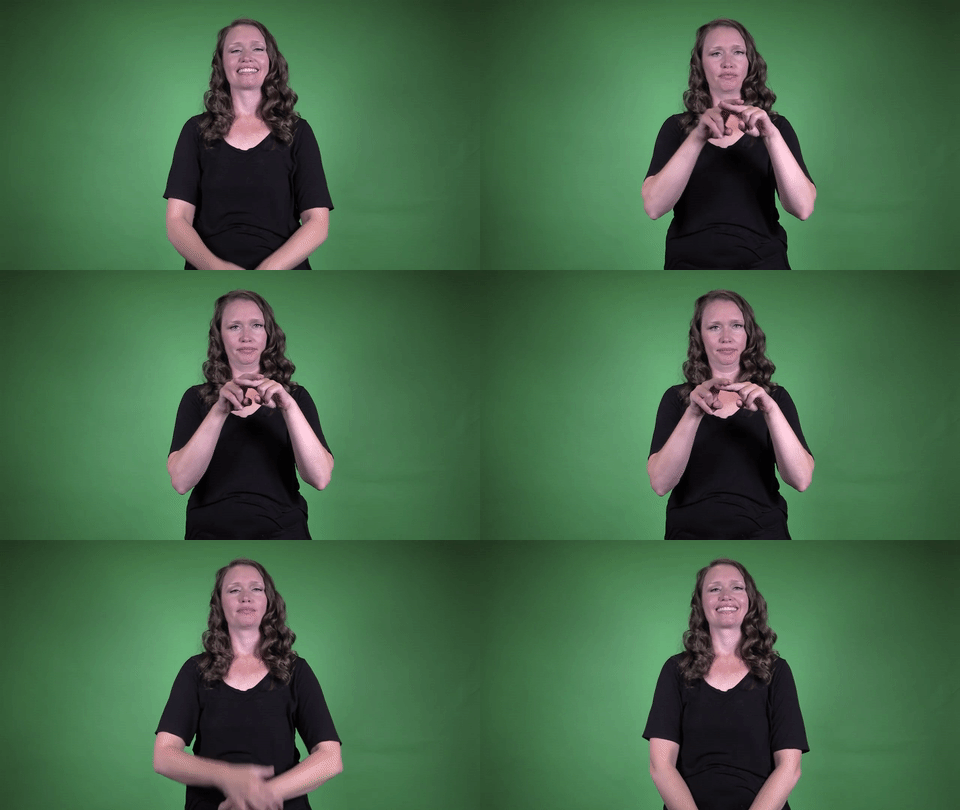
Sign for TRAIN in ASL | ASL Dictionary

Definition: A series of connected vehicles traveling on railways. Sign for TRAIN in ASL
YouTube player

Practice Activities

To master the sign for TRAIN in ASL, one of the most effective techniques is mirror work. Stand in front of a mirror and repeatedly practice the handshape and motion. This allows you to instantly correct your form, hand orientation, and facial expression. Observing yourself ensures you’re matching native signers’ movement and clarity. Recording your own signing is another valuable method. Use your phone or computer to video yourself signing sentences that include the sign for TRAIN in ASL. Play it back to evaluate your accuracy and fluency. Compare your recording with trusted ASL video dictionaries or native signers for improvement. Signing in context is key to building fluency. Incorporate the sign for TRAIN in ASL into everyday conversations. For example, describe your commute, talk about travel plans, or explain how to get to a destination using the train. This helps reinforce vocabulary and sentence structure naturally. Advanced drills can take your practice to the next level. Try finger spelling the names of train stations, combining the sign for TRAIN in ASL with directional verbs, or integrating time concepts like “every morning” or “last weekend.” These drills not only reinforce the sign itself but also expand your ASL grammar skills. Partner practice is also vital. Work with a study buddy or join an ASL conversation group. Use the sign in role-play scenarios such as buying a train ticket, giving directions, or telling a story about a train trip. The more real-life context you apply, the stronger your sign retention will become.

SEO Cultural Context

In Deaf culture, the sign for TRAIN in ASL is more than just vocabulary—it reflects a way of expressing travel and everyday life. Trains are a common mode of transportation, especially in urban areas, so this sign is frequently used in daily conversation. Knowing how to sign TRAIN accurately allows for clear communication about schedules, travel plans, and directions. The sign itself is iconic and mimics the action of train cars sliding past each other. It’s a visual metaphor that makes sense in the context of ASL’s spatial and movement-based structure. This is an example of how ASL often uses visual representation to communicate meaning, making it both intuitive and expressive. There are some regional differences in how the sign for TRAIN in ASL is performed. Some signers may use a slightly different motion or handshape based on geographic location or generational influence. However, the most widely recognized version involves dominant and non-dominant hands sliding together to represent train cars moving. Deaf culture values precision and clarity in signing. Misusing or sloppily producing the sign for TRAIN in ASL could lead to confusion or misunderstanding. It may even be interpreted as a different sign altogether. That’s why learning the correct form and practicing regularly is essential for respectful and effective communication.

Extended Definition

The sign for TRAIN in ASL involves two “H” handshapes. Place your non-dominant “H” hand in a horizontal position, palm facing down. Then slide your dominant “H” hand back and forth gently across the top of the non-dominant hand. The motion simulates train cars coupling or sliding along tracks. This sign is classified as an iconic sign because it visually represents the concept it conveys. It’s an example of how ASL uses physical space to depict real-world objects and actions. The repetitive sliding motion of the dominant hand mirrors the rhythmic movement of a train. It’s important not to confuse the sign for TRAIN in ASL with similar signs like TRACK, SUBWAY, or BUS. Each of these has distinct signs, though they may share some elements like directional paths or vehicle-related classifiers. Be careful not to overextend the motion or change the handshape, as that may alter the meaning. Some learners mistakenly use “U” handshapes or rotate the hand in the wrong direction. Others may bounce the hands instead of sliding them. These are common errors that can make the sign unclear or incorrect. Watching fluent signers and practicing slowly can help avoid these mistakes. In compound signs or storytelling, the sign for TRAIN in ASL can be modified with classifiers to show movement, speed, or direction. For example, you might show a train going around a mountain or stopping at a station. ASL’s classifier system enhances the way this sign can be used for rich, visual storytelling.

Tips for Beginners

When learning the sign for TRAIN in ASL, start slowly and focus on accuracy. It’s better to form the sign correctly at a slow pace than to rush and develop bad habits. Pay close attention to handshape, palm orientation, and the smooth sliding motion. One of the most common mistakes is confusing the handshape. Beginners often default to “U” or “V” shapes, which can lead to a completely different meaning. Make sure you’re forming the correct “H” handshapes and keeping your fingers tightly together. Another tip is to use both hands confidently. Some beginners hesitate to use their non-dominant hand, but in the sign for TRAIN in ASL, both hands are essential. The non-dominant hand acts as the stable “track” or base, while the dominant hand represents the moving train. Use visual memory aids if you’re struggling. Think of model train cars sliding together, or imagine the sound of a train moving on tracks as you sign. Associating the movement with a real-world image can help reinforce the concept. Practice regularly but in short sessions. Repetition builds muscle memory, and short, focused practice is more effective than long, tiring sessions. Keep a practice log or checklist to track your progress with the sign for TRAIN in ASL and include it in sentence-level practice as soon as possible.

Connections to Other Topics

The sign for TRAIN in ASL connects closely with the sign for TRANSPORTATION. Both are often used in conversations about how people get from place to place. Practicing them together helps reinforce a broader travel-related vocabulary set. Another related sign is SUBWAY, which also uses directional movement and can include classifiers. Understanding the sign for TRAIN in ASL helps learners grasp how different vehicles are represented in ASL and how classifiers enhance those signs. The sign for STATION is frequently used in combination with TRAIN. You can say “train station” by signing TRAIN followed by the sign for STATION, which uses a compound movement involving flat “S” handshapes. Learning how to chain these signs together improves sentence flow. Understanding directional verbs like GO and ARRIVE is essential when using the sign for TRAIN in ASL in full sentences. For example, “I go to the train station” or “The train arrived late” uses these verbs to provide full context. These grammar tools are foundation skills in ASL. Finally, TIME signs like MORNING, EVENING, or TOMORROW often accompany transportation signs. Being able to say “I took the train this morning” involves integrating the sign for TRAIN in ASL with time concepts, which strengthens your storytelling and conversation skills.

Lengthy Summary

The sign for TRAIN in ASL plays a fundamental role in conversations about travel, commuting, and public transportation. Its iconic representation of train cars sliding together makes it both intuitive and visually descriptive. Using two “H” handshapes, the sign mimics the rhythmic motion of a train, grounding it in ASL’s natural use of space and movement. Learners benefit greatly from diverse

Practice Activities

. Mirror work helps build self-awareness, recorded video allows for self-correction, and contextual signing ensures the sign is used fluently in real-life scenarios. Advanced drills and partner practice deepen understanding and build conversational confidence. Within Deaf culture, the sign for TRAIN in ASL holds practical relevance. It is used frequently in urban environments and is understood widely across regional variations. Respect for accurate and clear signing is a cultural norm, so learners should focus on precision from the beginning. A thorough understanding of this sign includes recognizing related vocabulary like SUBWAY, STATION, and TRANSPORTATION, and applying grammatical tools such as directional verbs and time signs. This interconnected knowledge enables learners to create complete, expressive sentences. Beginners should focus on mastering the correct handshape, palm orientation, and movement. Avoiding common errors and practicing consistently will lead to more natural and confident signing. Using visual aids, memory tools, and short daily practice sessions will reinforce learning over time. Ultimately, the sign for TRAIN in ASL provides a gateway to broader communication about travel and movement. It connects with essential ASL themes and showcases the language’s rich visual-spatial nature. Keep returning to this sign in your practice, and challenge yourself to use it in full conversations and storytelling. Stay motivated, stay curious, and keep signing. The more you engage with the sign for TRAIN in ASL, the more fluent and confident you’ll become in your ASL journey . Synonyms: train, railroad train, locomotive, railcar, subway Educational resources: Find related learning materials in our course bank! Want more? Check out some of our popular learning activities on the homepage! Need to look up a sign? Use our highly rated dictionary: https://aslinteractive.com/best-asl-dictionary/ Follow us on tiktok: https://www.tiktok.com/@aslinteractive. More social media links at the bottom of this page! Long-tail Keywords: Categories: tags: travel, transportation, vehicles, American Sign Language lessons, ASL vocabulary

Want more? Check out some of our popular learning activities!

ASL Interactive Resources

ASLInteractive YouTube Channel

Follow us on tiktok: @aslinteractive.com

Follow us on Instagram: aslinteractive

Facebook page: aslinteractive

Facebook group: aslinteractive

LInkedIn: ASL Interactive LLC

Twitter: @ASL_interactive

*Some information on this page is AI-generated. AI can make mistakes. Please check the information.  

Responses