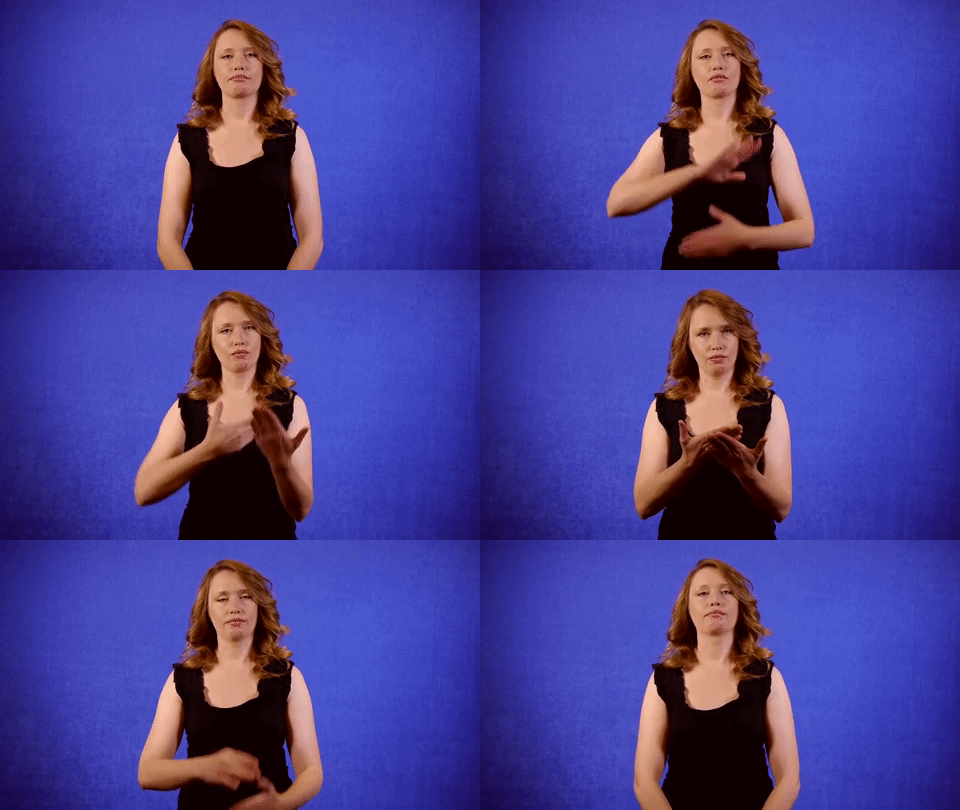
Definition: Everything.
Sign for ALL in ASL

Practice Activities:
To practice the sign for all in ASL, begin by signing it repeatedly in isolation. Focus on the hand movement, ensuring that one hand moves in a sweeping motion around the other hand before landing in an open position. Try this in front of a mirror to check for clarity and fluidity.
Incorporate the sign for all in ASL into short phrases. For example, sign “I want all,” “all of us,” or “all done.” Repeating these phrases while emphasizing smooth hand transitions will help reinforce the sign’s meaning.
Practice using the sign for all in ASL in full sentences such as “I ate all the food” or “We all went together.” Record yourself and compare with video references to fine-tune handshape and movement. If possible, sign with a partner and quiz each other by making statements using “all” and responding appropriately.
Create a short story or description that uses the sign for all in ASL multiple times. For example, describe a family gathering where all members were present or a shopping trip where you bought all the ingredients for a meal. Telling a short story aloud in ASL will improve fluency and natural signing skills.
Engage in an interactive game with a friend. One person signs a sentence using the sign for all in ASL, and the other person guesses the full meaning. This encourages expressive signing and comprehension. Practice switching roles for balanced learning.
For additional reinforcement, watch ASL storytelling or videos that use the sign for all in ASL in natural conversations. Try to recognize it and copy the movements. The more frequently you use it in various contexts, the more natural it will become in conversations.
Cultural Context:
The sign for all in ASL is commonly used in everyday conversations and storytelling. It conveys the idea of inclusivity, completeness, or totality, making it a versatile and essential sign in American Sign Language. Whether describing a group, an event, or an amount, the sign for all in ASL helps express broad concepts efficiently.
Deaf culture values inclusivity, and the sign for all in ASL reflects that principle. It can be used to describe a gathering where everyone is welcome or to emphasize that something applies to an entire group. ASL relies heavily on visual and spatial elements, and this sign showcases that expressive nature.
When using the sign for all in ASL, facial expressions and context play a crucial role in conveying the exact meaning. A slight change in movement or intensity can enhance the message, helping signers communicate more effectively. The beauty of ASL lies in these subtleties, making every sign dynamic and rich in expression.
The sign for all in ASL is often seen in both formal and casual interactions. It can be used in classrooms, workplaces, or social events to emphasize inclusivity or entirety. Learning this sign is beneficial for both Deaf and hearing individuals who want to improve their ASL fluency.
ASL is a living language that continues to evolve, and signs like the sign for all in ASL remain fundamental in communication. Understanding its cultural importance helps signers connect more deeply with the Deaf community. Mastering this sign enhances overall fluency and appreciation for ASL’s unique structure and expressiveness.
Using the sign for all in ASL correctly fosters clear communication and inclusivity. Whether in conversations, presentations, or storytelling, it is a sign that carries significance in ASL. Practicing and incorporating it into daily signing strengthens language skills and promotes accessibility for all.
Extended Definition:
The sign for all in ASL is a common and useful sign that expresses the concept of entirety or completeness. It is frequently used in both casual and formal conversations, making it essential for fluent communication in American Sign Language. Understanding how to correctly produce and incorporate this sign into everyday signing enhances clarity and meaning.
To sign for all in ASL, start with one hand in an open palm shape while the other hand moves in a circular motion, sweeping across the front of the stationary hand. This movement represents the idea of including everything or everyone in the concept being expressed. The motion and direction may vary slightly depending on regional or stylistic differences among signers.
This sign is commonly used when referring to groups of people or things collectively. For example, you can use it to indicate that something applies to an entire group, such as “all students” or “all people.” It can also be used in phrases like “that’s all” or “for all time,” emphasizing the completeness of an action or idea.
Facial expressions can enhance the meaning of the sign for all in ASL. A neutral or affirmative facial expression may be used for basic statements, while an exaggerated or enthusiastic expression can emphasize total inclusion. In conversational signing, modifying facial expressions helps to convey different nuances of meaning effectively.
Learning the sign for all in ASL improves communication skills and understanding in various contexts. It is especially useful in educational settings, group discussions, and storytelling. By mastering this sign, both beginner and advanced ASL learners can express themselves more efficiently.
Using the sign for all in ASL correctly helps ensure clarity in interactions with Deaf or hard-of-hearing individuals. Practicing with fluent signers or watching ASL videos can reinforce the correct hand movements and facial expressions. The more exposure and practice a signer has, the more natural and fluent their signing becomes.
Since ASL is a visual language, the movement and placement of each sign are crucial. The smooth motion of the sign for all in ASL ensures that the concept of inclusivity is clearly understood. Proper hand positioning and movement direction help maintain the sign’s intended meaning.
This sign is often used in combination with other signs to form meaningful phrases. For example, pairing it with signs like “finished” or “understand” can create expressions such as “all done” or “I understand all.” Combining signs effectively allows for greater flexibility and fluency in communication.
The sign for all in ASL is an essential part
Synonyms: whole, entire, complete, total, every
Educational resources: Find related learning materials in our course bank!
Want more? Check out some of our popular learning activities on the homepage!
Need to look up a sign? Use our highly rated dictionary: https://aslinteractive.com/best-asl-dictionary/
Follow us on tiktok: https://www.tiktok.com/@aslinteractive. More social media links at the bottom of this page!
Long-tail Keywords: what is the sign for all in ASL, how do you sign all in ASL, ASL sign for all
Categories:
tags: Activities, Language Learning, Commands, Verbs, Wh-words
Parameters
*Handshape*:
The sign for ALL in ASL uses an open dominant hand that starts with the palm facing the non-dominant hand. The non-dominant hand remains stationary in a flat shape. The dominant hand moves in a circular motion, sweeping across the palm of the non-dominant hand and ending with the palm facing outward. This fluid movement visually represents the concept of “all” or “everything.” The sign for ALL in ASL is commonly used to indicate inclusiveness or completeness.
*Palm Orientation*:
The palm orientation for the sign for all in ASL begins with the dominant hand in a flat “B” shape, palm facing the non-dominant side. As the dominant hand moves in a sweeping circular motion over the non-dominant hand, it gradually turns outward until the palm faces forward. The non-dominant hand stays still in a flat “B” shape, palm facing in. This movement helps convey the concept of inclusion and entirety.
*Location*:
The sign for all in ASL is produced in the neutral space in front of the body, slightly to one side. The dominant hand moves in a circular motion over the palm of the non-dominant hand before fully opening into a flat handshape. This location allows for clear visibility of the motion, ensuring the sign for all in ASL is easily distinguishable in conversation.
*Movement*:
The sign for all in ASL begins with the dominant hand in an open “B” shape, palm facing in, touching the non-dominant palm. The dominant hand then makes a circular motion outward and returns to rest on the non-dominant palm, now facing out. This fluid motion represents the concept of encompassing everything. Facial expressions can add emphasis, depending on context.
*Non-Manual Signals*:
Facial expressions for the sign for all in ASL should remain neutral or slightly affirmative, depending on the context. A slight nod or raised eyebrows can emphasize inclusivity or completion. If conveying emphasis, a firmer head movement or slight widening of the eyes can reinforce the encompassing nature of the concept. Keep your mouth relaxed unless additional context requires mouthing the word “all” to clarify meaning.
*Prosody, Dominant/Non-Dominant Hand*:
The sign for ALL in ASL uses both hands. The non-dominant hand stays in place with a flat palm facing the dominant side. The dominant hand, also in a flat palm shape, starts by touching the non-dominant hand’s palm and then moves in a circular motion before landing back on the same spot. This motion visually represents the concept of totality or completeness in ASL.
When signing ALL in ASL, maintain a smooth and fluid motion to ensure clarity. Hand positioning and movement are key; the dominant hand should trace a full arc without breaking the flow. Facial expression can enhance the meaning, especially if emphasizing inclusivity or entirety.
Tips for Beginners:
The sign for ALL in ASL is a flowing movement that requires smooth transitions and a clear handshape. When practicing, focus on keeping your dominant hand fluid as it sweeps around your non-dominant hand in a circular motion. Keep your fingers together and relaxed to maintain proper form without stiffness.
One common mistake beginners make is moving too quickly or too rigidly, which can make the sign unclear. Focus on controlled movements that emphasize the circular path of your hand. Exaggerating the motion slightly at first can help build muscle memory before refining the speed and size of the motion.
Hand positioning is important for clarity when signing in different contexts. Ensure the non-dominant hand remains steady in place while the dominant hand moves to complete the sign for ALL in ASL. Pay attention to fluidity so the transition between starting and ending positions feels natural.
Watching native ASL signers can be helpful in understanding how the sign fits naturally in sentences. Try practicing in front of a mirror to observe your movements, or record yourself and compare your motions with fluent signers. This will help you refine details like speed, hand placement, and the circular motion.
In conversations, context can affect how the sign for ALL in ASL is perceived, so be mindful of facial expressions and signing space. If used in a formal setting, maintaining steady, clear hand movements improves comprehension. In casual signing, slight variations may occur, but the essential movement should always remain smooth and intentional.
Like any ASL sign, practice and repetition will help improve accuracy and confidence. Try incorporating it into daily signing to build fluency. If you struggle, slow down and focus on the basics before increasing speed for a more natural gesture.
Connections to Other topics:
The sign for ALL in ASL connects to many other signs that express completeness, inclusivity, and totality. Signs such as EVERY, WHOLE, and ENTIRE share similar concepts and can sometimes be used interchangeably depending on context. For example, WHOLE emphasizes something in its entirety, while ALL can be broader in scope, applying to people, objects, or ideas. Understanding the nuanced differences helps in selecting the right sign for a given situation.
Many compound signs in ASL incorporate the sign for ALL, showing its influence in describing full amounts or inclusivity. The sign for ALL-DAY and ALL-NIGHT use movement variations to indicate the passage of time with completeness. Another common phrase is ALL-OF-YOU, which specifically includes an entire group of people. These signs demonstrate how modifying the movement or orientation of ALL creates more specific meanings.
Grammatically, the sign for ALL in ASL is useful in classifiers and descriptive signing. It can enhance explanations by reinforcing sweeping motions to indicate total coverage or large amounts. When combined with signs like UNDERSTAND or KNOW, it can emphasize universal knowledge or awareness, as in ALL-KNOWING. This makes it an important tool for expressing ideas beyond just numeration or inclusion.
The sign for ALL in ASL is also useful when discussing categories or groups within academic or workplace settings. Phrases like ALL-STUDENTS or ALL-WORKERS clarify that an entire group is being referenced rather than individuals. This is particularly helpful in teaching environments or when giving instructions to large groups. The ability to express such broad concepts efficiently is key to clear ASL communication.
ASL users often modify the sign for ALL to match the spatial and contextual needs of a conversation. For example, when signing ALL-INCLUSIVE or ALL-DONE, subtle shifts in movement and facial expressions provide additional context. These variations make the sign highly versatile and valuable in daily ASL interactions.
Summary:
The sign for ALL in ASL is widely used in both formal and casual conversations. It expresses the meaning of completeness, entirety, or inclusivity. This sign can be modified slightly depending on context and emphasis.
To sign ALL in ASL, start with your dominant hand in an open B-shape. Your non-dominant hand remains stationary in an open B-handshape, palm facing your body. Move your dominant hand in a circular motion before sliding it across the palm of your non-dominant hand.
The movement of the dominant hand represents encompassing or gathering everything. This motion helps emphasize the all-encompassing nature of the word ALL. The directionality and size of the movement can impact the emphasis of the concept being conveyed.
There is another variation of the sign for ALL in ASL where both hands begin in closed positions and then transition to open positions. This version provides a visual representation of revealing everything or showing the entirety of something. Context often determines which variation is used.
ALL in ASL conveys a concept rather than a direct word-for-word translation. ASL, as a visual language, uses spatial references, as well as movement, to express complete or collective meanings. Facial expressions also play a role in clarifying intent.
This sign is commonly used when discussing events, quantities, or inclusivity. For example, if someone wants to indicate that everyone in a group is included, they may use the sign for ALL. Adding facial expressions or repeating the sign can add emphasis.
The sign for ALL in ASL differs from using the sign WHOLE, although they share a similar meaning. WHOLE tends to focus more on an entire entity as a singular unit, while ALL emphasizes a collective or totality of components. Understanding these nuances is crucial for proper ASL interpretation.
Grammatically, the position of the sign for ALL in ASL within a sentence can alter meaning slightly. Signing it at the beginning of a sentence can indicate an overarching category, whereas signing it after a noun can emphasize total inclusion. ASL grammar relies heavily on these spatial and temporal placements.
In conversations, the sign for ALL in ASL can be combined with other signs to enhance specificity. Signing ALL along with a subject like FOOD would convey the meaning of “all food” universally. This method of layering signs is common in ASL structure.
There are cases where fingerspelling A-L-L may be used instead of signing it. This occurs in formal settings, or when emphasizing the English spelling for educational or transliterated purposes. However, in fluent ASL, the dedicated sign is preferred.
ASL classifiers further enhance the idea of ALL by representing groups or collections. A general classifier may be used before signing ALL to provide extra visual clarity. This technique is often seen in storytelling or detailed descriptions.
The sign for ALL in ASL plays a major role in how concepts of inclusivity and universality are expressed. It allows Deaf and Hard of Hearing individuals to efficiently communicate totality without needing excessive words or explanations. The efficiency of the sign makes it a fundamental part of ASL vocabulary.
In Deaf culture, the ability to sign concepts such as ALL correctly is important for clear communication. Inclusion and community are significant values within Deaf culture, and this sign reflects those principles. Using it fluently fosters smoother conversations.
ALL is closely related to other quantifier signs such as SOME, NONE, and WHOLE. Each sign visually represents a different level of inclusion or exclusion. When combined strategically, these signs help convey a range of meanings regarding extent and quantity.
Metaphorically, the use of spatial movement in the sign for ALL in ASL corresponds with cognitive linguistics. Research on ASL shows that signs taking up more space often emphasize greater magnitude or significance. This is a fundamental principle of visual languages.
ASL linguistics categorizes ALL as a quantifier, meaning it helps describe the amount or extent of nouns. Quantifiers are crucial in ASL since Deaf signers rely on non-verbal signals to distinguish between partial and total descriptions. This is why sign placement is so important.
The grammatical role of ALL in ASL aligns with similar concepts in spoken languages. However, since ASL is a spatial language, grammar is conveyed through movement rather than word order. Understanding this distinction helps non-signers appreciate the structure of ASL.
Children learning ASL often acquire quantifier signs like ALL early. These signs help them develop the ability to categorize objects and understand totality. ASL acquisition follows similar patterns to spoken language development.
When teaching ASL, instructors often emphasize frequency and repetition with signs like ALL to reinforce understanding. The clarity of movement and visual demonstration help students retain meanings more effectively than if they learned only through memorization.
The applied linguistics aspect of ALL in ASL extends to interpretation and translation fields. ASL interpreters must decide when to use the sign for ALL versus alternative words
Want more? Check out some of our popular learning activities!
ASL Interactive Resources
ASLInteractive YouTube Channel
Follow us on tiktok: @aslinteractive.com
Follow us on Instagram: aslinteractive
Facebook page: aslinteractive
Facebook group: aslinteractive
LInkedIn: ASL Interactive LLC
Twitter: @ASL_interactive
*Some information on this page is AI-generated. AI can make mistakes. Please check the information.


Responses