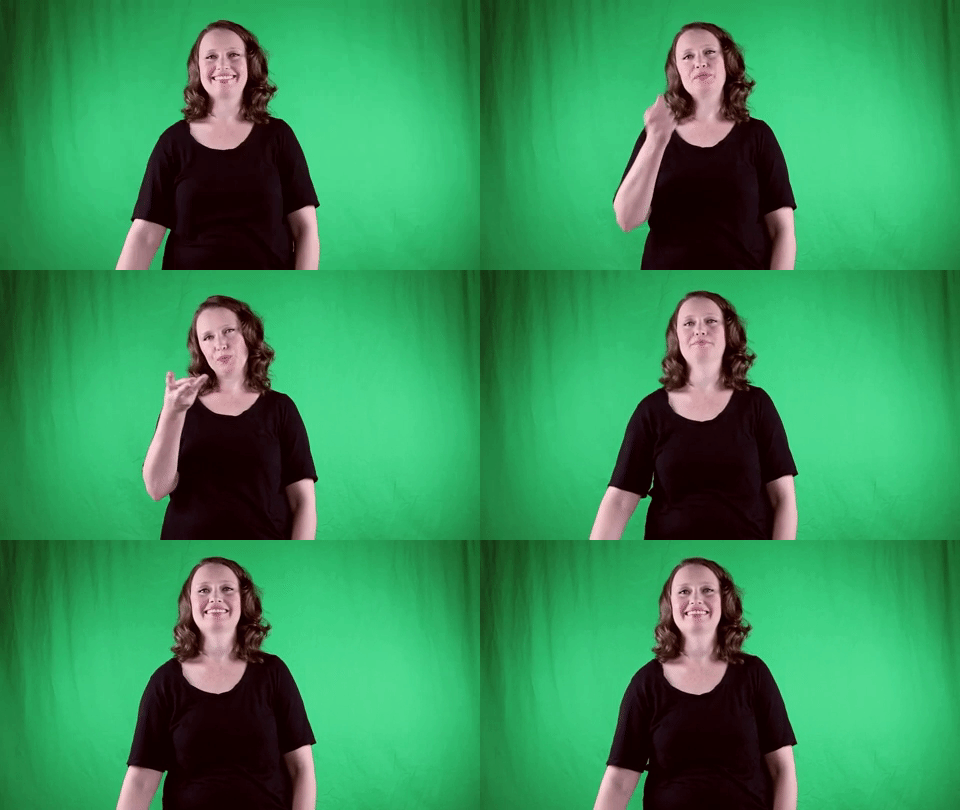
Definition: A small number of things.
Sign for FEW in ASL
Practice Activities:
Start by practicing the sign for FEW in ASL in isolation. Stand in front of a mirror and slowly transition from a closed handshape to a loose open hand, watching your movement and facial expression. Repeat this motion several times, adjusting the speed to reinforce muscle memory.
Next, incorporate the sign into short phrases such as “few cookies,” “few people,” or “few options.” This helps associate the sign for FEW in ASL with different contexts. Sign each phrase while thinking about the quantity implied and adjust your facial expression accordingly to reflect approximation.
Create five complete sentences using the sign for FEW in ASL. Examples may include “I have a few friends,” “There are few tickets left,” or “She ate a few grapes.” Sign the sentences fluidly, then sign them again with different intonations to practice how meaning can shift depending on the expression.
Try storytelling by imagining a scenario where you describe a day when you had only a few things to do. Start with an introduction like, “Today was quiet,” and then list the few activities using the proper sign. This allows you to naturally use the sign for FEW in ASL while improving your story sequencing skills.
For a partner activity, take turns giving each other descriptions that require estimating small amounts. One partner signs a sentence and the other identifies whether it expresses few, many, or none. This strengthens comprehension and proper sign usage in quick dialogue.
To reinforce learning, label three to five small objects in your environment and create a visual inventory using the sign. For instance, sign “few pencils,” “few dishes,” and “few shoes.” This concrete connection helps internalize the meaning and physical form of the sign for FEW in ASL.
Cultural Context:
In American Sign Language, quantity concepts like few, some, or many are expressed not just through specific signs but also through facial expression and movement. The sign for FEW in ASL carries subtle cultural and linguistic meaning depending on context and tone. It’s essential to understand how native signers use the sign for FEW in ASL to reflect perspective, feeling, and situational relevance.
Deaf culture relies heavily on visual and spatial language, where signs are often connected to real-life experience and shared understanding. The use of the sign for FEW in ASL is not always literal—context can shift the implied quantity. For example, a signer may use this sign with a raised eyebrow or a slight shrug to indicate approximation or even doubt.
In Deaf communication, conveying the right tone is just as important as accuracy. A signer might use a slower, deliberate motion to emphasize how small the number is. In contrast, using the sign for FEW in ASL with quicker movement might suggest it’s not a big deal or just a minor amount ️.
ASL values clarity, and the concept of FEW goes beyond a simple English translation. Using classifiers or pointing in space can add further precision to what few means in conversation. For example, pointing out three or four locations while signing FEW might indicate specific items or people rather than a vague quantity.
The sign for FEW in ASL also reflects cultural norms around sharing, community, and communication style. While English speakers might hedge or downplay with words like just a few, ASL users typically use body language to convey the same nuance. This creates a more dynamic and expressive form of communication that suits face-to-face interactions.
In casual conversation, the sign for FEW in ASL may also overlap with signs like SOME or SEVERAL, depending on the situation. This flexibility is part of what makes ASL a rich and visual language. Users learn to choose between different signs based not just on quantity, but on intention and emphasis.
Understanding the sign for FEW in ASL opens the door to better comprehension of Deaf communication. Whether you’re interpreting, learning, or engaging socially, knowing this sign in its cultural setting helps avoid misunderstandings. It adds depth to your ASL vocabulary while also showing respect for the culture’s unique logic and values.
In everyday interaction, children and adults alike use the sign for FEW in ASL when talking about food, time, supplies, or people. It’s a core concept that appears
Extended Definition:
The sign for few in ASL is used to express a small, limited number of items or people. It conveys the idea of something being not many, but more than one. This sign can vary slightly depending on the context and the signer’s style or regional influence.
To sign few in American Sign Language, the motion generally begins with a closed hand shape that gradually opens while moving slightly outward. This motion visually represents a small number increasing slightly. It is often used along with facial expressions to emphasize the degree of scarcity or limitation being described.
When using the sign for few in ASL, facial expression plays a critical role in communication. A slightly raised eyebrow or a pursed lip expression can help reinforce that the quantity being referred to is small. Adding appropriate facial grammar ensures that the message is understood accurately by the viewer.
The sign for few in ASL can be used in both formal and informal everyday conversations. It’s frequently used in phrases like few people came to the meeting or I have a few dollars. Its use helps provide clarity in describing amounts, which is an important function in any visual language like ASL.
Context is essential when interpreting and using the sign for few in ASL. Depending on the surrounding signs and sentence structure, it might be understood as indicating exactly two or three items, or it could imply a vague small number. Adjusting the speed and size of the gesture can also convey slightly different meanings.
This sign is often taught alongside related signs such as many, some, and several. Learning these together helps learners understand quantity indicators in ASL and improves overall fluency. Since these signs are core vocabulary, they appear in everyday conversations, storytelling, education, and media.
It’s also important to distinguish the sign for few in ASL from similar signs that might indicate a small amount but in different contexts, such as a little bit or a couple. Each of these has unique hand shapes and movements, and they serve different purposes in conversations. Practicing the signs together helps reinforce accuracy.
Learners should observe native signers or fluent ASL users to see how the sign for few in ASL is used naturally. Watching how it is used in full sentences can provide deeper understanding of facial expression, speed, and emphasis. Many online ASL dictionaries and video resources can assist with visual learning and examples.
In educational settings, understanding the sign for few in ASL helps students describe quantities effectively. Teachers often use this sign during classroom instructions to visually represent groupings or limited availability.
Synonyms: – several, a handful, a small number, a couple, a minority
Educational resources: Find related learning materials in our course bank!
Want more? Check out some of our popular learning activities on the homepage!
Need to look up a sign? Use our highly rated dictionary: https://aslinteractive.com/best-asl-dictionary/
Follow us on tiktok: https://www.tiktok.com/@aslinteractive. More social media links at the bottom of this page!
Long-tail Keywords: what is the sign for few in asl, how do you sign few in asl, asl sign for few
Categories:
tags: few in ASL meaning, how to sign few in ASL, few in American Sign Language, ASL dictionary few, learn ASL few
Parameters
*Handshape*:
The handshape for the sign for FEW in ASL starts with an “A” hand—fingers curled into a fist with the thumb resting along the side. As the motion progresses, the fingers gradually extend outward, one at a time, creating a smooth transitioning action.
This evolving handshape represents the idea of a small number or limited quantity. The sign for FEW in ASL uses this progression to visually reinforce the meaning of “few” with natural, expressive movement. ️
*Palm Orientation*:
For the sign for FEW in ASL, the palm orientation begins facing upward with a curved hand, similar to the shape of the letter “O.” As the motion progresses, the fingers slowly straighten one by one while the palm maintains its upward position. This palm orientation is essential because it emphasizes the gradual unfolding that visually conveys a small quantity. The sign for FEW in ASL uses this orientation to clearly differentiate it from signs like “some” or “many.” ️
*Location*:
The sign for FEW in ASL is formed in the neutral space directly in front of the body, usually at chest level. The dominant hand starts in a closed fist and gradually opens into a flat “O” or relaxed fingers as it moves slightly forward, indicating a small quantity.
This location allows the motion to be visible and effective in conveying the meaning of the sign for FEW in ASL. The hand remains centered to keep the focus within the signer’s signing space.
*Movement*:
The movement for the sign for FEW in ASL begins with the dominant hand held in an “S” handshape, palm facing up. Then, the fingers open gradually from the fist into a relaxed “5” handshape. This smooth motion mimics the idea of something increasing slightly.
Use a small, slow, deliberate movement to show that the quantity is not large. The sign for FEW in ASL conveys a minimal or limited amount using this subtle unfolding gesture.
*Non-Manual Signals*:
When using the sign for FEW in ASL, non-manual signals include a slight tightening of the lips and a subtle furrowing of the brows to convey a small quantity or minimal amount. The head may tilt slightly forward or to the side for emphasis.
Facial expressions are key to showing the relative size of the amount. Pairing these signals with the sign for FEW in ASL ensures the correct tone and meaning is conveyed .
*Prosody, Dominant/Non-Dominant Hand*:
The sign for FEW in ASL is a one-handed sign using the dominant hand only. Start with the dominant hand in an “S” handshape, palm up, near the torso. Slowly open the “S” into an open hand, moving the fingers outward slightly as if you are diminishing something in quantity. This movement visually represents a small amount. The non-dominant hand does not participate in the sign for FEW in ASL, remaining still or to the side.
Tips for Beginners:
When learning the sign for FEW in ASL, start by mastering the handshape and motion. This sign typically begins with the dominant hand in a fist and gradually extends the fingers one by one, usually starting with the index and continuing through the middle and sometimes the ring finger. Keep your palm facing up and the movement smooth and controlled.
Beginners often rush through the finger extension, which can make the sign unclear. Take your time to separate the finger movements so each one is distinctly visible. Practicing slowly in front of a mirror is helpful for refining the pacing and ensuring you’re not unintentionally changing the handshape mid-sign.
Another common mistake is overemphasizing the motion or adding unnecessary facial expressions that don’t match the meaning of the sign. While facial grammar is important in ASL, for the sign for FEW in ASL, a neutral or slightly thoughtful expression is usually most appropriate, since it often comments on quantity in a subtle way.
Make sure your hand is placed at a comfortable level, generally near the chest, and stays steady as the fingers unfold. If your hand shakes or moves too much, it can confuse viewers or distract from the meaning. Keeping your elbow relaxed will help you maintain control.
Context matters greatly when using the sign for FEW in ASL. Depending on the sentence, it may be paired with other quantifiers or topic indicators. Try using it in everyday conversations when talking about small numbers of items or people to build fluency and confidence.
Lastly, observe fluent signers using this sign in real ASL videos and practice mimicking their timing and hand placement. Adding the sign for FEW in ASL to your practice routine regularly will help reinforce correct movement and improve natural expression over time.
Connections to Other topics:
The sign for FEW in ASL is closely related to other quantity-based signs such as SOME, MANY, and SEVERAL. Each of these helps create nuance in communication around amount and frequency, allowing signers to describe not just how much, but how often or to what degree something occurs. The subtle motion that differentiates FEW from SEVERAL or A LITTLE connects this sign to a broader category of quantity indicators.
In many cases, the sign for FEW in ASL is used in storytelling and narration to introduce minor characters, limited amounts, or small timeframes. It often pairs with time signs like DAYS, TIMES, or WEEKS to indicate short durations—like “a few weeks ago” or “a few times.” Used this way, it allows for richer chronological and numerical detail in ASL sentences.
There are compound sign contexts where the sign for FEW in ASL combines with topical vocabulary. For example, when discussing availability, it may be used alongside signs like CHOICES or OPTIONS to suggest limited selections. Similarly, in academic settings, it can accompany the sign CLASS or STUDENT to describe small group scenarios or modest class sizes. This compound use helps learners express complex ideas with clarity and precision.
The sign also connects with facial expressions and non-manual signals. For example, when expressing that something is disappointingly small in number, the signer may use a slightly exaggerated or disappointed facial expression along with FEW. This mirrors how ASL often relies on context, emotion, and body language in addition to manual signs.
Understanding the sign for FEW in ASL also supports learning about comparative and superlative structures. It contrasts with signs like MOST, ALL, or EVERY, building a foundation for expressions involving range or proportion. By placing FEW in contrastive structures, users can highlight differences and make comparisons within a signed story or presentation .
Summary:
The sign for FEW in ASL is expressive and subtle, often requiring a nuanced presentation of handshape and movement. It typically starts with the dominant hand in an “A” handshape, palm up, and fingers slightly curled inward, gradually opening into a looser “5” handshape. This movement mimics the idea of counting off or gradually increasing quantity from a small number.
This sign is usually performed with a relaxed rhythm to convey general smallness in number without being specific. Facial expressions often play a vital role when using the sign for FEW in ASL. The speaker may raise their eyebrows or use a slight shrug of the shoulders to indicate uncertainty or approximation.
In context, the sign for FEW in ASL differs from signs like SOME or MANY, which either cover broader spectrums or indicate greater quantity. FEW exists in that middle ground where you’re not emphasizing scarcity nor abundance, but a minimal positive amount. This makes the sign context-sensitive and reliant on nearby signs and expressions for clarity.
From a grammatical point of view, the sign for FEW in ASL can act as a quantifier. It modifies nouns in much the same way as articles or adjectives in English. For instance, in the phrase “few friends,” FEW would precede FRIEND to establish quantity before subject identification.
Semantically, FEW tends to carry slight subjectivity. Unlike hard quantifiers like FIVE or TEN, it’s up to the signer’s interpretation based on the scenario. This subjective element makes its use widespread yet varied, depending largely on the speaker’s intent and perspective.
The rhythm and speed of the hand opening in the sign for FEW in ASL can subtly convey even more meaning. A slower, more deliberate unrolling of fingers can signal hesitancy or vagueness. A brisk movement may carry confidence or an assertion that the number is definitely small but sufficient.
The concept behind the sign aligns well with the cultural aspects of ASL, which values visual clarity and expression. ASL doesn’t merely indicate “few” as a number; it layers meaning through gesture, pacing, and facial cues. This holistic communication reflects the linguistic principles of sign languages being inherently multimodal.
FEW as a concept also links to broader themes around quantity and sufficiency in Deaf culture. When speaking about access to interpreters, to events, or even resources, using the sign for FEW in ASL may underscore not just quantity but underlying commentary on access or marginalization. Thus, signs like FEW may carry rhetorical weight depending on context.
FEW also has overlapping handshapes and pathways with other signs such as LACK, ENOUGH, and A-LITTLE. These overlaps can lead to some ambiguity if the signer does not use clear movement or accompanying facial expressions. Precision becomes vital in selecting between these semantically adjacent signs.
In signed discourse, the sign for FEW in ASL often pairs with temporal markers like SOMETIME, RECENT, or PAST. These combinations help to clarify whether something occurred few times, involved few people, or resulted in few consequences. The time element helps anchor the quantity in reality.
Applied linguistics teaches us that language users routinely infer quantity through tone — or in the case of ASL — through rhythm and expression. The sign for FEW in ASL serves as a great example of this embodied cognition. The sign is physical but nuanced, allowing subjective lenses like tone, certainty, or hesitation to come forward.
The cultural significance of few can also emerge in daily conversation topics among the Deaf community. Comments on turnout at advocacy meetings, for instance, may use the sign for FEW in ASL to express both disappointment and unmet potential. Thus, even a small word like “few” becomes layered with contextual values and sociocultural meaning.
Linguistically, the morphology of this sign is simple but elegant. It utilizes gradual finger extension from a closed form, providing a natural visual metaphor for growth or spreading. It harks back to the iconicity element in ASL, which relies on signs resembling their meaning visually.
Phonologically, FEW follows a movement from fixed wrist and flexible fingers. The palm orientation stays consistent in most dialectal variants, which aids mutual comprehension across regional users. This consistency preserves linguistic integrity across American Sign Language’s vast and diverse user base.
Common variations may appear regionally or depending on age group. Some older signers might use a slightly tighter handshape or shorter motion while younger signers could use a fuller spread of fingers. However, the core essence of incremental quantity generally remains intact.
The role of facial expressions cannot be overstated when discussing the sign for FEW in ASL. Furrowed brows, quizzical head tilts, or tight-pursed lips can supplement the meaning, especially in situations where you want to infer something like “just a few,” “only a few,” or “less than expected.” The grammar and affect are housed as much in the face as the hands.
FE
Want more? Check out some of our popular learning activities!
ASL Interactive Resources
ASLInteractive YouTube Channel
Follow us on tiktok: @aslinteractive.com
Follow us on Instagram: aslinteractive
Facebook page: aslinteractive
Facebook group: aslinteractive
LInkedIn: ASL Interactive LLC
Twitter: @ASL_interactive
*Some information on this page is AI-generated. AI can make mistakes. Please check the information.


Responses