Practice Activities
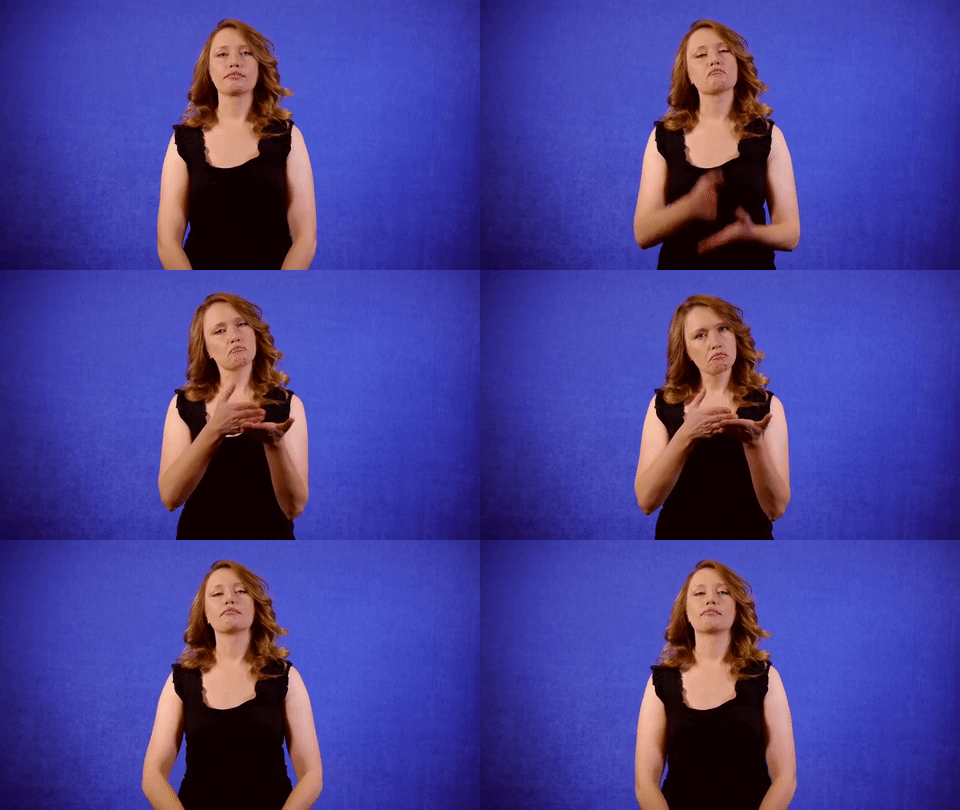
To master the sign for SOME in ASL, start by practicing in front of a mirror. This helps you focus on handshape, palm orientation, and movement. The sign typically involves a flat non-dominant hand, palm up, with the dominant hand making a slicing motion across the surface. Practicing slowly in the mirror helps develop muscle memory and accurate form. Record yourself signing to analyze your progress. Watching your own videos allows you to catch subtle errors and refine your technique. Try recording full sentences using the sign for SOME in ASL to reinforce your understanding of its placement in context. Use the sign in everyday conversations or create mock dialogues. For example, sign sentences like “I want some water” or “Some people are here” to build fluency. This will help you internalize the sign’s meaning and usage. Advanced learners can try drills that compare the sign for SOME in ASL with similar quantifier signs like EACH, MANY, or A FEW. These contrastive exercises deepen understanding and improve clarity in expressive signing. Pairing the sign for SOME in ASL with facial expressions also enhances communication effectiveness and cultural competence.
SEO Cultural Context
In Deaf culture, the sign for SOME in ASL plays a key role in expressing quantity and specificity. It appears often in everyday conversations, from describing food portions to discussing general amounts or unidentified individuals. It’s important to understand the nuance behind the sign, as it often implies an indefinite number or part of a whole. Deaf communication is rooted in clarity and visual grammar. Using the correct sign for SOME in ASL ensures that a message doesn’t become vague or confusing. For example, signing “SOME people like coffee” implies not everyone does—this subtlety matters in ASL discourse. There may be slight regional variations in how the sign for SOME in ASL is produced, especially in terms of movement speed or hand orientation. However, the core structure remains widely recognized across the Deaf community. Always observe native signers and ask for feedback to stay culturally aligned. Understanding when to use the sign for SOME in ASL is culturally impactful. It avoids overgeneralization and reflects respect for individuality and specificity. This aligns with Deaf cultural values that emphasize precision, visual clarity, and mutual understanding.
Extended Definition
The sign for SOME in ASL is a quantifier that refers to an unspecified portion or number of something. The dominant hand—usually shaped like the side of a flat “B” hand—makes a slicing motion across the non-dominant palm. This action visually represents taking a part or piece of a larger whole. It’s essential not to confuse the sign for SOME in ASL with similar signs such as A FEW or MANY. While SOME indicates an undefined quantity, A FEW suggests a small number, and MANY implies a large group. Each of these signs serves a unique grammatical role in ASL. Some learners mistakenly use the sign for PART or PIECE in place of the sign for SOME in ASL. While these signs may seem related, they convey different meanings. PART usually refers to a specific section, while SOME remains intentionally vague. Another common error is incorrect palm orientation or handshape. The non-dominant hand must remain still and flat, palm facing up. The slicing motion should be smooth and deliberate, not rushed or jerky. Watching fluent signers and mimicking their style can help correct these issues. The sign for SOME in ASL can also function in abstract ways. For instance, it may refer to a non-specific group of people, ideas, or even time periods. This flexibility makes it a high-frequency sign that’s invaluable in both casual and formal conversations.
Tips for Beginners3>
Beginners often find quantifiers like the sign for SOME in ASL tricky because they can be abstract. Start by anchoring your practice in visual context. For example, compare signing “I ate some cookies” while pointing to an actual plate of cookies. This will help you associate the sign with real-world usage. One common mistake is overextending the slicing motion or misplacing it above the hand rather than across the palm. Keep the motion tight, controlled, and centered. Handshape errors are also frequent—be sure your dominant hand forms a flat edge and your non-dominant hand remains stable. Don’t rush the learning process. Take time to watch videos of native ASL users signing sentences that include the sign for SOME in ASL. Pause and mimic their pace, handshape, and facial expressions. This repetition builds confidence and fluency. Use flashcards or digital apps that incorporate the sign for SOME in ASL into sentence frames. This will help reinforce its grammatical role and show how it connects with other signs. Practice consistently but in short focused sessions to avoid burnout. Stay patient and celebrate small victories. Correctly using the sign for SOME in ASL in your first conversation is a major milestone. Embrace feedback from Deaf signers—they offer cultural insight that no textbook can match.
Connections to Other Topics
The sign for SOME in ASL is closely related to other quantifier signs, like A FEW, SEVERAL, and MANY. Each of these signs conveys a sense of quantity but with different levels of specificity. Practicing them together helps reinforce their distinct meanings. Another relevant sign is MOST. Unlike SOME, which refers to an unspecified portion, MOST implies the majority. The two signs are sometimes confused by beginners, but their handshapes and motions differ significantly. Learning them side-by-side clarifies their usage. The sign for ALL is also connected to the sign for SOME in ASL. While SOME refers to a part, ALL refers to the whole. Understanding this contrast strengthens your grasp of ASL’s visual grammar and how it represents parts vs. wholes. Conceptually, the sign for SOME in ASL links to the grammatical topic of classifiers. Some advanced signers use classifiers to show portions or distributions, especially in storytelling or detailed explanations. This connection demonstrates the sign’s role within ASL’s broader language structure. Lastly, the sign for SOME in ASL often appears in conditional or hypothetical statements. Phrases like “If some people arrive early…” or “Some of the books are missing” show its use in more complex sentence structures. Studying these contexts deepens your comprehension and expressive ability.
Lengthy Summary
The sign for SOME in ASL is a powerful and versatile quantifier that plays a central role in everyday signing. It visually depicts taking a part of a whole, whether that’s some food, some people, or some ideas. Mastering this sign requires attention to handshape, movement, palm orientation, and facial expression. Culturally, the sign for SOME in ASL reflects Deaf values of clarity and specificity. It is used to express nuanced ideas and avoids overgeneralization, which is highly respected in Deaf communication. Whether in casual dialogue or academic discussion, the sign helps convey meaning with visual precision. Beginners should focus on correct form, avoid common errors like misalignment or excessive motion, and practice in context. Using the sign in full sentences builds grammatical awareness and fluency. Tools like mirrors, recordings, and interactive practice drills accelerate learning and promote retention. The sign for SOME in ASL connects with a larger network of quantifier signs, including MANY, A FEW, and MOST. Understanding these relationships enriches vocabulary and enhances expressive power. It also ties into grammatical features like classifiers and sentence structure, making it a foundational sign for learners at all levels. As you continue your ASL journey, keep integrating the sign for SOME in ASL into new contexts. Challenge yourself with varied sentence types, explore related signs, and engage with the Deaf community for authentic feedback. With consistent effort and cultural awareness, you’ll not only gain fluency but also deepen your appreciation for the rich visual language that is ASL. Keep signing and stay curious! Synonyms: someone yelling outside, person shouting outdoors, someone screaming outside, individual yelling outdoors, somebody calling out outside Educational resources: Find related learning materials in our course bank! Want more? Check out some of our popular learning activities on the homepage! Need to look up a sign? Use our highly rated dictionary: https://aslinteractive.com/best-asl-dictionary/ Follow us on tiktok: https://www.tiktok.com/@aslinteractive. More social media links at the bottom of this page! Long-tail Keywords: what is the sign for some in ASL, how do you sign some in ASL, ASL sign for some Categories: tags: quantity in ASL, everyday signs in ASL, food signs in ASL, clothing signs in ASL, travel-related signs in ASL
Want more? Check out some of our popular learning activities!
ASL Interactive Resources
ASLInteractive YouTube Channel
Follow us on tiktok: @aslinteractive.com
Follow us on Instagram: aslinteractive
Facebook page: aslinteractive
Facebook group: aslinteractive
LInkedIn: ASL Interactive LLC
Twitter: @ASL_interactive
*Some information on this page is AI-generated. AI can make mistakes. Please check the information.
Responses