Sign for CONCERT in ASL | 🎶 ASL Dictionary

Definition: A concert.

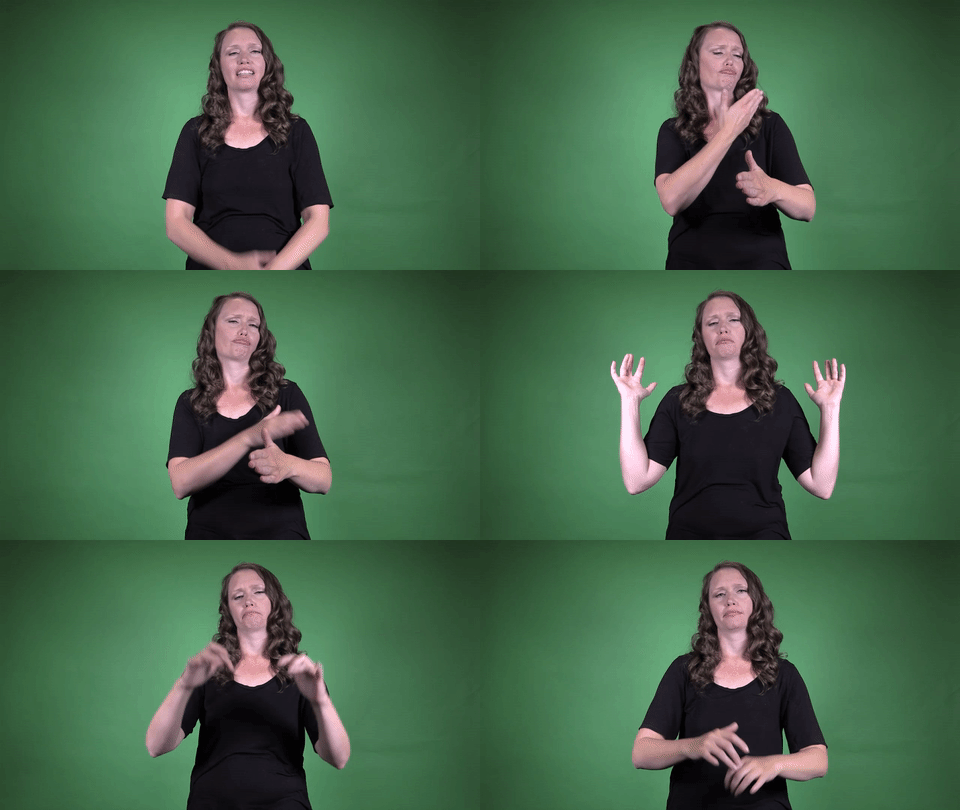
Sign for CONCERT in ASL

YouTube player

Practice Activities:

Start practicing the sign for CONCERT in ASL by isolating the sign and repeating it in front of a mirror. Use both dominant and non-dominant hands correctly, depending on your handedness, and ensure the small up-and-down circular movement across your chest is consistent. Practice this motion ten times slowly, then pick up the pace to match a normal conversational rhythm.

Next, try placing the sign in simple sentences such as “I LOVE CONCERT” or “WE GO CONCERT NEXT WEEK.” Sign each sentence multiple times, paying attention to facial expressions to match the meaning. Use a flashcard system where one side shows the English phrase and the other has the ASL gloss so you can quiz yourself or work with a partner.

Record yourself signing the phrase and use the video to self-assess your clarity, fluency, and hand movement. Try adding more context to your sentences, like “YESTERDAY, MY FRIEND AND I WENT CONCERT. IT WAS FUN!” This will help you use the sign for CONCERT in ASL more naturally in storytelling or conversation.

For a fun storytelling prompt, describe your favorite concert experience using ASL. Tell what kind of music it was, who you went with, and how you felt. If you’ve never been to one, invent a dream concert scenario. Use signs related to music genres, emotions, and places.

Practice with a partner by role-playing situations like planning to attend a concert or telling a friend about one you attended. Alternate between asking and answering questions that include the sign for CONCERT in ASL. Some examples include: “WHEN CONCERT?”, “WHO SING AT CONCERT?”, or “WHERE CONCERT LOCATE?” Building context will prepare you for real-life conversations involving music events.

Cultural Context:

In Deaf culture, going to a concert is a popular and celebrated activity, just like in hearing culture. The sign for CONCERT in ASL is important because it allows the Deaf community to talk about live performances, music events, or school concerts easily and naturally in conversation.

When you attend a concert in a Deaf-friendly setting, there are often interpreters or visual elements that make the performance accessible. The sign for CONCERT in ASL is commonly used in classrooms, social media posts, community discussions, and vlogs when referring to an upcoming show or sharing past experiences.

Deaf musicians and performers are also a growing part of the entertainment world. Knowing the sign for CONCERT in ASL helps support discussions about these artists and promotes inclusion in arts and cultural conversations—on stage and off.

Many Deaf individuals enjoy performances that include visual storytelling, rhythm-based movements, and vibrations. The sign for CONCERT in ASL allows them to discuss the kind of setup and access they prefer when talking about a specific event.

Using the correct sign for CONCERT in ASL shows cultural awareness and respect when communicating with the Deaf community. It’s not just about vocabulary—it’s about showing that you value inclusion, connection, and accurate expression within different cultural experiences.

Educational programs and interpreting services often teach the sign for CONCERT in ASL early on because music and live events are such big parts of social life. Discussing musical preferences or inviting someone to a concert becomes more accessible and inclusive when you know the sign.

In Deaf schools and family settings, the sign for CONCERT in ASL might come up when talking about school assemblies, talent shows, or trips to performances. It helps build strong language foundations and connects cultural experiences between hearing and Deaf worlds.

Social media is a key place where the sign for CONCERT in ASL appears. Deaf content creators often vlog or post stories featuring local shows and events, using the correct signs as part of their storytelling. Followers learn not just the language, but the vibe and community spirit around concerts.

The Deaf community also hosts its own concerts and festivals, such as Deaf Raves or ASL Slam events. In these spaces, the sign for CONCERT in ASL is used frequently and with pride. It reflects not just the event, but the shared cultural experience of enjoying music in a visual and physical way.

Whether you’re talking about a rock show, classical recital, or student performance, the sign for CONCERT in ASL makes your message clearer and more inclusive. It

Extended Definition:

The sign for concert in ASL is a fun and expressive sign that reflects the lively atmosphere of a musical event. It is often used in contexts where people are discussing live music, school performances, or any type of organized musical gathering. Whether it’s a classical performance or a pop show, the sign for concert in ASL helps convey excitement and the idea of shared experience through music.

To make the sign for concert in ASL, both hands typically play a role. The dominant hand moves in a waving motion over the non-dominant hand, which is held palm-down and steady. This motion can resemble the movement of sound or vibration, hinting at the rhythmic and auditory experience of a concert .

Depending on the region, the sign can vary slightly, as with many signs in American Sign Language. Some signers might emphasize the music aspect more, while others may focus on the performance or audience part. Still, no matter the variation, the general message is clearly understood among ASL users as referring to a musical event or live performance.

The sign is commonly used in everyday ASL conversations when people are making plans to attend a concert. For example, you might see it in phrases like going to a concert, saw a concert last night, or who’s playing at the concert. It fits seamlessly into casual discussions, Vlogs, social posts, or video messages among Deaf and signing communities.

In Deaf culture, concerts are a popular form of entertainment, especially when there’s visual or physical accessibility like sign language interpreters or high bass vibration. The sign for concert in ASL is an important part of describing these vibrant experiences where Deaf individuals can enjoy music in a sensory-inclusive environment. From drum circles to signed performances, concerts are more than just sound — they’re visual, tactile, and communal experiences.

Learning the sign for concert in ASL can enhance your vocabulary when discussing music-related events, especially in educational or interpreting settings. Teachers, students, and interpreters often use this sign to clarify schedules, describe past experiences, or share excitement about upcoming shows. It’s also useful when talking about local music events, community fundraisers, or school band recitals .

Social media users in the Deaf and signing community frequently use the sign for concert in ASL in video content, especially when sharing stories or promoting events. It’s a clear and visually engaging sign that quickly communicates the topic of a music-related gathering. When used in videos or Insta reels, the motion of the sign helps it stand

Synonyms: performance, show, musical event, live performance, recital

Educational resources: Find related learning materials in our course bank!

Want more? Check out some of our popular learning activities on the homepage!

Need to look up a sign? Use our highly rated dictionary: https://aslinteractive.com/best-asl-dictionary/

Follow us on tiktok: https://www.tiktok.com/@aslinteractive. More social media links at the bottom of this page!

Long-tail Keywords: what is the sign for concert in ASL, how do you sign concert in ASL, ASL sign for concert

Categories:

tags: concerts, events, music, activities, people

Parameters

*Handshape*:

The handshape for the sign for CONCERT in ASL typically uses both hands in the open “5” handshape. The dominant hand moves above the non-dominant hand, which remains stationary and palm-up, as if representing a stage. The dominant hand arcs side to side in small motions, simulating a performance.

This movement in the sign for CONCERT in ASL reflects the idea of music or a live show being presented. It’s expressive and visually conveys the entertainment aspect associated with concerts .

*Palm Orientation*:

For the sign for CONCERT in ASL, the dominant hand typically forms the letter “C” and moves in a slight arc above the non-dominant arm. The non-dominant forearm is horizontal with the palm facing downward. The “C”-shaped hand moves with the palm facing slightly inward or forward, depending on regional variations.

During the sign for CONCERT in ASL, the palm orientation of the dominant hand remains forward-facing or slightly diagonally inward as it moves over the arm. This motion represents the idea of music or performance. Both hands maintain consistent palm orientation throughout the sign.

*Location*:

The sign for CONCERT in ASL is produced in the area in front of the upper torso, typically at chest or upper chest height. This placement allows for clear visibility of the movement and handshape, which are essential for conveying the concept of a live music performance.

When signing the sign for CONCERT in ASL, the non-dominant hand is held steady while the dominant hand moves above it in a rhythmic, side-to-side motion. The proximity to the chest keeps the sign within the common signing space, making it easy to see and understand in conversation.

*Movement*:

To produce the sign for concert in ASL, place your non-dominant hand in front of your chest, palm facing down and fingers extended flat. With your dominant hand shaped in an open “C” or “bent hand,” make a side-to-side sweeping motion above the non-dominant hand.

Repeat the motion two or three times to show the idea of musical performance. The sign for concert in ASL mimics a band playing for an audience .

*Non-Manual Signals*:

Facial expressions play a key role when using the sign for concert in ASL. A look of excitement or enthusiasm is commonly used to match the energetic atmosphere of a live concert. Slight head nodding or raised eyebrows can help emphasize the context of music and performance.

The non-manual signals should match the emotional tone of the event. Whether signing about attending a concert or performing in one, showing engagement through your facial expressions enhances the meaning of the sign for concert in ASL .

*Prosody, Dominant/Non-Dominant Hand*:

The sign for CONCERT in ASL uses both hands, where the non-dominant hand remains stationary, palm facing sideways, representing the audience or stage platform. The dominant hand, in the form of the number 5 or open B-handshape, moves in a side-to-side arc above the non-dominant hand, mimicking the motion of a performer addressing a crowd.

The dominant hand emphasizes the performance aspect in the sign for CONCERT in ASL, while the non-dominant hand adds context to the setting. This visually represents music or public events, capturing the atmosphere of a concert effectively.

Tips for Beginners:

When learning the sign for CONCERT in ASL, make sure you pay close attention to your dominant hand’s movement. This sign typically involves your dominant hand in the “open B” handshape making a lateral back-and-forth motion above the non-dominant closed fist, as if indicating the directionality of sound. Try practicing in front of a mirror to ensure both the motion and handshape are clear and consistent.

A common mistake is either reducing the motion too much or performing it too quickly. Speed doesn’t necessarily make the sign right—clarity always takes priority. To help with the fluidity, imagine a musician playing for an audience, and let your hands symbolize the music moving over the crowd.

Facial expressions also matter when using the sign for CONCERT in ASL, especially if you’re referring to the experience as exciting, crowded, or loud. Incorporating appropriate expressions helps bring your sign to life and reflects how deaf individuals communicate in a more visual-spatial way.

For beginners, it helps to associate the motion with actual concerts you’ve attended. Visualization strengthens memory recall. Use repetition drills and mix the sign into short phrases or sentences in ASL to cement it further.

Try not to confuse the sign for CONCERT in ASL with similar ones like lecture, presentation, or show. Each sign has a unique nuance, and distinguishing among them is important for clarity. Watch native signers, especially in live or video interpretations of musical events, to see how the sign is used contextually.

Lastly, practice in a well-lit space so your hand movements are clearly visible. Clear contrast between your hands and your clothing helps when signing in groups or during virtual sessions. The more you immerse yourself in real interactions or videos featuring the sign for CONCERT in ASL, the more confident you’ll become.

Connections to Other topics:

The sign for CONCERT in ASL is closely related to other signs that involve gatherings, music, and public events. It often connects with signs like MUSIC, AUDIENCE, PERFORMANCE, and STAGE, making it easy to build a robust vocabulary around arts and entertainment contexts. Learners can begin to notice how classifiers and spatial referencing enhance communication when talking about events like concerts.

When combined with other signs, the sign for CONCERT in ASL can be part of compound phrases such as JAZZ CONCERT, SCHOOL CONCERT, or OUTDOOR CONCERT. In these cases, descriptors like SCHOOL or OUTDOOR help set the context, while the core sign keeps the meaning intact. This helps learners recognize how adjectives or specific types can be prefixed in ASL while maintaining clarity.

Signs like PERFORM or BAND often occur in sentences that include the sign for CONCERT in ASL. For example, someone might sign “I GO BAND CONCERT” to indicate attending a music performance. Understanding how sequencing and topic-comment structures work in ASL enables smoother expression in cultural or social settings.

This sign also connects with vocabulary related to hearing, sound, and enjoyment. It can be expanded for more detailed narratives, using facial expressions and body language to describe the size of the crowd, the volume of the show, or the excitement in the atmosphere. These visual elements are essential in storytelling and conversation.

Additionally, the sign for CONCERT in ASL is useful when discussing future plans or past experiences. Combining it with TIME-related signs like LAST NIGHT, NEXT WEEK, or SOMEDAY can teach learners how to build temporal meaning. This strengthens both grammar and fluency in ASL.

Overall, understanding the sign for CONCERT in ASL provides a gateway into rich dialogues about art, music, and shared cultural experiences. It empowers users to discuss more complex topics, from favorite bands to accessibility at large events .

Summary:

The sign for CONCERT in ASL involves a movement that reflects the idea of performance and audience engagement. Typically, the dominant hand in a “C” handshape moves in a small arc in front of the non-dominant hand, which is in a “1” or flat position, resembling a person on stage with an audience.

This motion mimics the imagined presence of an entertainer performing for a crowd. The circular or back-and-forth movement of the dominant hand portrays the dynamic vibe of a live music event. It captures the spontaneity and interaction between performers and spectators.

Grammatically, the sign for CONCERT in ASL is a noun and fits naturally in contexts discussing events, schedules, social life, or musical preferences. It can be used with time signs to specify when a concert is taking place or paired with location signs to discuss where it’s being held. It also aligns smoothly in sentence structures involving planning or attending.

The cultural relevance of this sign becomes significant when we consider how d/Deaf individuals experience concerts. Many concerts now include interpreters on stage, visual effects, and vibrating sound stages designed to make music more accessible for d/Deaf and hard-of-hearing audiences. As such, the sign for CONCERT in ASL often evokes not just a musical performance but an inclusive, shared sensory and social experience.

This sign also connects visually to signs like PERFORMANCE, MUSIC, or SHOW. Each of these signs may incorporate similar iconic movements that involve interaction between hands, representing performer and audience or instruments and listeners. Knowing these related signs provides nuances for more rich and precise communication.

One interesting linguistic note is how this sign uses spatial referencing. The non-dominant hand acts as a symbolic stand-in for a fixed audience or location, while the moving dominant hand evokes the performer or events happening in that space. This spatial referencing is a common trait in ASL and demonstrates how meaning is built interactively through motion and position.

In terms of applied linguistics, the sign for CONCERT in ASL exemplifies how signs are not just literal but deeply metaphorical and iconic. The physical form of the sign mirrors the concepts it refers to—a dynamic live show performed in front of spectators. This iconic relationship between form and meaning is crucial in ASL and richly enhances cognitive links.

The sign is also useful pedagogically when teaching music-related vocabulary in ASL. It’s especially helpful when explaining cultural events and participation in the arts. Students can use the sign for CONCERT in ASL in role-plays about weekend plans, travel experiences, or personal hobbies, reinforcing language acquisition in meaningful contexts.

For Deaf culture, music and concerts offer unique intersections between the hearing world and d/Deaf community. Events that include visual access and interpreters often empower cultural pride. Therefore, this sign represents more than just music—it embodies equity in experiencing the arts.

There is also an emotional layer to this sign that shouldn’t be overlooked. For Deaf individuals who have had moving experiences at concert events, this sign can carry strong personal connotations. It may be accompanied by facial expressions that show delight, excitement, or nostalgia.

ASL storytelling or poetry might also include the sign for CONCERT in ASL when describing moving performances or community events. The rhythm of the sign blends especially well in visual storytelling, and its cyclical, sweeping motion feels inherently rhythmic—mirroring the emotional arc of a concert itself.

This sign may differ based on regional or generational variations, with some using slightly altered handshapes or movement patterns. These variations reflect the dynamic and living structure of ASL, which evolves socially and culturally just like spoken languages. Understanding these differences creates more inclusive communication.

The specific handshapes—the “C” and the “1” or flat hand—also demonstrate how classifiers and handshape conventions work in the language. The “C” for CONCERT is not arbitrary; it pulls from the English word’s initial letter but is then applied iconically within ASL grammar.

Interpretive signs, like those representing music or concerts, often push the boundaries of traditional linguistic structure. They blend gesture, space, rhythm, and emotion fluidly. The sign for CONCERT in ASL is an excellent example of how signing can be more expressive than speaking in some contexts.

There are also practical implications for interpreters in live concerts. Knowing the sign for CONCERT in ASL is the first step, but being able to express the mood, genre, and energy of a live show is a higher-level skill. This sign serves as an anchor for those interpretations.

When paired with signs reflecting genres, like ROCK, JAZZ, CLASSICAL, or POP, the sign for CONCERT in ASL can become more nuanced. For example, adding a head nod and mouthing “rock concert” while signing enhances clarity and expresses specificity.

Social media often features Deaf influencers signing about events and entertainment. The sign for CONCERT in ASL shows up often in these videos when describing favorite

Want more? Check out some of our popular learning activities!

ASL Interactive Resources

ASLInteractive YouTube Channel

Follow us on tiktok: @aslinteractive.com

Follow us on Instagram: aslinteractive

Facebook page: aslinteractive

Facebook group: aslinteractive

LInkedIn: ASL Interactive LLC

Twitter: @ASL_interactive

*Some information on this page is AI-generated. AI can make mistakes. Please check the information.

Sign for CONCERT in ASL

Responses