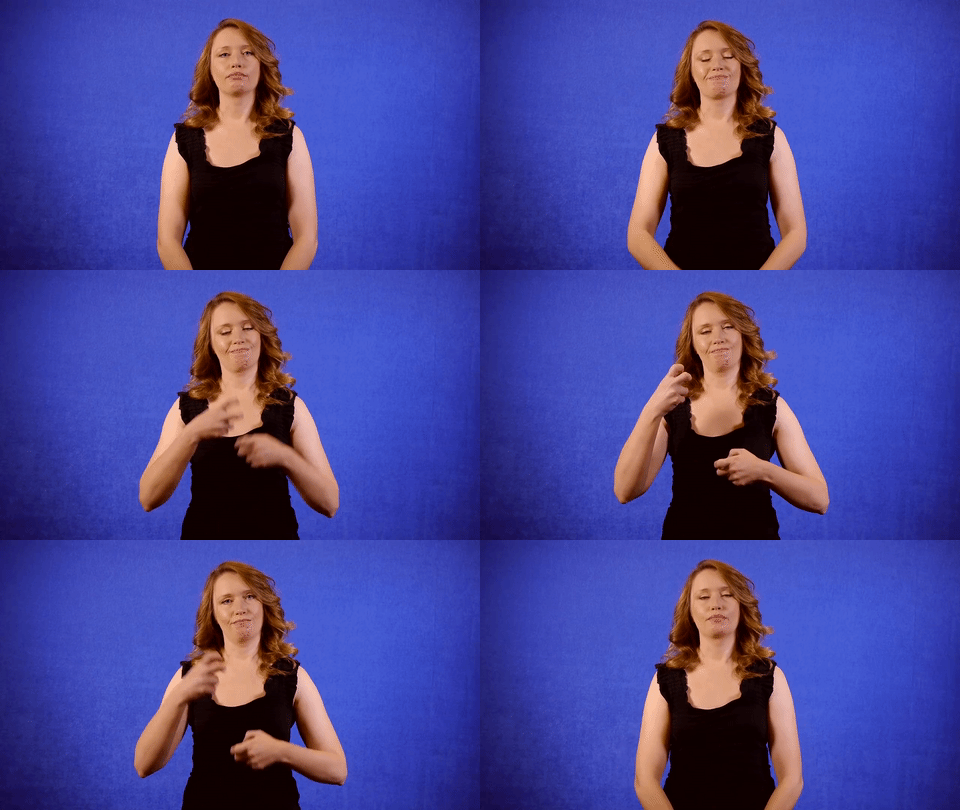
Definition: Hard to do or understand.
Sign for DIFFICULT in ASL

Practice Activities:
To start practicing the sign for DIFFICULT in ASL, spend time repeating the sign in short bursts. Use a mirror so you can focus on the handshape and facial expression, both of which are important in conveying the word accurately. Try signing it slowly, then more quickly, until you’re comfortable with both fluidity and clarity.
Next, practice using the sign for DIFFICULT in ASL within simple phrases such as “math is difficult”, “homework is difficult”, and “that question is difficult”. Say the phrases out loud as you sign them to reinforce the meaning and pacing. It helps to write out a list of adjectives and subjects so you can mix and match them with the sign, building fluency and flexibility in conversation.
Use storytelling tools to integrate the sign into longer narratives. For example, tell a story about a time when you learned something new and describe parts that were challenging. Include expressive facial grammar to show frustration or struggle—this enriches the meaning of the sign for DIFFICULT in ASL in context.
Partner activities are especially helpful. With a friend, take turns giving each other scenarios like “You’re trying to ride a bike as a kid” or “You’re learning to cook a complex recipe.” Include the sign in your storytelling where appropriate. Have your partner guess where the difficult part was, reinforcing how effectively you used the sign.
For solo practice, create flashcards with sentences that include the word “difficult” and challenge yourself to sign them smoothly. You can also watch short ASL videos and identify when and how the sign appears. Try to mimic the sign’s style, rhythm, and facial expression.
End your practice sessions by summarizing your day and adding at least one sentence that uses the sign for DIFFICULT in ASL to keep it familiar and relevant.
Cultural Context:
In American Sign Language (ASL), the sign for DIFFICULT in ASL carries a layered cultural meaning beyond just describing something hard to do. Within Deaf culture, communication is visual and expressive, and certain signs capture experiences in a more nuanced way than spoken words. The sign for DIFFICULT in ASL is one such example, often conveying not only the physical or mental challenge of a task but also the social or emotional weight it may carry.
When Deaf individuals use the sign for DIFFICULT in ASL, they may be describing more than a textbook definition of difficulty. It can hint at personal struggles, societal barriers, or even emotional challenges unique to the Deaf experience. For instance, learning environments, access to interpreters, and general communication obstacles are frequently referred to with this sign in everyday ASL conversations. The sign becomes more meaningful when placed in these contexts, showing how language reflects lived experiences.
The structure of the sign for DIFFICULT in ASL also speaks to its deeper message. The movement and facial expression often intensify depending on the situation, offering an emotional layer that’s central in ASL storytelling. Cultural values in the Deaf community support rich expression, and a sign like DIFFICULT highlights not only complexity but resilience. When someone repeats the sign with a marked expression, it signals a true struggle and a sense of pushing against odds.
It’s also common in the Deaf community for the sign for DIFFICULT in ASL to be used humorously. Finding humor in daily challenges, especially those caused by miscommunication or language access, is part of this community’s strong cultural identity. In some settings, signing DIFFICULT might trigger laughter, a shared acknowledgment of life’s little frustrations that are universally understood but particularly resonant in Deaf culture.
Parents teaching their Deaf children the sign for DIFFICULT in ASL may also use it as a teaching tool for emotional intelligence. Because ASL incorporates both sign and facial expression, children learn early on to recognize and express complex feelings. This sign helps explain moments in which tasks feel overwhelming, making it a bridge between language development and emotional understanding.
In Deaf art and storytelling, the sign for DIFFICULT in ASL can symbolize oppression, resistance, or even triumph. It may be used to discuss the difficulty of living in a hearing-dominated world or to illustrate personal victories. When signed with power and intent, it becomes a statement of identity as much as description.
In online Deaf spaces and ASL vlogs, you
Extended Definition:
The sign for difficult in ASL is a useful and commonly-used sign to express challenges, struggles, or things that are not easy. In American Sign Language, it’s a concept that often comes up in conversations about life experiences, school, learning, or emotional situations.
To form the sign for difficult in ASL, both hands are typically used with bent fingers. The dominant hand moves down and taps or brushes against the top of the non-dominant hand. This movement is quick and has a sense of force, conveying that the situation or task is not easy. Facial expressions help give additional meaning to the sign, with expressions of strain or frustration often accompanying it. ✋
This sign can be adapted slightly to show different levels of difficulty. For example, a stronger or sharper movement can show something is very hard, while a softened version of the sign might suggest something is only a little difficult. This flexibility makes the sign for difficult in ASL context-rich and expressive, just like the language itself.
In everyday conversations, people might use the sign when talking about a hard test, a difficult decision, or emotional struggles. When students learn something new that they aren’t grasping easily, they might say it’s difficult using this sign. Similarly, during a conversation about stressful events or emotionally draining experiences, the word difficult comes up frequently and naturally.
This ASL sign is part of a cluster of descriptive words that help users of the language convey depth and emotion. Signs such as hard, complicated, or challenge may be related in meaning, but the sign for difficult in ASL remains unique thanks to its motion and clear tone. It’s important for ASL learners to practice the movement and the matching facial expressions to make sure the meaning is accurate.
Anyone interested in expanding their ASL vocabulary should become familiar with common everyday terms like this one. The sign for difficult in ASL helps build a more complete understanding of how to express complexity in conversations. ASL is not just about hand motion—it’s about expression, rhythm, and context.
You can see the sign for difficult used in storytelling, classroom settings, or in casual interactions with friends. Since difficulty is a shared human experience, it’s a relatable expression that gets used often. Understanding how to use and recognize this sign can help you connect more easily with deaf or hard-of-hearing communities.
When adding new vocabulary to your ASL dictionary, high-frequency words like the sign for difficult in ASL are excellent entries. They offer both beginners and
Synonyms: challenging, hard, tough, demanding, strenuous
Educational resources: Find related learning materials in our course bank!
Want more? Check out some of our popular learning activities on the homepage!
Need to look up a sign? Use our highly rated dictionary: https://aslinteractive.com/best-asl-dictionary/
Follow us on tiktok: https://www.tiktok.com/@aslinteractive. More social media links at the bottom of this page!
Long-tail Keywords: What is the sign for Difficult in ASL, How do you sign Difficult in American Sign Language, Difficult ASL sign
Categories:
tags: difficult situations, challenges, emotions, language learning, verbs
Parameters
*Handshape*:
The handshape used in the sign for DIFFICULT in ASL involves both hands forming bent-V handshapes (bent index and middle fingers). These hands are positioned so that the fingertips of both hands touch or nearly touch.
In the sign for DIFFICULT in ASL, the dominant hand moves slightly downward or forward over the non-dominant hand, emphasizing resistance or challenge. This bent-V handshape is essential to conveying the meaning of difficulty or struggle in the sign. ️
*Palm Orientation*:
For the sign for DIFFICULT in ASL, both hands are typically in bent “V” handshapes. The dominant hand is placed above the non-dominant hand, and the fingertips of both hands face downward and slightly toward each other.
The palm orientation in this sign involves both palms generally facing down or inward, depending on the signer’s style. During the movement, the dominant fingers brush or tap over the non-dominant fingers, indicating the intensity or challenge of the concept being signed.
*Location*:
The sign for difficult in ASL is located in the neutral space just in front of the body, typically at chest height. Both hands are positioned in “bent V” handshapes with the dominant hand above the non-dominant one.
During the sign for difficult in ASL, the dominant hand taps or strikes downward onto the non-dominant hand. This motion occurs in the space about six to eight inches away from the torso, without touching the body.
*Movement*:
To perform the sign for difficult in ASL, form both hands into bent V-handshapes (bent index and middle fingers). Place the dominant hand above the non-dominant hand, both facing downward.
The dominant hand moves downward in a short, quick, and slightly erratic tapping motion onto the knuckles of the non-dominant hand. This movement suggests resistance or challenge, emphasizing the idea conveyed by the sign for difficult in ASL. ️
*Non-Manual Signals*:
When using the sign for difficult in ASL, the facial expression should reflect struggle or effort. Eyebrows may be furrowed slightly, and the mouth can show tension or a slight grimace to emphasize the challenging nature of the concept.
The sign for difficult in ASL is strengthened by a subtle head shake and squinting eyes, helping to express frustration or unease. These non-manual signals provide context and enhance the message clearly.
*Prosody, Dominant/Non-Dominant Hand*:
The sign for DIFFICULT in ASL typically uses both hands. The dominant and non-dominant hands are in bent “V” handshapes. The non-dominant hand stays stationary in front of the body, palm down. The dominant hand, also in a bent “V,” starts slightly above the non-dominant hand and taps or brushes over it with a quick, sharp motion to show difficulty or struggle.
When signing the sign for DIFFICULT in ASL, the motion is slightly tense and quick, emphasizing the challenging nature of a situation. Facial expression plays a big role, often including squinted eyes or a grimace for emphasis. This supports the meaning and is essential to correctly conveying the sign for DIFFICULT in ASL.
Tips for Beginners:
When learning the sign for DIFFICULT in ASL, one of the most important aspects is mastering handshape and movement. This sign uses bent “V” hands for both the dominant and non-dominant hands. Place the non-dominant “V” hand in front of you, palm down, and have your dominant hand come down and tap over it with a quick, slightly forceful motion. Be sure the fingers are curved properly and not too straight, otherwise it can change the meaning or make it less clear.
Pay close attention to the speed and force of the motion to convey the right tone. The sign for DIFFICULT in ASL is meant to show challenge or struggle, so a slight bounce can help express that. However, beginners often overdo the force or speed, making the sign look either too aggressive or unclear. Practice in front of a mirror to better understand how your motion appears.
Another common mistake is incorrect finger spacing. Make sure your “V” hand isn’t too wide or too narrow; keeping fingers naturally bent and apart adds clarity. Also, try not to let your hands drift too far apart—maintain a clean, centered frame in your upper chest area. This helps with readability, especially in conversations.
Facial expressions are just as important as hand movements. Use a slight grimace or raised brow to reinforce the concept of difficulty. Without facial grammar, the sign can lose part of its meaning. Practice this integrated approach, even when signing in drills.
Context is key when using the sign for DIFFICULT in ASL. Knowing when to use the sign literally or abstractly—like describing a hard class versus a hard day—will help you become fluent faster. Consistently reviewing real signing stories or dialogues online can deepen your understanding.
sign for DIFFICULT in ASL, asl difficulty sign, how to sign difficult, learn sign for difficult, ASL challenge sign, American Sign Language for difficult
Connections to Other topics:
The sign for DIFFICULT in ASL is closely related to conceptual opposites and comparative ideas like EASY, CHALLENGE, and HARD. These signs often appear in juxtaposition during conversations to contrast experiences, levels of skill, or expectations. Understanding how the sign for DIFFICULT in ASL relates to its opposite, EASY, helps learners grasp visual comparisons, which are key in ASL structure.
This sign also connects with expressions of effort and struggle, such as TRY, WORK-HARD, and PROBLEM. In discussions where someone is describing a tough situation or obstacle, combining the sign for DIFFICULT in ASL with WORK or STUDY can form compound ideas like DIFFICULT-WORK or DIFFICULT-STUDY. These compound expressions enhance storytelling and convey emotional or physical struggle effectively.
The sign’s use in educational settings is common, especially in phrases such as DIFFICULT-CLASS or DIFFICULT-SUBJECT. Pairing with academic subject signs like MATH or SCIENCE results in natural compound phrases that communicate specific challenges. In this way, the sign for DIFFICULT in ASL helps describe learning experiences as part of broader conversations about school or personal growth .
It also appears in emotional and mental contexts, linking to signs like STRESS, FRUSTRATED, and CONFUSED. When someone discusses a difficult decision, for example, combining DIFFICULT with DECIDE or CHOOSE illustrates internal conflict. This linkage allows for clearer emotional expression and deepens the user’s expressive skills.
Additionally, regional or stylistic variations of the sign for DIFFICULT in ASL might affect its speed or intensity, depending on the severity of the difficulty being described. This brings attention to how ASL uses non-manual signals (like facial expressions) to modify meaning. Overall, learning how to use this sign with others helps learners engage in more dynamic and authentic ASL conversations.
Summary:
The sign for DIFFICULT in ASL uses both hands in a bent “V” handshape. The dominant hand taps the non-dominant hand twice with a quick, sharp motion.
This gesture suggests friction or struggle between two parts, visually capturing the concept of something not being smooth or easy. The quickness and tension in the movement can reflect the intensity of the situation being described.
In ASL, the grammar of DIFFICULT varies based on facial expressions and signing speed. A more intense look with a sharp sign indicates a more severe challenge, while a softer expression and slower movement may convey something mildly problematic.
The concept of difficulty can be paired with temporal indicators or context-specific classifiers. This flexibility allows signers to build meaning-rich utterances that deepen understanding beyond a surface-level translation.
The sign for DIFFICULT in ASL often partners naturally with signs like CHALLENGE, HARD, or STRUGGLE, but their subtle uses differ. DIFFICULT emphasizes the tough nature of a task itself, whereas CHALLENGE may carry motivational, competitive undertones.
Culture plays a key role in how signs like DIFFICULT are expressed. In the Deaf community, the way one emphasizes or downplays the sign can convey emotion, cultural values tied to perseverance, or comment on systemic barriers.
Historically, the sign for DIFFICULT has remained relatively stable, possibly because of its intuitive and iconic form. The bent “V” handshape mimics the idea of unevenness or clashing forces, easy to remember and understand.
From an applied linguistics angle, the structure of this sign invites analysis in terms of conceptual metaphor. DIFFICULT is physically embodied through tension and contact—elements often used to represent complexity in signed languages.
In everyday language, DIFFICULT shows up in a variety of sentence structures. It can act as an adjective, modify a verb phrase, or become a predicate when paired with BE or subjects like TEST or JOB in ASL syntax.
The sign-interaction between hands, both shaped the same, also calls attention to ASL’s spatial grammar. Hand dominance leads the movement, but both hands participate, emphasizing balance and imbalance simultaneously.
Notably, the effort embedded in the sign can also reflect speakers’ attitudes. A rolling of the eyes or a puffed cheek while executing the sign can frame the difficulty as annoying, overwhelming, or just expected.
In translation work, the sign for DIFFICULT in ASL can create interesting choices. Interpreters must gauge the semantic weight of corresponding English expressions like tricky, tough, or complex and decide whether to use DIFFICULT or something more specific in ASL.
Moreover, the sign is extremely useful in educational and workplace contexts where Deaf professionals must navigate systems not built for their ease. Its frequent use underscores real-world accessibility challenges and cultural persistence.
When breaking down this sign with second-language learners of ASL, instructors often emphasize the sharp movement and the bent fingers. These physical elements are as semantic as they are phonological.
Learners sometimes confuse DIFFICULT with HARD due to overlapping meaning, but experienced signers distinguish them by context or by pairing them with different non-manual signals. This underlines the importance of facial grammar in ASL.
Parents teaching children ASL at home often sign DIFFICULT during everyday events—solving homework, tying shoelaces, or understanding rules. The sign becomes part of a vocabulary of struggle that is both individual and shared.
The prevalence of the sign for DIFFICULT in ASL narratives, visual poems, and storytelling suggests a broader metaphorical significance. It resonates with resistance, effort, and resilience—qualities deeply valued in Deaf culture.
In Deaf Gain frameworks, the emphasis on struggling through a “difficult world” acts as commentary on mainstream inaccessibility. The sign can be seen not only as descriptive but protest-driven when used in socio-political settings.
Digital ASL content creators often use the DIFFICULT sign when describing learning curves, limited resources, or inequities in access to information. Its visual impact conveys urgency and tactility in ways that hold audience attention.
The palm orientation and symmetrical handshape of the sign showcase ASL’s attention to ergodynamics. Signs like this are intuitively comfortable while still capturing conceptual power.
Learners studying signed and spoken language comparison might note that while spoken English uses abstract adjectives like complicated, ASL physically builds that abstraction through visual tension and motion.
The sign for DIFFICULT in ASL also evolves in children’s language acquisition. Beginning without the sharp motion and tension, young signers gradually build the skill to express the layered meaning embedded in the sign’s dynamic.
When analyzing video corpora in ASL linguistics, the DIFFICULT sign often co-occurs with intensified eyebrows, nose wrinkles, or slight shoulder glances. These add to the multi-channel expressiveness of the language.
Sign for DIFFICULT in ASL serves as a foundational term in expressing emotional wellness, acknowledging frustration, or navigating
Want more? Check out some of our popular learning activities!
ASL Interactive Resources
ASLInteractive YouTube Channel
Follow us on tiktok: @aslinteractive.com
Follow us on Instagram: aslinteractive
Facebook page: aslinteractive
Facebook group: aslinteractive
LInkedIn: ASL Interactive LLC
Twitter: @ASL_interactive
*Some information on this page is AI-generated. AI can make mistakes. Please check the information.

Responses