Sign for DISCUSS in ASL | ASL Dictionary

Definition: To talk about something.

Sign for DISCUSS in ASL

YouTube player

Practice Activities:

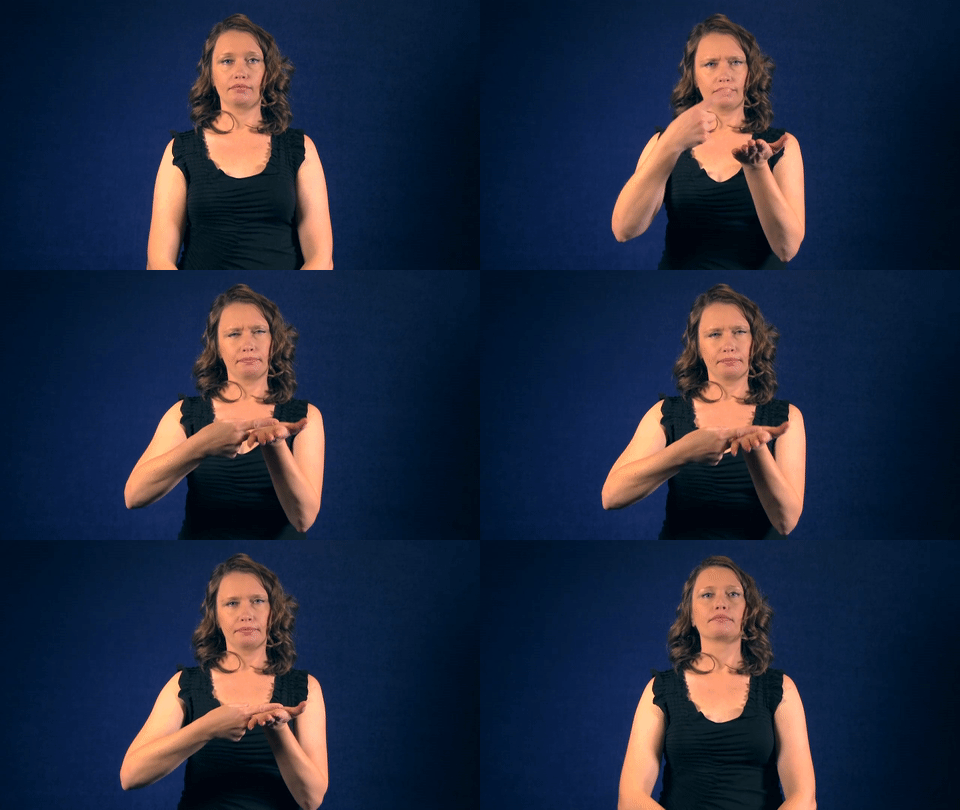
Start by practicing the sign for DISCUSS in ASL in front of a mirror to make sure your handshape and motion are clear and accurate. The sign involves using one hand in a flat handshape, held palm-up, while the other hand, shaped like an index finger, taps or circles gently on the palm. Repeat the motion slowly, paying attention to wrist alignment and fluidity.

Next, practice the sign in isolation by combining it with facial expressions. Use a serious face to simulate a deep discussion and a curious expression to represent a more casual conversation. Try transitioning between expressions while repeating the sign for DISCUSS in ASL to improve your fluency and affective communication.

Move into simple sentence practice. Use sentences like “We need to discuss the plan,” “Let’s discuss this later,” or “Can we discuss the problem?” Practice signing each sentence slowly, then try them at a conversational pace while maintaining proper grammar. You can even use these phrases during your routine to reinforce memory.

For storytelling, use daily-life scenarios where discussions happen. Create a short story about talking with a friend about a school project or discussing a family vacation. Use five or six signs to illustrate the story, placing the sign for DISCUSS in ASL at the appropriate moment.

Partner activities can help build your confidence. Pair up with another learner, and simulate a mock conversation using the sign multiple times. One person can start a topic, such as choosing a restaurant or planning a weekend trip, and both partners take turns using the sign during the exchange.

Finally, watch online dialogues or vlogs in ASL and note when and how native signers use the sign for DISCUSS in ASL. Try mimicking their style and pacing to improve your natural flow.

Cultural Context:

In American Sign Language, the sign for discuss in ASL holds more than just a literal meaning. It represents a deep-rooted value within Deaf culture: the importance of open communication, dialogue, and sharing ideas. The Deaf community places high importance on clarity and the free exchange of thoughts, especially through visually-rich interactions.

The sign for discuss in ASL visually depicts the concept of communication between two or more people. It often involves directional movement that mimics an exchange, where ideas flow back and forth. This reflects the cultural value placed on community dialogue, respectful debates, and an inclusive decision-making process.

Within Deaf culture, discussions are typically face-to-face and direct. This aligns with the visual nature of ASL and the cultural expectation of being straightforward and transparent. The sign for discuss in ASL fits naturally into this cultural process, promoting open and respectful communication.

Because ASL is a visual language, using the correct direction, expression, and motion when signing is essential. The sign for discuss in ASL often incorporates facial expressions and body language that convey tone, to ensure the message is fully understood. In Deaf culture, this extra layer of clarity helps avoid misunderstandings and encourages mutual respect during conversations.

The Deaf community often sees discussion as a collective act of learning, problem-solving, and growth. This value is embedded into community interactions, meetings, and even education. The sign for discuss in ASL is commonly used not just academically but also in daily life situations where ideas and viewpoints are exchanged.

In educational settings, especially in Deaf schools and colleges, the sign for discuss in ASL is frequently seen during class discussions, debates, and group projects. Students are encouraged to express their opinions clearly and listen actively to their peers. This mirrors the cultural emphasis on balanced and fair communication.

Family and community gatherings within Deaf culture also emphasize discussion as a way to bond and make decisions together. The sign for discuss in ASL is used in group talks, family meetings, and community forums. It highlights the value of collective voice and visual communication.

Deaf culture does not prioritize verbal communication over signed communication. Instead, ASL signs like the sign for discuss in ASL demonstrate the richness and efficiency of visual language. They help create environments where everyone has an equal opportunity to speak and be understood.

When interpreting or learning ASL, understanding the cultural meaning behind signs can greatly improve communication. The sign for discuss in ASL is more than a vocabulary word; it’s a reflection of values like openness, collaboration,

Extended Definition:

The sign for discuss in ASL is a commonly used expression in both casual and formal settings. This sign is essential for students, professionals, and anyone engaged in thoughtful conversation or debate. Understanding how to use it properly helps build clear and respectful communication in American Sign Language.

To produce the sign for discuss in ASL, use the dominant hand in a pointing shape and tap it in a small circular motion near the palm of the non-dominant hand, which stays flat and horizontal. This sign visually represents two or more people exchanging ideas or information. It’s effective for talking about topics that require back-and-forth conversation, sharing opinions, or problem-solving.

The concept behind the sign for discuss in ASL highlights sharing and communication. Whether you’re discussing weekend plans or complex academic topics, signing this word correctly helps express that a meaningful interaction is happening. The sign can be adapted with facial expressions and body language to indicate whether the discussion is casual, serious, or even heated.

The sign is commonly used in school settings when students and teachers are engaging in lessons. It also appears frequently in the workplace, especially during meetings, planning sessions, or team check-ins. Knowing how to sign discuss properly allows deaf and hard-of-hearing individuals to fully participate and share their insights.

In American Sign Language, the sign for discuss can be modified to show intensity or scope. For instance, a more animated motion can indicate a broader or more passionate discussion. Adding signs like idea, opinion, or agree can clarify the subject matter being tackled.

Signers often pair the sign for discuss in ASL with directional cues to show with whom they are discussing. By adjusting the direction of the sign toward different people or parties, you can show who is involved in the dialogue. This directional use adds valuable meaning to the conversation.

Non-manual signals like questioning eyebrows, nodding, or pausing for response can further enrich a signed discussion. These elements demonstrate the natural flow of real-life conversations and help mirror spoken storytelling or debates. ASL thrives on visual and spatial cues, making clarity essential.

In group settings, the sign for discuss in ASL fosters teamwork and collaboration. It encourages group members to contribute their thoughts. Social interactions become smoother and more inclusive when everyone knows appropriate signs for dialogue-based concepts.

While some signs in ASL may evolve over time or vary by region, the sign for discuss remains fairly consistent due to its fundamental role in communication. It is a sign that learners often acquire early in their ASL journey because

Synonyms: talk about, examine, debate, go over, review

Educational resources: Find related learning materials in our course bank!

Want more? Check out some of our popular learning activities on the homepage!

Need to look up a sign? Use our highly rated dictionary: https://aslinteractive.com/best-asl-dictionary/

Follow us on tiktok: https://www.tiktok.com/@aslinteractive. More social media links at the bottom of this page!

Long-tail Keywords: what is the sign for discuss in ASL, how do you sign discuss in American Sign Language, how to sign discuss in ASL

Categories:

tags: Discuss, Language Learning, Conversations, Verbs, Communication

Parameters

*Handshape*:

The handshape used in the sign for DISCUSS in ASL involves both hands using extended index fingers (the “1” handshape). The dominant hand’s fingertip taps the palm or base of the non-dominant open flat hand, simulating an exchange of ideas or conversation.

This structure visually represents communication or a dialogue, making it effective for the sign for DISCUSS in ASL. Utilizing clear finger positions helps ensure the meaning is conveyed accurately when signing.

*Palm Orientation*:

The palm orientation for the sign for DISCUSS in ASL involves both hands in an upright position. The dominant hand, typically in the 1-handshape, points outward with the palm facing toward the non-dominant, open flat hand whose palm faces upward or slightly inward.

During the sign for DISCUSS in ASL, the pointing finger of the dominant hand lightly taps or brushes the palm or fingers of the non-dominant hand. This gesture mimics the idea of exchanging or sharing ideas in a discussion.

*Location*:

The sign for DISCUSS in ASL is located in the neutral space in front of the body, slightly above waist level. One hand forms a flat palm facing up while the index finger of the dominant hand taps the palm repeatedly.

This placement in the neutral zone ensures clarity and visibility, making the sign for DISCUSS in ASL easy to integrate during conversations. The sign is executed in front of the torso, not touching the body.

*Movement*:

To make the sign for DISCUSS in ASL, begin with your non-dominant hand held in front of you, palm facing inward and fingers together in an upright position. Then, using your dominant hand in the form of an extended index finger, tap the tips or back of the stationary hand in a small, repeated motion.

This movement mimics the idea of exchanging ideas or points of view. The sign for DISCUSS in ASL conveys a sense of communication or verbal deliberation . Keep the motion firm but gentle, repeating it once or twice for clarity.

*Non-Manual Signals*:

When using the sign for DISCUSS in ASL, maintain a focused facial expression, showing engagement or intent to exchange ideas. Slightly raised eyebrows and a forward head tilt can indicate curiosity or prompting a conversation.

This natural expression helps clarify the context of the sign for DISCUSS in ASL, emphasizing the importance of communication. Leaning slightly forward reinforces an active discussion or exchange. ️

*Prosody, Dominant/Non-Dominant Hand*:

The sign for DISCUSS in ASL uses the dominant hand shaped like a flattened “1” handshape, representing an extended index finger. The dominant hand taps the tip of the index finger repeatedly against the open palm of the non-dominant hand, which is held horizontally. ️ The fingers of the non-dominant hand remain relaxed and spread slightly apart. This prosodic motion suggests an exchange of ideas or communication between people. The sign for DISCUSS in ASL emphasizes interaction and dialogue.

Tips for Beginners:

When learning the sign for DISCUSS in ASL, it’s important to focus on handshape and palm orientation. Use the index finger of your dominant hand and tap it on the open palm of your non-dominant hand a few times in a deliberate motion. The tapping should be firm but not exaggerated, resembling two people engaging in an exchange of ideas.

A common beginner mistake is tapping too softly or too quickly, which can make the sign unclear. Keep your hands at chest height and ensure your movements are visible to your conversation partner. Practicing in front of a mirror can help you become more aware of your angles and speed, improving clarity.

Facial expressions matter a lot when using the sign for DISCUSS in ASL. Since this concept often involves explaining, debating, or clarifying, your expression should match the context. A neutral or slightly thoughtful face works well in most scenarios, but an emphatic discussion may call for more intensity.

Try to associate the motion with the idea of exchanging thoughts—it might help to visualize a conversation or a debate. Doing so can improve recall and make your usage more natural. The more meaningful the association, the better it sticks.

Avoid using just one tap or a vague gesture, as this can be interpreted as something else entirely or come across as lazy signing. Clear, consistent repetition is key. Sign slowly at first and gradually increase your speed as you gain confidence.

To build fluency, integrate the sign for DISCUSS in ASL into everyday practice. Use it during silent practice sessions or when retelling conversations in ASL. Repetition in context helps lock in both the sign itself and the natural rhythm of ASL communication.

Connections to Other topics:

The sign for DISCUSS in ASL connects naturally with related cognitive and communicative concepts such as THINK, SHARE, DEBATE, and MEETING. These signs often appear together in structured conversations or educational settings. Understanding how ideas are shared or explored helps learners contextualize the sign for DISCUSS in ASL within larger dialogues.

This sign also integrates well with signs describing emotions and opinions. For example, in a classroom setting or a negotiation context, signs like OPINION, FEEL, AGREE, or DISAGREE commonly pair with discuss. These connections emphasize how DISCUSS functions beyond just conversation—it reveals positions and emotional engagement.

The sign for DISCUSS in ASL can also tie into group-related signs such as TEAM, GROUP, or COMMUNITY. When used in combination, it helps convey the idea of collaborative problem-solving or community dialogue. This reinforces the concept that discuss often implies purposeful interaction among multiple people.

In more advanced sign usage, the sign for DISCUSS is helpful in academic or political discussions, often preceding more specific topic signs like LAW, EDUCATION, ENVIRONMENT, or RIGHTS. These compound ideas support clarity and contribute to building fluency in structured ASL presentations or debates.

Furthermore, learners will find that the spatial use of signs plays a major role in effectively expressing the sign for DISCUSS in ASL. The directional aspects of engaging two or more parties illustrate how signers visualize the conversation or exchange of ideas. This adds dynamism and flow to the interaction.

Finally, this sign supports narrative skills in storytelling and explanation. ASL poets and performers may use discuss to set up tension or conflicting viewpoints before reaching a resolution. The sign thus becomes both functional in daily communication and artistic in expression, showcasing its depth in ASL.

Summary:

The sign for DISCUSS in ASL is a dynamic yet simple sign that conveys the essence of two or more people exchanging ideas. It uses a strong tapping motion that helps convey the intent to address a concept together or deliberate on a topic. This gesture mirrors the structure of conversation and demonstrates social interaction in visual language form.

To perform the sign for DISCUSS in ASL, one hand—typically the non-dominant—rests in an open, flat position, palm-up like a platform. The index finger of the dominant hand taps this palm in a repeated downward motion. This tapping symbolizes exchanging thoughts or addressing a topic with attention and intention.

This sign is embedded in many formal and informal Deaf culture settings. In Deaf classrooms, for example, teachers often use the sign to invite students into collaborative thinking. It signals not just the act of talking, but active participation and mutual understanding.

The roots of the sign for DISCUSS in ASL are tied to broader narrative structures important to Deaf storytelling and debating. It actively reflects the principles of equity in communication. Just as spoken discourse depends on turn-taking, so too does signed discussion, facilitated by this central sign.

Grammatically, the sign for DISCUSS in ASL can take on various temporal forms depending on accompanying facial expressions or additional contextual signs. A past discussion versus a future one can be implied with time markers. ASL relies heavily on nonmanual markers to shape meaning, and this sign is no exception.

Modifying the movement or intensity of the sign allows subtle shifts in meaning. A more emphatic tap might suggest a heated argument. A gentle motion could imply casual exchange or brainstorming.

The sign for DISCUSS in ASL connects closely with other signs such as TALK, CHAT, CONVERSE, or MEET. But while TALK may suggest simple verbal expression, DISCUSS implies analysis, exchange, or deliberation. It’s a more collaborative gesture in meaning.

The visual metaphor of the sign imitates ideas being placed or exchanged in a shared space. In philosophical or academic discourse, this sign becomes the backbone of active engagement. It is used to suggest not merely communication, but critical engagement.

In applied linguistics, the sign for DISCUSS in ASL showcases the power of spatial use and hand dominance in conveying meaning. It supports the idea of sign language as a full and dynamic linguistic system. The spatial and iconic strategies in the sign reinforce its cognitive strength.

The motor schema for the sign demonstrates ASL’s reliance on spatial and kinetic memory. It is quickly learnable and repeatable, reinforcing its importance in conversational flow. This invites both novice and fluent signers into active use early in their signing journey.

In structured ASL conversations, this sign functions as a discourse marker. It helps organize turn-taking or signal topical engagement. The context in which it is used can signal either a request to debate or an offer to negotiate ideas.

Within Deaf communities, prolonged or repeated use of the sign may reflect collective decision-making processes. Deaf culture values consensus-driven processes. Thus, the sign often aligns with communal and group-centered actions and values.

The presence of the sign for DISCUSS in ASL within educational interpreting reflects its frequent use in pedagogical dialogue. It is employed across disciplines such as science, literature, and philosophy. Anytime engagement with a concept is required, this sign surfaces.

In media or Deaf theater, it functions as a transitional cue. Characters may use this sign before engaging in signed argument or dialogue. It acts as a signal flag, alerting viewers to a pivotal exchange.

The sign is also important in conflict resolution settings. In Deaf-led mediations, DISCUSS can imply sincerity and the willingness to hear multiple points of view. It plays a role in expressing respect amid disagreements.

In virtual ASL spaces—such as video chats or distance learning—it’s critical for showing attention flow. Signers maintain expressiveness while incorporating DISCUSS to show that collaboration continues. The inclusion of this sign helps preserve the conversational tone even when spatial referencing is limited.

Comparatively, the sign finds relatives among international sign systems. While not universally identical, many visual languages mirror the same concept with hand-to-hand signs. This shows the shared cultural significance of dialogue across signing cultures.

Historical changes in the sign’s usage reflect educational trends and community needs. In early ASL, more generalized hand gestures were used to convey TALK or CONSIDER. Evolving pedagogy led to specialized signs like DISCUSS to reflect deeper cognitive engagement.

In sociolinguistics, the frequency and distribution of this sign in Deaf communities can be studied to understand communication breadth. It appears equally in formal discussions and casual exchanges. Its versatility makes it key to understanding language usage patterns.

Children acquiring ASL learn the sign for DISCUSS along with other social behavior signs. It is taught through modeling turn-taking and mutual respect. Teachers and parents often dramatize its motion to help children internalize the value of cooperation.

In online ASL dictionaries and learning applications, the sign maintains high visibility

Want more? Check out some of our popular learning activities!

ASL Interactive Resources

ASLInteractive YouTube Channel

Follow us on tiktok: @aslinteractive.com

Follow us on Instagram: aslinteractive

Facebook page: aslinteractive

Facebook group: aslinteractive

LInkedIn: ASL Interactive LLC

Twitter: @ASL_interactive

*Some information on this page is AI-generated. AI can make mistakes. Please check the information.


Responses