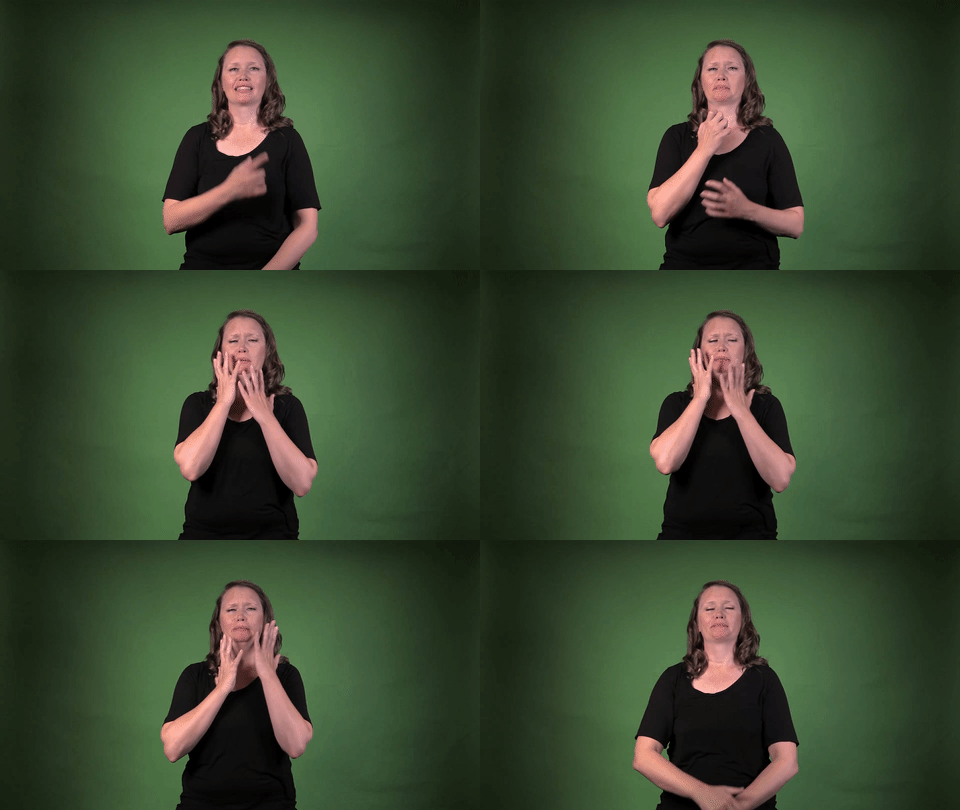
Definition: Feeling self-conscious or ashamed.
Sign for EMBARRASSED in ASL
Practice Activities:
Start by practicing the sign for embarrassed in ASL in isolation in front of a mirror. Focus on making the correct handshape and motion while adding the appropriate facial expression, such as a shy smile, downward glance, or a blushing look. Repeat the sign multiple times while gradually increasing your fluency and comfort level.
Once you are confident with the isolated sign, create simple sentences using the sign for embarrassed in ASL. Try examples like “I feel embarrassed” or “She was embarrassed at the party.” Sign these sentences slowly, then gradually increase to a conversational pace while maintaining clear expression and timing.
Pair up with a practice partner and take turns acting out short roleplay scenarios. One person can describe a situation while the other signs an appropriate response. For example, “You tripped in front of your classmates” and the response could incorporate the sign for embarrassed in ASL along with matching facial expression and body language.
Write a short ASL story that includes a character dealing with an embarrassing moment. It could be something humorous like walking out of the bathroom with toilet paper stuck to their shoe or more subtle like forgetting someone’s name. Practice signing the entire narrative, using classifiers and facial expressions to bring the story to life. Include the sign for embarrassed in ASL at the key moment and make sure it fits into the emotional flow of the story.
For solo activities, watch ASL vlogs or video clips where people describe awkward or embarrassing moments. Pause the video and try to retell the situation using your own signs. If possible, post your own short video using the sign on social media for feedback or self-review.
To build fluency, mix the sign for embarrassed in ASL into your daily practice with other emotion-related signs like happy, sad, confused, and surprised. Create sentences that contrast feelings for better context use.
Cultural Context:
In American Sign Language, the sign for embarrassed in ASL carries more than just a definition—it reflects deep cultural values about emotion, modesty, and body language. Within Deaf culture, showing emotion with appropriate facial expressions is a vital part of communication, and that is especially true when signing emotions like embarrassment.
The sign for embarrassed in ASL connects directly with how people in the Deaf community convey discomfort or self-consciousness. It’s not just about hand movements; facial cues, eye contact, and body posture help convey the full meaning. When using the sign for embarrassed in ASL, signers often show lowered eyes, flushed cheeks, or hesitant body language to mirror real emotional reactions.
Deaf culture greatly values visual nuance, and expressing feelings accurately is seen as a sign of respect and authenticity. That’s why the sign for embarrassed in ASL is more than a translation—it’s an expression grounded in shared social experience. Unlike spoken English communication, where tone and pitch do the work, signing relies heavily on visible emotion.
Kids learning the sign for embarrassed in ASL are often taught to observe others’ reactions as part of their language acquisition. Elders and experienced signers teach by example, showing how the same sign can shift slightly depending on how shy, humiliated, or awkward a situation is. These differences show the richness of ASL and how culture shapes every sign.
Emotion-based ASL signs like embarrassed help build empathy and closer bonds in communication. In Deaf communities, being able to show vulnerability honestly is valued, so mastering the sign for embarrassed in ASL includes understanding its many emotional variations. It’s expected that context will guide exactly how and when to use this sign appropriately.
Some variations of the sign for embarrassed in ASL may include circular motions near the face or both hands moving together, and these can carry personal or regional influences. Just like accents in spoken languages, sign language can change from one community to another. This makes learning from native signers especially valuable for accurate use.
When a newcomer signs embarrassed without proper facial expressions, it can come across as flat or insincere. That’s why ASL teachers emphasize the integration of feelings into signs during lessons. For learners, practicing the sign for embarrassed in ASL should always include mirror work or video feedback to better capture the emotion visually.
Additionally, the sign for embarrassed in ASL is often used in storytelling, jokes, and real-life storytelling in Deaf gatherings. Signing with the right expression can make emotionally sensitive stories more engaging and
Extended Definition:
The sign for embarrassed in ASL conveys a range of emotions, including shyness, awkwardness, and self-consciousness. It’s a facially expressive sign that helps show feelings of discomfort or unease in social situations.
To make the sign for embarrassed in ASL, place your open hands near your face and move them in small circles while changing your facial expression to show uneasiness. This circular motion around the face, combined with an expression of awkwardness, clearly communicates the emotion. Facial expressions play a crucial role in making the sign more accurate and meaningful.
Since many emotions in ASL rely heavily on facial expressions, the sign for embarrassed in ASL is no exception. Without the right expression, the meaning could change or come across as unclear. This makes it important to practice not just hand movements but also the accompanying facial expression.
Different people may use slightly varied versions of this sign, especially based on regional differences or personal signing styles. Some might use a more exaggerated circular hand movement, while others focus more on their facial cues. These slight variations still effectively communicate the same meaning.
It’s also useful to compare the sign for embarrassed in ASL with related signs like shy or nervous. While they may look similar, the difference lies mostly in facial expression and the motion of the hands. Practicing these distinctions will help improve fluency and understanding.
This sign can be used in many everyday conversations. Whether you’re talking about a time you felt awkward or telling a story that made you cringe, this sign adds emotion and realism to your storytelling. It’s also commonly seen in classrooms, social situations, and storytelling among fluent signers.
The sign for embarrassed in ASL is a good example of how American Sign Language blends movement, expression, and emotion. Learning emotional signs like this one enhances your ability to connect with Deaf individuals on a more relatable level. It builds empathy and shows respect for the nuances of ASL.
For ASL learners, mastering this sign early helps build a solid vocabulary in emotional expression. Adding personality to your signs through expressions can take your communication skills to another level. It’s more than just knowing the sign — it’s about using it naturally.
If you’re using the sign in a formal or serious context, keep the expression subtle and respectful. In storytelling or casual conversation, you can exaggerate the sign a bit for dramatic effect. This flexibility in delivery makes the sign useful in a variety of settings.
By consistently practicing the sign for embarrassed in ASL, both isolated
Synonyms: ashamed, flustered, humiliated, self-conscious, mortified
Educational resources: Find related learning materials in our course bank!
Want more? Check out some of our popular learning activities on the homepage!
Need to look up a sign? Use our highly rated dictionary: https://aslinteractive.com/best-asl-dictionary/
Follow us on tiktok: https://www.tiktok.com/@aslinteractive. More social media links at the bottom of this page!
Long-tail Keywords: what is the sign for embarrassed in ASL, how do you sign embarrassed in American Sign Language, ASL sign for feeling embarrassed
Categories:
tags: embarrassed in American Sign Language, how to sign embarrassed in ASL, ASL sign for embarrassed, learn embarrassed in ASL, embarrassed ASL meaning
Parameters
*Handshape*:
The handshape for the sign for embarrassed in ASL uses open, relaxed hands. Both hands typically form open “B” handshapes, with the fingers extended and together, and the thumbs gently tucked in toward the palm.
In the sign for embarrassed in ASL, the hands move in a circular or upward motion near the face, reflecting a flushing or blushing gesture . This open-handed movement helps express the emotional context tied to feeling shy or self-conscious.
*Palm Orientation*:
In the sign for embarrassed in ASL, both hands are open and held near the face with palms facing inward toward the cheeks. The fingers are slightly spread and relaxed, showing a natural hand formation.
As the movement begins, the hands gently circle and brush the cheeks, maintaining the inward palm orientation. This positioning helps express the flustered, self-conscious feeling conveyed by the sign for embarrassed in ASL .
*Location*:
The sign for embarrassed in ASL is typically produced in the area around the lower face, especially near the mouth and cheeks. The dominant hand moves in a small circular motion in front of the lower face while displaying a spread or open handshape, suggesting a flushed or blushing feeling.
This facial region location helps convey the emotional nuance behind the sign for embarrassed in ASL, especially when paired with appropriate non-manual markers like a flustered or sheepish expression. Maintaining proximity to the face enhances the emotional clarity of the sign.
*Movement*:
The sign for embarrassed in ASL begins with both open hands held near the face, palms facing inward. The fingers are relaxed and slightly spread.
With a quick, alternating circular motion, the hands move in small circles in front of the cheeks, mimicking the feeling of flushing or blushing. This movement captures the emotional reaction often associated with the sign for embarrassed in ASL, giving a visual metaphor for feeling flustered or self-conscious.
*Non-Manual Signals*:
The non-manual signals for the sign for embarrassed in ASL typically include a downward tilt of the head, eyes glancing away, and a sheepish or awkward facial expression. A slight blush or pursed lips, along with a wrinkled nose or raised eyebrows, can also convey the feeling of embarrassment.
To express the sign for embarrassed in ASL accurately, the signer may use nervous or shy body language, slightly drawing the shoulders inward. These non-manual cues help emphasize the emotional impact of being embarrassed.
*Prosody, Dominant/Non-Dominant Hand*:
The sign for embarrassed in ASL uses both hands. The dominant hand is open, palm facing inward, and moves in small circular motions over the face or cheek area. The non-dominant hand can remain at the side or mirror the circular motion slightly, depending on the expressiveness of the signer. Facial expression is key when signing the sign for embarrassed in ASL, often including a bashful or shy look .
Both hands may perform small alternating circles in front of the face as a variation, mirroring the insecure or flustered feeling conveyed by the word. Prosody is reflected not just in handshape but in the signer’s use of space and head position when using the sign for embarrassed in ASL.
Tips for Beginners:
When learning the sign for EMBARRASSED in ASL, it’s important to focus on both the handshape and the corresponding facial expression. This sign uses open hands that move in a small circular motion near the cheeks, and your expression should reflect shyness or discomfort—this visual component communicates the emotion clearly and effectively. Beginners often forget how vital facial expressions are in ASL, especially with emotion-related signs.
A useful tip is to practice in front of a mirror. Watch how your hands move and ensure your fingers are relaxed and facing appropriately with palms lightly circling. At the same time, make a shy or sheepish face—this enhances the meaning of the sign for EMBARRASSED in ASL and avoids confusion with similar signs like SHY or ASHAMED.
Try to avoid over-exaggerating, though. Many beginners assume that intensity will improve clarity, but overdone motion or dramatic expressions can distort the meaning. Aim for naturalness—smooth circling motions and subtle facial involvement are key. If possible, watch fluent signers and mimic their fluid movements to better capture proper rhythm and emotional tone.
Repetition is your friend. Use the sign frequently during daily practice and try incorporating it into simple conversations or role-playing scenarios. Using the sign for EMBARRASSED in ASL in context—like retelling a funny mistake or awkward event—can solidify its use and make learning more engaging
Also, make sure you are not using a similar palm orientation that belongs to other emotional signs. Palm orientation and placement go a long way in producing a clear sign. Record yourself or ask a fluent signer for feedback to improve your accuracy.
Remember, patience enhances progress. The more you expose yourself to authentic sign language, the more confident you’ll become using the sign for EMBARRASSED in ASL fluently and naturally.
Connections to Other topics:
The sign for EMBARRASSED in ASL often overlaps with signs related to emotions, particularly those that convey self-consciousness, nervousness, or awkwardness. It connects directly with signs like SHY, ASHAMED, or NERVOUS, all of which share facial expressions and body language that convey unease. This helps learners grasp how emotions in ASL are not just shown with handshapes but also with affective body movements and facial expressions.
In compound ideas or ASL narratives, the sign for EMBARRASSED can be blended into phrases like FEEL EMBARRASSED or GET EMBARRASSED using appropriate facial expressions to match the intensity of the moment. This is common in storytelling, where signs must blend smoothly and expressively to depict complex emotional experiences. Non-manual markers like eye-gaze aversion or flushed cheeks (shown by the hand movement) bring completeness to the sign in context.
The directional and facial aspects of the sign can also shift slightly to emphasize degrees of embarrassment. For example, intensifying the motion or expanding the hand movement can portray deep embarrassment, while a subtle or quick implementation suggests a fleeting or mild moment. This ties into how ASL expresses nuances without needing separate vocabulary for each emotional degree.
Learning the sign for EMBARRASSED in ASL also builds understanding of how signs are built from roots of visual and spatial metaphors. The motion of hands moving in a circular motion near the face, combined with a downward gaze, connects physically to how people often appear when embarrassed. This helps learners draw from everyday interactions and build signs based on visual logic.
In terms of signed conversations, pairing the sign for EMBARRASSED in ASL with context signs like MISTAKE, SORRY, or ACCIDENT allows learners to better understand storytelling involving missteps or social blunders. These combinations provide rich material for both expressive and receptive practice in ASL.
Summary:
The sign for EMBARRASSED in ASL captures a powerful emotional nuance that can be difficult to express in spoken language. Typically, it involves using both open hands moving in small, circular motions in front of the face. The fingertips face inward toward the cheeks, mimicking the feeling of heat or color rising to the face, as when someone blushes.
Facial expression is key when signing EMBARRASSED. The eyes often dart or look downward, and the brows may lift slightly while the mouth is lightly closed or flattened. Without an appropriate facial expression, the sign could be misunderstood or lose intensity.
The sign for EMBARRASSED in ASL is closely tied to other feeling-based signs, such as SHY, ASHAMED, or SORRY. However, each of these signs has its own movement, handshape, and emotional nuance. Where SHY involves a brushing motion on the cheek with a timid expression, EMBARRASSED is bolder and evokes social discomfort rather than internal modesty.
In ASL grammar and structure, the sign for EMBARRASSED can serve as a verb or adjective depending on the sentence context. You might sign it alongside pronouns to say “I’m embarrassed,” or it could appear after describing an event that led to embarrassment. ASL relies on spatial grammar and nonmanual markers to clarify tense and intensity.
There may be variations of the sign based on region, age, or familial sign dialects. Some people might make larger or flatter circular motions, and others may reduce the sign to one hand in conversational signing. These details make the sign dynamic and personalized to various communities.
Using the sign for EMBARRASSED in ASL requires careful attention to pacing. A slow, deliberate motion might suggest deep embarrassment, while a quick, playful one might indicate mild awkwardness or teasing. The signer’s intent sets the tone just as much as the hand movement.
Children learning ASL often acquire the sign for EMBARRASSED early due to its relevance in social settings. It helps express socially taboo or clumsy moments, giving them a tool to navigate complex emotional interactions. Over time, the sign becomes a bridge to discussing more sensitive or vulnerable topics.
In Deaf culture, emotional expression through facial grammar is often more pronounced and expected than in many hearing cultures. As such, the sign for EMBARRASSED in ASL becomes a performance of emotion as much as a linguistic act. This deepens the cultural role of the sign in daily conversation and visual storytelling.
The sign also plays a role in storytelling, both casual and theatrical. Telling a funny story in ASL usually includes a moment of embarrassment to build emotional tension. As the story is performed, the transition into the sign for EMBARRASSED helps visualize the character’s awkward predicament.
Linguistically, the sign falls under the category of affective verbs or descriptors. It doesn’t require a direct object but hinges on visual presentation. The circular hand motion represents a metaphorical rising of emotion, which is common in how ASL conceptualizes inner feelings.
Applied linguistics studies have shown that the sign for EMBARRASSED in ASL relies heavily on co-articulated elements. The hand motion alone is not enough; instead, it must be paired with nonmanual signals for accurate interpretation. This synergy of manual and facial elements exemplifies the multilayered nature of ASL.
Learning how to sign emotional states such as EMBARRASSED not only enriches vocabulary but enhances empathy and expressive ability. For interpreters and ASL students, mastering the subtlety in such signs is a critical skill for accurately presenting tone and context.
Humor plays a major role in how the sign is used situationally. It might show up in jokes, anecdotes, or cautionary tales in the Deaf community. Because many stories rely on humanness and humility, the sign for EMBARRASSED is essential for building rapport and narrative arc.
The linguistics behind the sign offer insights into how ASL handles abstract concepts. Embarrassment is not a physical object, yet ASL renders it through motion, touch-space, and symbolic facial tension. This spatial metaphor approach is common for emotions — placing the feeling on the face or body allows full immersion into the expression.
Classifiers are not used directly in the sign for EMBARRASSED, but they might appear in adjacent signs to describe embarrassing moments. For instance, using a person classifier to show them slipping, followed by the emotion sign, enriches the narrative. This illustrates how signs work in sequences to provide full sensory meaning.
Sociolinguistic studies have explored how Deaf individuals express vulnerability, especially through emotional signs. EMBARRASSED emerges often in discussions of identity, stigma, or social discomfort. It serves as both a personal admission and a cultural acknowledgment of shared awkwardness.
There’s a social politeness that often surrounds the use of the sign. It can serve a narrative or psychological function by making people laugh,
Want more? Check out some of our popular learning activities!
ASL Interactive Resources
ASLInteractive YouTube Channel
Follow us on tiktok: @aslinteractive.com
Follow us on Instagram: aslinteractive
Facebook page: aslinteractive
Facebook group: aslinteractive
LInkedIn: ASL Interactive LLC
Twitter: @ASL_interactive
*Some information on this page is AI-generated. AI can make mistakes. Please check the information.


Responses