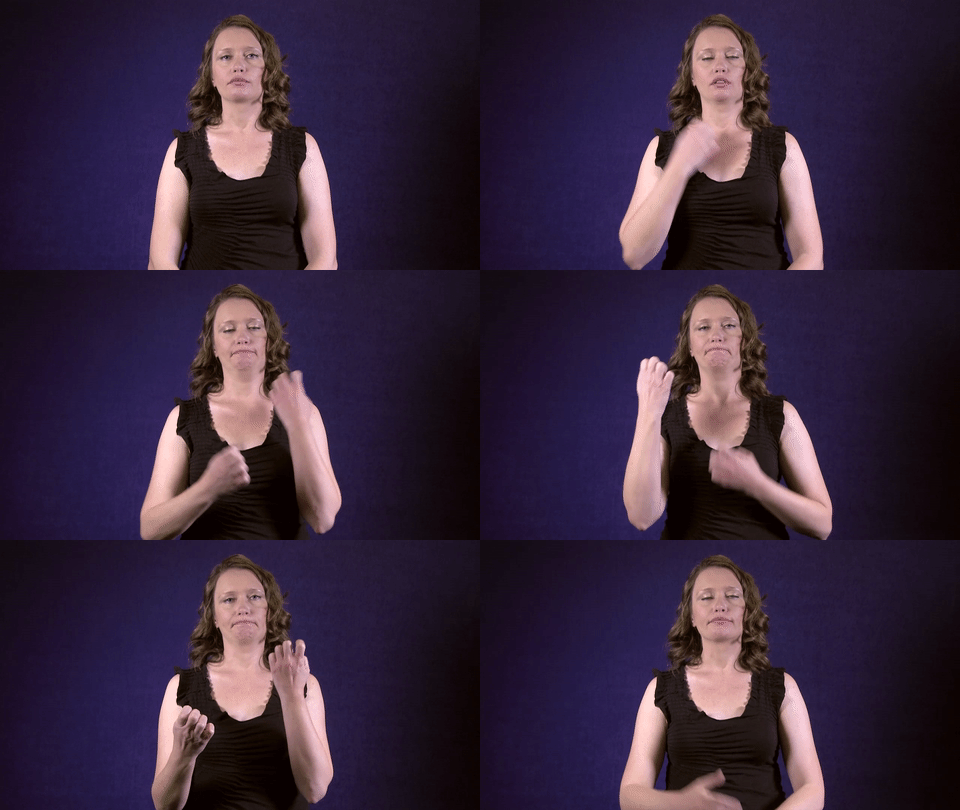
Definition: Strong feelings.
Sign for EMOTIONS in ASL
Practice Activities:
Practice the sign for EMOTIONS in ASL by isolating it first. Stand in front of a mirror and repeat the movement multiple times, focusing on clear handshapes and fluid motion. Say the English word aloud as you sign to reinforce the connection between the concept and the motion.
Create flashcards with various emotional states such as happy, sad, angry, frustrated, excited, and nervous. Use the sign for EMOTIONS in ASL as an intro sign, then follow up with the specific emotion. For example, sign EMOTIONS then show the sign for HAPPY. This helps learners see how the main sign pairs with descriptive vocabulary.
Engage in a storytelling activity where you describe a day filled with different feelings. Start by signing the phrase “MY EMOTIONS TODAY,” then add emotional-based signs following the timeline of your day. Practice both in front of a mirror and with a partner who can give feedback.
Work with a partner to act out short role-plays involving emotional reactions. One person tells a scenario, such as “you missed the bus” or “you won a prize,” and the other responds using the sign for EMOTIONS in ASL followed by a related emotion. This reinforces context-driven use.
Watch short video clips or read simple stories and try to identify different emotional expressions. Pause at different points and sign what emotion characters might be feeling, starting with the general EMOTIONS sign. This builds comprehension skills.
Create a daily journal entry in ASL, summarizing how you felt that day. Begin each entry with the phrase “MY EMOTIONS” and continue from there. Sign the entry aloud, record it, and review it to improve clarity and fluidity using the sign for EMOTIONS in ASL.
Cultural Context:
Understanding the sign for emotions in ASL gives deeper insight into how feelings are expressed within Deaf culture. In American Sign Language, emotions are communicated not just with hands but also through facial expressions, body movements, and overall context. These elements combine to create a full emotional message that goes far beyond the word itself.
The sign for emotions in ASL reflects the values and norms of the Deaf community, where expression and clarity in communication are essential. This visual language relies heavily on non-manual markers, like facial expressions and body language, to show intensity and nuance. A simple change in expression can shift the meaning of the sign for emotions in ASL entirely.
ASL teaches that emotions are shared with the whole body, not just with hand signs. When someone uses the sign for emotions in ASL, they are not simply relaying a vocabulary word. They are conveying a feeling in a way that is deeply cultural and experiential within the Deaf community.
In the Deaf world, it’s important to show how you feel openly and visually. Using the correct sign for emotions in ASL is about authenticity and ensuring the message lands with the right emotional weight. ASL users learn from an early age how these signs vary depending on the strength of the emotion and the context in which it is used.
Culture is tied to communication style, and the sign for emotions in ASL shows the community’s value on full-body, expressive dialogue. Whether showing happiness, sadness, anger, or surprise, the sign for emotions in ASL includes not just hand shapes but the whole communication experience. This richness allows for emotional depth that can sometimes be lost in spoken languages.
In Deaf spaces, emotions are not something to be hidden or toned down—they are meant to be expressed clearly. The sign for emotions in ASL is an example of this core cultural idea, where clarity and visibility are central. Since ASL is a visual language, emotions must also be visual to be fully understood.
Learning the sign for emotions in ASL gives hearing learners and new signers an opportunity to appreciate the cultural norms of emotional openness in the Deaf community. It emphasizes how Deaf culture promotes full emotional expression as a key part of honest communication. Unlike spoken language, emotional expressions in ASL are woven into every part of the signing process.
The sign for emotions in ASL is often one of the first concepts taught in ASL classes, reflecting its importance in daily conversation. Whether in schools, homes, or social gatherings,
Extended Definition:
The sign for emotions in ASL reflects the expressive nature of American Sign Language. ASL is a visual language that uses facial expressions and body movement in addition to hand shapes and motions, which makes it ideal for conveying how someone feels.
To sign emotions in ASL, you generally use signs that match specific feelings such as happy, sad, excited, or angry. Many emotion-related signs start from the chest area, reflecting that feelings come from within. Facial expressions play a huge role in accurately conveying emotion in ASL.
The sign for emotions in ASL can also refer more broadly to discussions or lessons about different feelings. It can include vocabulary that helps people express a wide range of emotional states. This is especially useful for children or beginners learning how to navigate personal expression through sign.
Some common emotions you’ll encounter in ASL include happy , sad , love ❤️, scared , and surprised . Each of these has its own unique sign, often accompanied by exaggerated facial cues for full expression. It’s important to show the correct facial reaction when signing any emotional word.
The ASL sign for emotions is also useful in storytelling, therapy, and education. Teachers often use signs for emotions to help students identify and discuss their feelings. Therapists trained in ASL also rely on emotional vocabulary to support clients who are Deaf or hard of hearing.
When you sign emotions in ASL, your non-manual markers—like facial expressions and body posture—are just as vital as the hand signs. A flat expression can change the meaning or tone of the signed emotion. For example, a smile with the happy sign reinforces the message much more clearly.
Learning the sign for emotions in ASL can improve communication not only with the Deaf community but also with children, especially those who are non-verbal or just starting language development. Emotion signs provide a way to express inner thoughts without needing spoken words.
Interpreters, teachers, and caregivers regularly use the sign for emotions in ASL to promote empathy and understanding. It helps create a more inclusive environment where everyone has the tools to communicate how they feel. It also encourages sensitivity to how emotions are shown and perceived visually.
The sign for emotions in ASL is versatile and appears in daily conversations, educational videos, and even social media content. Using the correct signs helps ensure that the message is understood clearly and respectfully. Repetition and practice aid in mastering each emotion’s unique sign and expression.
Whether you’re expressing joy, sadness, anger, or pride
Synonyms: Feelings, sentiments, moods, affections, passions
Educational resources: Find related learning materials in our course bank!
Want more? Check out some of our popular learning activities on the homepage!
Need to look up a sign? Use our highly rated dictionary: https://aslinteractive.com/best-asl-dictionary/
Follow us on tiktok: https://www.tiktok.com/@aslinteractive. More social media links at the bottom of this page!
Long-tail Keywords: What is the sign for emotions in ASL, How do you sign emotions in ASL, ASL sign for emotions
Categories:
tags: emotions in American Sign Language, ASL emotions vocabulary, expressing feelings in ASL, emotional signs in ASL, learn emotions in ASL
Parameters
*Handshape*:
The handshape used in the sign for EMOTIONS in ASL involves both hands forming the modified “E” handshape. Fingers are bent slightly at the large knuckles while keeping them together, with the thumb resting against the fingertips. This handshape is essential for expressing the sign for EMOTIONS in ASL as it mimics the concept of feelings rising from within.
Each hand moves in a small, alternating circular motion on the chest, maintaining the same handshape throughout. The soft, repetitive movement enhances the meaning and further emphasizes the emotional context conveyed in the sign for EMOTIONS in ASL.
*Palm Orientation*:
In the sign for emotions in ASL, both hands are in the open or bent “5” handshape with the fingers slightly curved. The palm orientation faces inward, toward the chest, as the hands alternately circle in small vertical loops near the upper chest area.
This inward palm orientation helps convey the internal feeling concept represented in the sign for emotions in ASL. The movement and directionality emphasize that emotions come from within.
*Location*:
The sign for EMOTIONS in ASL is located in the center of the chest, which symbolizes feelings and inner experiences. Both hands begin in the chest area, emphasizing the personal and internal aspects associated with emotions.
When performing the sign for EMOTIONS in ASL, keep the movement close to the torso, ensuring the hands remain within the midline between the shoulders. This placement helps represent the heart and emotional core.
*Movement*:
The sign for EMOTIONS in ASL uses both hands in the middle finger bent-handshape (also known as “claw” or “5-bent” hands). Place your fingertips on the center of your chest. Make circling movements with both hands at the same time by moving them clockwise in small, alternating circles, maintaining contact or near-contact with the chest.
This circular, rhythmic motion reflects the inner experience implied in the sign for EMOTIONS in ASL. The movement is fluid to suggest a continuous, internal process.
*Non-Manual Signals*:
When using the sign for EMOTIONS in ASL, your face should reflect the specific feelings you’re referring to, such as joy, sadness, or anger . Eyebrows may raise or furrow depending on the intensity or type of emotion, helping to convey clarity and depth. Slight head tilts or nods can reinforce the emotional tone, making the sign for EMOTIONS in ASL more expressive and accurate.
The overall facial expression must match the context of the emotion. Stay engaged with the emotion indicated—this intensifies communication and ensures the sign for EMOTIONS in ASL is not misunderstood. Emotional authenticity on the face complements the manual movement for full comprehension.
*Prosody, Dominant/Non-Dominant Hand*:
The sign for EMOTIONS in ASL uses both hands in an alternating circular motion on the chest, representing internal feelings moving outward. The dominant and non-dominant hands are in bent handshapes (like the bent “5”), with fingertips brushing the chest in small vertical circles, alternating in movement.
Both hands maintain symmetry and stay close to the body, emphasizing the inward nature of emotions. The sign for EMOTIONS in ASL reflects the depth and flow of feelings, with a smooth and gentle rhythm that mirrors emotional fluctuation.
Tips for Beginners:
When learning the sign for EMOTIONS in ASL, it’s important to focus on using both hands symmetrically and clearly. The sign typically involves the middle fingers of each hand brushing in small circular motions on the chest. This movement should be gentle and controlled to express feelings accurately.
A common mistake beginners make with the sign for EMOTIONS in ASL is either moving too quickly or not using both hands, which can confuse the meaning or make the sign unclear. Since this is an abstract concept, facial expressions also play a vital role. Match your facial expression to the emotion you’re discussing—it helps give the sign real-life context.
Consistency in signing location is key. Keep the motions on the upper chest area and don’t shift too low, as moving the sign too far from its standard location can distort the meaning. Practicing in front of a mirror can help reinforce hand position and synching both hands correctly.
Watch native signers or ASL instructors perform the sign for EMOTIONS in ASL in context, such as during conversations or storytelling. This can give you a stronger sense of how it’s used naturally. Repetition in different emotional contexts will also help reinforce proper execution.
Don’t forget to relax your hands and body while signing. Tension can make your movements look stiff or mechanical, which reduces clarity. Remember that in ASL, fluid movement is often more readable than forceful gestures.
Lastly, practicing the sign for EMOTIONS in ASL alongside other emotion-related signs—like happy, sad, or angry—can help you form sentences and recognize how the sign connects with others. The more you immerse yourself in emotional vocabulary with proper expression, the more naturally these signs will come to you.
Connections to Other topics:
The sign for EMOTIONS in ASL is closely linked to a range of affective and psychological concepts, such as FEELINGS, MOOD, and EXPRESS. Since emotions often involve internal experiences, this sign is commonly used in discussions related to mental health, personal expression, or storytelling. Using the sign for EMOTIONS in ASL connects naturally to signs like SAD, HAPPY, ANGRY, and EXCITED, which help break down individual emotional states.
In narrative or conversational contexts, the sign for EMOTIONS in ASL often appears with facial expressions to add nuance and depth. This allows the signer to convey not only the label of an emotion but also its intensity and context. For example, pairing the sign for EMOTIONS with appropriate classifiers or directional verbs can help learners discuss how emotions affect relationships or actions.
Compound signs can also involve the sign for EMOTIONS when combined with body-language indicators or time markers. A phrase like “emotions change over time” can be built using TIME, CHANGE, and EMOTIONS, showing how ASL expresses abstract psychological concepts in a visual and constructive way. This is useful for therapists, counselors, and educators working with Deaf or hard-of-hearing clients.
The conceptual relationship between EMOTIONS and the sign for FEEL is strong. In fact, FEEL is sometimes used interchangeably depending on the sentence. For example, “I have strong emotions” and “I feel strongly” might both incorporate FEEL or EMOTIONS depending on emphasis and grammatical structure.
Culturally, the sign for EMOTIONS in ASL plays an important role in Deaf poetry, personal storytelling, and visual theater, where expressiveness enhances communication. It invites learners to not just sign with their hands but to engage emotionally, integrating facial grammar and body posture to create meaning. This holistic use illustrates the immersive nature of ASL’s modality.
Summary:
The sign for EMOTIONS in ASL is deeply expressive and iconic, capturing the essence of what emotions represent through spatial movement and touch. It typically involves both middle fingers bent inward and circling alternately on the chest, suggesting a stirring or churning feeling originating from the heart.
This sign is closely tied to the concepts of inner life and psychological states in Deaf culture. Because ASL relies heavily on facial expressions to convey grammatical and affective content, the sign for EMOTIONS in ASL is often used in tandem with specific emotion signs like HAPPY, SAD, ANGRY, or EXCITED, amplifying their intensity and framing them in a collective category.
In ASL grammar, the sign for EMOTIONS can be used both as a standalone noun or in combination with auxiliary signs to form phrases such as CONTROL EMOTIONS or HIDE EMOTIONS. Its placement in a sentence depends on the topic-comment structure that is common in ASL syntax, meaning it could precede or follow the sentiment being discussed based on emphasis.
Linguistically, the sign for EMOTIONS in ASL belongs to a broader class of abstract noun signs. These signs often utilize the body, specifically the upper torso, and more centered signing space, which suggests internal processes or mental states. The circling motion here conveys an ongoing, often complex internal activity.
From an applied linguistics perspective, understanding the sign for EMOTIONS in ASL requires awareness of both classifier use and non-manual markers. Classifiers aren’t explicitly part of this sign, but the fluid movement mimics processes often shown in psychological and internalized state verbs, which strengthens its communicative function.
The sign is interchangeable with discussions that involve psychology, counseling, therapy, and education within the Deaf community. Educators use the sign for EMOTIONS in ASL frequently when teaching socio-emotional learning content to Deaf children, allowing them to explore and articulate their feelings more effectively.
Culturally, expressing emotions through ASL allows for a fuller embodiment of sentiment, with the language’s visual-gestural modality adding layers of meaning beyond what is often captured in spoken English. This is especially significant in artistic performance, such as Deaf poetry or storytelling, where the sign for EMOTIONS sets a thematic tone.
In popular Deaf media, especially vlogs and interpretive arts, the sign for EMOTIONS in ASL frequently appears to introduce personal narratives, reflections, or opinions. Its use often signals vulnerability and invites empathy, helping create a shared emotional context between signer and viewer.
The sign is versatile and may vary slightly in speed, size, and intensity depending on the depth of emotion being conveyed. A fast, wide motion often reflects intense or tumultuous feelings, while a slow, small motion may suggest subtle or repressed emotions.
Related signs include MOOD, FEELINGS, and HEART. While these signs can sometimes be used interchangeably in casual discourse, they carry different nuances. For instance, FEELINGS in ASL emphasizes the sensation of emotion, whereas EMOTIONS highlights the mental-emotional state as a broader concept.
The sign for EMOTIONS in ASL helps foster emotional literacy within the Deaf and signing communities. With the visually explicit structure of ASL, emotional awareness becomes more than a cognitive function—it becomes an embodied, visible, and shareable experience.
In therapy settings, deaf clients and counselors often use the sign for EMOTIONS in ASL to explore emotional regulation and expression. Its visible enactment helps make abstract psychological processes more engaging and concrete for both children and adults.
When teaching ASL as a second language, instructors often emphasize this sign because it opens up pathways to a number of other useful vocabulary items. Once learners grasp the sign for EMOTIONS in ASL, they can easily segue into learning specific emotional labels and how emotional states affect communication.
In discussions involving neurodivergence or mental health, the sign appears frequently to describe emotional dysregulation or coping strategies. Because these conversations are increasingly inclusive in the Deaf world, the sign’s usage is expanding to cover intersectional themes.
ASL interpreters working in mental health, educational, or wellness settings often rely on the sign for EMOTIONS in ASL to clearly convey complex affective states. Its use helps anchor conversations and facilitates a better understanding between Deaf clients and service providers.
In cross-linguistic comparisons, the sign for EMOTIONS in ASL reflects a global trend where emotion-related signs often anchor around the heart or chest to denote a core self. Still, each sign language varies in expression and form, revealing fascinating cultural and cognitive differences.
Deaf storytellers often exploit the sign for EMOTIONS in ASL to modulate narrative arcs. By introducing the sign at key tension points or character developments, they help the audience track shifts in mood and deepen their engagement with the story.
The sign’s grammatical flexibility also makes it useful in constructing rhetorical or poetic expressions. Combinations like EMOTIONS R
Want more? Check out some of our popular learning activities!
ASL Interactive Resources
ASLInteractive YouTube Channel
Follow us on tiktok: @aslinteractive.com
Follow us on Instagram: aslinteractive
Facebook page: aslinteractive
Facebook group: aslinteractive
LInkedIn: ASL Interactive LLC
Twitter: @ASL_interactive
*Some information on this page is AI-generated. AI can make mistakes. Please check the information.


Responses