Sign for FALL in ASL | ASL Dictionary

Definition: The season after summer and before winter.

Sign for FALL in ASL

YouTube player

Practice Activities:

To practice the sign for FALL in ASL, start by mastering the handshape and movement in isolation. Use a flat palm for your non-dominant hand held upright to represent the ground, while your dominant hand represents a person falling off balance and tipping over, landing flat. Repeat the sign slowly, then gradually increase your speed while maintaining clarity.

Use a mirror to observe your signing and make sure your facial expressions match the context. A surprised or startled expression can enhance the meaning of the sign, especially when describing someone unexpectedly falling. Record yourself and play it back to evaluate the fluidity and accuracy of your movements.

Once comfortable signing in isolation, begin creating short phrases using the sign for FALL in ASL. Say things like “child fall” or “I fall yesterday” while signing. These foundational phrases help you associate vocabulary with real-life situations and build signing fluency.

Practice storytelling by describing scenes where someone or something falls. For example, tell a story about a person slipping on ice, or a leaf falling from a tree. Emphasize transitions such as before and after the fall to help develop narrative skill and sequence in ASL structure.

Engage in a partner activity where you take turns miming actions that might lead to a fall—like tripping or slipping—and the other person responds by signing what happened. This encourages quick recall and improves receptive skills.

Incorporate the sign into seasonal vocabulary practice, especially autumn-themed settings, since the word can relate to both an action and a season depending on context. Create a seasonal scene and sign phrases like “leaves fall” or “fall come soon.” Practicing the sign for FALL in ASL in both literal and figurative situations helps cement its usage in various ASL conversations.

Cultural Context:

In American Sign Language, the sign for FALL in ASL carries more than just the meaning of a person or object falling. It can also relate to changes in environment, time, or transition – especially with the seasonal shift into autumn. This adds layered cultural meaning depending on context, gesture, and facial expression.

The sign for FALL in ASL can be used literally in situations where someone or something loses balance and drops. Whether it’s a child tripping, leaves dropping from trees, or snow tumbling from a rooftop, the action is commonly expressed using the same basic sign. For ASL users, the specific situation shapes how the sign is interpreted.

FALL is also symbolic in Deaf culture, particularly in relation to nature and seasonal transitions. When talking about the autumn season, the sign for FALL in ASL is often accompanied by signs for leaves, wind, and color changes. This makes the sign rich in descriptive potential, ideal for storytelling or sharing sensory experiences in ASL.

Deaf storytellers often use the sign for FALL in ASL creatively to describe scenes in poetry or folktales. A falling leaf can symbolize change, while falling snow may capture a moment of calm. How one signs FALL depending on the story’s tone or pace can communicate additional meaning without words.

In educational settings, the sign for FALL in ASL is introduced early as it ties into both physical actions and seasonal vocabulary. Teachers often pair the sign with weather signs or emotions to help students understand how it fits into broader topics. This builds fluency and helps learners build strong visual language connections.

Social media has brought more creative uses of the sign for FALL in ASL. Deaf creators on TikTok and Instagram often use it in dance videos, skits, or expressive clips that center around change or surprise. It has become a popular visual pun for emotional fallouts or unexpected events, sticking closely to its core meaning while expanding culturally.

Understanding the sign for FALL in ASL enriches communication, especially in a visual language that thrives on context and nuance. Users learn to read the body language, facial expressions, and timing that accompany this sign so it’s understood in the right way. This makes it an important part of everyday ASL use.

When used in daily conversation, the sign for FALL in ASL expresses accidents, clumsiness, or even emotional ‘falling.’ For example, someone might sign they’re “falling for you” with the same gesture, adding a romantic or emotional twist. These double

Extended Definition:

The sign for fall in ASL shows a person falling to the ground. To produce this sign, the dominant hand in a “V” shape (representing a pair of legs) falls off the back of a flat non-dominant hand, which is held palm down. It’s a visual representation of someone tipping over and hitting the ground.

This sign is often used to describe a physical fall, like slipping or tumbling. It can also be used in a more humorous or lighthearted way if someone trips or loses balance. The context of the conversation helps define how serious or playful the sign appears.

The sign for fall in ASL is useful in daily conversations, especially around weather changes in the autumn season or discussing accidents. For medical or emergency situations, this sign might come up often when describing a fall-related injury or explaining how an incident happened. The sign clearly communicates that someone went from an upright position to lying on the ground.

In storytelling, especially when narrating events or giving personal anecdotes, the sign for fall in ASL adds a visual component that makes the story more engaging. ASL is highly expressive, and this sign is no exception. Facial expressions that accompany this motion can dramatize or soften the message, depending on the situation.

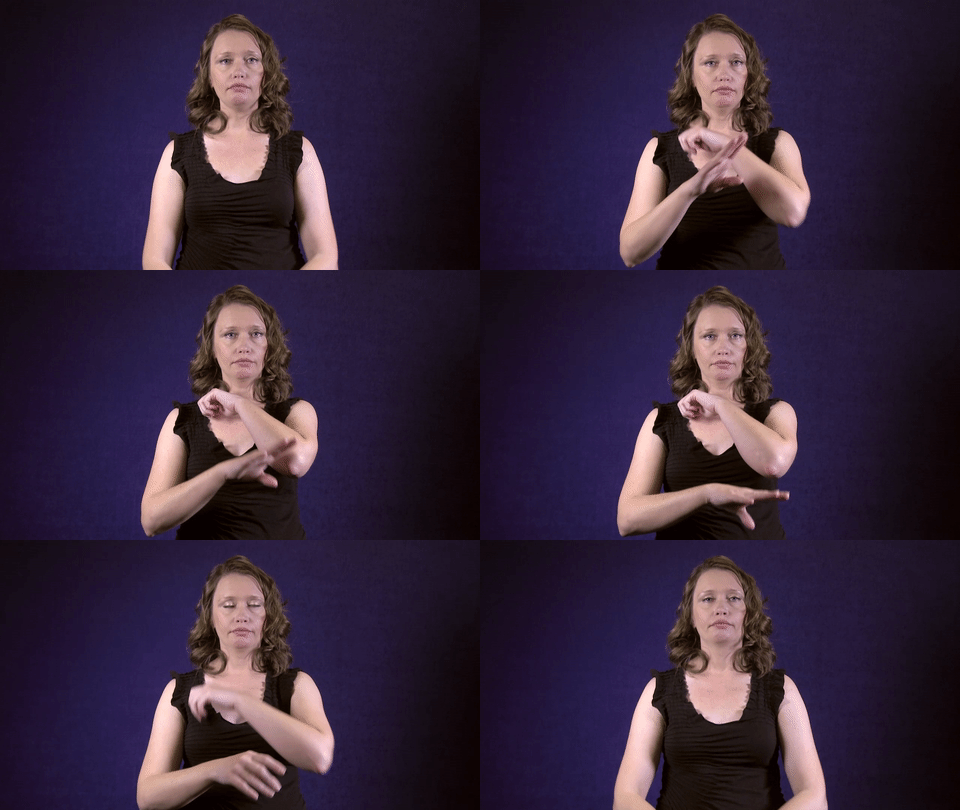
It’s also important to distinguish between the sign for the physical action of falling versus fall meaning the season. In ASL, the word for autumn or the fall season is signed differently, by brushing one bent arm over the elbow of the opposite arm in a downward motion. If you are using the sign for fall in ASL meaning to physically fall, context and movement are key to clarity.

This sign is common in educational settings when teaching children about safety, balance, or storytelling. In classes or during play, describing actions like falling helps build vocabulary and understanding. It’s a clear concept with a strong visual that sticks easily with learners.

Parents and caregivers also find the sign for fall in ASL helpful when communicating with young children or toddlers. Since they may experience trips and falls regularly, having a visual sign allows for quicker, clearer reactions and explanations. Teaching this sign along with others related to injury or safety promotes early communication skills.

Video demonstrations help in mastering this sign. Since the movement involves positioning and direction, watching native ASL users or certified instructors show the correct motion improves learning. Repetition and daily use naturally reinforce the sign.

When describing events, especially in health or emergency care interpreting, this sign becomes part of more detailed narratives.

Synonyms: autumn, collapse, drop, decline, tumble

Educational resources: Find related learning materials in our course bank!

Want more? Check out some of our popular learning activities on the homepage!

Need to look up a sign? Use our highly rated dictionary: https://aslinteractive.com/best-asl-dictionary/

Follow us on tiktok: https://www.tiktok.com/@aslinteractive. More social media links at the bottom of this page!

Long-tail Keywords: what is the sign for fall in asl, how do you sign fall in asl, asl sign for autumn

Categories:

tags: Fall in American Sign Language, ASL signs for seasons, how to sign fall in ASL, autumn in ASL, seasonal signs in ASL

Parameters

*Handshape*:

The handshape in the sign for FALL in ASL involves the non-dominant hand held flat, palm facing upward, representing the ground. The dominant hand begins as a bent “V” handshape, positioned upright on top of the flat palm.

To complete the sign for FALL in ASL, the “V” hand tilts forward and down, as if a person is toppling over. This handshape and movement work together to depict the concept visually and clearly.

*Palm Orientation*:

The palm orientation in the sign for FALL in ASL typically begins with the dominant hand in a “V” shape, palm facing down. The tips of the “V” fingers rest or move downward over the back of the non-dominant hand, which is flat and palm facing down to represent the ground.

This grounding hand stays stable while the dominant hand mimics a figure falling. The palm of the moving hand may rotate slightly as it descends, depending on the regional variation of the sign for FALL in ASL.

*Location*:

The location for the sign for FALL in ASL is in the neutral space in front of the torso. The dominant hand starts above the non-dominant hand, with the non-dominant hand acting as a base. Your non-dominant palm faces upward, representing the ground or surface. The dominant hand, shaped like an upside-down “V” or person, falls forward and down onto the base hand.

This movement occurs away from the body to clearly express the concept of falling. It’s important to keep the motion fluid and clear within the signing space in front of the chest to ensure the sign for FALL in ASL is easily understood.

*Movement*:

To make the sign for FALL in ASL, extend your non-dominant hand flat and hold it horizontally to represent the ground. With your dominant hand in a “V” shape (index and middle finger extended), position the fingers standing upright on the palm like a person.

The dominant hand then tips forward and downward, collapsing the “V” fingers onto the palm as if a person is falling. This falling motion clearly illustrates the concept behind the sign for FALL in ASL. ‍♂️

*Non-Manual Signals*:

When using the sign for fall in ASL, the facial expression is typically neutral or slightly surprised, based on context. Raised eyebrows may be used when asking a yes/no question involving the sign for fall in ASL, while furrowed brows can indicate confusion or concern about something or someone falling.

Mouth movements may mimic the sound or feeling of falling, such as a puff or a light “oof,” to emphasize impact or descent. The direction of eye gaze often follows the motion of the falling object to reinforce the meaning of the sign for fall in ASL.

*Prosody, Dominant/Non-Dominant Hand*:

The sign for FALL in ASL uses the dominant hand shaped like a “V” to represent a person. It starts upright on the flat, palm-up non-dominant hand, which symbolizes the ground, and then tips or falls forward. The movement mimics someone toppling over and landing face-first.

Both hands work together precisely to convey the meaning. This spatial arrangement is key to clearly expressing the sign for FALL in ASL ‍♂️➡️ .

Tips for Beginners:

When learning the sign for FALL in ASL, it’s important to focus on handshape precision and body orientation. This sign typically uses a flat non-dominant hand representing the ground, while your dominant hand (often shaped like a bent “V” or human figure) falls off the “ground.” Make sure your movements are smooth and clear to effectively convey the meaning.

Pay attention to the direction and speed of the motion when doing the sign for FALL in ASL. If your movement is too quick or sloppy, it may be mistaken for an entirely different sign. Controlled, deliberate motion helps ensure you’re easy to understand, especially in fast-paced conversations.

Practice in front of a mirror to monitor your hand placement and arm angle. Angle matters—too steep or flat, and the sign loses its visual accuracy. Many beginners struggle with visualizing what each hand represents, so remind yourself that one hand is ‘standing’ and the other shows a person or object falling off of it. That mental image can make your sign much more accurate

Avoid overextending your motion or making it overly dramatic, as this can slow your fluency and confuse the meaning. Also, be mindful not to confuse this sign with signs for “trip” or “collapse,” which may seem similar in movement. Double-check your facial expressions, as conveying surprise or suddenness through your face will pair well with the action of the sign.

Watching native signers and practicing in short ASL conversations will help you become more comfortable using the sign for FALL in ASL naturally. Record yourself signing and review it for clarity. With regular practice and a good attitude, you’ll master the sign for FALL in ASL and build confidence in your expressive skills

sign for fall in asl, asl vocabulary fall, how to sign fall in asl, american sign language fall, learn the sign for fall

Connections to Other topics:

The sign for FALL in ASL closely relates to directional movement and spatial concepts, which are fundamental in ASL grammar. It typically involves a classifier showing a figure or object suddenly descending, often represented using the “V” handshape acting as a person tipping over or collapsing. This visual and kinetic quality ties it to other motion-based signs like SLIP, TRIP, or DROP, which also involve sudden changes in elevation or direction.

This sign connects with seasonal vocabulary, particularly when talking about the season of fall (autumn). While FALL for the season has a different sign involving a leaf-like motion or a brushing gesture over the opposite arm, learners often confuse the two, making it essential to understand context and classifier use. These distinctions help reinforce topic relevance in conversations using visuals to distinguish meanings.

Many compound sign phrases incorporate the sign for FALL in ASL. For example, FALL DOWN STAIRS combines the classifier for a person and the classifier representing the staircase to vividly show the action. Similarly, FALL IN LOVE shows progression by using a configuration that demonstrates someone metaphorically “falling” into an emotional state, reinforcing metaphorical use of spatial language.

Students learning the sign for FALL in ASL often find it helpful to explore its use in narratives and storytelling. In ASL storytelling, depicting someone slipping, tumbling, or falling adds drama and helps convey detailed scenarios, which encourages fluency and expressive signing. These examples often use classifiers and spatial referencing to enhance clarity and visual impact.

Understanding the nuances of the sign for FALL in ASL opens up wider conversations about accidents, seasons, and emotional states. It supports broader vocabulary development and helps signers become adept at using spatial and classifier elements to create vivid, accurate portrayals of events. This fosters not only a deeper connection to the language but also more natural and nuanced communication.

Summary:

The sign for FALL in ASL typically uses a classifier handshape that mimics a person or object losing balance and dropping to the ground. It starts with a non-dominant hand flat and horizontal, acting as the ground or surface. The dominant hand takes an upside-down “V” shape, representing legs or a standing figure, and tips off the non-dominant hand to show the action of falling.

This visual metaphor powerfully conveys the idea of a body toppling over, exaggerating the fall for clarity. The motion is usually short and smooth, showing gravity taking immediate effect. Like many signs in ASL, it relies heavily on context to define whether the “fall” is literal, metaphorical, or part of a compound sign.

The sign for FALL in ASL can be modified using facial expressions and movement speed to reflect severity or intention. A dramatic facial expression can suggest a serious or painful fall, while a casual one indicates a minor slip. The same base sign can be adapted to express emotional or social “falls,” depending on communicative context.

ASL grammatically allows the sign for FALL in ASL to behave as both a noun and a verb through spatial referencing. Placing or repeating the sign in a specific location in signing space can indicate multiple fall events or subjects involved in falling. This spatial grammar is unique to sign languages and critical for full expression.

A related classifier structure is used for the sign TREE-FALL or BUILDING-FALL, where the upright classifier shifts its meaning based on scale and setting. The handshape remains generally the same but can be contextualized with other signs to specify the object. It’s a fascinating use of visual imagery in linguistic systems.

In expression, classifiers play an important role. The classifier for the sign for FALL in ASL is not only functional but elegant, offering a compact, cinematic gesture loaded with meaning. Signers can show different angles or shifts in direction with the same basic structure, adding vibrancy to storytelling.

The sign for FALL in ASL also appears frequently in narratives, especially within Deaf poetry and storytelling communities. It can metaphorically suggest failure, descent, or loss. Such poetic uses elevate the sign to a thematic tool, where it functions symbolically as much as literally.

For example, in visual vernacular performances, FALL can be slowed down to convey emotional disintegration. Adjusting movement can bring depth, making it a fluid tool in visual storytelling. Signers often use variations creatively, even playing with time and space for dramatic effect.

Linguistically, the structure of this sign reflects ASL’s preference for verb-like classifiers to convey physical action. The verb is right there in the movement: a body, upended and brought down. It mirrors how motion and space directly shape meaning in ASL syntax.

Applied linguistics draws attention to how the sign for FALL in ASL helps learners internalize classifier principles quickly. Because it’s so visual and physical, it becomes a prime example of the intersection between gesture and grammar. Educators often use this sign to introduce students to movement verbs and classifier use.

Cross-linguistically, falling is represented similarly in many signed languages, indicating a shared semantic logic. Still, the exact configuration may differ slightly between those systems. ASL’s particular version relies more on spatial detail and palm orientation to remain intelligible.

In terms of culture, FALL as a sign resonates among Deaf sports communities, where accidents and fast-paced action require instant communication. Whether describing a skateboard trick gone wrong or a skier’s topple, the sign has practical resonance. It helps embed safety and immediacy into conversations.

The sign for FALL in ASL has seasonal relevance as well. In English, “fall” doubles as the autumn season, and in ASL this concept uses a completely different sign based on leaves dropping. Because of this polysemy in English, learners must be careful to distinguish physical falling from seasonal FALL in ASL.

When used metaphorically, the sign for FALL in ASL can describe interpersonal situations, such as falling from grace, social status, or integrity. Combined with signs for HONOR or RESPECT, the narrative crafts a loss of esteem. These abstract uses further underline ASL’s capacity to express emotional and symbolic content.

Children learning ASL often find the sign for FALL entertaining and expressive. It connects visually with their own physical experiences of tumbling or stepping wrong. Teachers use that interest to motivate engagement with classifiers and sequencing through kinetic learning.

The sign is frequently taught alongside BALANCE, STAND, and RISE to emphasize oppositional concepts. These signs form a grammatical group, with contrasting handshapes showing functions similar to antonyms. This makes FALL an anchor term in discussing movement and change.

For interpreters, the challenge lies in distinguishing literal from figurative usage in live context. Accuracy depends on registering tone, speed, and accompanying signs. Misreading could lead to confusion in scenarios like medical emergencies versus poetic performances.

In Deafblind communities,

Want more? Check out some of our popular learning activities!

ASL Interactive Resources

ASLInteractive YouTube Channel

Follow us on tiktok: @aslinteractive.com

Follow us on Instagram: aslinteractive

Facebook page: aslinteractive

Facebook group: aslinteractive

LInkedIn: ASL Interactive LLC

Twitter: @ASL_interactive

*Some information on this page is AI-generated. AI can make mistakes. Please check the information.


Responses