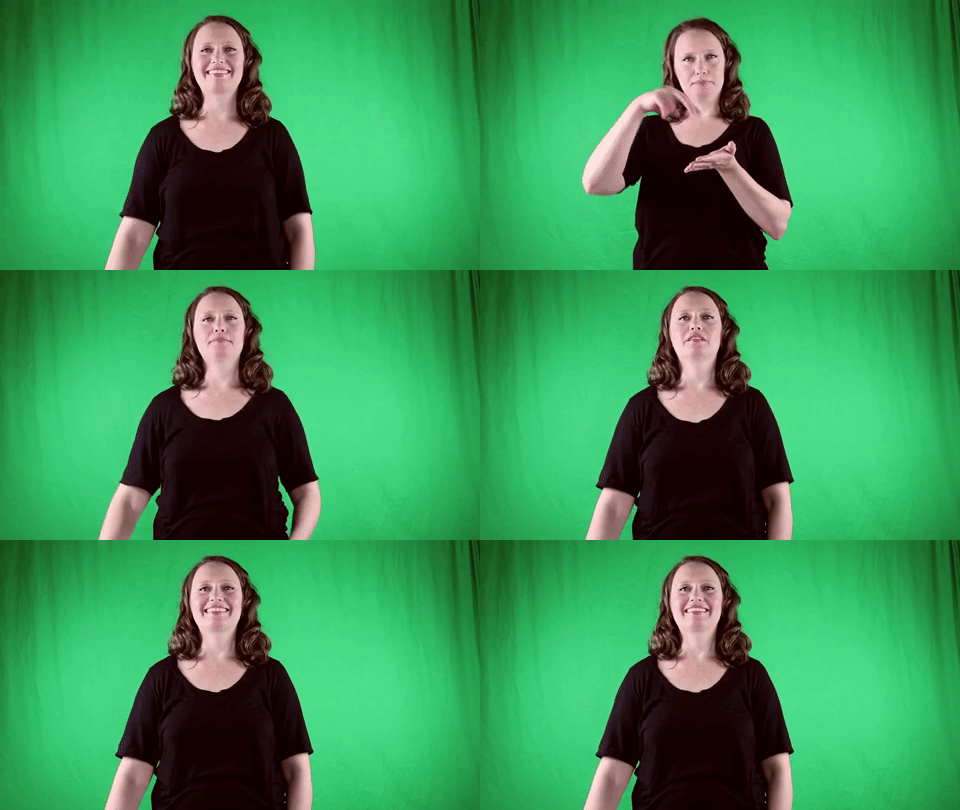
Sign for FORK in ASL | ASL Dictionary

Definition: An implement with two or more prongs.

Sign for FORK in ASL

YouTube player

Practice Activities:

Start your practice with the sign for FORK in ASL by practicing it in isolation. Stand in front of a mirror and repeat the sign slowly, paying attention to the handshape and movement. Try to alternate between your dominant and non-dominant hand to reinforce muscle memory and comfort.

Next, try using the sign for FORK in ASL alongside other common dining-related signs like KNIFE, SPOON, PLATE, and EAT. Create simple sentences such as “I need a fork,” or “The fork is on the plate.” Signing these phrases will help give context to the individual sign and improve fluidity between signs.

Use flashcards with pictures of a fork and other utensils. Show each image and quickly sign the appropriate term. This builds both speed and recognition without relying on written prompts. You can also label utensils at home with sticky notes and sign each time you pick one up to use.

Pretend to set a table using signs for all dining items you include. Narrate your actions using ASL: “I put the fork next to the plate,” or “Where is the fork?” You can also use the sign for FORK in ASL while miming eating actions to simulate natural conversation.

Partner or group activities can include ASL restaurant role-plays where one person acts as a server and another as the customer. Use signs to request or offer a fork, such as “Do you have a fork?” or “Here is your fork.” Practice various replies and expressions to mirror a real-life interaction.

Storytelling prompts can be as simple as describing a picnic or dinner at a restaurant. Incorporate the sign for FORK in ASL throughout your story to reinforce its usage and placement within complex sentence structures. Focus on how the sign fits logically into the flow of ideas and use body shifting to show different people in the scene.

Cultural Context:

In American Sign Language, the sign for FORK in ASL is more than just a way to talk about utensils. It reflects a visual and tactile approach to language that connects daily life to meaningful gestures. Using the sign for FORK in ASL during mealtime conversations shows how seamlessly Deaf culture incorporates everyday objects into its linguistic system.

In Deaf culture, food and shared meals play an important social role. Talking about dishes, sharing meals, or asking for utensils like a fork gives plenty of opportunities to use the sign for FORK in ASL naturally. Expression, context, and body language all enhance the way signed conversations happen during meals.

The sign for FORK in ASL is also often used when teaching children basic vocabulary as they learn about kitchen utensils, eating, and self-care. Children often begin to sign items they use daily, making this sign common in early ASL education. Repetition and context are key, and utensils like a fork are frequently included in learning games and visual stories.

Visual storytelling is central to Deaf communication, and incorporating props like real forks when learning the sign for FORK in ASL makes language learning more immersive. In performances, skits, or ASL poetry that involve eating scenes, signs for utensils bring realism and clarity, allowing the audience to fully engage in the moment.

When Deaf individuals dine out or go grocery shopping, using the sign for FORK in ASL can help communicate preferences or needs to those familiar with basic signs. Since hospitality staff and caregivers often learn simple ASL signs, recognizing the sign for FORK in ASL can improve accessibility and communication across environments. Including ASL vocabulary in these spaces supports inclusivity and shows cultural respect.

In Deaf-friendly events such as potlucks and community meals, signs for food and utensils like the sign for FORK in ASL are part of the shared visual language that ensures everyone feels included. Visual cues replace spoken announcements, relying heavily on clear signing. This means understanding and using the sign for FORK in ASL helps both communication and social bonding.

Online ASL content like cooking tutorials, educational apps, and sign language songs for kids may include the sign for FORK in ASL when covering food themes. Content creators in the Deaf community integrate this vocabulary into fun and engaging formats. Seeing relatable signs like this helps engagement grow among learners of all ages.

Visitors to Deaf households or events may notice how common it is to see the sign for FORK in ASL, especially when setting the table

Extended Definition:

The sign for FORK in ASL is a useful vocabulary word when discussing food, cooking, or dining settings. American Sign Language has specific and clear signs for utensils, and the sign for FORK is a practical one you’ll encounter often in conversations about meals or kitchens. This makes it important for learners of ASL to become familiar with the correct way to express this term.

To sign fork in ASL, the dominant hand is typically shaped like the number two ✌️ with bent fingers, mimicking the prongs of a fork. This handshape taps or slides against the palm of the non-dominant hand, which is held flat like a plate. This visual representation helps convey the meaning of the sign clearly, making it easier to remember.

The sign for FORK in ASL may vary slightly among regions or individuals, but the general concept remains consistent. Many signs in ASL are iconic, meaning they resemble the object or action being described. This is true for utensil-related signs like fork, where the motion and handshape directly reflect the item’s shape and use.

ASL learners often encounter signs like fork early in their studies because food-related vocabulary is common in daily conversation. The ability to express what you are eating, using, or preparing is key for effective communication. The sign for FORK in ASL ties into that larger theme of practical, everyday signing.

Teaching children the sign for FORK in ASL can help them learn to express needs and understand mealtime routines. In family settings, educators or caregivers may introduce this sign during meals or playful role-plays involving kitchen items. Using signs at appropriate times reinforces learning and helps build connections with real-life experiences .

When documenting or teaching the sign for FORK in ASL, it’s helpful to include visual aids like videos or images. Because ASL is a visual language, seeing the movement and hand positioning is essential. Animations or step-by-step photos can improve comprehension and ensure accurate signing.

The sign for FORK in ASL fits into a broader category of signs that include spoon, knife, plate, and other dining-related terms. Combining these signs allows signers to describe meals more fluently. For example, one could sign plate, fork, and food to indicate a complete dining scene.

Some people learning ASL may confuse the sign for FORK with other utensil signs. Paying attention to finger positioning and movement will help differentiate between similar signs. Practice and repetition are key to

Synonyms: branch, split, divide, diverge, separate

Educational resources: Find related learning materials in our course bank!

Want more? Check out some of our popular learning activities on the homepage!

Need to look up a sign? Use our highly rated dictionary: https://aslinteractive.com/best-asl-dictionary/

Follow us on tiktok: https://www.tiktok.com/@aslinteractive. More social media links at the bottom of this page!

Long-tail Keywords: what is the sign for fork in ASL, how do you sign fork in ASL, ASL sign for fork

Categories:

tags: Fork in American Sign Language, how to sign fork in ASL, ASL dictionary fork, learn fork in ASL, signing fork in American Sign Language

Parameters

*Handshape*:

The handshape for the sign for FORK in ASL starts with both hands using the “V” handshape, representing the tines of a fork. The dominant hand is placed over the non-dominant hand, and the fingers lightly tap or point down, mimicking the motion of a fork going into food . This visual representation helps reinforce the meaning of the sign for FORK in ASL through a clear and iconic gesture.

The movement may vary slightly, but the key handshape remains consistent to illustrate the utensil’s pronged end. The simplicity and recognizability of the “V” shape are what make the sign for FORK in ASL easy to learn and remember.

*Palm Orientation*:

In the sign for FORK in ASL, the palm orientation typically faces inward toward the signer’s body. Both hands are used, with the index and middle fingers extended and slightly apart, resembling the prongs of a fork .

During the movement, the dominant hand may tap or mime the action of a fork moving toward the mouth. This palm orientation helps clearly show the concept represented by the sign for FORK in ASL.

*Location*:

The sign for FORK in ASL is typically produced in the neutral space in front of the body, slightly below the chin and at chest level. It allows clear visibility of the movement and handshape without interference from the torso or face.

This placement ensures the sign remains distinct from other utensil signs. When demonstrating the sign for FORK in ASL, the location allows enough room to mimic the prongs of a fork and their interaction with an imaginary plate.

*Movement*:

To show the sign for FORK in ASL, begin with the dominant hand in the “V” handshape, representing the prongs of a fork. The non-dominant hand stays flat, palm-up, symbolizing the plate.

Tap the “V” fingers of the dominant hand onto the flat non-dominant hand a couple of times, mimicking the motion of a fork touching a plate or picking up food. This common movement clearly expresses the concept behind the sign for FORK in ASL .

*Non-Manual Signals*:

When using the sign for FORK in ASL, maintain a neutral or slightly inquisitive facial expression, especially if identifying or asking about a specific utensil. Your eyebrows may raise slightly to indicate categorization or specification, especially in contexts involving food or tabletop items ️.

Subtle head nodding can help affirm the meaning or contrast it with other utensils. Eye gaze should follow hand movement naturally and focus on the area of signing to maintain clarity when using the sign for FORK in ASL.

*Prosody, Dominant/Non-Dominant Hand*:

The sign for FORK in ASL uses the dominant hand in a V handshape, resembling the prongs of a fork. The dominant V hand taps or pokes into the open palm of the non-dominant hand, which is held steady and upright.

This motion can be repeated once or twice to mimic the action of picking up food. The sign for FORK in ASL clearly depicts the utensil and is easily understood in context.

Tips for Beginners:

When learning the sign for FORK in ASL, one of the most helpful tips is to focus on finger placement and movement. The sign typically uses the dominant hand shaped like a “V”, representing the prongs of a fork, tapping into the palm or the back of the non-dominant hand. Practicing this specific handshape and motion clearly will help convey the meaning without confusion. Be sure your fingers are evenly spaced and parallel, which mimics the look of a real fork.

Beginners often struggle with either making their “V” shape too loose or failing to clearly target the contact area on the other hand. To avoid this, practice in front of a mirror and check how your sign looks from different angles. This will help you gain awareness of how the sign is perceived by others during conversation. Clarity is important in making the sign for FORK in ASL easily understood.

Make sure to keep your movements controlled and not overly exaggerated. Signing too quickly or with too much flourish can reduce the readability of the sign. Stay relaxed in your hands and wrists, and focus on precision over speed. It’s helpful to watch videos of native signers for consistency and proper rhythm.

Another key point is remembering the context — the sign for FORK in ASL is typically used during conversations about meals, dining, or kitchen activities. Pairing it with other signs like EAT, KNIFE, or FOOD can help reinforce your understanding and allow you to use it naturally in full sentences. Practicing those common combinations helps build fluency faster.

Finally, don’t be afraid to ask for feedback from fluent signers. They can point out subtle issues with handshape or placement. This kind of personal correction is invaluable for building confidence and improving accuracy when learning the sign for FORK in ASL.

fork in asl, fork sign language asl, how to sign fork in asl, the sign for fork in american sign language, asl vocabulary fork

Connections to Other topics:

The sign for FORK in ASL connects directly with a broader category of dining- and kitchen-related vocabulary. It often appears alongside signs like SPOON, KNIFE, PLATE, and FOOD, creating useful clusters of signs that can be taught and practiced together. This helps learners effectively discuss meals, settings at a restaurant, or household routines around food.

In practical usage, the sign for FORK in ASL can be compounded with signs such as EAT or USE to express more complex ideas like “use a fork” or “eat with a fork.” This demonstrates how instrumental signs can be linked with action verbs to build grammatically sound and semantically rich phrases. Understanding how FORK integrates in phrases also supports fluency and conversational skills during meal-related dialogue.

This sign is also helpful when discussing etiquette, preparation, or cooking, making it relevant to lessons focused on cultural behaviors and daily living. For instance, in kitchen-themed storytelling or procedural signing (such as “how to set a table”), the sign for FORK in ASL fits naturally and gains repeated use. It’s common in narratives describing family dinners, restaurant outings, or food-related instructions.

From a morphological standpoint, signs like FORK help illustrate classifier use. For example, a classifier handshape showing utensil movement can indirectly refer to a fork in action, adding layers of meaning. It deepens learners’ ability to describe motion, shape, and function — key elements in more advanced sign language storytelling or technical discussion.

The sign also broadens discussions related to cultural tools and cross-linguistic comparisons. Some ASL users may rely more on visual imagery when describing eating tools, which can spark exploration of regional or generational variations in signs. The sign for FORK in ASL, while straightforward, opens opportunities to explore everyday language, functional signing, and descriptive classifiers.

Summary:

The sign for FORK in ASL can vary slightly by region, but a common version involves using the dominant hand in the “V” handshape, mimicking the prongs of a fork. This hand taps the tips of the “V” shape into the palm of the non-dominant hand, which remains open with the palm facing upward.

The configuration of the “V” handshape closely resembles the look of a fork, making it a visually iconic sign that connects well with the object it represents. This use of visual symbolism, or iconicity, is a fundamental part of how signs are created and understood in ASL.

In everyday use, the sign for FORK in ASL is often paired with other signs that relate to eating or kitchen settings. It is frequently seen alongside signs like KNIFE, SPOON, PLATE, and EAT, helping construct full sentences and narratives around dining and meals.

The grammatical role of this sign in a sentence is typically that of a noun. However, ASL does not rely on rigid word order like English, so the sign can appear in varying positions depending on the syntax and emphasis intended.

The cultural importance of the sign for FORK in ASL becomes clearer during shared meals and communal interactions within the Deaf community. Like in many cultures, food is an important social connector, and having distinct signs to represent utensils enhances smooth communication during such gatherings.

In more formal or professional interpreting situations, knowing the nuances of household items like the sign for FORK in ASL is important. Proper use ensures the Deaf consumer understands the context fully, such as in classroom discussions, cooking shows, or food safety trainings.

There is a subtle linguistic layer to this sign because of its visual mapping onto real-world objects. The “V” fingers symbolically stand in for the prongs, and this helps Deaf children and language learners grasp the meaning more intuitively.

The sign mirrors the real-world action of a fork tapping or resting on a plate or hand. This mapping of conceptual understanding through physical gesture is at the core of signed languages and reflects broader theories in applied linguistics around embodied cognition.

Children learning ASL frequently acquire utensil signs early, as food-related signs are high-frequency and essential for daily communication. The sign for FORK in ASL is introduced alongside basic mealtime vocabulary, reinforcing functional language use.

Linguistic studies in sign language acquisition note that signs with high visual affinity to their referents, such as this one, tend to be retained and recalled more easily. It exemplifies the power of iconicity to support memory and usage among both native signers and second-language learners.

The sign for FORK in ASL also gives insight into classifier usage. In some contexts, the same “V” shape used in the FORK sign serves as a classifier for a narrow, elongated object, highlighting the multifunctionality of handshapes in the language.

Regional variation may affect how the sign is performed. Some signers may simulate a stabbing motion with the “V” hand into the other palm, while others may opt for a slight twisting or tapping motion, showing a spectrum of expressive movement.

Understanding these variations enhances cross-regional communication and mutual intelligibility among Deaf communities in different parts of the United States. It’s a great example of how ASL is both unified and diverse.

While the English word “fork” can be metaphorical—as in “a fork in the road”—that metaphor does not directly translate to the same sign in ASL. Alternative structures or idiomatic expressions would be used instead, highlighting the non-linear equivalence between English and ASL.

From a broader thematic view, the sign for FORK in ASL represents how physical surroundings influence the structure and logic of a sign language. The utensils we use shape the signs we invent and support cultural transmission through language.

Like many utensil signs, this one belongs to a semantic lexical field. It clusters with items that aid in eating and cooking, reinforcing relationships between meaning, context, and usage frequency.

In ASL storytelling and visual narrations, signs like FORK contribute greatly to scene-building. When signing a narrative about a dinner party or family meal, utensils become essential props in painted visual spaces.

Studying this sign lends itself to discussions around morphology, especially as it relates to compound signs. In advanced usage, FORK can be part of idiomatic combinations or compound phrases when detailing complex food interactions or table manners.

The sign for FORK in ASL may not be included initially in core vocabularies for beginner learners, depending on context. But it rapidly gains importance when students begin learning food-related or daily life signs.

Language immersion programs emphasize this sign during everyday interaction phases because it allows young signers to request or label items during snack time or meal prep. Thus, its pedagogical utility is amplified by its daily practicality.

The sign also reveals how ASL grammatically marks plurality or specificity. For example, adding facial expressions, movement repetition, or

Want more? Check out some of our popular learning activities!

ASL Interactive Resources

ASLInteractive YouTube Channel

Follow us on tiktok: @aslinteractive.com

Follow us on Instagram: aslinteractive

Facebook page: aslinteractive

Facebook group: aslinteractive

LInkedIn: ASL Interactive LLC

Twitter: @ASL_interactive

*Some information on this page is AI-generated. AI can make mistakes. Please check the information.


Responses