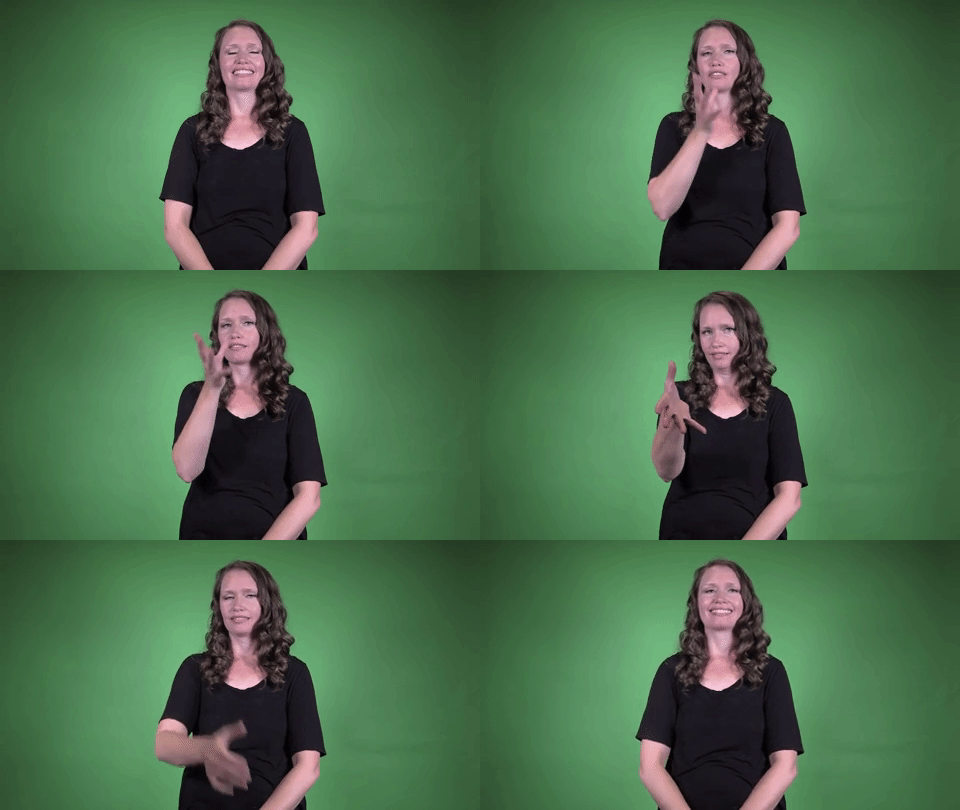
Sign for GRANDMOTHER in ASL | ASL Dictionary

Definition: The mother of one’s father or mother.

Sign for GRANDMOTHER in ASL

YouTube player

Practice Activities:

Start by practicing the sign for GRANDMOTHER in ASL in isolation. Stand in front of a mirror and repeat the sign several times while observing your handshape and movement. Make sure your thumb touches your chin and then moves outward in a small motion, representing the generational distance from “mother.”

Repeat the sign slowly at first and then gradually increase your speed as you become more confident. Once the basic movement feels natural, switch hands and mirror the motion to build coordination. Record a short video of yourself signing and watch it to check for accuracy.

Use flashcards with pictures of family members and sign “grandmother” when appropriate. Separate the cards into categories and include both “mother” and “grandmother” to help reinforce the distinctions between similar signs. Pair this with fingerspelling activities so you can spell out G-R-A-N-D-M-O-T-H-E-R and then sign it fluently.

Practice creating simple sentences that include the sign for GRANDMOTHER in ASL, such as “My grandmother is kind,” or “I visit my grandmother every Sunday.” Sign the sentences slowly, emphasizing facial expressions and body language to support your signing. Write out a list of 5–10 sentences and sign them daily to build fluency.

Try storytelling exercises using iconic imagery. Tell a short story about your grandmother or a fictional grandmother figure, incorporating the sign for GRANDMOTHER in ASL multiple times throughout the narrative. You might say, “Grandmother baked cookies,” then act out the baking with your hands as supporting signs.

If possible, pair up with a practice partner and switch off telling stories or asking each other questions like “Where does your grandmother live?” or “What does your grandmother like to cook?” Reinforce learning by watching ASL family vocabulary videos and identifying when the sign for GRANDMOTHER in ASL is used.

Cultural Context:

In American Sign Language, the sign for grandmother in ASL carries more than just a literal translation. It reflects the deep cultural importance of grandparents in Deaf families and communities. Using proper signs shows respect for familial roles and traditions within the Deaf culture.

The sign for grandmother in ASL is not only a way to identify a family member; it also acknowledges the generational bonds that are treasured in Deaf households. Elders often play a central role, offering wisdom, support, and historical context. Accurately using this sign demonstrates cultural awareness and respect.

In Deaf culture, communication is often highly visual and expressive, and this includes signs for family members like grandmother. The sign for grandmother in ASL uses a distinct motion that sets it apart from other signs such as mother or father. This slight difference gives depth to the language and helps preserve clarity in conversation.

Deaf families typically pass down language, values, and stories through generations, often through visual storytelling. The sign for grandmother in ASL is frequently used in these narratives, showing how language and culture intertwine. Grandmothers may also be among the first to teach young children their first signs.

In classroom settings, students learning ASL are taught the sign for grandmother in ASL early because it’s a foundational family sign. It helps learners understand spatial relationships and movement within signs. Mastery of basic family signs like this one also increases fluency and confidence.

Cultural contexts shape how and when signs are used in conversation. In Deaf events or family gatherings, using the correct sign for grandmother in ASL shows that you’ve not only learned the language but also embraced its cultural values. This supports inclusion and builds stronger connections.

Some regional dialects or variations in sign language might slightly alter how the sign for grandmother in ASL looks, but the core meaning remains the same. These minor differences contribute to the rich diversity within the broader Deaf community. Familiarity with these variations is part of evolving ASL proficiency.

Understanding the sign for grandmother in ASL isn’t just about imitation; it involves knowing why it’s important. It ties into broader cultural traditions around family structure, respect for elders, and intergenerational learning. Signs carry emotional weight because they represent real relationships.

The sign for grandmother in ASL continues to be highlighted in modern ASL media, children’s books, and educational videos. Its repetitive use in these resources ensures its place in everyday vocabulary for both Deaf and hearing individuals learning ASL. Grandmothers often play beloved, nurturing roles in

Extended Definition:

The sign for grandmother in ASL is a widely recognized and cherished gesture within the Deaf community. It carries not only linguistic meaning but also cultural and familial significance. American Sign Language uses handshapes, movements, and facial expressions to visually represent concepts like family members.

To make the sign for grandmother in ASL, start with an open hand or the “5” handshape. Place the base of the palm on your chin and then move the hand outward and slightly forward. This motion differentiates it from the sign for mother in ASL, which stays closer to the chin.

The outward motion in the sign for grandmother in ASL symbolizes a generational step away from the immediate parent. It visually represents someone who is one generation older than your mother. This generational distinction is important, and similar signs are used for other elders in ASL vocabulary.

Facial expressions play a helpful role when signing grandmother in ASL. Warm or affectionate expressions can show the speaker’s emotional connection to the grandmother being referenced. This expressiveness adds depth to the visual language and enhances meaning beyond hand movements alone.

In Deaf culture, the sign for grandmother in ASL is often one of the first family signs children learn. It connects learners to family structure and helps them express relationships clearly and respectfully. Early exposure to family-related signs builds a foundation for deeper communication in American Sign Language.

This sign can also be modified slightly in storytelling or casual conversation. For example, showing age progression or a specific personality trait through facial expression and pacing can personalize the sign for grandmother in ASL. Such flexibility reflects the dynamic and expressive nature of ASL.

In formal ASL grammar, possession and direction are added by adjusting space or using additional signs. So, indicating “my grandmother,” “her grandmother,” or “their grandmother” involves incorporation of classifiers or directional cues along with the original sign. This enriches communication and prevents misunderstandings.

When learning the sign for grandmother in ASL, consistent practice is key. Watching video demonstrations, participating in ASL conversations, and engaging with the Deaf community can improve accuracy. The correct motion and placement should be internalized to avoid confusion with similar signs.

It’s helpful to remember that regional variations may exist. Some communities or older signers may use slightly different handshapes or starting points. Still, the general movement and concept for the sign for grandmother in ASL remain largely consistent across most ASL users.

Including this sign in classroom settings or home practice is a positive way to build family

Synonyms: Grandma, Granny, Nana, Nanny, Gram

Educational resources: Find related learning materials in our course bank!

Want more? Check out some of our popular learning activities on the homepage!

Need to look up a sign? Use our highly rated dictionary: https://aslinteractive.com/best-asl-dictionary/

Follow us on tiktok: https://www.tiktok.com/@aslinteractive. More social media links at the bottom of this page!

Long-tail Keywords: what is the sign for grandmother in ASL, how do you sign grandmother in American Sign Language, ASL sign for grandmother

Categories:

tags: grandmother in american sign language, how to sign grandmother in asl, asl sign for grandmother, learn grandmother in asl, grandmother asl meaning

Parameters

*Handshape*:

The handshape used in the sign for GRANDMOTHER in ASL is the open five hand. The fingers are spread apart with the thumb extended outward, resembling a relaxed, open palm. This starting shape is similar to the sign for MOTHER but moves outward from the face.

In the sign for GRANDMOTHER in ASL, the hand starts at the chin and then moves forward in a small arc. This outward movement helps indicate the generational difference, showing that “grand” shifts the relationship one step further.

*Palm Orientation*:

The palm orientation for the sign for GRANDMOTHER in ASL begins with the dominant hand forming the number 5 handshape. The palm faces outward, away from the signer. It starts at the chin area and then moves forward in a small arc.

In the sign for GRANDMOTHER in ASL, the outward-facing palm represents the generational distance from “mother,” which begins near the chin. Keeping the palm spread and open emphasizes connection and openness within the family.

*Location*:

The location for the sign for grandmother in ASL is at the chin area of the face. The dominant hand starts in a five-handshape, with the thumb touching the chin. From there, the hand moves outward slightly, away from the face in an arc motion.

This placement distinguishes it from the sign for mother, which stays at the chin without moving out. The chin is the typical area for female family signs, reinforcing the familial context of the sign for grandmother in ASL.

*Movement*:

Start with the dominant hand in the 5-handshape (open hand) and place the thumb at the chin. Then move the hand outward slightly in a small, circular forward arc, ending about 6-8 inches away from the face. This motion shows the generational distinction from “mother,” as the movement goes one step further.

The sign for GRANDMOTHER in ASL uses a gentle, outward move from the chin to the front to represent the idea of extended generations. Keep the fingers spread and relaxed during the motion for clarity and fluidity.

*Non-Manual Signals*:

The non-manual signals for the sign for GRANDMOTHER in ASL typically include a warm, affectionate facial expression, often with a gentle smile , to indicate the familial and loving nature of the relationship. Eyes are open and focused, reflecting respect and connection.

Using soft, relaxed eyebrows and a slight nod can add emotional context to the sign for GRANDMOTHER in ASL, especially when conveying stories or memories involving her. These non-manual cues help personalize the sign and strengthen meaning.

*Prosody, Dominant/Non-Dominant Hand*:

The sign for grandmother in ASL uses the dominant hand in the shape of the number 5. Place the thumb on the chin, then move the hand outward in a small arc away from the face. The movement represents a generational step from mother to grandmother. The non-dominant hand is not used in this sign.

When performing the sign for grandmother in ASL, facial expression should remain pleasant. This prosody helps convey respect and affection.

Tips for Beginners:

When learning the sign for GRANDMOTHER in ASL, hand placement and movement are key. To sign it properly, use the five-handshape (open hand), placing your thumb on the chin, then move the hand slightly outward in a small arc. It’s important to clearly show the movement away from the face, as this distinguishes it from the sign for MOTHER, which stays at the chin.

A common beginner mistake is not extending the hand outward enough or confusing the sign with similar family signs. Practice in front of a mirror to ensure consistency in movement. Smooth and confident hand motion makes the sign more readable to fluent signers.

Facial expressions can also help enhance the meaning when using the sign for GRANDMOTHER in ASL—think about the context in which you’re using it. A warm or affectionate face when mentioning a beloved grandmother can add emotional depth to your signing. This nuance helps make your message more natural and expressive.

Keep your fingers straight and spaced for the five-handshape, as a sloppy handshape can obscure meaning. Be mindful of your elbow, too—don’t lift the whole arm. The motion should come from the wrist and forearm for accuracy.

When fingerspelling or combining signs in a family-related context, it’s easy to rush. Slow down and hit each sign clearly before moving on. This not only helps in readability but also boosts your confidence in using the sign for GRANDMOTHER in ASL during conversation.

Repetition and real-life usage are crucial. Try incorporating the sign when talking about family or while watching ASL videos. The more often you practice, the more natural the sign for GRANDMOTHER in ASL will become in your everyday signing vocabulary.

Connections to Other topics:

The sign for GRANDMOTHER in ASL is closely related to the broader family vocabulary in ASL, such as MOTHER, GRANDFATHER, and FAMILY. The sign builds on the sign for MOTHER, but moves the hand forward or out farther from the chin to show the generational difference. This spatial relationship is a common technique in ASL to distinguish age or generational hierarchy.

Understanding the sign for GRANDMOTHER in ASL also helps learners grasp compound or modified family signs, such as GREAT-GRANDMOTHER. For this compound, the sign GREAT is typically fingerspelled and then followed by the sign for GRANDMOTHER, showing how ASL uses both traditional signs and fingerspelling to expand vocabulary. Learning how fingerspelling integrates with standard signs can also strengthen overall fluency.

This sign connects to broader cultural concepts such as family roles and storytelling in the Deaf community. GRANDMOTHER is often a central figure in narratives shared visually in ASL, emphasizing expressive features and role-shifting for storytelling. Recognizing the sign’s position allows learners to follow generational context in conversations or performances.

The sign for GRANDMOTHER in ASL also connects with spatial referencing and non-manual markers. Directional usage and placement of this sign in signing space can reflect physical or metaphorical distance when telling stories, such as indicating a grandmother living far away or emphasizing emotional closeness.

In classroom or home settings, pairing the sign for GRANDMOTHER in ASL with possessive signs like MY or YOUR teaches learners how to construct complete sentences about family members. This supports understanding of ASL grammar and structure. For example, signing MY GRANDMOTHER alongside descriptions helps students practice both vocabulary and sentence formation at once.

Furthermore, learning the sign for GRANDMOTHER in ASL supports comprehension of plural forms like GRANDPARENTS, which combines GRANDMOTHER and GRANDFATHER side by side. This introduces learners to compound pluralization strategies, a key aspect of conversational ASL.

Summary:

The sign for GRANDMOTHER in ASL is expressed by taking the “5”-handshape and placing the thumb on the chin, then moving the hand forward in a small arc. This sign visually and conceptually connects with the sign for MOTHER, which also uses the “5”-handshape touching the chin, but without the outward movement.

The movement outward from the chin in the sign for GRANDMOTHER signifies generational distance, indicating a relative who is one step removed from the sign for MOTHER. This subtle outward gesture in ASL conveys both familial lineage and time depth, which is a common principle in many kinship signs in the language.

The sign for GRANDMOTHER in ASL belongs to a conceptual group including GRANDFATHER, AUNT, UNCLE, and other family terms, many of which share similar handshapes and movement features. These signs show how ASL organizes familial relationships through spatial and directional expression, emphasizing relational order and hierarchy.

In terms of grammatical placement, the sign for GRANDMOTHER in ASL generally appears early in a sentence when establishing people in discourse. It can serve as the subject or topic of a sentence, which is often seen in ASL’s topic-comment sentence structure.

The cultural importance of grandparents in Deaf families and communities enhances the relevance of the sign for GRANDMOTHER in ASL. Grandmothers often serve as important caregivers and transmitters of culture and language, including ASL itself, adding emotional weight to this sign.

Like many ASL signs, the sign for GRANDMOTHER in ASL is iconic—its shape and movement reflect the concept it represents. The outward motion symbolizes generational distance or the metaphor of being “one step away” from the maternal figure.

Linguistically, the sign uses a handshape that is categorized within the open-hand family, which is often associated with nurturing, openness, or emotional connection. This aligns with the cultural archetype of a grandmother as a nurturing figure in many social contexts.

In Deaf studies and applied linguistics, the sign for GRANDMOTHER in ASL offers insights into how space and movement function semantically in signed languages. The shift from chin outward models how physical and temporal relationships can be expressed nonlinearly in visual modalities.

The sign’s morphology includes location (chin), handshape (open-5), and movement (arcing outward). These parameters combine systematically, illustrating the rich morphological structure unique to signed languages.

Children learning ASL often find it easier to remember kinship terms like the sign for GRANDMOTHER in ASL because of their clear visual anchors—touching the face and moving outward creates a memorable pattern. This helps with early language acquisition and retention in both Deaf and hearing children learning ASL.

Over time, users develop variations in the sign’s production based on regional dialects of ASL. Some communities might produce the movement portion faster or with slightly more exaggerated arcs, demonstrating natural linguistic variation in signing communities.

The sign for GRANDMOTHER in ASL is related to MOTHER and GRANDMOTHER in that all use the same base handshape placed at the chin area. The location and movement are what distinguish MOTHER from GRANDMOTHER, showing how signs can evolve through minimal changes.

This is a clear example of derivational morphology in ASL. An existing sign is modified to derive a new meaning, parallel to how suffixes or prefixes function in spoken languages—except here, movement and spatial modification replace affixation.

The use of space in the sign for GRANDMOTHER in ASL can also serve pronominal functions. If a signer introduces their grandmother on the right side of their signing space, subsequent references to her may simply point in that direction, demonstrating pronoun features of ASL.

When storytelling, especially in narratives that involve family structure or heritage, the sign for GRANDMOTHER in ASL plays a vivid visual role. Its placement and expression often highlight emotional elements or traditional family values.

Facial expression is often paired with a warm or respectful demeanor when producing the sign for GRANDMOTHER in ASL, reflecting cultural norms of politeness and affection toward elders. This contextual expression enriches the meaning beyond the sign’s physical form.

In visual storytelling modes such as Deaf poetry or signed songs, the sign for GRANDMOTHER in ASL might be enhanced with expanded classifiers or body shifts to bring depth to characterizations. This demonstrates ASL’s fluid blending of language and performance.

Cross-linguistically, many sign languages have similar kinship systems that encode generational distance through spatial movement. The sign for GRANDMOTHER in ASL shares this feature with languages like British Sign Language and French Sign Language, though specific orientations may vary.

Technology plays a role in the teaching and sharing of the sign for GRANDMOTHER in ASL. Virtual ASL dictionaries and education tools often include video demonstrations, allowing for clarity in movement and expression that’s essential for accurate learning.

In applied settings like classrooms or Deaf history events, signs

Want more? Check out some of our popular learning activities!

ASL Interactive Resources

ASLInteractive YouTube Channel

Follow us on tiktok: @aslinteractive.com

Follow us on Instagram: aslinteractive

Facebook page: aslinteractive

Facebook group: aslinteractive

LInkedIn: ASL Interactive LLC

Twitter: @ASL_interactive

*Some information on this page is AI-generated. AI can make mistakes. Please check the information.


Responses