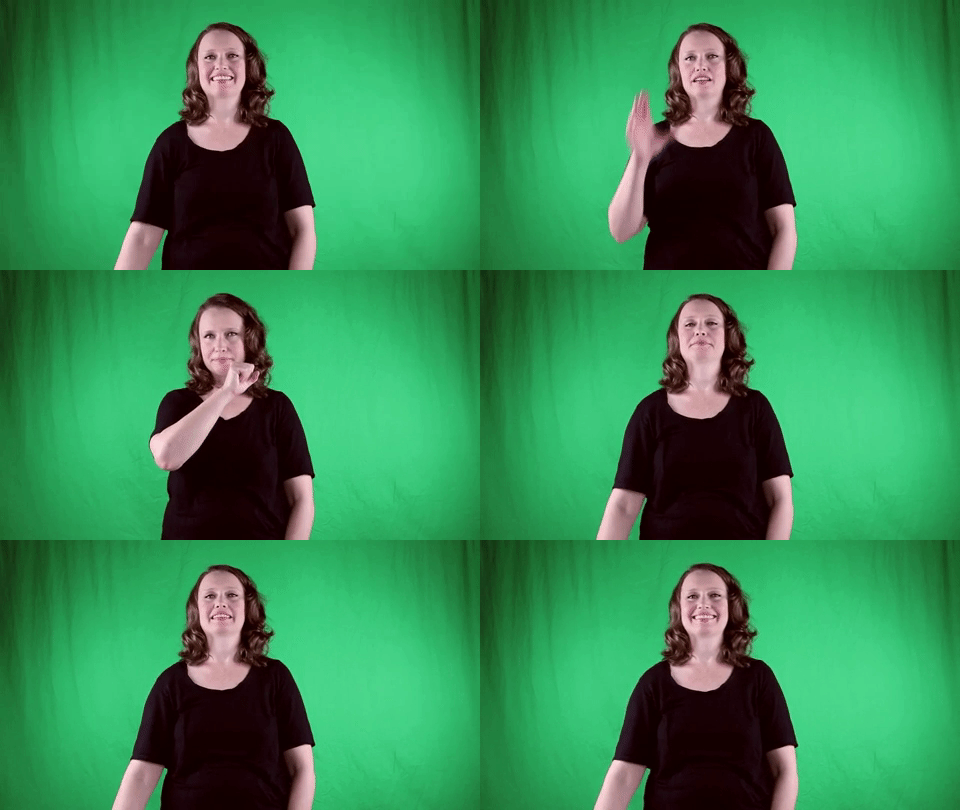
Definition: To estimate or suppose something without sufficient information.
Sign for GUESS in ASL
Practice Activities:
To practice the sign for GUESS in ASL, start by standing in front of a mirror and signing it repeatedly with a relaxed motion, as if you are grabbing something from the air. Focus on your facial expressions, incorporating a curious or uncertain look to match the meaning of the sign. Repeat several times until the movement feels natural and smooth.
Use flashcards with English words or pictures where the answer requires a guess. For example, hold up an image partially covered, and sign GUESS followed by your guessed answer. This helps to simulate real-life scenarios where a guess might be necessary, such as games or quizzes.
Create simple sentences using the sign for GUESS in ASL. Try phrases like “I GUESS he is late” or “She GUESS the right number.” Practice signing these slowly at first, then increase speed as you become more confident. Use a video recorder to film yourself and review for accuracy.
Find a practice partner and play a guessing game together. One person can describe something with clues while the other signs guess before expressing their answer. This encourages conversations using the sign in a natural context and boosts receptive and expressive skills.
Storytelling can also enhance fluency with the sign. Make up a short story involving someone making a mistake or needing to make a decision without all the facts. Incorporate the sign for GUESS in ASL each time uncertainty arises. Retell the story to a partner or record it to critique your own signing.
You can also adapt popular games like 20 Questions. The signer uses clues and the other player must sign GUESS before replying. These activities build familiarity and help reinforce the sign for GUESS in ASL in different social and communicative settings. Repeat activities regularly for best progress.
Cultural Context:
Understanding the sign for GUESS in ASL involves not only learning hand movements but also appreciating its meaning within Deaf culture. This sign is commonly used in both casual and formal conversations in American Sign Language, carrying the same inquisitive and uncertain tone that it does in spoken English.
In Deaf culture, clear communication is particularly important, so when someone uses the sign for GUESS in ASL, it’s often paired with facial expressions to clarify meaning. A curious look or raised eyebrows can transform the intent from a serious guess to a playful one. These non-manual markers are essential and can change how the sign is interpreted.
The sign for GUESS in ASL isn’t just for trivia or mental puzzles. It’s often used in everyday situations, like guessing someone’s age, what’s for dinner, or even what someone is feeling. In social settings within the Deaf community, using this sign can lead to engaging conversations and deeper connections.
Because ASL is a visual and expressive language, the sign for GUESS in ASL may vary slightly among regions or communities. Some people may use a more exaggerated motion while others keep it more subtle. These variations are important cultural markers that reflect personal and community identity.
In conversations, people may use the sign for GUESS in ASL to introduce a thought or idea gently, especially if they are unsure. This makes it a useful tool in polite discussions or when offering opinions. Saying “I guess” in ASL can signal that you are open to other perspectives, which aligns with respectful communication norms in the Deaf community .
This sign also has importance in ASL storytelling, where guessing can be part of building suspense or involving the audience. Whether in jokes, riddles, or interactive stories, the sign for GUESS in ASL brings audience members into the narrative and encourages participation.
Deaf culture values inclusivity and interaction. Using signs like GUESS helps invite others into the conversation, even when the answer is uncertain . It reflects a deeper aspect of communication—acknowledging that not everything needs to be known or certain to be shared.
In educational settings, teachers often use the sign for GUESS in ASL to engage students. It encourages them to think critically and take risks without the fear of being wrong. This use of the sign creates a supportive learning environment, which is a core value in Deaf education.
Parents in Deaf families also frequently use the sign for GUESS in ASL when playing games or teaching young children. It introduces
Extended Definition:
The sign for GUESS in ASL is a natural and expressive gesture that reflects the action of making a quick decision or taking a guess. It’s commonly used in daily conversations when someone is uncertain or trying to come up with an answer they aren’t completely sure of. This sign captures the visual essence of pulling something out of the air, showing the spontaneous nature of guessing.
To perform the sign for GUESS in ASL, start with your dominant hand open near your face and then quickly close it into a fist while moving it slightly to the side. The motion mimics grabbing or snatching an idea out of thin air. Facial expressions are important—showing a thoughtful or puzzled look enhances the meaning of the sign and provides necessary context.
ASL is a visual language, and each sign has layers of meaning based on how it’s used in real-life situations. The sign for GUESS in ASL doesn’t just indicate guessing facts; it can also imply prediction, estimation, or forming an opinion when not all information is available. Whether used in a game, a conversation, or an academic setting, this sign remains relevant and flexible.
Children and beginners often enjoy using the sign for GUESS in ASL during guessing games or classroom activities. It’s easy to learn and fun to use, which makes it a great addition to foundational ASL vocabulary. Learning signs like this helps build confidence and promotes deeper engagement with the language.
In American Sign Language, context is key. The sign for GUESS in ASL can change slightly depending on tone, speed, and accompanying non-manual signals like a raised eyebrow or head tilt. These subtle changes help convey emotions such as surprise, doubt, or curiosity.
For example, someone might use the sign casually while trying to guess what’s in a mystery box. In another setting, the same sign might express a more serious or hesitant guess during a discussion. ASL thrives on this kind of flexibility, and the meaning of a sign is often deepened by the situation in which it’s used.
Some regional variations may exist for the sign for GUESS in ASL. Different Deaf communities or cities might have their own preferred versions of the sign. However, the general motion and meaning remain widely understood across most areas where ASL is used.
Remember to always observe skilled signers and practice in front of a mirror to perfect your version of the sign. Watching videos made by native Deaf ASL users will also give insight into the correct usage and subtle facial expressions
Synonyms: estimate, speculate, conjecture, surmise, assume
Educational resources: Find related learning materials in our course bank!
Want more? Check out some of our popular learning activities on the homepage!
Need to look up a sign? Use our highly rated dictionary: https://aslinteractive.com/best-asl-dictionary/
Follow us on tiktok: https://www.tiktok.com/@aslinteractive. More social media links at the bottom of this page!
Long-tail Keywords: what is the sign for guess in ASL, how do you sign guess in ASL, ASL sign for guess
Categories:
tags: Guess in ASL, ASL question signs, ASL guessing signs, American Sign Language vocabulary, interactive ASL learning
Parameters
*Handshape*:
The handshape used in the sign for GUESS in ASL begins with a loose open hand, or “5” handshape, near the side of the face. This hand quickly closes into an “S” handshape while moving slightly away from the face, as if snatching something invisible from the air. This motion reflects the concept of grabbing at an idea or making a quick decision.
The sign for GUESS in ASL uses a transition between these two handshapes to convey the act of guessing or speculating. The handshape change adds a visual nuance that matches the uncertainty or spontaneity behind a guess.
*Palm Orientation*:
The palm orientation for the sign for GUESS in ASL begins with the dominant hand open, facing the side or slightly inward depending on the signer’s style, then quickly changes orientation as the hand moves across the face into a grabbing or closed motion. The quick, sweeping gesture mimics an action of catching or guessing something suddenly.
In the sign for GUESS in ASL, orientation plays a key role in conveying a spontaneous or uncertain action. The palm may briefly face outward or inward, but shifts dynamically as the motion is completed, emphasizing the unplanned nature of guessing.
*Location*:
The sign for GUESS in ASL is produced in the neutral signing space directly in front of the face. The movement begins close to the nose or forehead and extends outward into the space in front of the face. This location is essential as it mirrors the concept of grabbing or catching an idea from the mind, reinforcing the idea behind the sign for GUESS in ASL.
Because the location is near the face, it allows the signer to easily incorporate facial expressions, which are vital for conveying tone and context. The sign for GUESS in ASL benefits greatly from this area, as it offers clear visibility and accurate representation of the concept.
*Movement*:
The dominant hand, in an open five-handshape, moves in a quick and fluid motion in front of the face, changing into a flat O-handshape as it passes. This sweeping gesture mimics the action of snatching an idea from the air, symbolizing a hunch or sudden thought.
The sign for guess in ASL focuses on a spontaneous grasp, resembling how guesses come unexpectedly. Make sure the movement is light and not too rigid to capture the meaning behind the sign for GUESS in ASL ✋ .
*Non-Manual Signals*:
When performing the sign for GUESS in ASL, the non-manual signals typically include a furrowed brow or slightly puzzled facial expression to convey uncertainty or speculation. Eyes may squint slightly, and the mouth often shows a subtle pursing or an “mmm” shape that emphasizes the guessing action. These expressions reinforce the abstract or unsure nature behind the sign for GUESS in ASL . Maintain a natural flow to support the concept visually.
*Prosody, Dominant/Non-Dominant Hand*:
The sign for GUESS in ASL uses the dominant hand in an open 5-handshape, which moves quickly across the face and turns into an “S” handshape, mimicking the motion of grabbing something out of the air. The non-dominant hand is typically not used in this sign.
Facial expressions play a key role in conveying uncertainty or speculation when signing the sign for GUESS in ASL . It’s important to execute the motion swiftly to reflect the nature of guessing or assuming.
Tips for Beginners:
When learning the sign for GUESS in ASL, pay close attention to the fluidity of your movement. This sign mimics a quick grabbing motion, as if you’re pulling something intangible out of the air. Keep your hand relaxed and natural to express the concept clearly. Overexaggerated or stiff movements can make your sign look unnatural or be misunderstood.
A common mistake that beginners make when attempting the sign for GUESS in ASL is confusing it with signs for “grab” or “snatch.” To avoid this, focus on the smoothness and subtlety of the motion. It should look more like you’re grasping at an idea rather than snatching a physical object. Watching native signers can help you see the nuance in the movement.
Make sure your facial expression matches the context of your guess. In ASL, non-manual markers play a huge role in conveying meaning. A raised eyebrow or a slightly uncertain expression adds essential context to your signing. Using a neutral face can lead to confusion or misinterpretation.
Another helpful tip when learning the sign for GUESS in ASL is practicing in front of a mirror. This helps reinforce movement correctness and handshape. It’s also beneficial to video yourself signing to review and correct your form later. Practicing with a fluent ASL user can give you instant feedback, helping you improve faster.
When incorporating the sign into full sentences, take care to position your body towards the person you’re addressing and maintain eye contact. ASL is a visual and spatial language, so misalignment can affect clarity. Take your time when first practicing. Speed comes with consistency and confidence.
Lastly, try to use the sign in different contexts—like joking, genuinely unsure moments, or even rhetorical questions—to get comfortable with its versatility. Immersing yourself in conversation is key to mastering usage of the sign for GUESS in ASL.
Connections to Other topics:
The sign for GUESS in ASL connects to broader concepts like imagination, probability, and assumptions. It shares semantic territory with signs such as THINK, SUPPOSE, and MAYBE, often appearing in conversations about uncertainty or inference. Understanding nuances between these terms helps learners grasp how ASL communicates abstract thought.
This sign can be related to expressions of opinion or speculation. For instance, when used with facial expressions showing doubt or hesitancy, it adds depth to phrases like “I guess so” or “I guess not.” It blends well with conditional signs or structures like IF or POSSIBLE, enhancing the natural flow of conversation.
The sign for GUESS in ASL frequently appears in compound structures, such as “guess what” or “take a guess.” In these cases, it may be paired with signs like WHAT or TRY to indicate playful prompting or engagement. These structures help learners understand how questions and statements can be made more expressive and dynamic.
Moreover, the sign for GUESS in ASL supports discussions involving logic, reasoning, and prediction. In classroom or academic contexts, pairing it with signs like THINK, REASON, or ANALYZE reinforces critical thinking. It plays a key role in problem-solving conversations, especially when paired with TRY or FIGURE-OUT.
This sign also relates to the concept of uncertainty and is often connected to signs like MAYBE or NOT-SURE. In storytelling or casual conversation, it is used to portray characters’ thoughts or internal dilemmas. Recognizing how this sign fits into narrative discourse can deepen linguistic fluency in ASL.
The sign for GUESS in ASL also has cultural implications, as guessing or assuming something without clarification may carry social risks. This demonstrates the importance of facial grammar and body language for softening meaning or indicating the tentative nature of a statement.
Summary:
The sign for GUESS in ASL is made by starting with a flat hand near the forehead, then quickly closing it into an S-handshape as the hand moves down and away from the face. This snapping or catching motion represents something fleeting, like grabbing an idea or making a quick assumption. The movement is light, fast, and often accompanied by a thoughtful or pensive facial expression.
This sign is visually motivated by the idea of catching an abstract idea from the air. It suggests the impermanence and impulsiveness of guessing, as if the signer is plucking uncertain knowledge from thin air. The sign is directional and spatial context is not typically required.
The sign for GUESS in ASL includes both physical movement and non-manual markers. These non-manual signals—such as squinting eyes or a hesitant mouth movement—can give insight into whether the guess is confident, unsure, or purely imaginative. Facial expressions are critical to conveying the nuance and tone of the guess.
In grammar, the sign for GUESS in ASL acts as a verb and can be used in a variety of sentence structures. It can function in both declarative and interrogative forms, like in “I GUESS YOU RIGHT” or “YOU GUESS WHAT?”. The flexibility of this verb matches its ambiguity in English, where “guess” can express skepticism, a prediction, or casual offering.
Culturally, the notion of guessing isn’t often about randomness in ASL, but about participation and engagement. It plays a key role in games, storytelling, and dialogues between Deaf individuals. When someone signs the word GUESS, it can invite active thought and interactive communication — fostering deeper engagement between signers.
The sign can also be used to express uncertain knowledge or a polite estimation. Context reveals the intended meaning, and the intensity or duration of the motion can subtly change the interpretation. For example, a quick motion may indicate a lighthearted guess, while a slow or exaggerated movement might suggest guessing with doubt or deliberation.
The sign for GUESS in ASL is related to signs such as THINK, IMAGINE, TRY, and SUPPOSE. All of these access the cognitive domain, which is expressed spatially and gesturally within ASL rather than verbally. Each of these signs involves the head or forehead area, visually representing the mind’s activities.
The concept of guessing bridges objective knowledge and subjective insight. In ASL, this is visually marked through fluid and abstract symbols. The sign GUESS shares space in the lexicon with other abstract verbs that signify states of mind, such as FORGET and REMEMBER.
Linguistic research shows that signs like GUESS engage iconic mapping, where the physical movement metaphorically matches the concept. This makes GUESS a semi-iconic sign in the lexicon, where the hand shape and motion visually refer to the mental process of estimation or supposition. This mapping makes the sign intuitive for native users and easier to acquire for learners.
In conversational ASL, the sign for GUESS can function pragmatically as a hedge or disclaimer. For example, someone might sign something like “ME GUESS MEET NEXT WEEK”, softening their commitment to a date. This pragmatic use reflects how English uses “guess” to express uncertainty or polite commitment.
In questions, the sign can take a rising brow and a head tilt to express inquiry. For example, when someone signs “YOU GUESS HER NAME?”, they are inviting speculation. Non-manual signals help distinguish the intent and emotion behind the simple hand movement.
The sign for GUESS in ASL also plays a role in educational settings. Deaf educators and students may use it during problem-solving or classroom games. The sign encourages interaction with unfolding possibilities, strengthening memory, inference skills, and language fluency.
Some dialectal variations exist in ASL depending on the region or community. While the general motion and hand shape for GUESS is widely recognized, slight differences in execution exist. These variations are natural, reflecting ASL’s regional richness and socio-cultural diversity.
In terms of acquisition, learners of ASL often find the sign for GUESS relatively easy to remember due to its iconicity. However, mastering the associated facial expressions and proper timing takes practice. The sign must be fluid, not mechanical, to convey the intended subtlety.
The act of guessing reflects a broader human tendency to navigate uncertainty. The sign for GUESS in ASL captures this universal experience using visual and spatial language. It reminds us that ASL, like all languages, provides tools to describe both concrete and abstract ideas.
From a sociolinguistic perspective, the use of GUESS may vary not only by region but also by age or social context. Older signers may use it differently or pair it with other signs to show formality or informality. This reveals the embedded richness of ASL as a living language shaped by its community.
In the context of storytelling or Deaf theatre, GUESS can be dramatically altered for effect.
Want more? Check out some of our popular learning activities!
ASL Interactive Resources
ASLInteractive YouTube Channel
Follow us on tiktok: @aslinteractive.com
Follow us on Instagram: aslinteractive
Facebook page: aslinteractive
Facebook group: aslinteractive
LInkedIn: ASL Interactive LLC
Twitter: @ASL_interactive
*Some information on this page is AI-generated. AI can make mistakes. Please check the information.


Responses