Definition: A frozen dessert made from dairy, sugar, and flavorings, often enjoyed in cones or bowls.
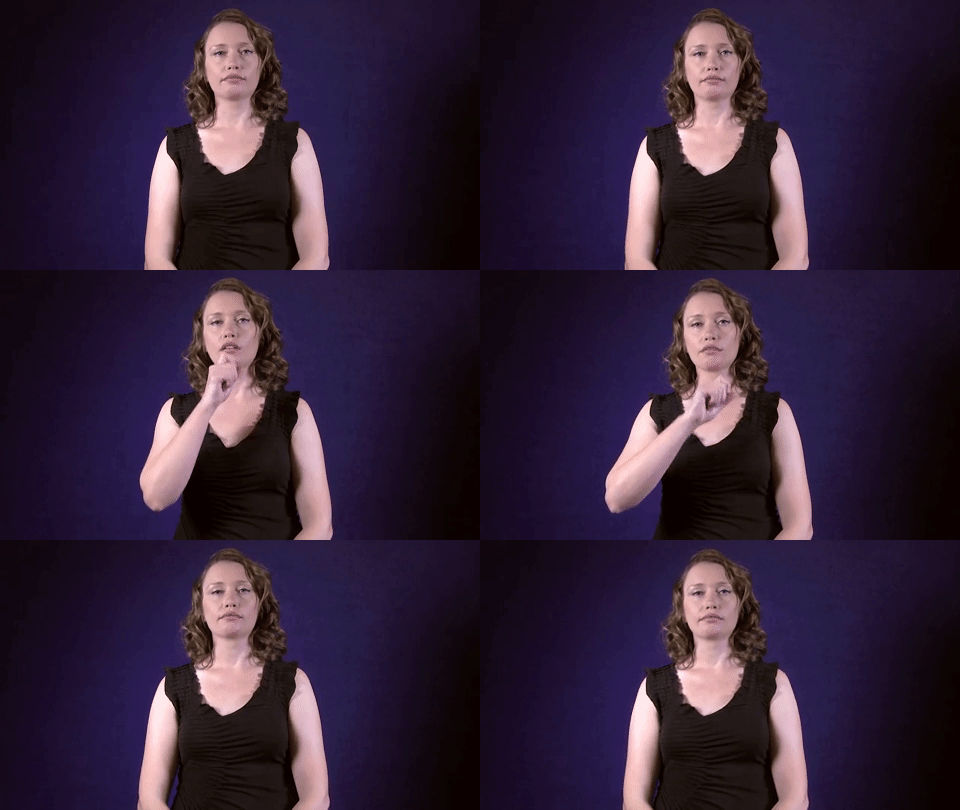
Sign for ICE CREAM in ASL
Practice Activities:
To start practicing the sign for ICE CREAM in ASL, begin by repeating the sign while looking in a mirror. Focus on the handshape and facial expression. This helps reinforce correct motion and clarity. Practice using the sign in isolation until it feels natural and smooth.
Once comfortable, begin signing short phrases like “I want ice cream” or “chocolate ice cream.” Add variation by changing the flavor or context, such as “She loves ice cream” or “Do you want more ice cream?” This allows learners to connect the sign to real communication. Incorporate expressive signing to reflect emotions like excitement or sharing.
Storytelling is another fun way to practice. For example, tell a short ASL story about going to an ice cream shop with your family or friends. Describe what kind of ice cream you chose, how it tasted, and something funny that happened. Use space in signing to show different people and actions clearly.
For partner work, one partner can ask “What is your favorite ice cream?” and the other can respond with a signed sentence or short description, using classifiers for size or shape if appropriate. Switch roles after each turn. You can also play a flashcard game identifying family, food, or dessert items and signing them quickly with correct placement and smooth transitions.
Try creating a video diary entry describing your favorite summer treat, and include multiple uses of the sign for ICE CREAM in ASL. Watch and critique your signing or share it with a classmate for feedback. Focus on clarity and signing fluency.
Finally, while watching a family movie or baking show, point out and sign each time someone eats or mentions ice cream. Using this sign in context builds strong connections for memory and real-world use, making learning both fun and functional .
Cultural Context:
In American Sign Language, everyday words like ice cream carry more than just a sweet meaning—they connect culture, experiences, and shared moments. The sign for ice cream in ASL is more than a gesture; it’s a quick and relatable way to express joy, cravings, or nostalgia within Deaf culture. Whether you’re a child learning your favorite treat sign or an adult reminiscing about summer days, this sign often sparks a smile and instant recognition.
Food signs in ASL, including the sign for ice cream in ASL, often reflect the shape, movement, or experience of the food itself. This adds a natural feel to signing, making communication clear and expressive. For ice cream, the motion used mimics the act of licking a cone, making it easily understood across age groups and contexts.
Within Deaf culture, using food signs like the sign for ice cream in ASL helps build stronger community connections. Events, meetups, and conversations around food are common, and these signs make participation seamless and expressive. Being able to talk about favorite flavors, going out for dessert, or childhood memories becomes more vibrant and inclusive with the right signs.
This sign also plays a part in early childhood education within the Deaf community. Kids quickly pick up expressive signs like the sign for ice cream in ASL while learning about foods, colors, and preferences. The fun, visual nature of the sign helps encourage language development and social interaction.
When Deaf and hearing people communicate, simple and clear signs like the sign for ice cream in ASL make it possible to bridge gaps. It’s often one of the first signs taught in basic ASL classes because it’s fun, memorable, and useful in many social settings. Sharing a treat or heading to an ice cream shop becomes a moment of connection rather than confusion.
ASL is a rich, living language, and food-related signs like the sign for ice cream in ASL reflect how language grows with culture. New flavors, trends, and shared moments at places like ice cream parlors keep the sign relevant and widely used. Storytelling often includes favorite foods, and this sign adds vivid imagery to those narratives.
The sign for ice cream in ASL is also common across regional dialects, though minor variations can occur based on location or family preference. Still, the core movements remain mostly consistent, keeping communication smooth across different parts of the country. This consistency highlights how ASL binds communities together with shared language and experiences.
In ASL storytelling, visual references to treats like ice cream
Extended Definition:
The sign for ice cream in ASL is a fun and easy gesture that mimics the motion of licking an ice cream cone. This common sign is frequently used in everyday conversations, especially when talking about favorite treats, desserts, or summertime snacks. Learning the sign for ice cream in ASL can help both children and adults express themselves more clearly during social interactions.
To make the sign for ice cream in ASL, form an S handshape with your dominant hand, as though you are gripping an invisible ice cream cone. Then, bring the hand up to your mouth and make a small motion as if you’re pretending to lick the cone. This visual representation makes it easy to remember and recognize during signed conversations.
This sign is often used with facial expressions of pleasure or excitement, helping to convey the positive emotions usually associated with enjoying ice cream. Facial expressions are an important part of American Sign Language and can provide additional meaning and emotion behind the words being signed. When using the sign for ice cream in ASL, smiling or showing enthusiasm can enhance the communication.
Children learning ASL often pick up the sign for ice cream quickly because of how closely it relates to a real-life activity they enjoy. Parents and educators can introduce the sign during snack time or while reading books that mention ice cream. This helps create a strong connection between the spoken word, its meaning, and the sign itself.
The sign for ice cream in ASL is universal within American Sign Language and is the same regardless of gender or age. Its intuitive design makes it accessible for both hearing and Deaf individuals. Whether you’re ordering at an ice cream shop or talking about your favorite flavors, this sign helps facilitate clear and enjoyable communication.
Practicing this sign can be a great way for beginning learners to build confidence in using ASL in social settings. It’s also useful for language learners focusing on food-related vocabulary. Like other ASL food signs, the sign for ice cream can be incorporated into sentences, questions, or playful conversations among friends and family.
In storytelling or play-based learning scenarios, using signs like the one for ice cream can help bring stories to life. Parents and teachers can use this visual tool to make storytime more interactive and engaging. Signing simple concepts like flavors, weather, or days of the week alongside the sign for ice cream introduces a rich language environment for young learners.
During summer or special events, this sign often becomes more common in ASL communities. Individuals may use it at festivals, family gatherings, or community centers when
Synonyms: ice cream, ice-cream, iced cream, frozen dessert, ice creme
Educational resources: Find related learning materials in our course bank!
Want more? Check out some of our popular learning activities on the homepage!
Need to look up a sign? Use our highly rated dictionary: https://aslinteractive.com/best-asl-dictionary/
Follow us on tiktok: https://www.tiktok.com/@aslinteractive. More social media links at the bottom of this page!
Long-tail Keywords: what is the sign for ice cream in ASL, how do you sign ice cream in ASL, ASL sign for ice cream
Categories:
tags: food in ASL, desserts in ASL, how to sign ice cream in ASL, ASL signs for food and drinks, American Sign Language vocabulary for desserts
Parameters
*Handshape*:
The handshape for the sign for ICE CREAM in ASL uses the dominant hand in an “S” handshape. This hand is held near the mouth and moves downward in a motion that mimics licking an ice cream cone.
The sign for ICE CREAM in ASL relies on this gripping form to represent holding a cone, and the motion adds visual context. It’s a simple yet effective way to convey the concept non-verbally.
*Palm Orientation*:
The palm orientation for the sign for ICE CREAM in ASL involves a closed “S” handshape with the palm facing inward toward the mouth. The motion mimics the action of holding an ice cream cone and licking it. This directional movement helps convey the clear meaning of the sign for ICE CREAM in ASL and adds a visual connection to eating ice cream.
This palm-inward orientation helps distinguish the sign for ICE CREAM in ASL from other similar handshapes. Keeping the palm angled slightly toward the face adds realism and clarity, which makes the sign easily understood in context.
*Location*:
The sign for ICE CREAM in ASL is located at the mouth area. The dominant hand is shaped into the “S” handshape and moves in a small downward motion as though mimicking the action of licking an ice cream cone. This placement near the mouth helps visually connect the sign to the act of eating ice cream.
Because the sign for ICE CREAM in ASL is performed so close to the face, it effectively conveys the idea through natural and relatable gestures. The mouth-level location plays a key role in giving the sign its meaning and association with enjoying a treat.
*Movement*:
The sign for ICE CREAM in ASL uses the dominant hand in the shape of an “S” handshape, mimicking the motion of licking an ice cream cone. Starting near the mouth, the “S” hand moves up and down slightly, as if one is holding and licking a cone.
This repetitive motion gives a clear visual cue and helps convey the meaning. The sign for ICE CREAM in ASL is simple, intuitive, and easy to remember .
*Non-Manual Signals*:
When demonstrating the sign for ICE CREAM in ASL, the facial expression is usually neutral or slightly exaggerated, mimicking the act of eating something cold and sweet. Slightly pursed lips and raised eyebrows can accompany the gesture to show enthusiasm or enjoyment, depending on the context.
Include a subtle head nod or slight forward lean if you’re emphasizing or asking about ice cream. These non-manual signals support clarity and emotional tone when using the sign for ICE CREAM in ASL .
*Prosody, Dominant/Non-Dominant Hand*:
The sign for ICE CREAM in ASL uses the dominant hand in an “S” handshape. The motion mimics licking an ice cream cone by bringing the fist to the mouth and making a short vertical movement, similar to holding and licking an actual cone.
The non-dominant hand is not used in this sign. When learning the sign for ICE CREAM in ASL, be sure the “S” hand stays firm and the motion remains subtle to keep the meaning clear .
Tips for Beginners:
When learning the sign for ICE CREAM in ASL, it’s helpful to visualize the action of holding a cone and licking it. This sign uses a simple motion—make a fist with your dominant hand and mimic the movement of licking the top of an ice cream cone with your tongue. This visualization not only helps with memory but also with executing the motion naturally. Practice the gesture slowly at first to ensure your hand shape stays consistent.
One common issue with the sign for ICE CREAM in ASL is over-exaggerating the licking motion or using the wrong hand shape. Beginners sometimes open their fist or turn it at an odd angle. Be sure your hand remains in a tight “S” position, and the motion comes from your wrist, not your entire arm. Keeping the movement small and controlled makes the sign look more fluent and less theatrical.
To increase accuracy, practice in front of a mirror. This allows you to monitor your hand positioning and facial expressions, which are an essential part of American Sign Language. Keeping a neutral or slightly happy expression matches the context of talking about an enjoyable treat like ice cream. Avoid looking stiff or robotic—ASL is expressive and should look comfortable.
Repetition is key. Use the sign during daily interactions, such as when asking someone what flavor they like or expressing a craving. Associating the sign for ICE CREAM in ASL with real-life experiences speeds up memorization. Try to use it in different contexts rather than only in isolated practice.
If you’re ever unsure, check with fluent signers or reliable ASL video resources. Getting feedback early prevents bad habits. Developing muscle memory will make this snack-related sign second nature, so stick with it and have fun using it in everyday conversation.
Connections to Other topics:
The sign for ICE CREAM in ASL is closely related to other food and dessert signs, especially those indicating texture or the act of eating certain items. It mimics the action of licking an ice cream cone, which connects it to signs like LOLLIPOP or even CANDY, where hand movements also simulate consuming sweet treats. This makes it relatable for understanding gestures based on real-world interactions, helping learners connect signs to sensory or physical associations.
This sign is a great example of how classifiers and mime-based gestures show up in everyday vocabulary. The mimetic nature of the sign for ICE CREAM in ASL supports connections to signs like DRINK, EAT, or COOKIE, all of which may incorporate characteristic movements or handshapes that reference their real-life counterparts. Learners can deepen their understanding of how the physical world shapes sign creation through these kinds of comparisons.
ICE CREAM can also be part of compound phrases, such as ICE CREAM CONE, ICE CREAM FLAVOR, or ICE CREAM TRUCK. In these cases, signers might fingerspell extensions like FLAVOR or TRUCK, or include classifiers to show the shape and movement of a vehicle, for example. This supports broader fluency by teaching how to combine basic signs into more specific, detailed expressions in context.
Understanding the sign for ICE CREAM in ASL also offers insight into cultural elements of Deaf community events, such as parties or summer gatherings, where food signs are commonly used. It serves as a bridge to explore various event-related vocabulary like SUMMER, COLD, PARTY, and SNACK. Connecting conversational contexts enhances retention and conversational fluidity.
Finally, the sign for ICE CREAM in ASL helps highlight the difference between lexical signs and iconic gestures. This is helpful for ASL learners developing skills in understanding the general patterns of sign logic and how meaning is conveyed through handshape, movement, and facial expressions .
Summary:
The sign for ICE CREAM in ASL typically mimics the hand motion of licking an ice cream cone. The dominant hand forms an “S” handshape, held near the mouth, and then moves downward in a short motion—similar to licking the side of a cone. This simple yet expressive movement reflects the literal action associated with the treat, making it an iconic representation.
This sign is widely understood among Deaf communities in the United States and Canada. The gesture is clear and intuitive, often making it one of the early food-related signs children learn. Its repetitive and tactile nature supports retention in visual learners.
The sign for ICE CREAM in ASL is highly iconic, which means it visually resembles what it represents. Iconicity in ASL helps bridge comprehension gaps, especially for beginner signers or language learners. It also illustrates how ASL effectively draws from everyday experiences.
This sign is almost always used as a noun. So in a full ASL sentence, it might be followed by a classifier or description, such as flavor or quantity, using appropriate non-manual markers to emphasize emotional reactions—like excitement or desire. Non-manual signals, such as raised eyebrows or a happy facial expression, often accompany this sign.
Grammatically, the sign for ICE CREAM in ASL fits smoothly into basic subject-verb-object (SVO) sentence structures. For example, “I EAT ICE CREAM” would use the respective signs in that order. ASL tends to be flexible, allowing topicalization depending on context and emphasis.
Deaf culture places a strong emphasis on visual context, and the sign for ICE CREAM in ASL benefits from this. It taps into shared cultural experiences around enjoying foods, making it not just a label but part of the broader linguistic experience. You might encounter this sign at birthday parties, festivals, or community events.
Applied linguistics tells us that such highly visual signs help children acquire language more effectively. Children often use the sign for ICE CREAM in ASL during play or social activities. It serves as a bridge between tangible reality and symbolic representation, crucial in language development.
In media featuring ASL, this sign is frequently demonstrated when teaching basic vocabulary. It’s often one of the first food signs introduced in beginner ASL classes. Teachers use it to engage students in culturally familiar topics to maintain interest.
There are related signs in the same semantic field—including signs for CAKE, COOKIE, and SNACK. These food-related signs can be clustered thematically for educational purposes. Comparisons between them help learners notice subtle handshape or movement differences, deepening their understanding of ASL structure.
The sign for ICE CREAM in ASL may also signify comfort, indulgence, or celebration depending on the context. In Deaf social gathering narratives, sharing a moment over ice cream can symbolize community and relaxation. This adds to the cultural richness of the sign.
Its origin dates back to early ASL roots when signs were often mimetic adaptations. The motion of licking a cone translates universally, making this sign easily understood even by novices. Such transparency supports intergenerational learning within families.
Locational parameters are important: the hand stays near the chin or mouth. Altering this location may affect clarity or be mistaken for other signs involving an “S” handshape, like SHAVE or CANDY. Therefore, practicing standard positioning ensures comprehension.
In terms of movement, the wrist and arm do minimal work—the sign is localized and efficient. Efficiency in sign movements helps in storytelling or rapid conversation where many signs are chained together. This economy of motion reflects ASL’s streamlined beauty.
While the standard sign uses one downward stroke, some dialectal variations exist. You might see a double stroke or a slightly different angle, which can reflect regional or generational influences. These small differences rarely affect understanding due to the sign’s iconic nature.
In narratives involving food or sensory experience, this sign is rich with expressive potential. Facial expressions often include mock enjoyment or lip-smacking to animate the description. ASL allows signers to layer emotion and sensation atop vocabulary using non-manual tools.
The sign blends perfectly in role-shifting scenarios—for example, when portraying a child desperately wanting a treat. In signed stories, characters engaging with foods like ice cream showcase emotional range and charisma. These dramatized uses reinforce the sign’s place in storytelling.
Language acquisition studies suggest signs like ICE CREAM motivate early communication because of their sensory and emotional dimensions. Young Deaf or hard-of-hearing children can use this sign to initiate interactions, showing agency and personal desire. This elevates the sign beyond vocabulary to social expression.
Interpreters use this sign frequently in educational and recreation settings. Whether signing in a movie, during a birthday party, or in literature translation, it remains functional and evocative. It often elicits a smile from both signers and recipients due to its joyful association.
In bilingual settings, the sign for ICE CREAM in ASL may be compared to spoken word acquisition
Want more? Check out some of our popular learning activities!
ASL Interactive Resources
ASLInteractive YouTube Channel
Follow us on tiktok: @aslinteractive.com
Follow us on Instagram: aslinteractive
Facebook page: aslinteractive
Facebook group: aslinteractive
LInkedIn: ASL Interactive LLC
Twitter: @ASL_interactive
*Some information on this page is AI-generated. AI can make mistakes. Please check the information.


Responses