Sign for PARKING in ASL | ️ ASL Dictionary

Definition: The act of leaving a vehicle in a particular place.

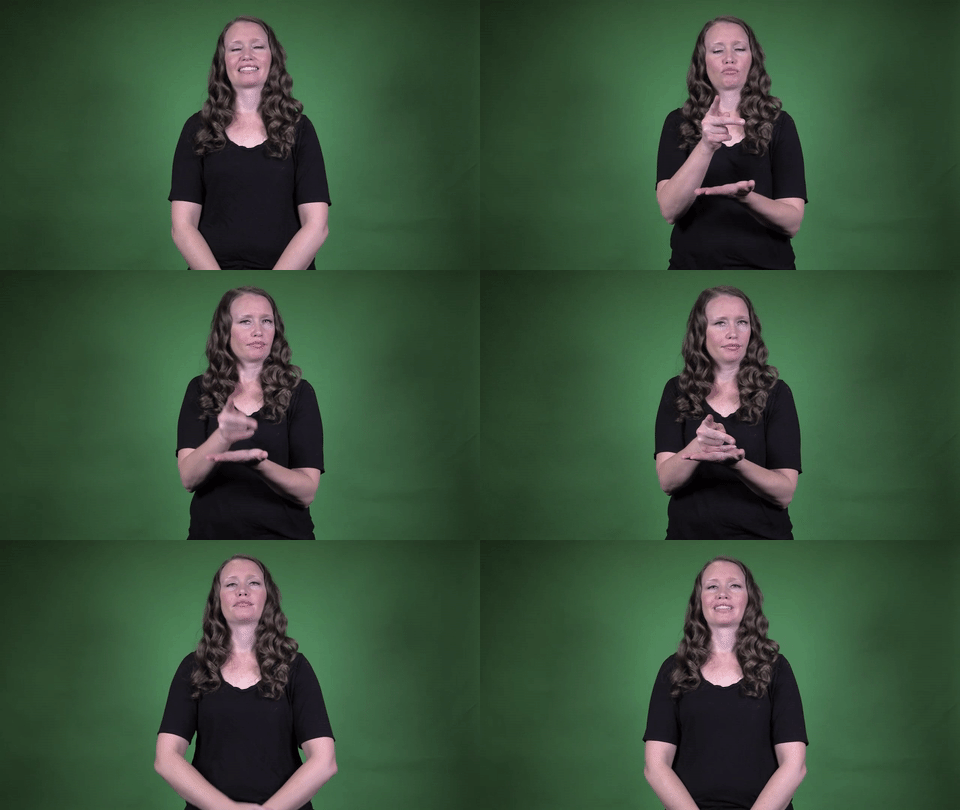
Sign for PARKING in ASL

YouTube player

Practice Activities

To master the sign for PARKING in ASL, learners should begin with mirror work. Stand in front of a mirror and practice the handshape and movement to ensure accuracy. Pay close attention to your facial expression, as it adds clarity and context to the sign.

Recording your own signing is another effective strategy. Use your phone or webcam to capture yourself signing the word in isolation and within full sentences. Watch the videos back to evaluate your hand positioning, palm orientation, and fluidity.

Try using the sign for PARKING in ASL in real-life scenarios. For example, describe your parking experience when you arrive somewhere or when giving directions. This helps reinforce contextual usage and makes the sign more memorable.

Advanced drills can include fingerspelling surrounding vocabulary words like “garage,” “lot,” and “ticket,” followed by incorporating the sign into full ASL sentences. Pair with a signing partner to practice giving and receiving directions that involve parking locations.

Another great activity is location-based roleplay. Pretend to be at a mall, downtown area, or event, and use the sign for PARKING in ASL to explain where to leave a car. This encourages natural language use and prepares you for real-world interaction.

SEO Cultural Context

In Deaf culture, clear and efficient communication about everyday activities is essential. The sign for PARKING in ASL reflects this principle by being both direct and visually iconic. It often mimics the motion of a car being placed into a space, which aligns with the visual-gestural nature of ASL.

This sign is commonly used in everyday conversations, especially when discussing transportation, directions, and accessibility. In Deaf spaces, such as Deaf events and schools for the Deaf, knowing how to use the sign for PARKING in ASL is part of being able to fully participate and navigate.

There can be slight regional variation in how the sign is formed. Some signers might use a classifier for “car” and show it moving into a parking space, while others use a more lexicalized form. Both are correct, depending on the context and the community.

Understanding the cultural context also means recognizing the importance of visual clarity. When signing in a busy environment like a parking lot, Deaf individuals rely on clear signs and gestures to communicate needs such as where to park or whether a space is accessible.

Using the sign for PARKING in ASL reflects respect for the norms of Deaf communication. It demonstrates that you are aware of how language is used in context — not just as vocabulary, but as part of a visual culture that values clarity and inclusion.

Extended Definition

The sign for PARKING in ASL typically involves one hand representing a flat surface (like the ground or a parking lot) and the other hand representing a car that moves into place. This visual metaphor makes the meaning intuitive, especially for visual learners.

To form the sign, place your non-dominant hand flat, palm facing up. Then use your dominant hand in a “3” handshape (thumb, index, and middle fingers extended) to represent a car. Move the “car” hand into a spot on the palm of the other hand, simulating the act of parking.

There are also variations that use classifiers, particularly in more advanced conversations. For instance, you might use the Classifier 3 (CL:3) to show a car maneuvering into a tight space or parallel parking. These variations add nuance and are especially useful in storytelling or detailed explanations.

Common errors include using the wrong handshape or incorrect palm orientation. Some learners mistakenly use a “V” handshape instead of the “3,” which changes the meaning. Others might reverse the direction of the movement, which can lead to confusion.

Another mistake is over-exaggerating the movement, making the sign look unnatural or comical. Keep your hand movements smooth and controlled. This ensures the sign for PARKING in ASL is clear, accurate, and respectful to native signers.

Tips for Beginners

If you’re just starting out, learning the sign for PARKING in ASL may seem a bit complex due to its use of classifiers. But don’t worry — with consistent practice, it becomes second nature. Start by breaking the sign down into its component movements.

Use slow, deliberate motions at first. This will help you internalize the correct handshape and movement path. Practicing in front of a mirror can help you catch small mistakes and build muscle memory more effectively.

One common beginner error is forgetting to use the flat non-dominant hand as the base or “lot.” Without it, the car movement loses its context and becomes unclear. Always remember that ASL is spatial — the position of your hands matters just as much as their shape.

Also, don’t forget facial expressions. Even a simple sign like the sign for PARKING in ASL benefits from a slight nod or raised eyebrows to show confirmation or question. Facial grammar is a big part of ASL and adds depth to your signing.

Finally, be patient with yourself. ASL is a rich and complex language, and mistakes are part of learning. Stay curious, ask for feedback from more experienced signers, and keep practicing in a variety of settings to build fluency.

Connections to Other Topics

The sign for PARKING in ASL connects naturally with signs related to transportation, such as CAR, DRIVE, and GARAGE. These signs often appear together in conversations about travel, errands, or giving directions.

Another related concept is the use of classifiers. Classifier 3 (CL:3) is commonly used to represent vehicles, and learning how to manipulate this handshape in space will help you describe more than just parking — like driving, turning, or crashing.

The sign also ties into directional verbs. When giving directions, you may use the sign for PARKING in ASL along with spatial referencing to show where someone should park. This introduces learners to ASL’s unique grammar structure based on space and location.

You might also explore topic-comment structure, a key grammatical feature in ASL. For example, a sentence might begin with “PARKING LOT” (the topic) followed by a comment like “FULL” or “NEED FIND NEW ONE.” This shows how the sign fits into broader sentence patterns.

Lastly, the sign is closely linked with accessibility and Deaf rights. Conversations about accessible parking, transportation access, and community events often include this sign. Understanding its use helps learners participate in meaningful discussions within the Deaf community.

Lengthy Summary

The sign for PARKING in ASL is a dynamic, visual representation of placing a vehicle into a space. It uses a combination of classifiers and spatial referencing, making it an excellent example of how ASL expresses ideas through movement and placement in space. By learning this sign, you’re not just adding a word to your vocabulary — you’re engaging with a concept deeply rooted in visual communication.

In Deaf culture, clarity and visual storytelling are central to effective communication. The sign for PARKING in ASL is used in a wide range of everyday contexts, from giving directions to describing events or locations. Being able to use it fluently shows that you can navigate real-world situations with confidence in ASL.

Beginners may encounter challenges such as choosing the correct handshape or maintaining proper orientation. However, through consistent practice — including mirror work, role-play, and recorded review — these hurdles become stepping stones to greater fluency. Engaging with the sign through context-rich activities reinforces its meaning and improves retention.

This sign also connects to broader ASL concepts like classifiers, directional verbs, and topic-comment structure. By exploring these connections, learners can deepen their understanding and use the language more naturally. The sign for PARKING in ASL serves as a gateway to mastering more complex ideas and interactions.

Your journey to mastering the sign for PARKING in ASL doesn’t stop here. Keep practicing in real-life contexts, seek feedback from native users, and immerse yourself in Deaf culture whenever possible. Every sign you learn brings you closer to fluency and cultural competency. Keep going — your dedication will lead to meaningful connections and confident communication.

Synonyms: parking, parking lot, car park, parking space, parking area

Educational resources: Find related learning materials in our course bank!

Want more? Check out some of our popular learning activities on the homepage!

Need to look up a sign? Use our highly rated dictionary: https://aslinteractive.com/best-asl-dictionary/

Follow us on tiktok: https://www.tiktok.com/@aslinteractive. More social media links at the bottom of this page!

Long-tail Keywords: what is the sign for parking in ASL, how do you sign parking in ASL, ASL sign for parking explained

Categories:

tags: travel signs, transportation vocabulary, ASL locations, parking-related ASL signs, everyday ASL activities

Want more? Check out some of our popular learning activities!

ASL Interactive Resources

ASLInteractive YouTube Channel

Follow us on tiktok: @aslinteractive.com

Follow us on Instagram: aslinteractive

Facebook page: aslinteractive

Facebook group: aslinteractive

LInkedIn: ASL Interactive LLC

Twitter: @ASL_interactive

*Some information on this page is AI-generated. AI can make mistakes. Please check the information.


Responses