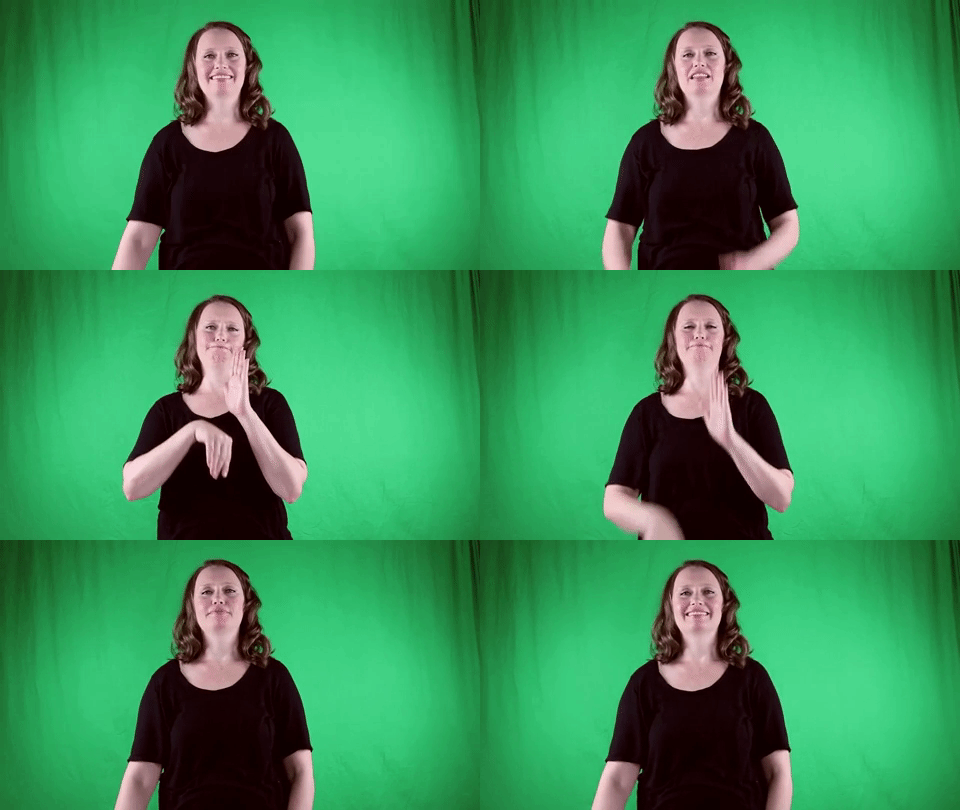
Definition: Inexpensive.
Sign for CHEAP in ASL

Practice Activities:
To start learning the sign for CHEAP in ASL, try practicing the movement in front of a mirror. Repeat the sign slowly and then at a normal conversational speed. This will help build muscle memory and improve fluency. Focus on the movement of the dominant hand and the expression on your face, as facial grammar can give emphasis to the meaning.
Use flashcards to associate the sign for CHEAP in ASL with its English counterpart. Add other related terms like expensive, money, and cost to your flashcard deck to reinforce theme-based learning. Practicing in clusters helps build vocabulary naturally. You can also record yourself signing CHEAP and compare your version to a fluent signer’s example.
Create simple descriptive sentences such as “That car is cheap,” “This meal is cheap but delicious,” or “The store has cheap clothes.” Sign these sentences slowly, then sign them with more natural flow and speed. Repeating full sentences will help you get used to the sign in context.
Partner activities are great for solidifying understanding. Take turns with a partner describing different objects and whether they are cheap or not. You can play a game where one person signs an item and the other responds with whether it’s cheap or expensive using ASL sentences.
Try short storytelling prompts such as describing a trip to a store where you found cheap items for a party. Focus on integrating the sign for CHEAP in ASL multiple times throughout the story. This repetition in a storytelling context will deepen retention and increase confidence.
Use fingerspelling exercises to complement your practice. Identify brands or items in your home, fingerspell them, and then comment on whether they are cheap. This mixed-method activity links vocabulary development and contextual use efficiently.
Cultural Context:
In American Sign Language, understanding the cultural context of a sign is just as important as learning the handshape or movement. The sign for cheap in ASL is no exception. This sign carries a specific connotation that reflects cultural values around money, cost, and worth within the Deaf community.
The sign for cheap in ASL typically implies that something is low in price, but the meaning can shift depending on facial expressions and context. When used with a neutral or positive expression, it simply reflects affordability. But with a negative expression, it might imply poor quality or low value.
In Deaf culture, communication is direct and intention matters. Using the sign for cheap in ASL when discussing things like gifts, service, or work can come across as disrespectful if the context isn’t clear. That’s why it’s important to use the facial grammar that goes along with it to show whether you mean inexpensive or low in value.
When describing products, services, or purchases, people in the Deaf community often use the sign for cheap in ASL to compare options. This helps convey the idea of financial awareness or getting a good deal. However, culturally, there’s sensitivity around implying that someone is unwilling to spend money or is being stingy, so clarity in communication is key.
The sign for cheap in ASL is also used in educational settings to explain value judgments. Students and teachers might compare brands, prices, or services using this sign, emphasizing the importance of visual and contextual clarity. This supports Deaf Gain, encouraging learners to become more expressive and descriptive.
It’s also important to note how the sign for cheap in ASL can be misinterpreted by non-signers who rely on gloss alone. Within the culture, there is a shared understanding that signs must be paired with appropriate expressions. Without that nuance, the meaning can shift dramatically and even cause offense.
In informal settings, discussing sales, discounts, or budget-friendly items often includes the sign for cheap in ASL. It helps promote financial accessibility without shame, which aligns with community values around equity and inclusion. Communication that is sensitive to tone and context allows for richer social interactions.
Online and in social media conversations, the sign for cheap in ASL is commonly used in videos promoting affordable options. Content creators in the Deaf community share product reviews, shopping hauls, or budget tips using this sign, contributing to cultural sharing and language development.
When interpreting from English to ASL, the sign for cheap in ASL must be used thoughtfully. Translators consider both literal
Extended Definition:
The sign for cheap in ASL is a common word used in daily conversations, especially when discussing prices, budgeting, or comparing costs. It’s a helpful sign in various situations, from shopping to talking about expenses or bargains. The sign for cheap in ASL uses a movement that conveys the concept of value in a visual and intuitive way.
To sign cheap in ASL, the dominant hand typically brushes downward along the palm of the non-dominant hand, suggesting that the value is dropping or low. It’s a simple yet expressive sign that pairs well with other money-related vocabulary in ASL. Because of its visual nature, it can be understood clearly even by those new to the language.
The sign for cheap in ASL can also carry different meanings based on facial expressions or context. It might be neutral, like describing something low in price, or negative, like calling something low-quality or poorly made. In ASL, facial expressions help clarify whether you mean affordable, a great deal, or something that’s not worth much.
You can use the sign for cheap in ASL when you talk about shopping ️, sales, or financial situations. For example, you might say something is cheap when comparing options or recommending a good place to buy something. It’s also useful when making recommendations, like telling someone where they can find a cheap item.
Context plays a big role in how the sign for cheap in ASL is interpreted. Combined with signs like good, price, or store, the meaning becomes more specific. You might say good cheap deal to express satisfaction or cheap poor to indicate disappointment.
Learners of American Sign Language often seek out signs like the sign for cheap in ASL because it’s practical and easy to remember. It’s commonly used by teachers in classrooms, interpreters during live conversations, and families during everyday activities. It helps bridge communication when talking about expenses, needs, or even opinions on products or services.
When teaching the sign for cheap in ASL, it’s important to demonstrate it in conversations and real-world examples. Signing it slowly at first and using visual cues like facial expressions makes learning easier. Videos or live demonstrations can help show how the hand movements and face work together.
You might also see the sign for cheap in ASL in discussions about budgeting , sales, and thrift shopping. In Deaf culture, this sign is often used by consumers who are proud of finding deals or making smart purchases. It’s a relevant part of vocabulary that shows how AS
Synonyms: affordable, inexpensive, budget-friendly, low-cost, economical
Educational resources: Find related learning materials in our course bank!
Want more? Check out some of our popular learning activities on the homepage!
Need to look up a sign? Use our highly rated dictionary: https://aslinteractive.com/best-asl-dictionary/
Follow us on tiktok: https://www.tiktok.com/@aslinteractive. More social media links at the bottom of this page!
Long-tail Keywords: What is the sign for cheap in ASL, How do you sign cheap in ASL, ASL sign for cheap
Categories:
tags: Language Learning, Basic Grammar, Everyday Activities, Verbs, Negation
Parameters
*Handshape*:
The handshape for the sign for CHEAP in ASL involves both hands. The non-dominant hand remains stationary in a vertical position with an open flat palm, symbolizing a surface. The dominant hand also uses a flat handshape, moving downward across the palm of the non-dominant hand, brushing off the edge to suggest lack of value .
In the sign for CHEAP in ASL, both hands use the “B” handshape, with fingers extended and together, and palms open. This structured movement captures the meaning visually, helping to reinforce the concept of something being low in cost or value.
*Palm Orientation*:
For the sign for CHEAP in ASL, both hands play a role. The non-dominant hand is typically held upright in front of the body with the palm facing to the side, resembling a flat wall. The dominant hand, also palm facing the side, brushes downward against the palm or fingers of the non-dominant hand in a quick movement.
This movement should show a contrast in value or worth, which reflects the meaning behind the sign for CHEAP in ASL. The palms remain mostly neutral in orientation—neither directly inward nor outward—but angled slightly sideways to each other to facilitate the brushing motion.
*Location*:
The sign for cheap in ASL is typically produced in the neutral space in front of the body, slightly above waist level. The dominant hand moves downward past the non-dominant palm as if brushing something away, conveying the concept of low value or inexpensive.
When using the sign for cheap in ASL, positioning it at chest or mid-torso level ensures clear visibility. Maintaining a comfortable distance from the body helps keep the movements fluid and understandable.
*Movement*:
The non-dominant hand is held palm-up and vertical, as if representing a flat surface. The dominant hand, in a flat-B shape, begins above the non-dominant hand and moves downward along the palm, sliding off the edge.
This downward movement off the palm emphasizes the concept of something being reduced in value. When performing the sign for cheap in ASL, ensure the motion is smooth and concise to clearly convey the meaning.
*Non-Manual Signals*:
Facial expressions play a crucial role in conveying the meaning of the sign for cheap in ASL. For this sign, you’ll typically see a downward tilt of the head, narrowed eyes, and a wrinkled nose to express disdain or the idea of low value.
A slight frown or compressed lips enhances the visual meaning of the sign for cheap in ASL. These non-manual markers emphasize the concept of something being inexpensive or of lesser worth .
*Prosody, Dominant/Non-Dominant Hand*:
The sign for CHEAP in ASL uses both hands. The non-dominant hand stays open and vertical, palm facing to the side, representing a surface. The dominant hand, also open, moves downward past the non-dominant palm with a quick brushing or sliding motion, suggesting something falling in value.
This motion in the sign for CHEAP in ASL reflects the concept of low cost or inexpensive. Keep facial expression neutral or slightly dismissive to match the meaning.
Tips for Beginners:
When learning the sign for CHEAP in ASL, it’s important to pay close attention to hand positioning and movement. This sign relies heavily on a quick, downward brushing motion, so maintaining a relaxed wrist will help you produce the motion smoothly. Keep your non-dominant hand vertical and still, while your dominant hand brushes down past it.
A common beginner mistake with the sign for CHEAP in ASL is either too stiff or exaggerated movement. Try to avoid jerky motions or overly forceful brushing. The sign should appear effortless and fluid. Watch experienced signers or ASL video resources to mimic the pace and movement as closely as possible.
Facial expressions add a lot of meaning to the sign for CHEAP in ASL. For example, slightly tightening your lips or raising your eyebrows can reinforce that something is low-cost or of little value. Don’t neglect these non-manual markers—they are just as critical to the overall message as the hand sign itself.
Practice in front of a mirror to observe your signing from the viewer’s perspective. This helps ensure correct handshape and movement direction. When possible, ask fluent signers for feedback or record yourself for later review. These strategies will speed up your progress and help fine-tune your skills.
Consistency in repetition is key. Use the sign in sentences like “That shirt is cheap” or “The price is cheap” to understand how it fits grammatically within ASL structure. The more you use the sign in different contexts, the easier it becomes to remember and execute.
Most importantly, don’t rush mastery. The sign for CHEAP in ASL is simple but requires control and confidence. Keep your learning lighthearted and engage with ASL communities or signing buddies regularly to keep improving.
Connections to Other topics:
The sign for CHEAP in ASL shares visual and conceptual qualities with signs like COST, PRICE, and VALUE. These signs, though distinct, often involve similar movements or locations on the body, providing learners with a clear way to distinguish how nuanced meanings are expressed. For example, the sign for VALUE often includes a similar handshape but with different motion, emphasizing worth rather than affordability.
This sign is frequently used in everyday dialogues and can combine with other signs to modify context. For instance, combining the sign for CHEAP with things like CLOTHES, FOOD, or HOTEL gives learners a practical way to use the sign in real-life scenarios. These compound expressions enhance communication and help form full sentences like “That hotel cheap” or “Cheap clothes good quality,” which follow appropriate ASL grammar.
The sign for CHEAP in ASL also connects to discussions around socioeconomic status or budgeting. When signing about saving money or being frugal, this sign may appear alongside related signs such as SAVE, MONEY, or SPEND. This allows users to broaden their expressive range when discussing finances, shopping, or economic behavior, especially in educational or professional settings.
Understanding the sign for CHEAP also enriches the ability to express opinions or preferences. It can be used in contrasts with signs like EXPENSIVE or QUALITY to form comparisons. Using facial expressions is essential when signing CHEAP, as they add meaning—like indicating disdain or approval—which is important in conveying intent clearly.
Learners using the sign for CHEAP in ASL will also benefit from learning regional or cultural variations to the sign, as some communities may use alternative movements or additional signs for clarity. This fosters greater understanding of ASL’s diversity and promotes better communication across different signing communities.
Summary:
The sign for CHEAP in ASL involves a firm, straightforward motion that communicates the concept of low cost or minimal value. To execute the sign, the dominant hand is placed vertically near the back of the non-dominant horizontal hand, palm facing inward. The dominant hand then glides down the side of the other hand in a downward brushing motion, similar to brushing something off a surface.
This movement is symbolic. It visually represents the value “falling” or being “brushed off” as if to say something is not worth much. The simplicity of movement reinforces the meaning behind the term cheap, suggesting something of low monetary worth or of lesser importance.
The sign for CHEAP in ASL strongly carries a cultural tone depending on the context. In certain situations, using this sign may suggest a negative judgment about quality or personal generosity. Just as in spoken English, calling something cheap can have pejorative undertones, so its reception can be context-sensitive within the Deaf community.
ASL is not a word-for-word representation of English. Instead, it relies on conceptual accuracy. When signing the phrase, context further dictates whether to use CHEAP in its literal financial sense or to express something figurative—such as cheap behavior or a lack of emotional substance.
Grammatically, the sign for CHEAP in ASL can function descriptively or as part of a predicate. For example, to say “That car is cheap,” the user may sign “CAR CHEAP” following ASL syntax. Adverbs or facial expressions may be used to intensify or moderate the meaning.
Directional signs are not involved in this particular sign, but facial expressions play an important grammatical and affective role. Squinting, tilting of the head, or raising the brows while signing can shift the nuance from objective to evaluative commentary. This allows subtle differences between “affordable” and “low quality” to be conveyed without altering the manual sign itself.
The sign also has overlaps and contrasts with related signs such as AFFORDABLE, COST, and VALUE. While COST may involve tapping or dragging across a flat palm with an x-handshape, VALUE uses circular movements around the fingertips to denote worth. In contrast, CHEAP indicates the concept of being not worth much, a one-directional movement with a dismissive quality.
Some signers may show variation in the brushing motion—some with more abruptness or faster motion to emphasize the perceived worthlessness or disdain toward the item or idea in question. Varying speed or force in the sign reflects both emotional interpretation and user idiosyncrasy.
Another interesting aspect of the sign for CHEAP in ASL is how it aligns with broader linguistic and conceptual metaphors. Across cultures and languages, concepts related to money, worth, and quality often map onto vertical movement, falling, or dismissal. The downward brushing motion aligns with the universal metaphor of “falling value.”
Applied linguistics connects with how learners acquire signs like CHEAP that may hold different nuances than their English equivalents. A learner may initially translate literally but then realize the importance of context, affect, and non-manual markers in rendering the correct meaning.
Cheeky or humorous applications can sometimes accompany the sign, layered with exaggerated facial postures to mimic a judgmental tone. In Deaf storytelling, you might see CHEAP exaggerated for comedic effect when describing stingy characters or unlucky purchases. These applications highlight the highly performative and context-sensitive nature of ASL and Deaf humor.
There is also an opportunity to explore socio-economic contexts in ASL by discussing the sign for CHEAP and how it’s used in narratives about budgeting, shopping, or financial decisions. For instance, a Deaf vlogger giving tips on frugal living might rely heavily on the sign, using it multiple times within a discourse stream. Each time, the meaning adjusts depending on what follows: whether the item is genuinely affordable, or simply of poor quality.
With this core sign, Deaf culture can also express critique of consumer practices, marketing trends, and even spending habits. Signing CHEAP in a way that combines lip patterns and shoulder shrugs might convey superiority or skepticism about a “good” deal.
In language teaching, instructors often emphasize signs like CHEAP to help students grasp how subtle differences in motion and expression change meaning. While the sign itself is conceptually simple, its full communicative power lies in how discrete shifting of body language aligns with manual production.
Another cultural consideration involves value. While the sign indicates inexpensive or low worth in a traditional capitalistic frame, within Deaf culture, value has broader meanings. Emotional investment, community worth, and cultural relevance may supersede material cost, complicating how one views the idea of cheapness.
Interestingly, the translation of idiomatic expressions like “cheap shot” or “cheap trick” might not use the same sign, but rather incorporate expressions of unethical behavior or emotional cheapness through concepts like DISRESPECT or TRICKY. Literal translations of idioms often fail,
Want more? Check out some of our popular learning activities!
ASL Interactive Resources
ASLInteractive YouTube Channel
Follow us on tiktok: @aslinteractive.com
Follow us on Instagram: aslinteractive
Facebook page: aslinteractive
Facebook group: aslinteractive
LInkedIn: ASL Interactive LLC
Twitter: @ASL_interactive
*Some information on this page is AI-generated. AI can make mistakes. Please check the information.


Responses